The organized gaming community. How “Wednesday Mass” transformed cooperative gaming into a refuge for a group of friends. From cannibalism in The Forest to community self-governance in Valheim, an ode to friendship that survives any virtual apocalypse.
Every Wednesday since 2020, I log on at ten o'clock at night to play with friends. We've been making memes, uploading videos, creating songs with AI, and generating very specific content for many days now. It's a level of enthusiasm that's quite atypical for something experienced in the privacy of home, with six computers connected from afar. We are people who have known each other for many years, but in a different environment: the virtual one. We come together exclusively to play cooperative video games. That's how we live our Wednesday Masses.
It's involuntary; the eye naturally gravitates toward the score markers, and by the end of the game, it becomes the most anticipated moment. Of course, there are other significant moments: the siege of the last civilization standing or the defense of the unfortunate player who took the first hit from the enemy in any strategy game (I mean, Age Of Empires II, point taken) or the first time in the game when one of the survivors wakes up a Witch or gets taken down in the middle of one of the toughest hordes in a session of Left 4 Dead. But when the last catapult fires or the last Tank falls, the group's eyes turn to the scoreboard. What scoreboard? Whatever one there is. Who killed the most enemy units or zombies, how many losses each player had, the lucky rescues, the special monsters they took down, the times they were revived—basically: numbers.
The idea of a group trying to overcome obstacles to achieve a common goal is also a competition similar to Legolas and Gimli seeing who can kill more orcs during the siege of Helm's Deep. And there's nothing wrong with that, but there are other dynamics that emerge in cooperative games when the pace is different and the focus is on something greater than the individual.
The cooperative experience is nothing new. It's the spirit of arcade games, beat 'em ups, and “walk and fight” games.
We live in a world where there are no prizes for the best Left 4 Dead or Killing Floor 2 team. Nobody watches Payday 2 matches to see how a group of chubby guys pulls off the heist of their lives robbing a bank while dodging a horde of super SWAT cops on the highest difficulty. Everything remains competitive, about outdoing the other. Sure, there are often teams against teams, where there's a squad strategy, but it’s all frantic and mechanical, the ephemeral state of adrenaline and disposability.
The cooperative experience is not new. It's the spirit of arcade games, beat 'em ups, and “walk and fight” games, or as it's said in Spain, “everyone against the neighborhood.” You had to work in unison to reach the fourth boss of Cadillacs And Dinosaurs with just one coin. Only two people who knew each other well could progress level by level in Tumblepop, Snowbros, Die Hard Arcade, and Time Crisis 2. And that was a bit of the arcade spirit, the microcosm formed among lanky teenagers and kids in lab coats, surrounded by the smell of cigarettes and empty soda cans. And while there was a lot of that in couch-playing with consoles with college friends, there was another pivotal moment that pushed us back to cooperative gaming almost like a religion.
The Covid-19 pandemic cut off any social gatherings and confined us, whether to fall into madness or start making sourdough. Floods of reels or binge-watching series; the options seemed endless but were actually very few and all solitary, mediated by the parasocial coldness of a screen. Hardly anyone can forget a gathering with friends over Meet or a “happy birthday” sung out of sync due to connection speed. And when it dragged on, the charming adventure of confinement ended up suffocating us.
And how could I escape this suffocation? Video calls were too alienating: who can stand staring at a camera like an idiot when not in a work meeting or class? How do you hold a conversation with friends when there’s no beer, no cards, or closeness? The answer is obvious: through Peronism. No, just kidding, but through something that feels a bit like “organized community” or simply... gamer communism?
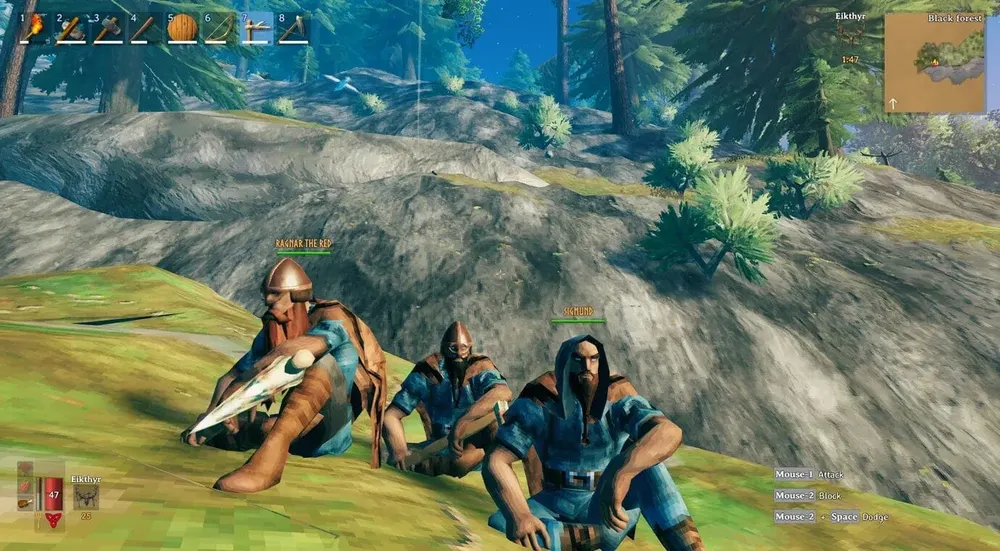
Valheim is a survival game. Set in a Nordic limbo where some Vikings have the mission to hunt down Odin's enemies, seven monsters. Reaching these monsters isn't easy: gigantic deer that summon thunder with their antlers or legendary dragons that spew ice storms get in the way. Then you have to survive, gather resources to craft better weapons and armor, food and potions, and only then hunt the main monster. Great, but in the meantime come the questions: how are resources managed among players? Who gets the best axe first? Who keeps fighting with a leather thong while the other has full plate armor? And who mines? And who hunts? And who crafts arrows? And who cooks the game? Maybe the answer is: “each one for themselves.” But no, dear internet friend, the Darwinian market logic doesn’t work when you die for the fifth time in the swamp (where everything poisons you in seconds) trying to be an übermensch Scandinavian, while the rest of the group are five unfortunate souls throwing toothpicks with third-world cherub bows.
The growth of the group must be gradual, slow, patient, and collective. The miners return with the blacksmith, and weapons are forged for the community. Who needs a helmet? Who had a cape? Sword or spear? The production is Soviet-style, the forges spit out ingots night and day, while delicacies and potions that boost stats for survival are cooked, raids bring new resources, and the base keeps expanding. And when explorations reveal that we inhabit an island, the adventure expands, and we have to sail on one of the most exciting seas I've ever played. There’s a unique experience in crossing the first storm not knowing if we’ll reach our destination, run aground on a goblin-infested coast, or be attacked by a sea serpent.
The seas of Valheim, ladies and gentlemen of the internet, are the Meet gathering that life denied us. The shared work of the helmsman, the cartographer, and the other sailors, while chatting about life, inflation, baldness, the latest series, the latest social media chaos, or the latest editorial from Rebord.
Epic, but something is missing, a national component, a sense of bull and pampas. That's why we introduce our own. It's essential to ride a bike under the sunset in 7 Days To Die, while 'Convide rutero' plays. Chaotic routes filled with potholes, zombies leaping at your throat, and someone plays Almafuerte on the Discord music bot, as we stop at a gas station to siphon gas from the pumps and take out any undead that crosses our path. That's when the group of friends transforms into the Falcon Group, and in the delirium of immersion, one cleans rooms of resurrected corpses as if it were a tactical shooter.
Ah, I forgot to describe this game. 7 Days To Die exudes a 2000s vibe with its Mad Max and The Walking Dead aesthetics, and I think that's why it pairs so well with a voice chat of friends and a Ricota playlist. Unlike Valheim, 7 Days To Die is a first-person post-apocalyptic survival game where we must withstand a horde of zombies that attacks on the seventh day. This race against time forces us to build a base strong enough to withstand the onslaught. Like in Valheim, the game's evolution involves traveling to new biomes, discovering technologies, planting, harvesting, and hunting, with the difference that the clock is always ticking, and organization is vital for survival.
It's essential to ride a bike under the sunset in 7 Days To Die, while 'Convide rutero' plays. Chaotic routes filled with potholes, zombies leaping at your throat, and someone plays Almafuerte on the Discord music bot.
That's why it's crucial to divide tasks and specialize. 7 Days To Die operates on a system of experience, levels, and perks that helps build a custom character. You can be a Jack of all trades, but sooner or later, you'll need a mechanic who knows how to make the most of the scrap from abandoned vehicles. Specialization is key: the farmer/cook unlocks seeds and recipes faster, learns to use yucca fruits and goldenrod tea to hydrate and cure dysentery, brews coffee to withstand the cold and give a productivity boost to those doing the heaviest tasks, and can even turn rotten meat into nutritious dishes. The miner/smith delves into the depths of a mineral vein to extract large quantities of iron, nitrate powder, or lead with pure pickaxe, using their skills to maximize collection and get more out of the forges, using fewer resources to craft casings, bullet tips, and the powder needed to fuel our little industrial-military complex. This shapes the player and their role on the server, transforms the world around them (let the miners know to cover the holes they leave), and the dynamics that form within the group.
I can't help but mention the construction. Almost like an adult Minecraft, you can build from scratch or take over a supermarket in a ruined city and turn it into your dream home, a brutalist colossus, where we can withstand the zombie siege while simultaneously hanging a giant sign that says 'THE H DID NOT DIE'.
Now, 7 Days To Die is quite a rough game. Far from the stylistic sophistication and gameplay of Valheim, The Fun Pimps' work (yes, that's their name) is riddled with compatibility issues, glitches, bugs, performance problems, and other things that can ruin the experience. But with a computer that runs decently and a group of friends who know how to blend fun with some technical skill, you can create a great meeting spot.
However, both games lack a storyline and don't have a fixed ending. Everything changes with The Forest. What happens when the gaming experience turns a bit darker? What happens as a group when we dive into a horror story?
It's an incomparable experience to spend the first night on edge, surrounded by the dense vegetation of a pristine island, after the passenger plane we were on crashed. Also, experiencing the fear of hearing the whispers of mysterious natives lurking among the trees, ready to make us their dinner. And everything is much better when experienced with a group of friends. Because it's astonishing how easily players of The Forest go from being terrified tourists to something much more terrifying than the natives stalking them.
Like in other survival games, the idea of building, cooking, and hunting is present, but there's one element that sets it apart from any other game: the enemy corpses. Considering we're short on food, well, the opportunity speaks for itself. It doesn't take long before cannibalism kicks in, stripping away any trace of humanity, both ours and others'. And it's as terrible as it is fun. After the fourth or fifth day, you start repeating 'War is God' while munching on a grilled arm of a tribesman who attacked you five minutes ago, and then using their ribs for your bone armor.
In addition to being cannibalism-friendly, The Forest is an adventure to enjoy as a team. There's a sense of discovery when we leave the starting beaches to reach the jungle heart of the island, with its streams and villages of man-eaters, a feeling that intensifies as we delve into the depths of the caves where the best weapons and tools are found, but also the most terrifying moments of the game. We think we are the apex predators of the island, only to remember at the worst moment that there's always a bigger fish than us.
We were terrified and became the terror in The Forest. And so, during Wednesday Mass, we became closer friends. Because friends who survive together, build community together.
The pandemic has long passed, but social bonds are not at their best. Playing video games with our friends may not be the cure for present problems, but it can make life much more fun and bearable. There are laughs and a unique lore that can only be replicated in our Wednesday gatherings. It's a mix of the week's news, outdated memes, the latest movies we've seen, or the book we're obsessed with. We talk about love, the beehive that appeared next to the house, how expensive services are, all while loading up bazookas to clear a horde of zombies. We record videos announcing that 'today we play' in the same group as always, the one that already knows. But that's how we remind ourselves that Wednesday is a special day, one that continues to forge our own silly, absolutely vital private legend, a fuel to get up every day.
We were Vikings in Valheim and Tribes Of Midgard, scavenged through the remnants of a universal flood in Raft, and became farmers to survive a robotic apocalypse. We wandered fearfully through cities teeming with the dead in Project Zomboid and made them our home in 7 Days To Die. We were terrified and became the terror in The Forest. And so, during Wednesday Mass, we became closer friends. Because friends who survive together, build community together.
✦ Suscribite
Las notas de 421 no tienen paywall
Y a cada colaborador se le paga por su trabajo. Las dos cosas dependen de los suscriptores.
Escritor, autor de "Los gigantes", "Diferentes tonos de rojo" y "Asusta un poco verte así" Docente en el Taller Gutter y parte del programa "Cita a Ciegas" en Posdata. Fan del horror, los mandriles y Nick Cave.