What defines a great strategist? From chess to computer games, strategy has become increasingly complex. Crusader Kings takes this to the extreme: you don’t just rule a country, but an entire dynasty, where an inept son or a rumor can bring your kingdom to ruin.
Classifying video games into clearly distinguishable genres has become, at this stage of their development, just as impossible as it is in literature or film. However, it is possible to make a general division between two types of games: those where hand-eye coordination is key to success, and those where it is not. The former includes everything from platform classics like Mario or Sonic to multiplayer shooters or real-time RPGs, while the latter, in a very broad sense, encompasses everything referred to as “puzzle.”
In this inflated sense, “puzzle” can refer to both Pokemon, which features turn-based combat, and Europa Universalis or a LucasArts graphic adventure. It’s true that even this stark division between games that require good joystick/mouse/keyboard handling is relative, as real-time strategy (RTS) games like the classic Dune II or the unforgettable StarCraft also involve at least some ability to click quickly on units and give them appropriate orders in each situation. But, in principle, one could argue that there is a significant difference between these games that value intellect and others that prioritize reflexes. At some point, one might compare this contrast (and even its gray areas) to the classic division of board games based on the level of chance they involve, which can range from nearly the entirety of the game (like in Ludo or the Game of Goose) to literally none, as in checkers or chess.
Strategy relates, in other words, to the mechanics of power and its main dilemmas: how to gain it, how to maintain it, how to prevent others from having it.
But if we get more precise, “puzzle” and “strategy” are quite different things. The latter term conjures up grander images. Strategists are, at first glance, great military leaders, but also politicians and businessmen (and more rarely women, due to well-known historical issues). Strategy relates, in other words, to the mechanics of power and its main dilemmas: how to gain it, how to maintain it, how to prevent others from having it.
The relationship between strategy and gaming is very difficult to historicize, as it depends on how we define both concepts, which are rich in complexities and literature. Broadly speaking, the question of gaming is interesting because it arises from a very concrete problem: to train motor skills, repetition is key. It doesn’t matter if it’s wielding a sword or getting past the impossible level of Battletoads, repetition ultimately becomes skill.
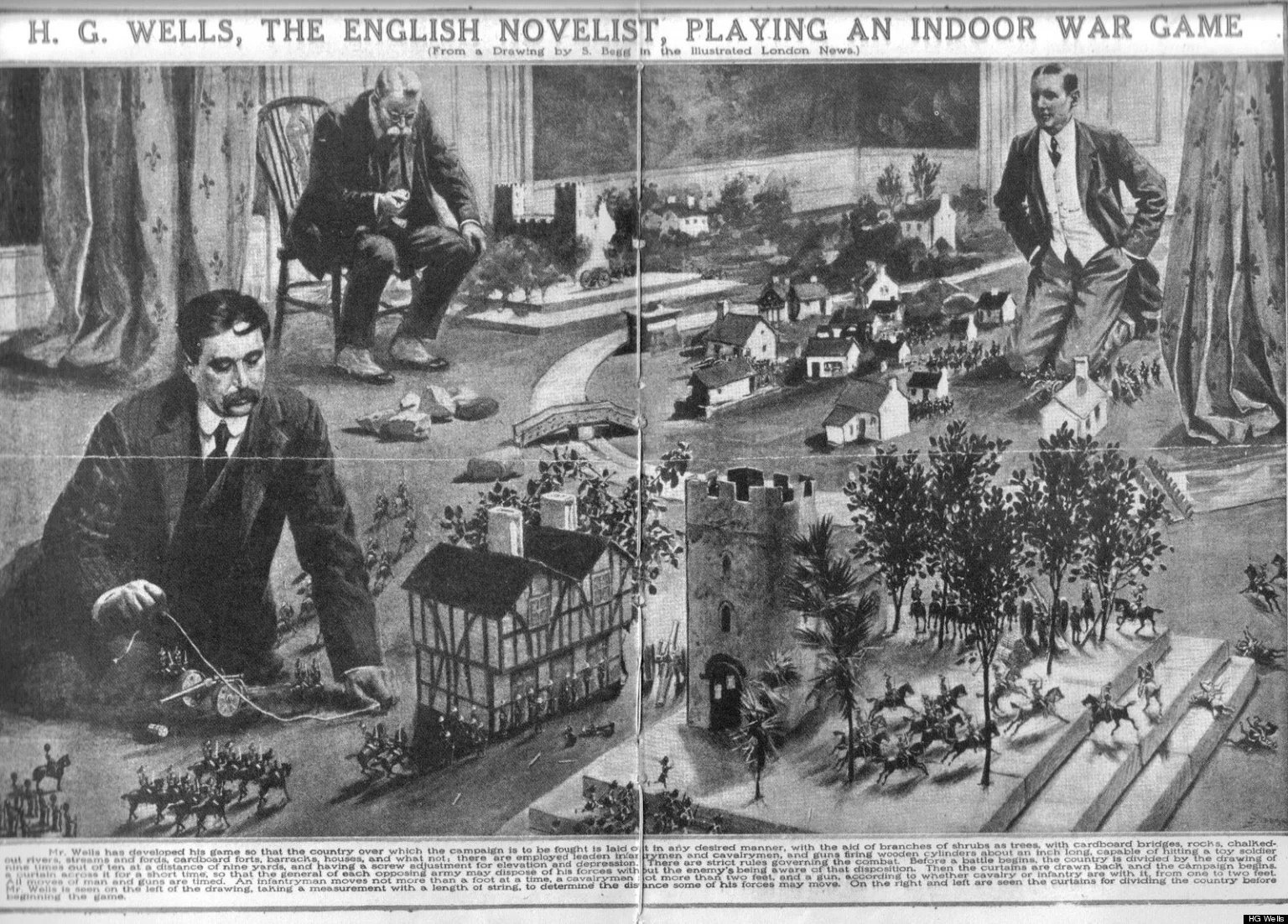
“H. G. Wells, the English novelist, playing an indoor war game,” illustration published in The Illustrated London News, January 25, 1913. Public domain
But how is strategy trained? The answer to that question weaves a thread that runs from chess to the Prussian Kriegsspiel, also including games like Diplomacy, which the Kennedy brothers were fond of. Once designed for the upper classes who had the chance to practice strategic skills, most of these games have been democratized for decades, and in some cases, like chess, have become professional sports.
The basic problem of strategy games is the tension between realism, which involves potentially incalculable factors (the outcome of a battle can be determined by the direction of the wind; a company can collapse because the CEO chokes on a chocolate), and simplification, that is, the idea that one can isolate a set of elements (pieces, rules, maps) and bring the macro world down to a micro dimension (which still maintains the general logic of decision-making). Risk, TEG, and other 20th-century games are examples of the quest for that difficult balance between complexity and simplicity.
The map and the territory: the PC as a motor of complexity
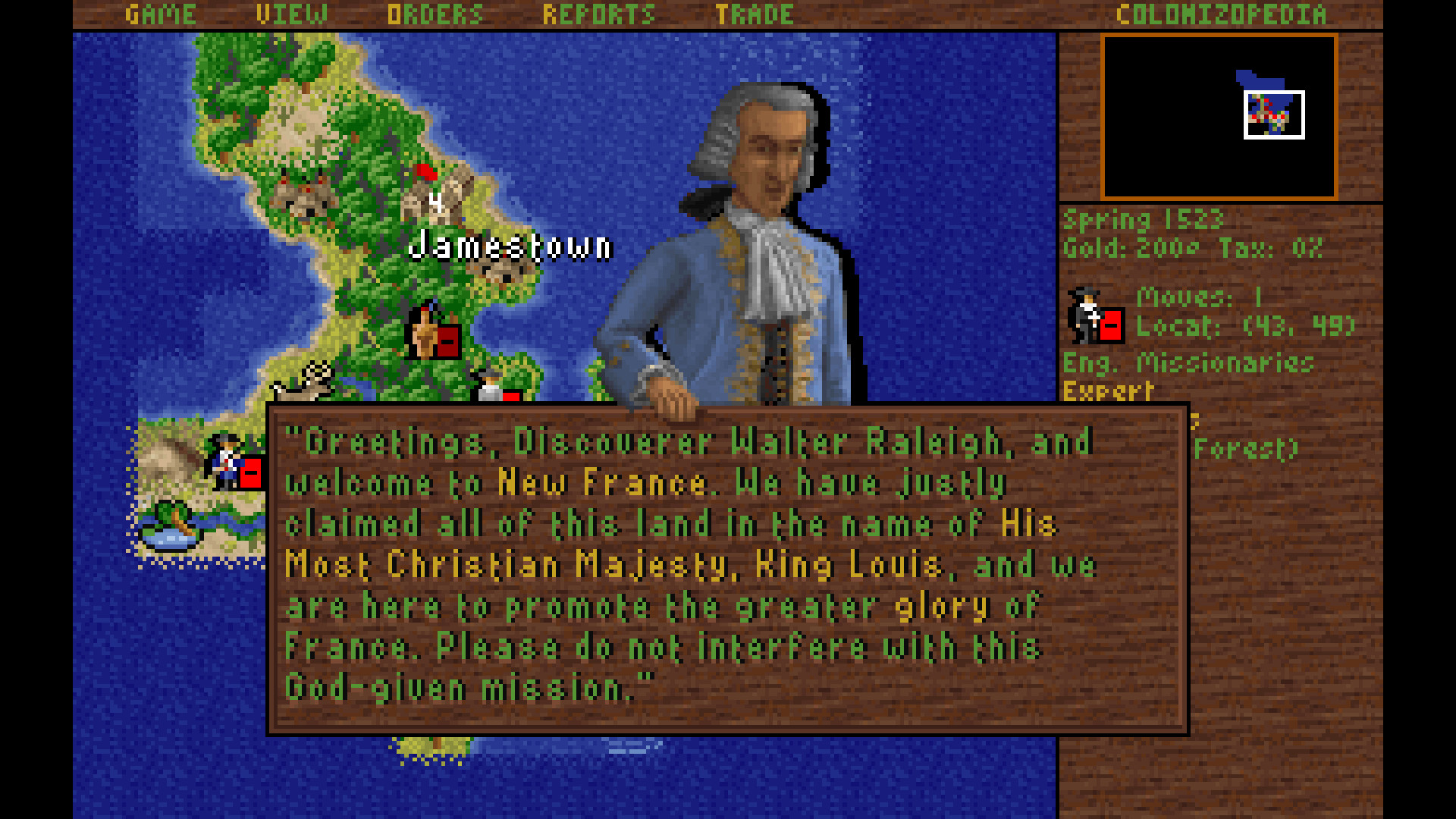
But the PC opened up a new universe of possibilities. Why? Simply because of its computing power. In traditional board games, calculations must be made by humans, almost always in real-time. This necessitates a huge simplification (like the battles in TEG, reduced almost entirely to the roll of the dice) or a somewhat cumbersome mechanic that scares off most players. The PC, even one that today seems primitive like those that ran the original Civilization, can perform countless calculations of which we need not be aware. This ability to articulate between player choices and the processing of their effects in the background (or, if you prefer, in the back-end) has opened up almost infinite possibilities for complicating rules that simultaneously do not interrupt the flow of the game. Moreover, the graphical interface enabled the possibility to zoom from the micro to the macro (even though the macro was never even a fraction of the complexity of the real world) in a way that no foldable board could replicate or will ever replicate.
Screenshot from Sid Meier’s Colonization (MicroProse, 1994).
But, as always happens, new possibilities brought new demands from players. The rapid development of the genre branched out into subdivisions. On one hand, strategy associated with simulators, like SimCity or Theme Hospital. On the other, military strategy, whether turn-based or real-time, like in Command and Conquer or WarCraft. Today, much is said about two subgenres that particularly interest us: 4X games and what is called Grand Strategy.
What does 4X mean? Besides being an obvious play on the three Xs of porn, it is the synthesis of four verbs: eXplore, eXpand, eXploit, and eXterminate. Exploring a territory or map that, at first, begins being totally or partially hidden from the player; expanding across that territory by creating bases, camps, or cities; exploiting the resources of that territory; exterminating other players (human or artificial) in the same quest or, at least, subjugating them. It’s the basic recipe for imperialism since Rome and even before. It presupposes the basic idea, so important in geopolitics, that resources are finite and that discovering or capturing them justifies, in the end (or at the beginning), the use of violence.
The Crusader Kings and the medieval dynastic mindset
The Crusader Kings saga from Paradox Interactive is not exactly a 4x game. A better definition would be Grand Strategy, which is harder to pin down but involves the idea of multidimensional strategic capability on an expansive map, not limited to a single capacity (like military or economic), but rather combining many of them.
Unlike Age of Empires II, which is undoubtedly the most well-known medieval strategy game but focuses exclusively on warfare, in Crusader Kings strategy involves a greater economic complexity (not just based on resources to create an army) and, above all, a unique political microcosm. We don't play as a nation, empire, or 'civilization' as is typical. We are not a character like a king or a commander. Our protagonist is a dynasty. We win if the dynasty survives and grows throughout the Middle Ages, and we lose if it goes extinct or if there is no one left with a relatively autonomous political authority (though we can survive as vassals). This means we start as a duke or an empress, but when the character in question dies, we take control of the next heir of the dynasty (typically the child of the previous character, but that depends on succession laws).
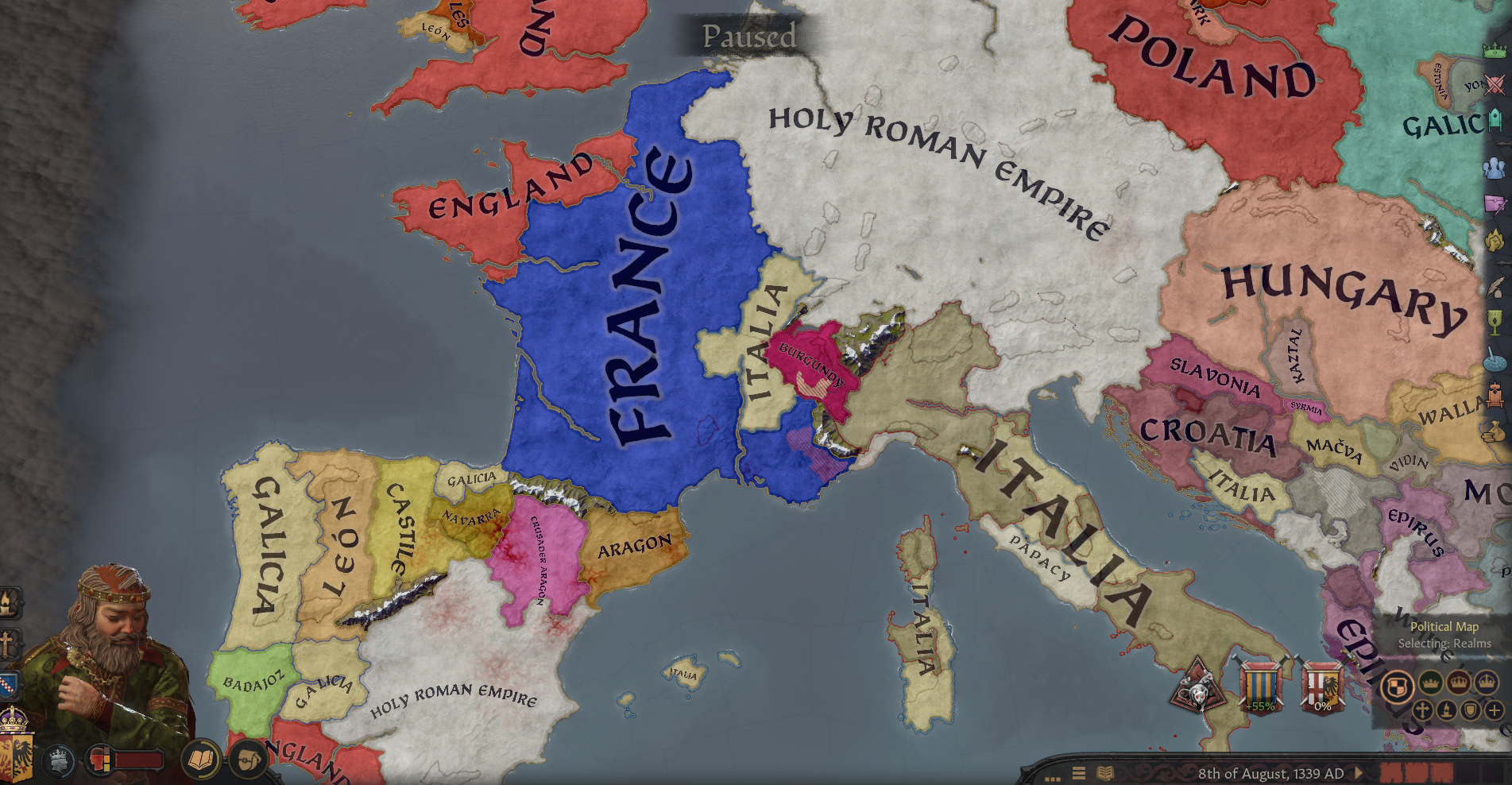
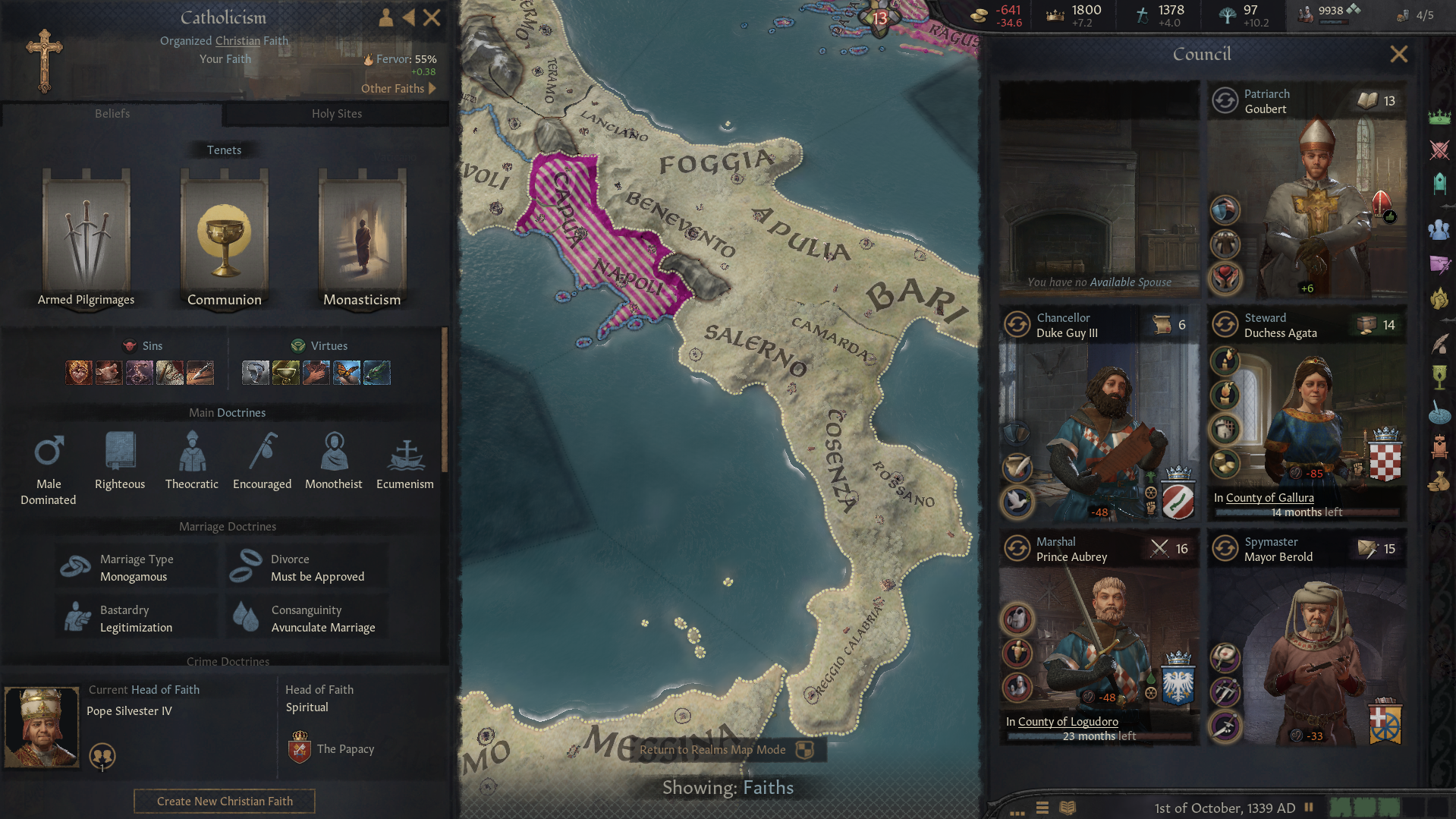
Screenshot from Crusader Kings III (Paradox Interactive, 2020).
This factor alone is one of the most decisive for the game and is a big part of its originality. We are not a celestial eye nor the 'spirit' of a people. Each character in the dynasty we embody has their own traits, talents, limitations, loves, and hates. All of these affect how we interact with our subjects, their opinion of us, and our ability to forge alliances, lead conspiracies, and collect taxes. This is why Crusader Kings is both a Grand Strategy game and a kind of role-playing game where we have to make decisions about how we act at feasts or how we respond to a letter from the pope.
This factor not only changes gameplay and strategy but also allows us something that is always very difficult to simulate. When we immerse ourselves in the game, we suddenly find ourselves plagued by a series of concerns that, we can say without fear of contradiction, actually obsessed the powerful in the Middle Ages. What if my son is an idiot? If my wife has only given me daughters, should I try to separate from her, have a bastard child but then legitimize him, or arrange for a lower-ranking noble to marry my daughter in exchange for accepting a matrilineal marriage (meaning their children will take my daughter's surname and not his)? Or should I change the laws of my kingdom so that my daughter can assume the crown? And what should I do if I am an elderly king with a very young and inexperienced son and a brother, who is the most powerful vassal in the kingdom, in the prime of his life?
It involves the idea of multidimensional strategic capability on an expansive map, not limited to a single capacity (like military or economic), but rather combining many of them.
Many of these political concerns are akin to A Song of Ice and Fire or, as it's known from the HBO adaptation, Game of Thrones. Indeed, there are mods for Crusader Kings 2 and 3 to replicate the map and characters from George R. R. Martin. But even without using them (I personally prefer the old traditional European map), it's inevitable to feel somewhat in that world, even though there are no dragons or magic of any kind here.
The game is truly a paradise for history lovers in general and the medieval period in particular. This is because, like other Grand Strategy games, it combines historical realism with the possibility of creating entirely original narratives. In some of my playthroughs, I managed to found the unified kingdom of Italy as early as the 13th century, or have Ireland conquer Normandy and northern Spain. I have yet to achieve the unification and maintenance of the entire Iberian Peninsula under Islam until the end of the game (which ends in 1453, marking the traditional end of the Middle Ages, even if in my playthrough Constantinople survived).
Screenshot from Crusader Kings III (Paradox Interactive, 2020).
Despite all this narrative and immersive character, Crusader Kings ultimately operates through a complex expansion of stats and modifiers: +1 in tax collection due to our character's 'greedy' trait, -3 in diplomacy because we chose not to respond to the pope's letter, +5 in chances of marrying off our daughter because our dynasty has the trait 'Splendor'. Some players may obsess over these elements and try to guarantee the maximum possible in each subcategory, just as there are real-world politicians and economists who think everything is about moving knobs (dollar price, taxes, interest rates, etc.) to find the perfect balance. But the game, I dare say, is not designed for that. It is also not designed (and this confuses people used to other games) to conquer the entire world or exterminate all rivals, which is practically impossible.
Each dynasty has its own dynamics and way of life, which is discovered from game to game. And the game reminds us that power is not a straight line of progress. It is more like a fragile web of wills and contingencies. We don't play to win, but to discover what kind of story our hand, and our dynasty, can write.
✦ Suscribite
Las notas de 421 no tienen paywall
Y a cada colaborador se le paga por su trabajo. Las dos cosas dependen de los suscriptores.
Humanista. Profesor de literatura e investigador en CONICET. Editor de la revista de teoría literaria Luthor (revistaluthor.com.ar). Hago videoensayos y streamings caseros en el canal de YouTube "Hotel Abismo".