Did you know that Monkey Island came about thanks to a cave-dwelling madman, an anti-Soviet proto-internet, and George Lucas’s divorce? Join us on a journey through the history of the graphic adventure.
Will Crowther had studied physics and in the early seventies was working with computers. Specifically, he was working on ARPANET, a project of the Department of Defense aimed at developing communication infrastructure capable of surviving a Russian bombing. At that time, connected to just a few universities and research companies, ARPANET would eventually evolve, a couple of geopolitical adjustments later, into what we know as the Internet.
Will spent his days programming network protocols, but weekends and holidays were dedicated to what was his true passion, and that of his wife Patricia: “spelunking,” or spelunking and caving, the recreational exploration of caves. In plain terms, the couple traveled across the country with a group of enthusiasts, crawling into caverns and mapping out potential routes and connections. It didn’t take much imagination for Will to do what so many other programmers did: computerize his hobby.
In 1975, amid a divorce and with plenty of free time, he set to work on a simulation of the cave he knew best, the Mammoth Cave in Kentucky. For the project, Will Crowther used the PDP-10 mainframe from his company, one of those enormous computers that take up an entire wall and are accessed via remote terminals. The terminals, of course, could only display text, so Crowther’s “simulation” was purely descriptive:
You are standing in front of a brick building at the end of a road. Around you is a forest. A small stream flows from the building and down a ravine.
The program spoke to the user in the second person, describing a place and waiting for instructions. The user would type GET LAMP or GO NORTH to set the world in motion. For that time, it was a captivating experience, like starring in an interactive story or a campaign in a role-playing game, not too different from chatting with an AI these days. To get an idea, tell your ChatGPT or Claude buddy that you want to “play Crowther’s adventure.”
Since Crowther's PDP-10 was connected to ARPANET (a small and mostly academic network, it’s true, but full of enthusiasts) and information flowed freely in that realm, the source code of the program, ADVENT, spread like wildfire. Other programmers began to “mod” it, adding elements of fantasy and treasure hunting, turning that spelunking simulation into one of the first video games in history, now known as Colossal Cave Adventure or simply Adventure.
The program spoke to the user in the second person, describing a place and waiting for instructions. The user would type GET LAMP or GO NORTH to set the world in motion. For that time, it was a captivating experience.
This modest rise of the game in universities and offices coincided with the commercialization of the first personal computers, the “trinity” of 1977: TRS-80, Commodore PET, Apple II. For that first generation of hackers with their own PCs, imitating Crowther’s adventure was the obvious way to test their new toy. While the arcade was dominated by Space Invaders and Atari was trying to bring it into homes, computer hackers were playing to explore dungeons and read bucolic descriptions, solving puzzles and slaying the occasional orc. Long before there was a software industry, Will Crowther had, unintentionally, launched a genre. The ramifications of Adventure are many and fascinating: the interactive fiction of Infocom, action-adventure on consoles, that noble fruit known as roguelikes...
Sierra Online: the invention of the graphic adventure
But we came here to talk about graphic adventures, so let’s get to the story of Roberta Williams. Besides being a woman, she had another fundamental difference from the computer users of her time: she wasn’t a hacker, she didn’t even know how to program. When she played Adventure addictively on her Apple II, she wasn’t dismantling a clockwork mechanism in her head; what she saw wasn’t a puzzle but a means of creative expression. Roberta was one of many who, having traversed the cave, set out to create her own adventure, but she didn’t do it as a programmer but as (perhaps the first) video game designer.
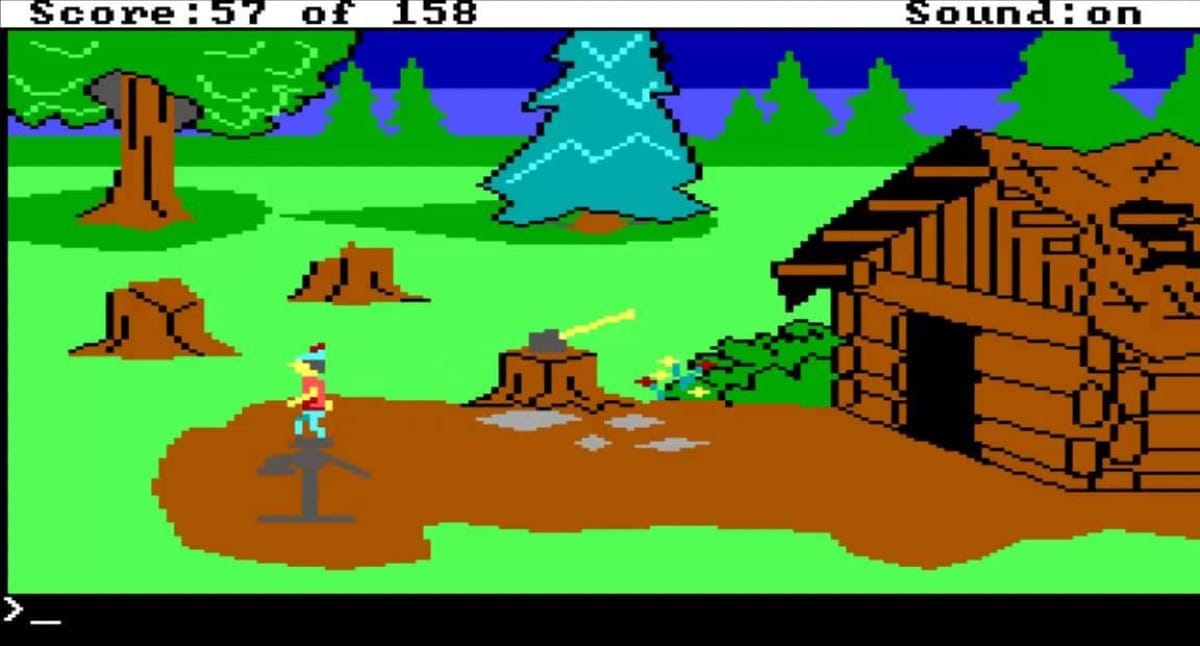
King's Quest 1984. Sierra On-Line. Source: Wikimedia Commons.
The one who did know how to program was Ken, her husband. Ken Williams was also not a hacker: a programmer by trade, he wrote business software to make a living while working on his own company project to get rich. Ken was convinced to postpone his ambitions to help Roberta, but if they were going to dedicate their time to making a little game, it had to have the potential to become a business: it wasn’t enough to create another adventure like the ones every hacker was crafting on their home computers; Roberta’s game needed something to grab attention, something that would set it apart. Ken found the key in the rudimentary graphic capabilities of their Apple II: while most were doing ports, clones, or variations of Adventure, Ken and Roberta were the first to pair text with images. The graphics were crude, yes, and static; what they created wasn’t what we would today call a graphic adventure, but merely an illustrated adventure. And beyond the graphics, the game design was confusing, rather amateurish. But that didn’t matter; the mere inclusion of images was enough to turn what would later be called Mystery House into an instant hit and kick off a line of profitable commercial adventures for the Apple II.
Textual descriptions became secondary; now images were at the center of the experience: with King’s Quest, Sierra On-Line invented graphic adventures.
Thus, the small family business of the Williams (then On-Line Systems, later Sierra Online) published hit after hit, grew rapidly, and moved to lavish offices; Ken and Roberta became celebrities, appeared in the news, and signed contracts to adapt movies. But everything that rises must converge: with the arrival of the next generation of personal computers (the Commodore 64 and various IBM PC models), their formula of text adventures illustrated with “grafitti” became obsolete. To survive, Ken Williams had to lay off most of his employees, go into debt, and reinvent Sierra, repeating what he had done five years earlier: exploiting cutting-edge hardware to give the genre another twist. For King’s Quest, Sierra developed a engine in which the game’s protagonist was visible on screen and the player had to control him to interact with the environment, pick up objects, dodge dangers, and talk to (or kill) other characters. Textual descriptions became secondary; now images were at the center of the experience: with King’s Quest, Sierra On-Line invented graphic adventures.
Lucasfilms: the leap in quality
“Stay cool, guys, be the best, don’t lose money.” That terse message was all George Lucas said the one time he bothered to visit the offices of Lucasfilm Games. Lucas had little interest in computing and even less in games; the fact that he owned a small PC video game studio was more a result of corporate accidents.
Lucasfilm Games. Source: Wikimedia Commons.
Star Wars was a massive success, but its production had been traumatic for Lucas, who ended up hospitalized due to stress and panic attacks. Already with plans for a couple of sequels, he not only delegated directing duties going forward but also invested part of his profits in technology to ease the editing and special effects tasks, which in the late seventies were still mostly handcrafted. Say what you will about George Lucas as a director, but it’s impossible to overstate his contribution to the technological revolution in the entertainment industry. Without that post-Star Wars investment, we couldn’t explain Terminator 2, Jurassic Park, or Toy Story.
In addition to Skywalker Sound, THX, and Industrial Light & Magic, Lucas funded a “graphics group,” the embryo of Pixar, made up of talented idealists convinced that one day we would all go to the movies to see completely computer-generated films. Around that time, in the early eighties, Atari was still sweeter than Lucasfilm and was investing in research and development to find a successor to its popular but outdated console. When Atari representatives saw what was cooking in the graphics group, they offered Lucas a million dollars specifically to explore the use of that technology in video games, in exchange for preferential access to whatever came out of the experiment. Lucas wasn’t interested in video games but it was easy money, so he accepted, and what would later become LucasArts was born as a spin-off of what would later become Pixar.
In the following years, Lucasfilm Games operated similarly to the graphics group: creating flying prototypes with fractals and trying to build the first MMORPG. Why not take the opportunity to make some little Star Wars games? That was the problem: years earlier, when the word “video game” meant nothing more than Pong, Lucas had licensed the production of all kinds of “games and toys” to a doll company. In other words, Lucasfilm's video game division couldn't touch Lucas's intellectual property: neither Star Wars nor Indiana Jones were on the agenda. But what initially seemed like a serious limitation turned out to be a benefit for the designers, who had the budget and creative freedom to develop original concepts, as long as they lived up to the brand.
The tide began to change in the mid-'80s: Atari floundered with its new consoles and withdrew from collaboration with Lucasfilm; the Star Wars trilogy was completed, and the Indiana Jones series went on pause after Temple of Doom, reducing the production company's income: George Lucas announced a divorce that would cost him $100 million. It was time to start tightening the belts, and the first to go were the eccentrics at Pixar, who were racking up losses, then trying to market an extremely expensive graphics computer. Steve Jobs, recently fired from his own company for being unbearable, bought the studio, which he would have to continue funding for several years before hitting it big with Toy Story. The video game group, interestingly, was comparatively cheap to operate and had already marketed a couple of its projects, so they were allowed to stay at the production company, as long as they kept paying the bills and didn't embarrass George.
At just 19, Ron Gilbert had already gained some renown for a graphics package he had programmed for the BASIC language on the Commodore 64. Lucasfilm Games saw his work and offered him a freelance contract to port the studio's games, which had been exclusive to Atari, to the Commodore. Like most nerds who received the call from Lucasfilm, Gilbert didn't have much to think about: he dropped out of college, packed his stuff into the car, and headed to California.
The video game division that Gilbert joined operated at Skywalker Ranch, the “filmmaker's refuge” that Lucas had built in the countryside, with offices disguised as farm buildings, grazing animals, a vineyard, an artificial lake, and even an astronomical observatory. At the center of the property stood a neo-Victorian mansion with an Art Deco-style cinema and a research library topped by a glass dome. The employees of Lucasfilm Games not only had access to Hollywood-grade technology for their production, but they could also share the buffet where Lucas had lunch with Leonard Nimoy or the Rolling Stones, play softball with Huey Lewis, or attend private screenings of Spielberg's films (who, by the way, was much more interested in technology than Lucas and never missed an opportunity to drop by and try out whatever they had in development).
Once the conversions of Lucasfilm's Atari catalog were completed, and while most of his colleagues were busy finishing the game based on the movie Labyrinth, Ron found himself without a project and nothing concrete to do. Before anyone noticed and either fired him or, worse, put him to work on something boring, he quietly began outlining the concept for an original game. It was around that time that he visited his uncles for Christmas and found his eight-year-old cousin mesmerized at the PC, playing King’s Quest.
We can imagine Ron Gilbert as the opposite of Roberta Williams: just as Roberta played Adventure, became fascinated, and wanted to make her own game, Gilbert played King’s Quest and, true to his grumpy programmer nature, found it riddled with problems, became exasperated, and felt the need to fix everything that was wrong with graphic adventures. The game seemed designed against the player, tricking them at every turn, killing them for no reason, and, in the process, laughing at them. Especially frustrating was the interface, which, despite showing characters and objects on screen, still required typing convoluted commands in the exact way the game expected. Ron saw this as a step backward from text adventures, an experience filled with distractions that broke the immersion that he believed should be the goal of any narrative game. Back in California, he decided that the project he had been outlining would be a graphic adventure, but a (the first) well-made one.
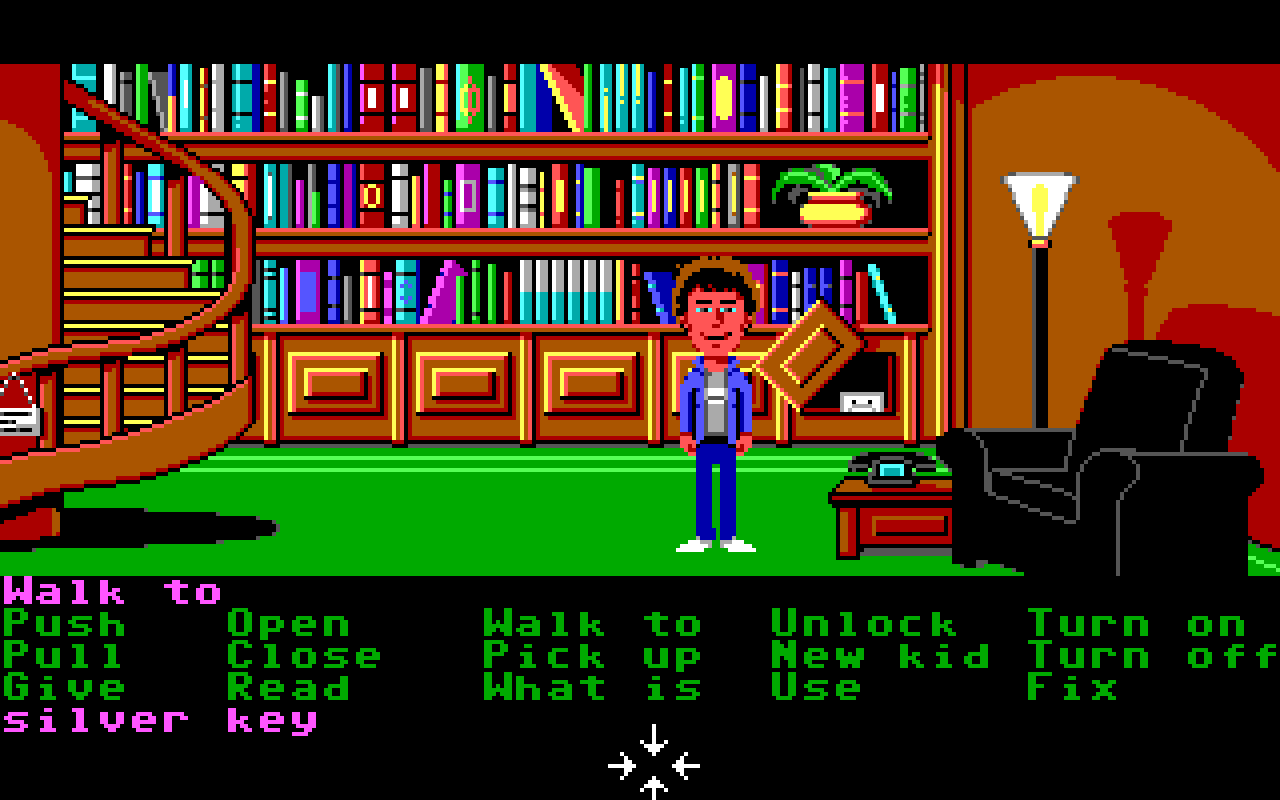
When his supervisor remembered Ron, the project concept was already acceptably polished, so he gave him the green light and resources to continue. For the storyline, Ron drew on a classic80s: B-movie horror films. A group of teenagers must rescue the protagonist's girlfriend, kidnapped by a mad scientist in his mansion, the Maniac Mansion. The house, as seen in the game, is directly inspired by the main building of Skywalker Ranch, including its famous library with a spiral staircase.
Ron drew on a classic 80s theme: B-movie horror films. A group of teenagers must rescue the protagonist's girlfriend, kidnapped by a mad scientist in his mansion, the Maniac Mansion.
As a good programmer, Gilbert developed an engine that abstracted the technical details and allowed for the natural description of scenes in a graphic adventure, almost like a movie script. The engine, which he named SCUMM (Script Creation Utility for Maniac Mansion), allowed for “implementing ideas that came up during lunch conversations in the afternoon.” But the biggest innovation of SCUMM was in the interface it offered to the user: a list of clickable verbs and inventory items, which eliminated the need to type commands, the last remnant of text adventures. If King’s Quest was the first graphic adventure, Maniac Mansion would be the first point-and-click.
Also, as a good programmer, Gilbert was overly ambitious and imposed the idea that the player could control multiple characters at once. Each had their own personality and skills that opened different paths to solve puzzles, allowing Maniac Mansion to be played in 15 different ways. This decision multiplied the work for the programmers, who had to anticipate every possible player move. The combinatorial complexity, combined with the author's inexperience and the novelty of the genre, explains why, although it represented a clear evolution in gameplay, Maniac Mansion is not without its unfairness and dead ends. Despite his best intentions, Ron Gilbert couldn't fully realize his vision. For that, we would have to wait for his next game.
Monkey Island: the definitive graphic adventure
“Imagine being able to get off the boat and wander around, talk to pirates, board their ships.” That’s how Ron Gilbert explained it to anyone who crossed his path in the office. Ron wasn't into Tolkien's fantasy or Roberta Williams' chivalric tales, but he sought a genre that would still stimulate creativity and imagination. He came up with the idea of reconstructing the world that was barely glimpsed in the Disney park attraction Pirates of the Caribbean.
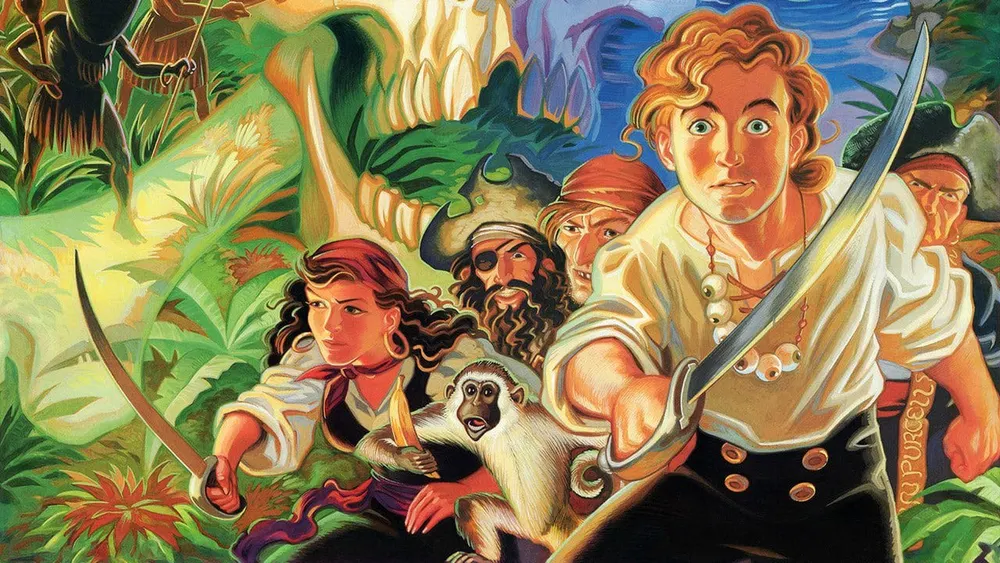
The Secret of Monkey Island, 1990. Lucasfilm Games. Source: Wikimedia Commons.
After Maniac Mansion, Gilbert co-directed Indiana Jones and the Last Crusade, a rushed graphic adventure to coincide with the release of the film that Spielberg was editing next door. For his next project, Ron set out to take his design ideas to the extreme: what he didn't like about King’s Quest, what he hadn't quite settled on in Maniac Mansion, what he had denounced in his manifesto, he was going to fix once and for all in this game. This time he had more experience, an improved version of the SCUMM engine, the contributions of Mark Ferrari and Steve Purcell (possibly the best pixel artists of the EGA era), and the collaboration of two young talents, Dave Grossman and Tim Schafer (future creators of Day of The Tentacle, Full Throttle, and Grim Fandango).
The Secret of Monkey Island, released in 1990, is a well-rounded, perfectly polished adventure, akin to the Back to the Future of video games. The player embodies Guybrush Threepwood, a pirate apprentice who, during his training, falls in love with the governor of Mêlée Island and must rescue her from the ghost pirate LeChuck. The game is, first and foremost, linear, elegantly establishing the protagonist's motivation, allowing the player to familiarize themselves with the environment and story, learning to play alongside Guybrush as he learns to be a pirate. Once the conflict is established, the game opens up in scope and difficulty, allowing multiple puzzles to be tackled simultaneously, transitioning from a learning narrative to an epic tale. For the climax, Guybrush returns to the starting point on Mêlée Island, now a pirate, thus completing the hero's arc.
The Secret of Monkey Island, released in 1990, is a well-rounded, perfectly polished adventure, akin to the Back to the Future of video games.
At all times, the objective is clear; the player knows what they need to do, and when in doubt, it’s often the characters themselves (rather than the manual or help line) who provide the best answers. Opposed to the tradition of text adventures and Sierra's graphic adventures, the player feels confident to try anything they can think of, not just looking for solutions but also to discover the gag the author planted anticipating their moves. Every detail serves the humor, from the dialogues and puzzles to certain quirky uses of the SCUMM engine, which unexpectedly changes the list of verbs or snatches the mouse pointer from the user.
The Secret of Monkey Island is the gold standard, the measuring stick for all graphic adventures to come. From its release, the Lucasfilm Games label (soon to be called LucasArts) signified a guarantee of quality, not just because of George Lucas's name but due to a track record of games that excelled in narrative and production compared to the competition. While the studio was producing a second Indiana Jones adventure and the rights to Star Wars were being released, Gilbert, Grossman, and Schafer set to work on the inevitable sequel, Monkey Island 2: LeChuck’s Revenge. Immediately after its release, perhaps anticipating the changes ahead, Gilbert left to found his own company, inexplicably retreating into children's games, leaving two franchises and a genre he had practically invented orphaned.
In 1992, Ron Gilbert was the first to leave LucasArts, but most of his colleagues would follow. By 1998, after a critically acclaimed but poorly selling Grim Fandango, the genre was declared dead and a winter began that would last 15 years.
✦ Suscribite
Las notas de 421 no tienen paywall
Y a cada colaborador se le paga por su trabajo. Las dos cosas dependen de los suscriptores.
Soy ingeniero en informática y programador de software libre. En 2025 publiqué giralibros.com, una app gratuita para cambiar libros en persona. Escribo sobre software y ficción en olano.dev