Salvador Allende’s Cybersyn: The Futuristic Cybersystem That Organized the Chilean Economy
In the 1970s, Chile created Cybersyn, a live network of telex machines and computers designed to manage the economy in real time. It was an experiment in cybernetic socialism and direct democracy that seemed like science fiction, and it was dismantled by the 1973 coup.

11 de abr. de 2026 — Cristóbal Soto Calistro
In mid-1971, in London, Stafford Beer, a theorist of organizational cybernetics, received a letter that would change his life. The sender was the Government of Chile and, more specifically, the first democratically elected Marxist president in the world, Salvador Allende Gossens.
The letter was an invitation to participate in a project that involved the centralized organization of the Chilean economy. An innovative system that allowed for the coordination of production among state-owned enterprises. Beer traveled to Santiago to meet with Allende to share his vision for its development. He recounted in a conference years later that when he explained to Allende, knowing that the president was a doctor, he said the system would be like a living organism:
The first time I explained the cybernetic model of a viable system to Allende, I drew it on a piece of paper placed on the table between us. I sketched out the entire system of interconnected homeostats, based on the neurophysiological version of the model, since he was a doctor. The system consists of five hierarchical systems, and I explained them to him from the bottom up: the first, the second, the third, and the fourth. When I reached the fifth level, I made a theatrical gesture to say, “And this, comrade president, is you!” But the president anticipated me and, with a broad smile, said: “Finally five… the People!”
The project was not conceived out of dreamy ideas, but rather to respond to an urgent need. The government of the Popular Unity had several structural change objectives for the country in its program. Among them was the nationalization of strategic industries, including banking. Thus, about 90 companies came under state control to be managed publicly, from agriculture to mining. This led to (oh, surprise!) the U.S. responding by imposing a blockade on Chile and funding the right-wing opposition, which carried out attacks and boycotts against the government. There were no precedents on how to address the needs of the Chilean economy; globally, there was no experience of socialism without armed revolution. Therefore, the response from the Popular Unity government had to be not only original and efficient but also inexpensive.
 Julio Alonso
Thus, Cybersyn was born. The system aimed to coordinate state-owned enterprises in both their production and operational needs. Ministries, undersecretariats, etc., would also be connected. Each of them would have a device that would send real-time technical information to a central room called Opsroom. Through control and Bayesian filters (Bayesian inference is a type of statistical inference in which evidence or observations are used to update or infer the probability that a hypothesis may be true), goals and production methods were projected based on comparative data. For example, a particular company would receive a purchase request for a supply and would coordinate with another entity that could fulfill it. The important thing was that the country could not stop its production, which was precisely what Allende's enemies aimed for: to boycott production.
The system aimed to coordinate state-owned enterprises in both their production and operational needs. Ministries, undersecretariats, etc., would also be connected.
The devices used for communication were telex machines. This was a switched client-to-client teletype network similar to a telephone network, using telegraph-grade connection circuits for bidirectional text messages. If we were to explain what one of these devices really was by comparing it to today, it would be like a chat. A keyboard that sent information, and on the other end, it came out printed on paper with a bunch of data. These had been purchased in the previous government but ultimately went unused and ended up gathering dust in a warehouse. It was an expensive device, perfectly suited for the system that was to be implemented.
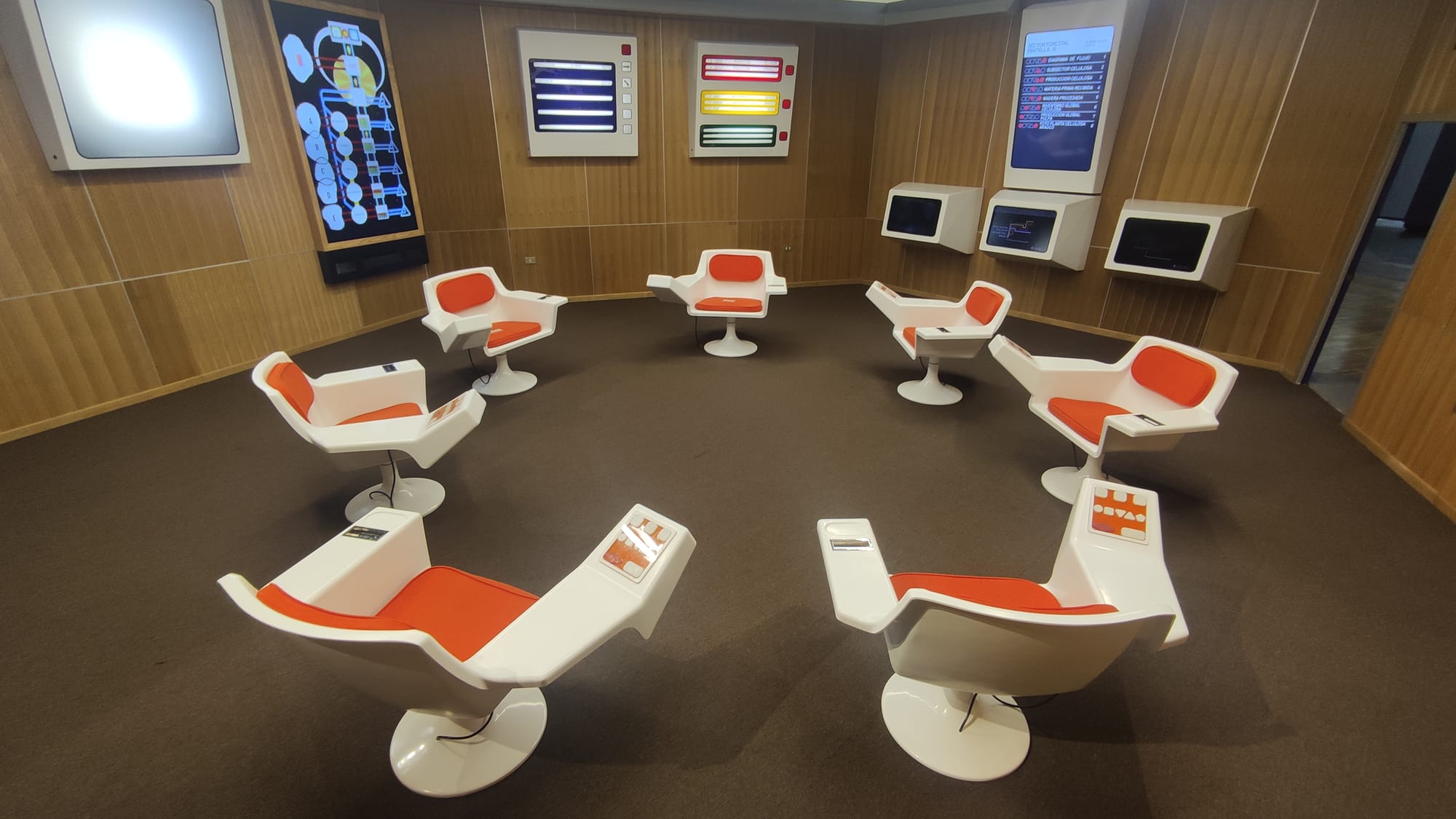
What was astonishing was Opsroom and its design. The idea of the project as a living organism meant it needed a brain. The information sent by the telex machines was received and encoded onto punch cards to then be entered into an IBM Mainframe 360 to store the data on magnetic tapes at the Communications Company (ECOM). As noted by Medina in “Cybernetic Revolutionaries. Technology and Politics in Salvador Allende's Chile” (2013):
The visualization in Opsroom was arranged in the Data Feed, a system of over 1500 slides organized in three overhead projectors controlled by an electromechanical system placed in each of the seven chairs in the room. Each chair had a remote control with a first series of three buttons that allowed the selection of one of the three screens (A, B, and C). Then came a second series of five buttons, each with a geometric shape (circle, square, upward triangle, downward triangle, and pentagon), which allowed the selection of a graph showing the daily evolution of some indicator with significant variations. A central screen displayed a catalog of graphs, each marked with a combination of geometric figures to facilitate information retrieval. Finally, there was a button to activate the selection of screen and graph with the signal “Hold.”
The design was entrusted to Gui Bonsiepe, a designer and academic from the University of Ulm, Germany. He had been invited by CORFO (Corporación de Fomento de la Producción) to teach and work with them. When a designer was sought for Cybersyn, they did not hesitate to call him. He then sketched ergonomic chairs that connected to the screens with cables under the floor, and the buttons on the armrests would change the images on those screens. Beer insisted that it was important for the information (and Opsroom) to be understood and managed by anyone, not just technicians; that is, a mechanism for horizontal cognitive control. Thus, a room was built with a design that was at the cutting edge for its time, and its appearance, many experts claim, was very futuristic, like a Star Trek room. There was also no paper or pencil; everything was electronically stored information.
 Emilio Méndez
CHECO (Chilean Economy) was also developed. This was a software program for simulating future economic scenarios based on historically accumulated data. The information was displayed on the "Future" screen of Opsroom, where political and economic decisions for state-controlled companies were made.
To automate data analysis and prevent it from being in the hands of a single person, they created a program called Cyberstride. The person in charge would be the Brazilian mathematician Carlos Senna. Journalist Natalia Nasser interviewed Senna, and I want you to pay attention to the spirit of the people working at Synco:
[Carlos]: It has to be a system that is somewhat alive. In other words, it should resemble a living organism. And (...) it should adapt through levels of autonomy.
[Natalia]: That meant that…
[Carlos]: There can't be a boss controlling all the variables, all the units, all the departments. Management has to be autonomous. Just like in the human body, Stafford used to say. Right now, I'm talking to you; I'm not controlling my heart's pulse or the rhythm of my breathing, and my foot? I don't even remember I have a foot.
[Natalia]: You don't consciously control it. But if there's a problem, for example, if someone steps on your foot…
[Carlos]: That's when a signal comes saying: “Look, something's wrong with the leg.” That was the system. That was the idea.
[Natalia]: That alert was sent by Cyberstride. The program received all the information from Cybernet —the telex network we talked about— and there Cyberstride analyzed the data and made short-term predictions: if the program calculated that copper, for instance, was going to be in short supply, it would automatically send an alert to the factory.
Around 90 companies and 15 ministries, along with their secretariats, were connected. Cybersyn was taking shape, the Opsroom, based at CORFO, provided real-time data, delivering information and solutions to the entire country.
Synco is put to the test
Like an organism, like a body, the system was then put into practice. The strategy of destabilization by the business community and the opposition resorted to a new tactic: in October 1972, they carried out a nationwide truck lockout to destabilize the government. It is estimated that over 40,000 trucks stopped across the country, causing a nationwide shortage. Some sources claim that the CIA paid $4 a day for each stopped truck to the transport employers. The state, on the other hand, had only about 300 trucks; they had to manage with what they had.
 Juan Ruocco 🧙♂️
While there was a social and political crisis caused by this "strike," it did not achieve its goal of overthrowing Allende. Besides the will of social organizations and a highly mobilized populace, Synco was the technical support that resisted the right's onslaught: thanks to the system, production in public industries and the rest of the state never stopped during the long 35 days of the lockout. The system demonstrated all its potential.
Cyberfolk, or the Cyberpower of the people, the next step
Having demonstrated that an interconnected system for production worked under real and objective needs, it was time to dream of a new step in socialism. Thus, a cutting-edge idea was born: Cyberfolk. This consisted of a system for citizen participation in decision-making, both at the municipal and national levels. The idea was that each household would have a device similar to a television, where you could express your opinion by turning a dial on what, for example, the municipal council was discussing regarding that year's budget. In real-time, legislators had the statistical demands of the residents on the table. Like a permanent organic consultancy to the people.
Synco represented a generation that managed to transform urgencies and boycotts into original and avant-garde solutions. Thinking of technology as a service to democracy and popular participation, always subordinated to social needs and not the market, was their dream.
Although Cyberfolk never came to fruition, two experiments were conducted: one in the city of Tomé, in the south of the country, and another in Mejillones, in the north. Devices were installed in the homes of randomly selected families, allowing the community to provide real-time feedback. The data indicated that, while many details needed fine-tuning, progress was being made. Notably, among those involved in the development of Cyberfolk were none other than Humberto Maturana and Francisco Varela, scientists who developed the concept of autopoiesis in their book "From Machines to Living Beings" (1972).
The End of Cybersyn
By August 1973, the most cutting-edge socioeconomic and technical project in the world at that time was ready. Synco was gathering information and coordinating everything from copper production in the mines to potato farming in the fields. However, the CIA and the Chilean military had a plan that was the complete opposite of what Cybersyn represented. The system was ready just a few weeks before the coup d'état carried out on September 11, 1973, by Pinochet, with the support of the U.S..
At the beginning of September, the order came to move Opsroom to the La Moneda palace, the seat of the Chilean government. It was set to be inaugurated a few days later, likely after the fateful 11th. But everything was destroyed. Nothing remained but a few scattered papers in a bombed-out palace. Salvador Allende died, along with the socialist dream of Chile and, of course, Cybersyn.
Stafford Beer, the guru of organizational technology, would later say that he constantly conversed with the artistic intellectuals of Chile. He had long discussions with Pablo Neruda, with Ángel Parra (the son of Violeta), who would write a song for him and the Synco project, and with scientists Maturana and Varela. After the coup, Beer, who was a millionaire (to the point of owning mansions and Rolls Royces), sold everything and went to live in a nearly hermit-like manner in the countryside. Perhaps those conversations influenced his decision. He tried to sell the project to various countries, but a democratization system like that was seen (and perhaps still is) as a nuisance.
If you want to know more specific details about the project, as it is much more complex than what can be conveyed in this note, there is a podcast that features the work of journalist Natalia Messer with more information, which was one of the main sources.
Synco represented a generation that managed to transform urgency and boycotts into original and avant-garde solutions. Envisioning technology in service of democracy and popular participation, always subordinated to social needs rather than the market, was their dream. A participatory economy, a political system where people's opinions mattered.
Enjoyed the read? The Wizards are who keep 421 alive. Join and get the digital magazine, exclusive content, and more.