Cannibal Corpse, Carcass, and Death don’t make music (just) to shock. They make music about the one thing you can’t ignore: that you have a body, that it will betray you, and that the world will go on without you when that happens. A guide to understanding the most brutal genre in rock history.
“I listen to metal, but I never got that far.”
Music enters through the ear and penetrates you. It can hurt or caress you. If you don’t like a movie, you fall asleep or you leave. When you don’t like a song, you scrunch your nose and say, "get that crap out of here."
We all have our limits.
A distorted guitar with a tone from the grave, a rhythm so fast it defies human capabilities, a guttural scream that sounds more like the cry of a butchered pig. Even the most open palate can feel expelled by those textures. "You can’t understand a word they’re singing," "it’s just noise."
Venom, Bathory, and especially Slayer with their Reign in Blood (1986) brought metal closer and closer to the edge of aggression and evil. But that was just the beginning. Within extreme metal, the founding line is death metal. Death. Short and to the point.
Death Metal: one step beyond the limit
In the mid-eighties, death metal emerged scattered around the world: Possessed and Autopsy in California; Sepultura in Brazil; Carcass in the UK; Entombed in Sweden. But the center of the movement would be Florida: the sun, the suburbs, the stifling humidity, the boredom, the abandoned malls, the crocodiles in the yard. Not the gothic darkness of Norway nor the industrial coldness of Birmingham. Death metal sounds so dense and heavy because it was born where the sun is so brutal that all that’s left is to close the blinds and play faster and faster. Just naming the bands is enough: Death, Morbid Angel, Obituary, Deicide, Cannibal Corpse. They all defined what this is about.
In the mid-eighties, death metal emerged scattered around the world: Possessed and Autopsy in California; Sepultura in Brazil; Carcass in the UK; Entombed in Sweden.
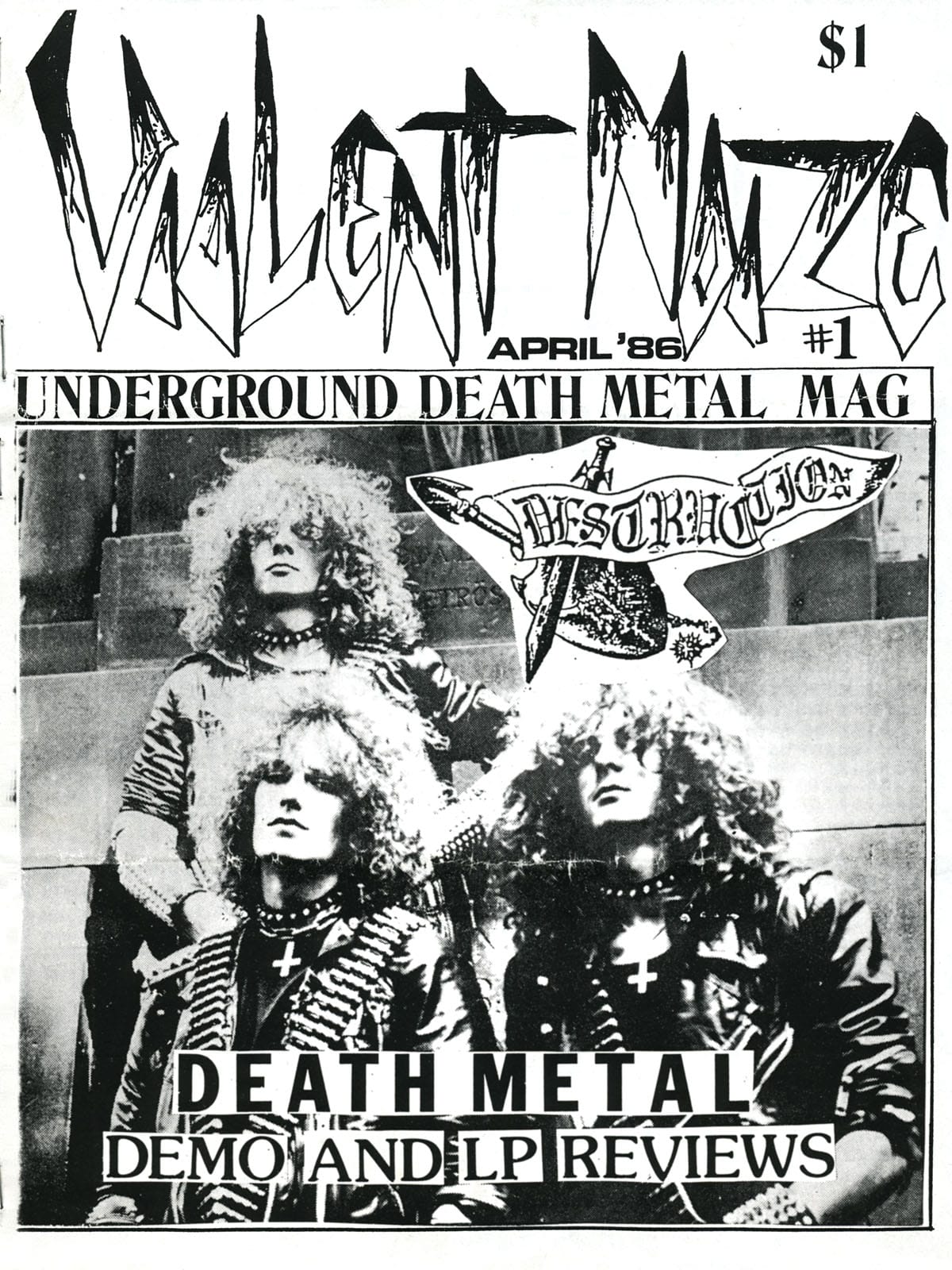
The scene grew like everything that the market doesn’t want: from the ground up, by mail, little by little. Photocopied fanzines in the living room (Violent Noise, Brain Damage) and cassettes that were copied and sent back and forth among fat guys who only knew each other through letters. In Florida, producer Scott Burns turned Morrisound Recording into the sound laboratory: that dense bass, that dry drum, that growl that seems to come from the basement of hell.
When Death released their Scream Bloody Gore (1987), something different from thrash was already taking shape: music that no longer sought to be listened to in the conventional sense. Death metal built its entire infrastructure before having an audience. It was born without a market, and that was its advantage: no product designed to sell could have afforded that level of freedom.
As a cultural product, death metal is identifiable in its most superficial gestures. From provocative covers with rotting bodies, open organs, blood, and decay to the downtuning of its guitars, the dense and dark atmosphere, and the deep, unintelligible gutturals. The growl, that guttural grunt that is the genre’s trademark, makes it almost impossible to understand any lyrics; the words dissolve into the body.
The first issue of the fanzine Violent Noise from 1986.
For those not in the scene, this can be reduced to childish transgression or a gratuitous display of raw and evil violence. Sociologist Keith Kahn-Harris describes extreme metal as a practice of reflexive transgression: a music that knows its own limits and consciously works with them, that knows what it’s doing when it offends, frightens, or repels. It’s the calculated savagery of someone who chose to settle on the edge and stay there.
Death metal and B-movies solved the same problem in the same way: since no one took them seriously, they could talk about anything. Through genres labeled as cheap entertainment (horror, fantasy, and crime), B-movies appropriated symbolic materials and mythological narratives without being weighed down by the burden of “high” artistic or cultural pretensions. On an Obituary album, you’ll find the same reflections on death and the human body as in Pink Floyd (with worse production and without the capital A Art label). Pink Floyd tells you it’s Art. Obituary does not. It lowers its guard.
Cannibal Corpse: the face of a hammering
"Lifeless body, slouching dead / Lecherous abscess, where you once had a head"— Hammer Smashed Face, Tomb of the Mutilated (1992)
Where there once was a head, the vessel of consciousness, subjectivity, and identity, there is now only a hole. That obliteration is presented with total indifference.
Try telling your friends that, while taking the Sarmiento to work, you’re listening to something with a cover like what appears on Tomb of the Mutilated (1992). The cool guys might laugh and call you a degenerate, but the more pretentious ones will recommend a psychiatrist.
Still, Alex Webster’s band managed to become probably the most popular in the world in its genre. Born in Buffalo in 1988 and later relocated to Florida, Cannibal Corpse has enjoyed thirty years of career despite bans in several countries, censored covers, and concert cancellations around the world. They’ve sold over two million albums and even appeared in Ace Ventura.
In Cannibal Corpse, there’s no plot, no analysis of the psychology of the perpetrator, no moral reflection. The songs systematically list the body and its processes of disintegration with neutrality. The body is pure, organizable, reusable, and disposable matter.
In modernity, the body is a resource: it must be managed for work, medicine, and the pharmaceutical industry. Cannibal Corpse erases all that euphemism. What remains is the end of the value chain: the flesh that dies and is replaced.
"Bodies sold to science, profiting from the dead" — Living Dissection, Butchered at Birth (1991).
If you see a Cannibal Corpse show (or any band in the genre), you’ll notice there are no screens, no rockets, no stage production. Just the sound and the volume, which become something tangible: the low frequencies of the bass and the double kick drum reverberate in your chest and jaw. They hit you hard. The body receives the sound before the mind processes it.
The mosh pit is a space where bodies collide, push, lift, and stretch. It has a logic that capitalism cannot comprehend: no one wins, no one accumulates, no one produces anything. It’s energy spent purely for the pleasure of spending. The anthropologist Marcel Mauss had a name for this. He called it potlatch, a feast in some Pacific cultures where power was measured not by what you gathered but by what you destroyed. The mosh pit is that: a ritual of waste.
A bulldozer.
Cannibal Corpse embodies the grotesque in the way Bakhtin described. The classical body (the one from Greek sculpture, the one from academic medicine) is closed, finished, without fissures. The grotesque is the opposite: orifices, protrusions, viscera, fluids. It’s the body that doesn’t stay contained within itself. Cannibal Corpse doesn’t invent anything new here. They take that logic to its extreme.
In the Middle Ages, opening the body and displaying the viscera was a political gesture: the carnival inverted the order, the lower classes mocked the upper classes. It was liberating. Cannibal Corpse does the same, but without the liberation. In industrial modernity, there are no hierarchies to subvert nor possibilities for change. The carnival transforms into catastrophe. Death metal describes a world that doesn’t need monsters, fantasy characters, or images from the mind to show horror. Dehumanization in its purest form: without subtext, without metaphor, without anyone apologizing. Something existed. It no longer does. On to the next thing, butterfly.
Carcass: forensic clinicalism
We cross the pond. In Europe, death metal developed some of its most brutal aesthetic gestures.
The Necroticism-Descanting the Insalubrious (1991) by the British band Carcass opens with a neutral, institutional recorded voice:
"A body is committed to a public mortuary. Any victim of sudden or unexpected death will be brought here for a post-mortem by a pathologist; their job..."
It’s a real recording of a forensic procedure. After that, nearly an hour of music dissects, classifies, and names the process of human decomposition as if it were a medical thesis. The feverish and beastly dream of an anatomy student: "Corporal Jigsore Quandary", "Carneous Cacophony", "Forensic Clinicism".
In their early albums, Reek of Putrefaction (1988) and Symphonies of Sickness (1989), Carcass seemed similar to Cannibal Corpse. But if you pay attention, there’s something different: the obsessive use of real medical terms, with clinical precision. The band borrows the cold language of medicine and builds all its horror imagery from it.
Here it’s hard not to think of The Birth of the Clinic by Foucault. The philosopher traces the emergence of the modern medical gaze. Before it, medicine classified diseases like a biologist classifies plants. Disease was abstract, independent of the sick person's body. With modern clinical practice, the sick body becomes the field of medical truth: there is no disease without the individual who contracts it. The sick body becomes an object of knowledge, the flesh becomes visible and accessible to science and technique.
The doctor describes: names with precision, catalogs symptoms, constructs a technical language. For that gaze to be possible, the autopsy became the foundation of their knowledge. Opening corpses makes a new way of seeing possible.
For Foucault, this is where biopower is born: the modern form of control that administers the social body. He who has the words to name the body, controls it.
Carcass takes that gaze to stage the abject, which is not the same as the disgusting. The abject is what reminds the body of its fragile limits. A corpse is disturbing because it shows what you are beneath what you think you are. It exists at the exact edge of the self: not outside, not inside, but at that boundary that tells you where you end and the world begins. Secretions, fluids, corpses. Carcass grabs that and makes it the central theme of an album. And they do it with the same coldness with which a doctor fills out a form. They parody the medical institution and from that caricature reveal a paradox: science, which promised to dominate death, achieved nothing more than naming it with greater precision. Another way to dehumanize: not with violence, but with clinical coldness.
The body is opened. Its parts are named. Next, please.
The horror of a world without us
Philosopher Eugene Thacker describes three layers of the world. The first is the one we inhabit: the world organized by our language, our laws, our maps. The second is the one measured by science: atoms, magnetic fields, biochemical processes. We know, name, and control these two layers.
The third, however, is the world that would exist if we ceased to exist tomorrow. It’s not a hostile world; to be hostile, it would have to care about something. It’s indifferent. Death metal lives in that territory: the decomposing body is proof that the processes of the world do not wait. This world-without-us advances over what we were and does not ask for permission.
Direct reference to the mythology of H.P. Lovecraft.
Cannibal Corpse claims that world as their sole territory. There is no subject, no consciousness, no mourning. There is only flesh being destroyed. Carcass does the same, but from the observer's perspective: the medical gaze names decomposition and does not humanize it.
The world-without-us also explains why a significant portion of death metal maintains such a deep connection with the literature of H.P. Lovecraft. Morbid Angel, for instance, constructs a Lovecraftian cosmology: gods predating humanity, indifferent to it, whose mere existence renders our history irrelevant. The horror in Lovecraft is the vertigo of realizing that the universe existed before we arrived and will continue to exist after we leave. We are but a parenthesis.
Death metal is a musical style that seeks to inhabit that vertigo and screams until it tears us apart.
That's where Death comes in with a difference that changes everything.
Death: the flesh and the power it contains
Death is, by all rights, the most important band in the genre and one of the best in the history of metal as a whole (even though the genre's name didn't originate from them: Possessed coined the term "Death Metal" on their 1985 album Seven Churches).
It all began in Altamonte Springs, Florida, with a young heavy metal enthusiast: Chuck Schuldiner. He had only been playing guitar for six or seven months when, in late 1984, while waiting in line to see Evil Dead at the movies, he suggested to his bandmates a change of identity: "Why not just Death?".
The lyrics were entirely rooted in horror cinema: "Zombie Ritual", "Evil Dead". Gore violence as pure aesthetic language, drawn from Sam Raimi, without political pretension.
After years of demos circulating in the underground and lineup changes, Death signed with Combat Records. Along with drummer Chris Reifert, they recorded Scream Bloody Gore in 1987. All the death metal was already there: the speed, the heavy thrash riffs taken to the extreme, Chuck's growl. The lyrics were entirely rooted in horror cinema: "Zombie Ritual", "Evil Dead". Gore violence as pure aesthetic language, drawn from Sam Raimi, without political pretension.
What happens next is another story.
The title track of their next album, Leprosy (1988), describes limbs decomposing and falling off while still alive. Up to that point, we remain in familiar territory. One single verse will be enough to open a crack in the entire discography of the band:
"Cast out from their concerned society"
The sick body is cast out from a society that watches, judges, and separates. For the first time, behind the flesh, there is someone who suffers.
This is the starting point of one of the most intense arcs in the history of metal. What Schuldiner will develop over 7 albums is the following: What happens to consciousness when it discovers it lives in a vessel that belongs to the world-without-us? What remains for the spirit when its own body never asked it anything before existing nor will it ask for permission to shut it down?
Spiritual Healing (1990) shows a body that suffers not only from illness but from the interventions that claim it from the outside: religion, medicine, the State.
"A mind without emotion / progressive anatomy"– Genetic Reconstruction, Death (1990)
The modern project of mastering flesh produces, at its limit, a being without emotions. The promise ultimately expels the subject that inhabits it.
The most abrupt turn appears starting with Human (1991), where the album title is a declaration of intent. The album opens with the image of a mind colonized by a stranger:
"an uninvited stranger / which comes and goes as it chooses to appear” – Flattening of Emotions, Death (1991)
Consciousness observes its functioning as if it were foreign to it. Even within us, there are processes that happen without our consent. The world-without-us is not only outside, as in Morbid Angel or Cannibal Corpse. It exists inside, in the brain's biochemistry, in the matter that supports thought.
In the song "Suicide Machine," the question is who decides, to whom does the end of a life belong:
"A request to die with dignity / is that too much to ask?"– Suicide Machine, Death (1991)
In Individual Thought Patterns (1993), Chuck provides an answer:
"Behind the eyes is a place no one will be able to touch / containing thoughts that cannot be taken away or replaced" – Jealousy, Death (1991)
We shouldn't confuse the answer with optimism, as it is actually about resistance. When everything can be taken from us, there remains a space behind the eyes that is not matter, that does not decompose, that the world-without-us cannot claim. That tension between what the spirit desires and what the flesh can endure is the driving force behind Schuldiner's last albums.
Death doesn’t exist for people to understand it. It exists to hurt. And sometimes, the things that truly hurt are the only ones that say something genuine about the world we live in.
There’s a Romanian philosopher from the 20th century who articulated what Schuldiner did with riffs. Emil Cioran wrote that we are a package of flesh and consciousness, and if we could truly understand what that means, that understanding would crush us. The animal doesn’t have that problem: it lives, eats, dies without knowing it will die. We do know. And that knowledge is our greatness and our curse. I don’t know if Schuldiner read this, but he understood it in the most direct way possible: by living it.
Chuck died in 2001, at the age of 34. Brain tumor. It took years to diagnose, years during which he continued to play, record, and write lyrics about bodies that betray the consciousness inhabiting them. When he sang about the right to die with dignity, he already knew firsthand what it was like for medicine to offer nothing. Art and life at the same point. Rarely so literal.
Symbolic (1995) opens with the nostalgia of human innocence:
"In need of a fix called innocence / a high that can never be bought or sold" — Symbolic, Death (1995)
What does he mean by that innocence? It refers to the longing for that state before full consciousness, that moment when flesh and spirit have yet to discover they are distinct entities, that they will separate, and that one will prevail. Once that is discovered, it’s impossible to put the veil back on.
Death's last album was The Sound of Perseverance (1998). The song that encapsulates all these ideas is "The Flesh and the Power It Holds":
"When you live the flesh it is the beginning of the end / it will take you in / it will spit you out" — The Flesh and the Power It Holds, Death (1998)
I still remember the first time I listened to this album, one of the most memorable musical experiences I’ve ever had. It was like opening a third eye.
Schuldiner suggests that individuality and human consciousness are born from that expulsion and rejection of the spirit by the flesh.
What sets Death apart from the rest of the genre is that it does not erase the subject. Cannibal Corpse obliterates it with calculated pleasure. Carcass dissolves it under a clinical gaze. Schuldiner defends it. He does the opposite: he rehumanizes from within the genre that knows best how to destroy. Inside the body, there is something that cannot be reduced to tissue or cataloged in a report.
Schuldiner's political thesis, though he never states it as such, is that modernity not only manages bodies but also tries to manage the soul.
Conclusion
Death metal is, above all, a sonic aesthetic of the threshold.
Not in a metaphorical sense, but in a technical one. The blast beat pushes speed to the point where rhythm ceases to be rhythm and becomes texture. The growl takes the voice to the point where words stop being words and turn into a roar. Distortion brings the guitar to the point where the instrument no longer sounds like itself and becomes something nameless. Death metal systematizes the limits of what sound can do before collapsing into noise, at the edge of what music can convey before it becomes incomprehensible. This work is not an aesthetic accident or an all-in bet on scandal. The genre chooses sounds that are on the edge because it speaks of things that are: the body in decay, consciousness on the brink of what’s bearable, the subject at the limits of modernity.
Today we have war, genocide, and human depravity just a scroll away. Instant access to the atrocious. The gaze colonizes and records everything. In that very gesture, we are neutralized. Seeing doesn’t necessarily mean understanding. The saturation of extreme images produces anesthesia: horror is contained, scrolled through, big data. The question that death metal poses (what does it mean for the body to belong to a world that owes us nothing?) has become more urgent than ever. It doesn’t show those images for consumption.
Death doesn’t exist for people to understand it. It exists to hurt. And sometimes, the things that truly hurt are the only ones that say something genuine about the world we live in.
Back the project and unlock everything: Magazine 421 a month early, comments on every piece, the monthly council with the newsroom and the exclusive Magic app.