It's More Complex
UBA and LambdaClass unveiled the Bachelor's Degree in Complex Systems, a program that combines math, physics, computer science and artificial intelligence with economics, history and philosophy to train people who can think and act in a world of permanent crisis.

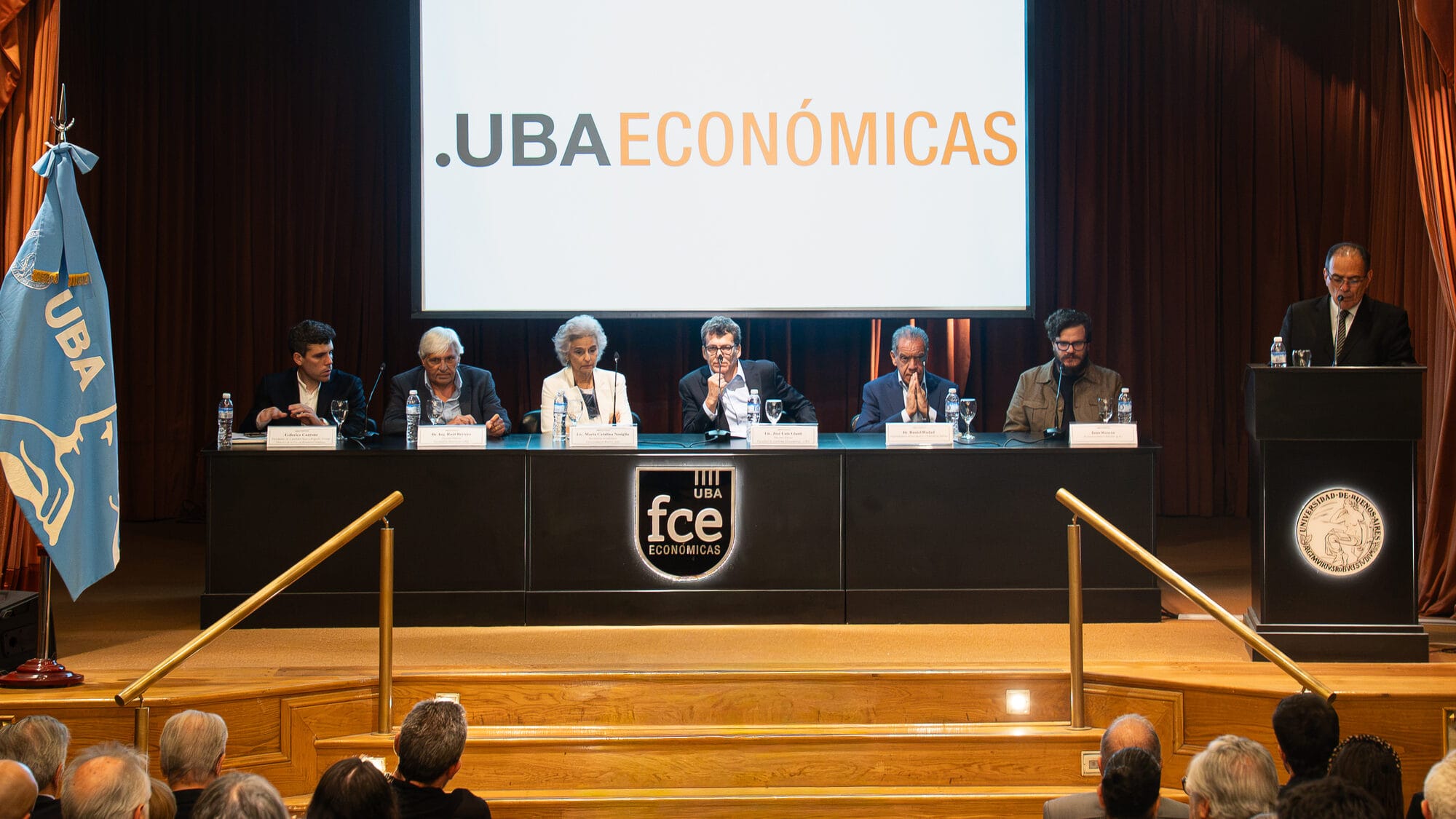
Yesterday, Wednesday, November 11, 2026, the University of Buenos Aires officially launched its Bachelor's Degree in Complex Systems. The program is a joint effort between the School of Economics and the School of Engineering, aimed at providing answers to a present that is increasingly — how to put this without being repetitive — complex [1].
The program, driven by Federico Carrone and the LambdaClass team, aims to train a cohort of graduates capable of navigating the turbulent waters of the contemporary world: understanding it in depth through rigorous mathematical and scientific knowledge, making tough decisions in shifting environments, and building projects that stand the test of time.
With enormous generosity, Federico invited me to take part in the launch and to contribute what little I know to the more humanistic side of the program. I shared the panel with José Luis Giusti, Federico Carrone, Daniel Hadad, María Catalina Nosiglia and Raúl Bertero. There are several courses, like “History of Institutions, Technology and Power” and “Epistemology, Complexity and Ethics,” where philosophical thinking can bring its particular perspective on the world. But beyond that, integrating philosophy as an overarching perspective within the program can open up space for people with bachelor's degrees, master's degrees and PhDs in philosophy to contribute theirs. My role will be to serve as a bridge to that world: connecting people far more talented and qualified than I am to teach the courses that call for it. I think it's, without a doubt, a very significant opportunity for philosophy to be part of a program with a potentially major future impact.
As I see it, the Bachelor's Degree in Complex Systems is one of the first systemic responses that part of Argentina's leadership, from the private sector and academia, can offer to the permanent crisis the world seems to have been going through for at least two decades: it started in 2008, intensified from 2019 on, and in Argentina it seems to have become a permanent state of affairs.
Let's take a quick look at what this systemic crisis is all about.
Capital, human intelligence and natural resources
Between 1857 and 1858, Karl Marx wrote in his working notebooks, later known as the Grundrisse, a passage that wouldn't be published until more than eighty years later, between 1939 and 1941 (Marx, Grundrisse, 1857–1858). That passage, known as the “Fragment on Machines,” was taken up by Italian operaismo and, later, by various accelerationist offshoots, including those that emerged around the CCRU (Cybernetic Culture Research Unit). It is, no more and no less, the concept of the “general intellect.” It matters because it ties together three constitutive elements of the industrial era: capital, natural resources and human intelligence.
“Nature builds no machines, no locomotives, railways, electric telegraphs, self-acting mules etc. These are products of human industry; natural material transformed into organs of the human will over nature, or of human participation in nature. They are organs of the human brain, created by the human hand; the power of knowledge, objectified. The development of fixed capital indicates to what degree general social knowledge has become a direct force of production, and to what degree, hence, the conditions of the process of social life itself have come under the control of the general intellect and been transformed in accordance with it. To what degree the powers of social production have been produced, not only in the form of knowledge, but also as immediate organs of social practice, of the real life process.”
As I see it, the never-ending crisis plays out today on these three levels, which make up the landscape that Complex Systems graduates will have to learn to navigate, or to surf: natural resources, capital and intelligence.
Natural resources and war
Russia and Ukraine: the drone war
Two of the three biggest powers on the planet were at war this year. Russia, which was counting on a quick campaign in Ukraine, has been bogged down since 2022 in a war of attrition. The constant presence of drones rules out any large-scale movement on the front [3]. Its edge in troop numbers and mechanized systems lost much of its value against FPV drones: a dirt-cheap technology, easy to build and flown remotely like a video game. All thanks to tiny processors that make it possible to control these quadcopters.
A Ukrainian FPV attack drone costs on average between 300 and 500 dollars [4]. Drones that hunt other drones are a different category and cost more: between 1,000 and 2,500 dollars apiece [5]. Ukrainian FPV production went from around 3,000 to 5,000 units a year in 2022 to roughly 3 million in 2025, and by early 2026 its industry could turn out more than 8 million a year [4].
The cost asymmetry is brutal. The manufacturer SkyFall claimed that its Shrike 10 drone, which costs under 400 dollars, took part in downing a 19-million-dollar Russian Mi-28 helicopter [6]. Armored vehicles, the main target of these drones, cost between 1 and 4 million dollars [7]. On the American side, the Switchblade 300, which was one of the army's benchmark attack drones, costs about 53,000 dollars according to the Army's 2023 budget, and up to 80,000 or 90,000 with all its equipment [8]. That is, between 100 and 200 times more than a Ukrainian FPV.
Most of the drones on both sides fly on Chinese flight controller boards [9], although lately Ukraine has started making its own to reduce that dependence: in the first eight months of 2026, 28% of its drone components came from China, compared to nearly 90% in early 2024 [10]. Ukraine, which had almost no drone industry before the war, now aims to become a key supplier for European defense.
Iran, the United States and the Strait of Hormuz
A large share of the inputs the chip industry needs passes through the Strait of Hormuz, even though not a single chip is made there. Helium comes from Qatar: it's produced at Ras Laffan as a byproduct of natural gas, and that complex supplies about a third of the world's helium [11]. Chips need it, ultrapure and with no substitute, to cool wafers during lithography [12]. Korea, Taiwan and Japan got almost all of it from Qatar, through Hormuz. On top of that, Taiwan depends on Middle Eastern gas for its electricity, and TSMC, which makes about 90% of the most advanced chips, alone consumes around 9% of the island's electricity [13]. Taiwan has gas reserves for barely 11 days [14].
When the war with Iran broke out in late February 2026, Hormuz was shut down and Iranian attacks damaged Ras Laffan. Qatar suspended its deliveries and the price of helium doubled [15]. Chip production didn't stop, but it got more expensive and inputs had to be rationed. The big winner was the United States: it went from supplying less than 4% of the helium Taiwan imports to nearly 60% [16]. So the war Washington launched ended up handing it control over a critical input for the chips that all of AI depends on. Today traffic through Hormuz is slowly recovering, but the damage lingers: in August, Ras Laffan was producing helium at barely a quarter of its capacity [17], and some facilities will take three to five years to repair [16]. The case shows the fragility of a complex system: a strait in the Persian Gulf can reshuffle who controls the chip supply chain.
Capital: debt, financial assets and housing
The debt model
Since the 2008 crisis, developed economies have climbed out of every crisis with the same tool: more debt and cheap money. To bail out the banks and prop up the economy, central banks cut rates to near zero and bought bonds en masse. The Federal Reserve's balance sheet went from less than US$1 trillion before 2008 [18] to about US$9 trillion in 2022 [19]. That money never reached wages: it flowed in through the financial system. With rates at zero, bonds stopped yielding and investors went hunting for returns in stocks, real estate, crypto and collectibles, which inflated their prices. At the same time, cheap money let governments borrow with no visible cost: US debt went from around US$10 trillion in 2008 [20] to more than US$40 trillion today [21].
Wages foot the bill, in two ways. First, new money reaches those who already own assets first, and they watch their wealth grow; only later, and diluted, does it reach the real economy. Second, when debt gets too big to pay off, the way out is to inflate it away, as happened in 2021–2023, when prices rose faster than paychecks. Assets are protected from inflation; wages aren't. That's why those who owned assets multiplied their wealth, while those who live off a paycheck drifted further and further from being able to buy a home. And within each market, value concentrates in the intelligence layer (NVIDIA, Palantir, Anduril), not in physical production.
US general government gross debt as % of GDP [22]
| Año | Deuda / PBI | Contexto |
|---|---|---|
| 2019 | 108,8% | Antes de la pandemia |
| 2020 | 132,6% | Gasto de emergencia por el covid |
| 2022 | 119,1% | La inflación licua parte de la deuda |
| 2025 | 123,9% | La deuda total supera los US$38 billones |
| 2026 (proy.) | 125,8% | La deuda total supera los US$40 billones |
| 2031 (proy.) | 142,1% | La peor trayectoria del G7 |
Assets since 2019
| Activo | Ene. 2019 | Nov. 2026 | Multiplicador |
|---|---|---|---|
| NVIDIA [23] | US$3,4 | US$189 | ×55 |
| Bitcoin [24] | US$3.700 | US$75.700 | ×20 |
| Ethereum [25] | US$140 | US$2.270 | ×16 |
| Nasdaq 100 [26] | 6.300 | 28.200 | ×4,4 |
| Oro | US$1.285 | US$4.100 | ×3,2 |
| S&P 500 [26] | 2.500 | 7.570 | ×3 |
| Deuda de EE.UU. [21] | US$22 billones | US$40,5 billones | ×1,85 |
Valores aproximados.
Housing in Argentina
In our country, this crisis shows up as an almost total loss of access to housing through wages. In the '80s, a used apartment of about 50 m² in the City of Buenos Aires cost between 40 and 50 monthly salaries [32], and by the late '90s it was down to about 30 [31]. After the end of convertibility, that relationship broke down: in December 2019 it took about 205 salaries to buy the same apartment, and in November 2023, the low point of the series, about 250. Today, with the square meter at around US$2,476 [29] and an average salary of roughly US$1,207 [30], it takes about 103 salaries. Things have improved in recent years, but it's still two and a half to three and a half times more work than in the '90s. On top of that, mortgage lending barely exists: only 16% of purchases are made with a mortgage [29], and anyone who wants to buy has to save up the full amount. Housing stopped being something you can reach by working and became an asset for those who already have capital.
Used apartment of about 50 m² in Buenos Aires City, in monthly salaries
| Época | Salarios mensuales |
|---|---|
| Años 80* | ~40–50 |
| 1994–96 | ~40 |
| Fines de los 90 | ~30 (mejor momento de la serie) |
| Dic. 2019 | ~205 |
| Nov. 2023 | ~250 (peor momento) |
| 2026 | ~103 |
* Con sueldo de joven profesional. Los valores de 2019, 2023 y 2026 son cálculos propios con datos de Zonaprop y del salario promedio al dólar paralelo.
Intelligence: philosophy and its link to computing
It may not seem like it, but there's a direct connection between computing and philosophy. The computer wasn't born as the answer to an engineering problem, but to a philosophical question: what is reasoning, and can it be mechanized?
Let's start with Aristotle. More than 2,300 years ago, with the syllogism, he discovered something strange: that an argument can be valid by virtue of its form, regardless of what it's about. “All A are B, all B are C, therefore all A are C.” It doesn't matter whether we're talking about cats or planets.
Two thousand years later, in the 17th century, Leibniz dreamed of taking that to the extreme: a calculus of reasoning. He imagined that, faced with any dispute, it would be enough to sit down and say, “Let us calculate.”
In 1854, George Boole published a book whose title says it all: The Laws of Thought. He turned logic into algebra, with three operations: AND, OR and NOT. Hold on to those three words.
In the early 20th century, Bertrand Russell and Alfred North Whitehead published Principia Mathematica (1910–1913). They were after something hugely ambitious: grounding all of mathematics in pure logic.
In 1928, the mathematician David Hilbert posed a question that seemed purely theoretical: is there a mechanical procedure capable of deciding whether any mathematical statement is true or false?
The answer came in two blows. In 1931, Kurt Gödel proved that in any sufficiently powerful formal system there are truths that can't be proven within the system itself. And in 1936, a 24-year-old Turing answered that no such procedure exists. But to prove it, he had to define precisely what a "mechanical procedure" is, and to do that he imagined an abstract machine we now call the Turing machine: the theoretical model of every computer in existence. In that same paper he proved that there is no algorithm capable of analyzing any program and deciding whether it will eventually finish or keep running forever. This later became known as the halting problem, and from it follows the impossibility of mechanically deciding the validity of any logical statement.
A year later, in 1937, Claude Shannon showed that Boolean algebra could be built out of electrical circuits. Those three words, AND, OR and NOT, are today the basic operations of every chip: in the phone in your pocket, in your laptop, in your car.
In 1950, Turing published "Computing Machinery and Intelligence," in which he proposed setting aside the question "Can machines think?" and replacing it with another: if a machine can converse with a person so well that the other party can't tell it apart from a human, what reasons do we have left to deny that it thinks? That paper became the foundation of the debate on thought, language and machines.
Computing handed philosophy a new vocabulary for thinking about an old problem. If thinking is processing information, then the mind can be described by what it does rather than by the stuff it's made of. That gave rise to the cognitive sciences and a whole way of thinking about the architectures of the mental. Today, language models are putting those ideas to the test again.
(Artificial) intelligence, natural resources and capital
Into this whole landscape burst large language models. Accelerated intelligence may become a commodity, and thousands of jobs are under threat in a world where, as we've seen, wage labor has already been losing ground to capital.
Faced with this crisis, there are at least two major political ways out. The humanist one tries to preserve the central place of human beings on the epistemic and planetary map. The accelerationist one, siding with the machines, seeks to accelerate the production system as much as possible and decouple it from the human.
Just as Turing thought through the relationship between humans and machines in the 1950s, today we need a new language to grasp all the layers of complexity of the problem in front of us. Yes: it's more complex.
I don't think the world is going to calm down anytime soon. On the contrary, I see everything we've described getting deeper. We need that language, and young people who think and act in this context: who can model the present and act on it.
Philosophy has always been accused of being useless, and that accusation has an ancient history. In the Theaetetus, Plato tells how Thales of Miletus was walking along gazing at the stars and fell into a well. A Thracian slave girl who saw him laughed: all that staring at the sky and he couldn't see what was right at his feet (Plato, Theaetetus, 174a). But Aristotle, in the Politics, tells a different story (Book I, ch. 11). People reproached Thales for being poor, as proof that philosophy was good for nothing. So Thales, thanks to what he knew about the stars, foresaw that the next olive harvest would be huge. In the dead of winter he rented, for next to nothing, every olive press in Miletus and Chios, since nobody wanted them. When the harvest came, everyone needed them and he had them all. He got rich, and according to Aristotle he did it to show that philosophers can get rich if they want to, but that's not what they care about.
The guy who fell into the well from looking at the stars was the only one who saw the harvest coming. For centuries, logic was the perfect example of useless knowledge, and today it runs on every chip on the planet. This degree program is a bet on training people who look at the stars and who also see the harvest coming.
Pre-registration for the 2027 intake of the Bachelor’s Degree in Complex Systems is now open on the website of the UBA School of Economics (in Spanish).
Las notas de 421 no tienen paywall
Y a cada colaborador se le paga por su trabajo. Las dos cosas dependen de los suscriptores.