Lovecraftian Fossils
Lovecraftian Fossils
Lovecraftian is a term derived from the works of H. P. Lovecraft that refers to both cosmic horror narratives and elements that appear in those works. When it comes to his monsters, we're talking about interdimensional entities or gigantic alien creatures armed with rows of tentacles, strange symmetries, multiple eyes, and anatomies so complex they seem foreign to this world.
But beyond evoking existential anguish, a fascinating detail of Lovecraft's horror is the anatomical descriptions of his terrifying, inescapable, and above all, invertebrate creatures. The author, who was passionate about science, described his beings as if he were a naturalist examining a specimen. And to find anatomies 'out of this world,' you don't have to look far; invertebrates have such an extensive and complex evolutionary history that it has allowed for the emergence of various body forms so strange that they rival the imagination.
Invertebrates have such an extensive and complex evolutionary history that it has allowed for the emergence of various body forms so strange that they rival the imagination.
In this special note, as we celebrate Lovecraft's birthday on August 20, we're going to explore fossil animals that you probably had no idea existed and that could have come straight from the imagination of the famous cosmic horror writer.
The classic of tentacles: lobopods
To find truly alien creatures, the Paleozoic era is the perfect time to snoop around. 500 million years ago, during what is known as the Cambrian period, life was developing and evolving in the seas, with invertebrates as the absolute rulers of the ecosystems.
Within this context, one of the strangest groups is the lobopods, a group of panarthropods (invertebrates closely related to modern arthropods) characterized by having soft bodies with tubular, fleshy appendages resembling tentacles called lobopods, which have small claws at their ends. This is complemented by a bulbous head with mouth structures that vary by group, and eyes of different levels of complexity depending on each morphotype.
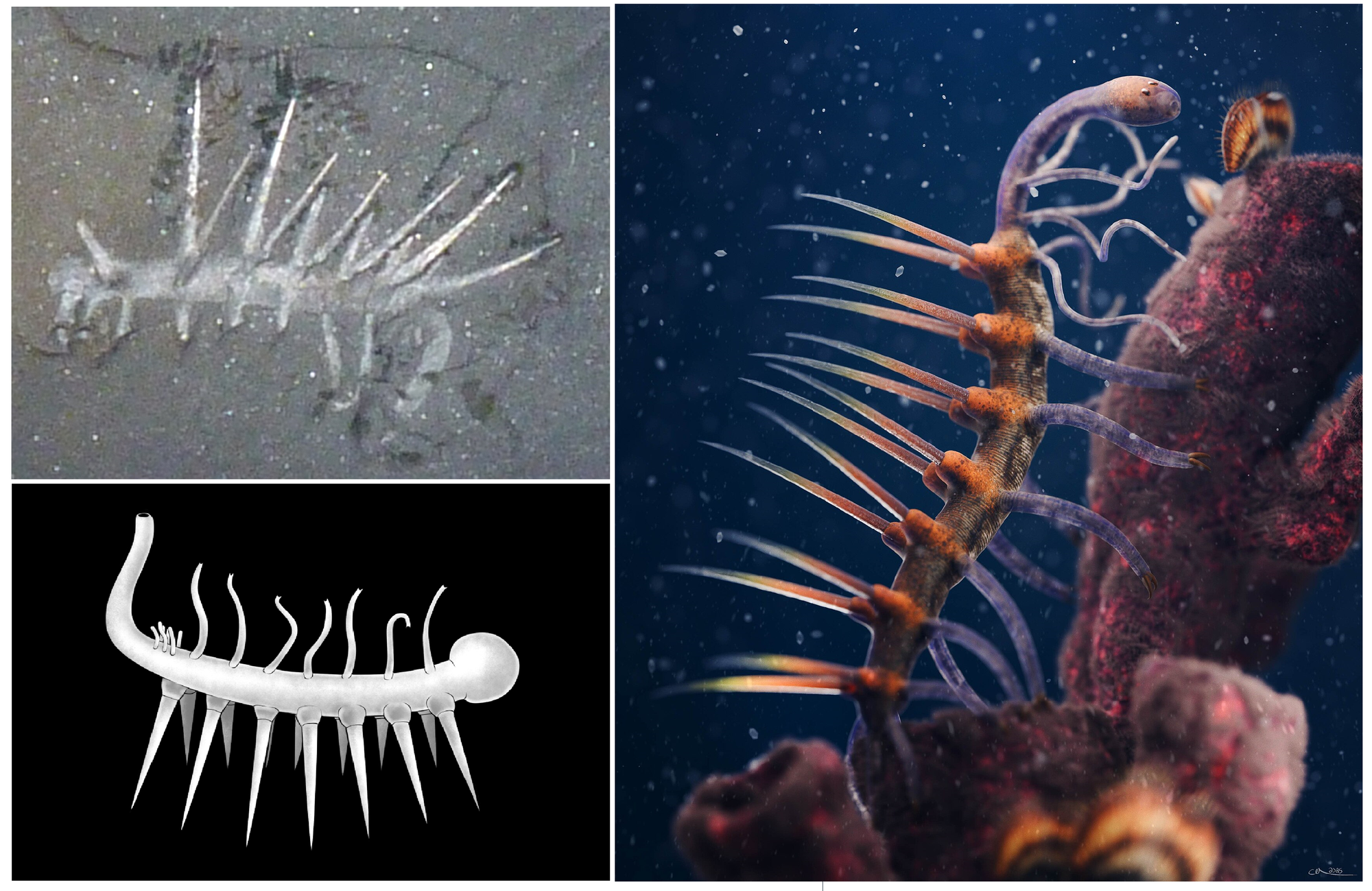
Lobopods could measure just a few centimeters, but that didn't stop them from being controversial, as is the case with Hallucigenia sparsa. Its remains were found in the Burgess Shale in Canada in 1977 by Simon Conway Morris, who named it for its 'strange and dream-like' appearance. This little creature, ranging from 0.5 to 5 cm, looked like nothing known, and it wasn't even clear which end was the head or which was the top of the body. In fact, Conway Morris initially interpreted it with the tentacles up and the spines as legs. It wasn't until 1991 that a study was published, where, studying other specimens from China, they could identify Hallucigenia as a lobopod, which changed its interpretation. The tentacles were actually pairs of appendages used for movement, and the spines were dorsal and protective, in addition to identifying that the lobe was a head with small eyes.
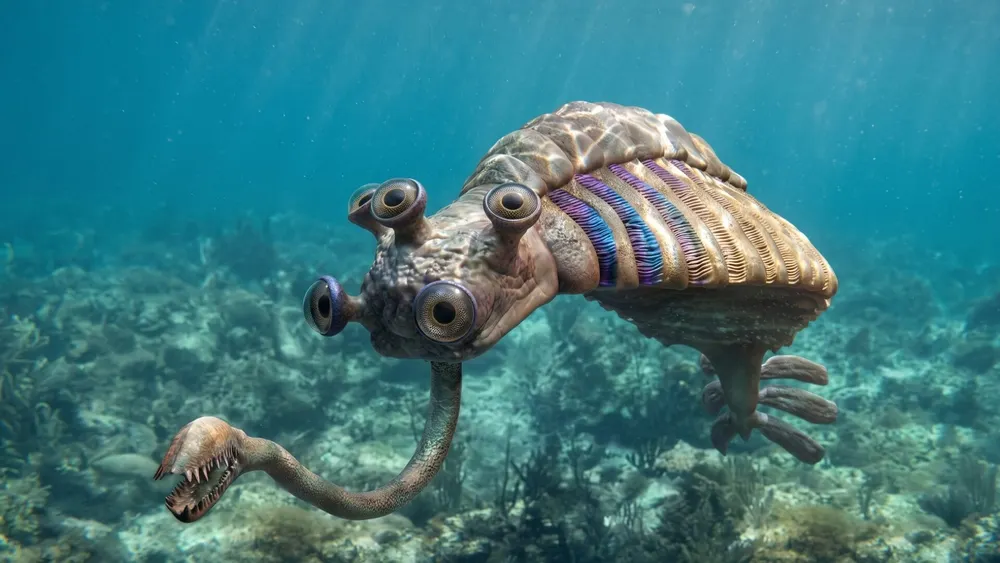
Within this group, there's a diversity of body forms. We also have the rare Opabinia, found in the Burgess Shale (Middle Cambrian, about 505 million years ago), which has a segmented trunk with folds along its sides and a fan-shaped tail, but its strangest feature was its head. It had a trunk with claws that likely served to bring food to its mouth and had five compound eyes; this little guy decided that having an odd number of eyes was the best choice.
Another extremely rare lobopod form is Ovatiovermis, characterized by having especially long front pairs of legs equipped with rows of fine spines on both sides. Unlike other relatives that used their spines for defense against predators, Ovatiovermis used these front limbs to filter small organic particles from the water. To avoid being swept away by ocean currents while 'fishing,' its last three pairs of hind legs had strong hook-shaped claws, with which it anchored itself firmly to sponges or corals on the seafloor.
Although their aesthetics are nothing to envy compared to the facehugger from Alien or an entity from Lovecraft's depths, most of these animals led quite peaceful lives, being detritivores or filter feeders that consumed organic matter suspended in the water or deposited in the sediment.
The eyes of the abyss: Thylacocephala
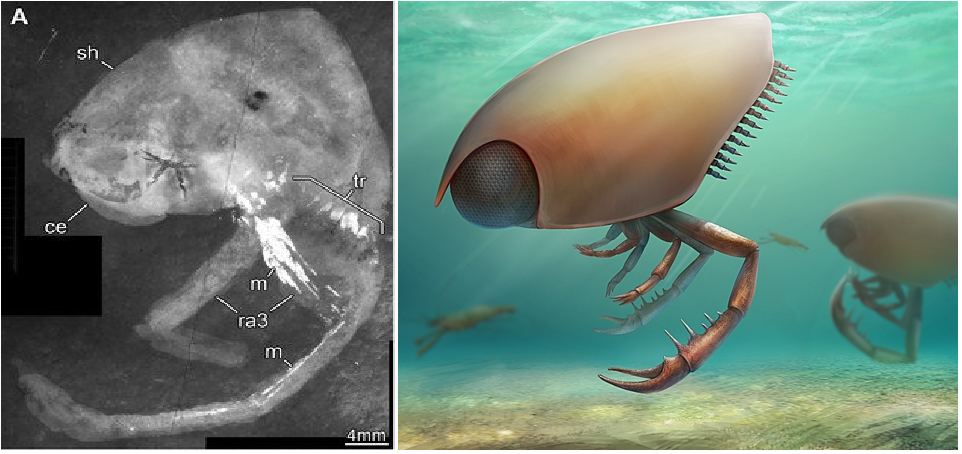
On the list of extinct arthropods (that you probably didn't know existed) we have the Thylacocephala. Their name comes from the Greek thylakos, meaning 'bag' or 'sack,' and kephale, meaning 'head,' referring to their large shell that envelops their entire body, as if they were inside a clam, with only their eyes and appendages sticking out. A striking feature of their eyes is that they are gigantic in proportion to their entire body, made up of numerous small lenses like those of modern arthropods, but they were so large that they occupied the entire frontal area of the head. This, combined with their raptorial appendages, gives them an appearance reminiscent of an alien ship from War of the Worlds.
Although their aesthetics are nothing to envy compared to the facehugger from Alien or an entity from Lovecraft's depths, most of these animals led quite peaceful lives.
These animals lived through an extensive geological lifespan, from the Silurian (about 435 million years ago) to the Late Cretaceous (about 84 million years ago). And, despite their terrifying appearance, they were quite small, ranging from a few millimeters to several centimeters. They are found in marine sediments in various parts of the world. Despite their long history, their lifestyle remains a paleontological enigma. Due to the enormous variety in the shape of their appendages and the structure of their eyes within the group, it is believed they occupied various ecological roles. While some species seem to have been active hunters of small pelagic organisms using their raptorial legs, others may have been detritivores, filter feeders, or scavengers of the seafloor. It has been proposed that their hypertrophied eyes would have been key to capturing the scant light of the ocean abyss, indicating that they were species living at great depths.
Primordial symmetry, the echinoderms
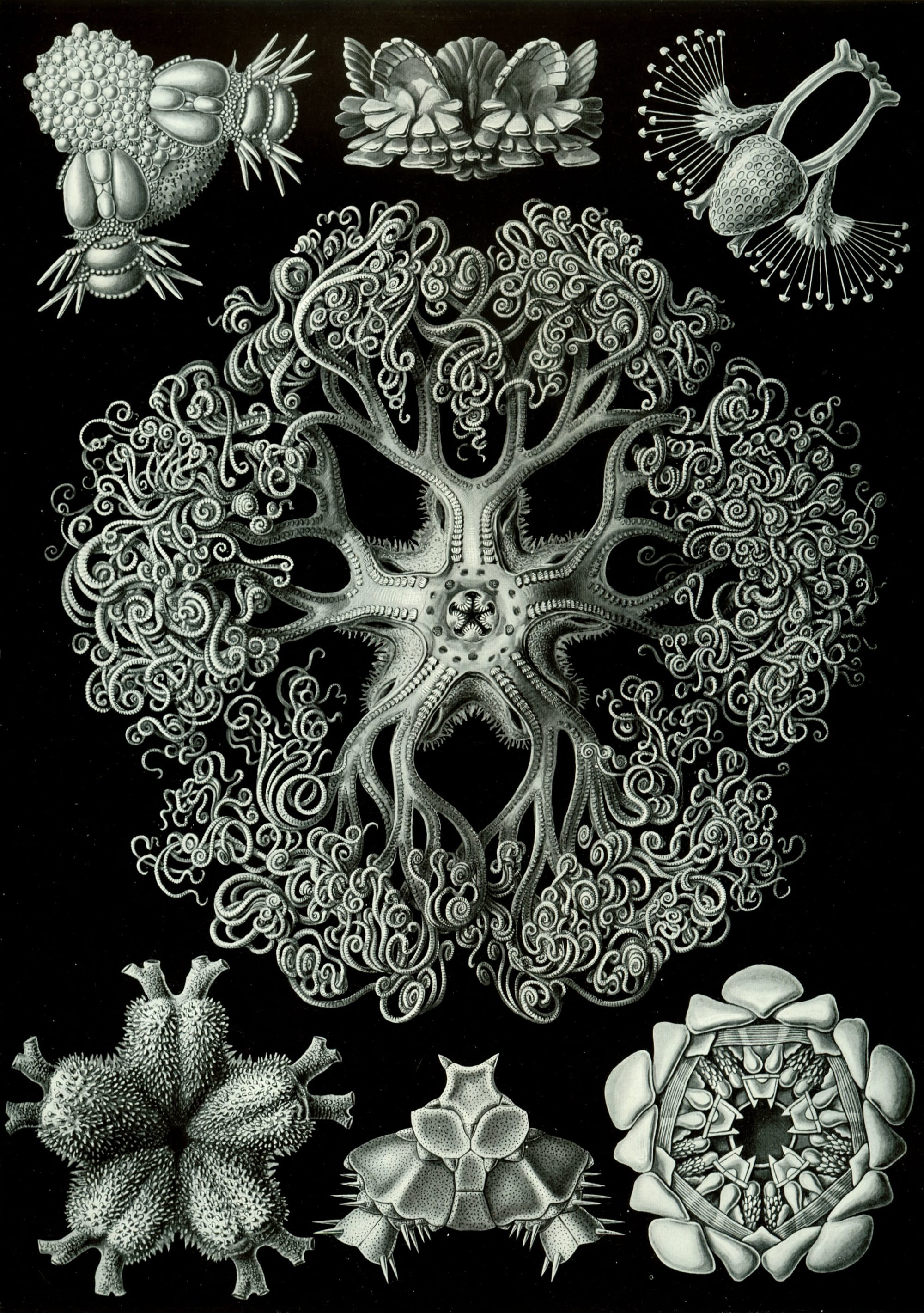
When we talk about anatomies with strange body symmetries, the invertebrates that specialize in this are the echinoderms. Humans and most animals are accustomed to bilateral symmetry (a symmetrical left and right side). However, adult echinoderms broke that mold and adopted pentaradial symmetry, with bodies organized around five axes around a center, creating patterns that resemble cosmic mandalas.
These invertebrates have been on this planet since the Cambrian Explosion (over 515 million years ago). This group has an endoskeleton made up of thousands of articulated calcareous ossicles. This mineral structure, combined with a water vascular system (a complex internal hydraulic system that moves their tube feet), not only gives them the appearance of a 'living model' but also makes them perfect candidates for fossilization.
This group includes starfish, sea cucumbers, brittle stars, sea urchins, and sea lilies. And if we look at the current forms, they already seem to come from another planet, in addition to the diversity of body shapes that seem to have nothing in common with each other. These guys became famous through the Schmidt Ocean Institute's Stream expeditions alongside CONICET, where we got to know batatita and the plump starfish, among others.
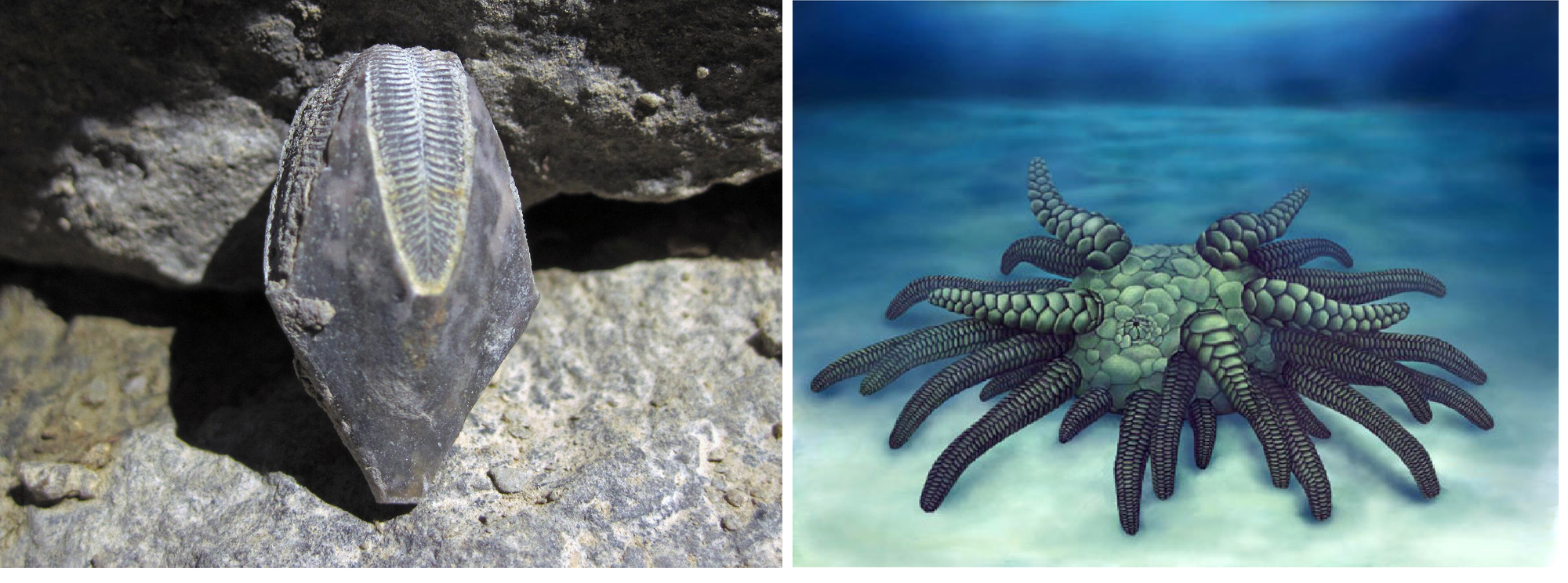
During the Paleozoic, this group experimented with body forms, having various shapes and symmetries. One of the most striking groups is the Homalozoans, characterized by being asymmetrical and having a body formed by a shell of calcite plates and a single long appendage. Among this group, the strangest in appearance are the stylophorans, a group that has a shell with two faces and a more complex shape. For over a century, scientists debated whether the appendage was a tail or an arm, until an exceptional fossil from Morocco revealed that the only appendage it had had tube feet, indicating it was a feeding arm.
These guys became famous for the Schmidt Ocean Institute's expeditions streamed alongside CONICET as they explored the depths of the South Atlantic.
Among the ancient and rare echinoderms, there were those with a helical design, such as Helicocystis moroccoensis. This echinoderm, which lived during the Middle Cambrian (about 520 million years ago), measured just a few centimeters in length and had a very peculiar cigar-shaped form, with its mouth on top. The skeletal plates that formed its body were arranged in a spiral pattern, but with pentamerous symmetry, meaning five rows of spiral plates, which is a precursor to the radial symmetry that echinoderms would later possess.
Other Paleozoic forms of extinct echinoderms are the blastoids, small forms that lived attached to the seafloor and were filter feeders. Their body (theca) was made up of interlocking calcareous plates with perfect pentaradial symmetry. The mouth was located at the top center, surrounded by five ambulacral areas arranged like petals. This encapsulated structure gave them the appearance of a cocoon or cocoon of alien origin.
To close this group, there is a fossil that pays explicit homage to the master of cosmic horror: Sollasina cthulhu. Belonging to the ophiocistioids (an extinct group related to holothurians and sea urchins), this creature, measuring just a few centimeters in diameter, had a bulbous body surrounded by 45 tubular tentacles.
All these fossil forms inevitably refer, both in their anatomy and their strange architecture, to the Elder Things (Elder things). In fact, in the novel At the Mountains of Madness, Lovecraft describes them as beings with both plant and animal anatomy featuring pentaradial symmetry, barrel-shaped bodies, and a mass of apical tentacles, which means they could easily be classified as alien echinoderms.
The children of Cthulhu: Giant Cephalopods
So far, all the animals I've mentioned had an undeniably Lovecraftian appearance, but they lacked the 'size' factor, as they were organisms just a few centimeters long that we could hold in our hands. However, there is a group of invertebrates that have achieved colossal proportions worthy of the title 'monsters of the deep': the cephalopods.
Throughout their evolutionary history, cephalopods have managed to reach gigantism multiple times. Long before marine reptiles or cetaceans dominated the oceans, they were the top predators on the planet.
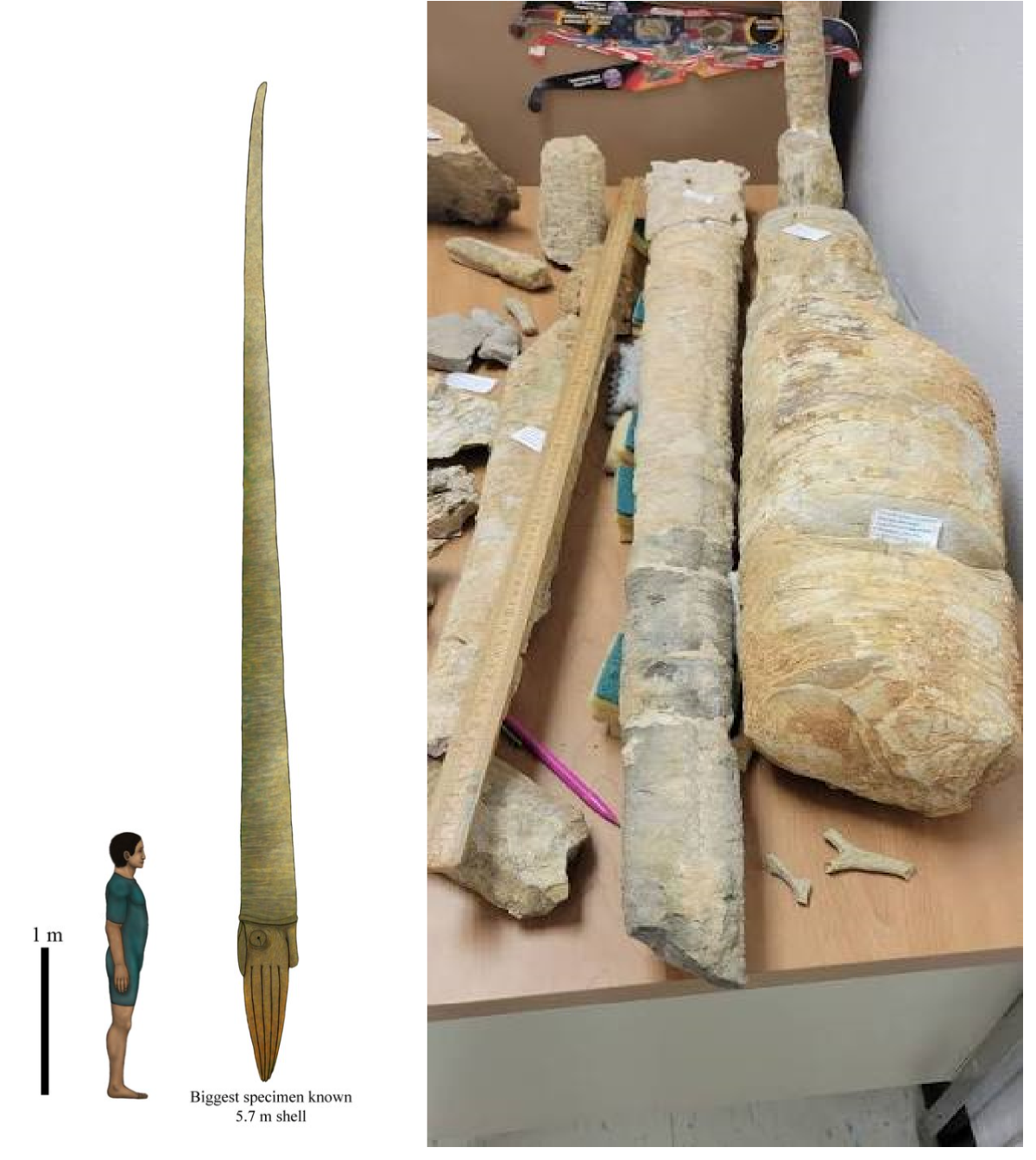
Long before fish developed jaws, the undisputed king of the Paleozoic seas was Endoceras giganteum (endo: 'inside', ceras: 'horn'). A cephalopod from the Ordovician (470-450 million years ago) known for its giant calcareous shell. Unlike modern octopuses or squids, most Paleozoic cephalopods had large external calcareous shells that protected their soft bodies. The shell of Endoceras was an elongated, straight cone with an internal tube (siphuncle) where deposit cones or endoconchs accumulated.
The largest record of Endoceras corresponds to a specimen at the Museum of Comparative Zoology at Harvard University, whose reconstructed shell reaches 5.73 meters in length, making it one of the longest cephalopods of the Paleozoic. However, despite its length, its body was relatively narrow. It is estimated that an adult weighed around 100 kg, far below the 300 kg that a modern giant squid (Architeuthis dux) can reach. Still, Endoceras was the largest predator of the Ordovician, ambushing its prey and dropping down on them, which makes it quite terrifying.
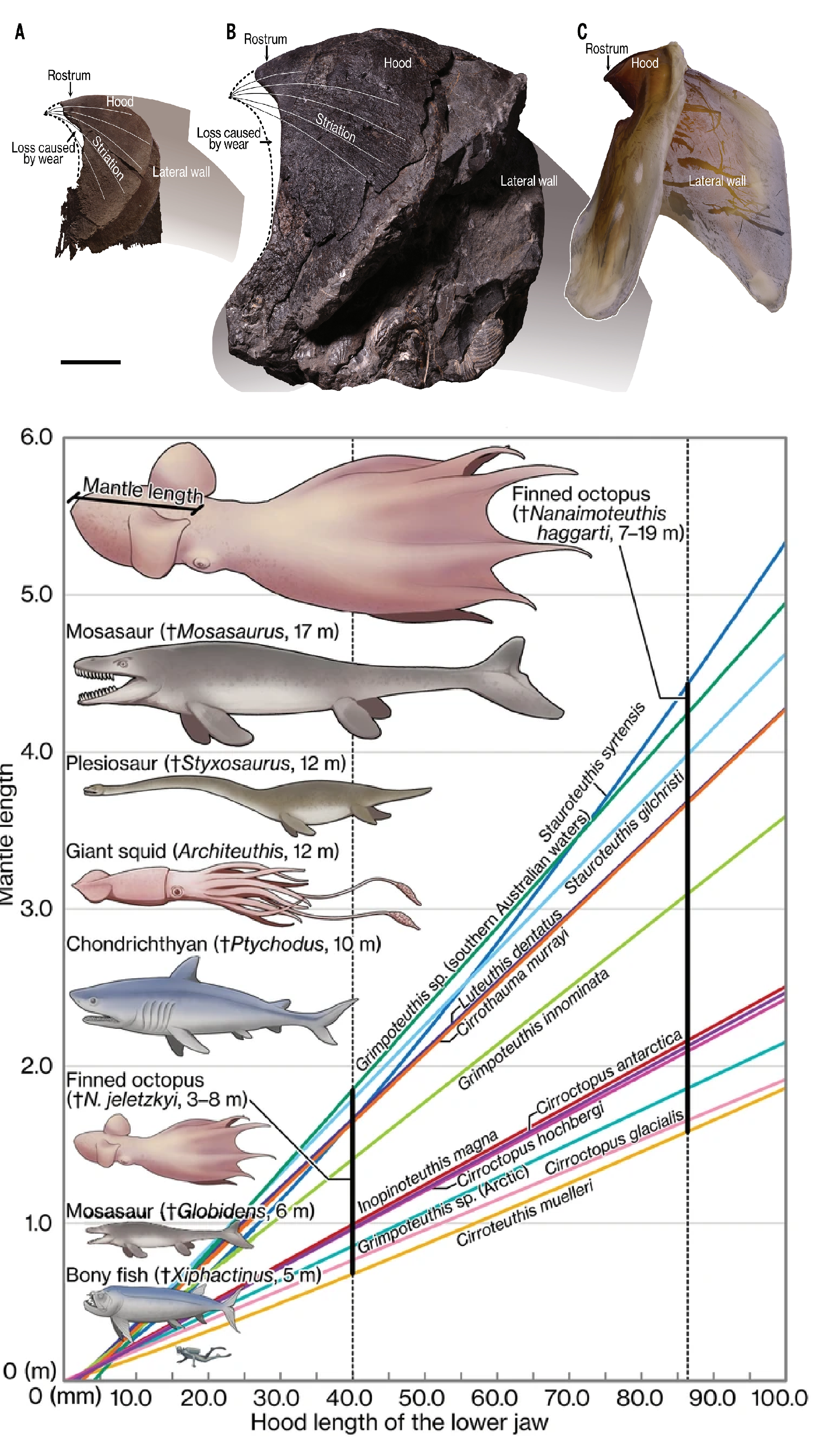
Now, if there is a fossil species that would challenge the size limits of cephalopods known to date, it is Nanaimoteuthis. A fossil genus of octopus known only by its beaks, as this is the only structure that can be preserved in the fossil record, since octopuses lack shells. It was found in what would be the Cretaceous (100-72 million years ago) in Canada and Japan in 2008.
Recently, the analysis of new specimens revealed exceptionally large fossil jaws. In cephalopod anatomy, the hood is the curved dorsal section that forms the 'visor' of the upper beak; in the largest specimen of Nanaimoteuthis, this measurement is 86.4 mm, a size 1.5 times larger than the beak of a modern giant squid (Architeuthis).
There’s no need to look to the stars or invoke parallel dimensions to find beings that seem to defy human logic. Lobopods, thylacocephalans, echinoderms, and giant cephalopods were not aberrations of nature, but organisms that were part of the great tree of life.
Nanaimoteuthis would belong to the group of Cirrata (cirrate octopuses), which are abyssal cephalopods that have fins on the sides of their heads for movement and small cirri on their arms (this includes the famous 'Dumbo octopus' we saw in CONICET's deep-sea broadcasts). Considering this, based on the size of its beak and the scale of its current relatives, it was estimated that the total length of Nanaimoteuthis could have ranged from 6.6 to 18.6 meters. Although some paleontologists suggest that the upper limit of 18 meters may be overestimated (since we only have its jaws and do not know what the actual animal looked like), it is certain that its beaks did not belong to a small octopus.
Unlike the popular myth of the Kraken battling marine reptiles, the wear marks on the beaks of Nanaimoteuthis indicate a durophagous diet, meaning it used its robust jaws to crush hard-shelled animals, such as the large ammonites of the time. Just like in current invertebrates, gigantism is closely linked to cold, deep waters (abyssal gigantism). Therefore, if we could travel back to the Cretaceous, we wouldn't be able to spot these giant octopuses on the surface; instead, they would be hidden in the darkness of the seafloor, as enigmatic and unreachable as today's giant squids.
In the end, there’s no need to look to the stars or invoke parallel dimensions to find beings that seem to defy human logic. Lobopods, thylacocephalans, echinoderms, and giant cephalopods were not aberrations of nature, but organisms that were part of the great tree of life, where evolution experimented with incredible symmetries and body architectures long before our arrival, and some even persist to this day. Lovecraftian creatures have always been right here, hidden in the rocks of the past, and are part of the normality of life on Earth. The true cosmic horror is not what we find in the fossil record, but the certainty that the vast majority of creatures that existed on the face of the Earth did not manage to fossilize, an extensive array of incredible forms and anatomies that we lost in the shadows of time.
Las notas de 421 no tienen paywall
Y a cada colaborador se le paga por su trabajo. Las dos cosas dependen de los suscriptores.