Godot: an Argentine Solution to Global Problems
Godot: an Argentine Solution to Global Problems
The video game industry took several decades to acquire its current form. Like Freezer, Cell, or Majin Buu, it evolved over the years until reaching its final form. Today we can identify four fundamental players in this framework: Studios, Publishers, Engines, and Distribution Platforms.
How the video game industry is structured
Studios are the factories of video games. They create the works around which the rest of the industry revolves. They range from giants like Naughty Dog, Rockstar, CD Projekt, or FromSoftware to mid-sized teams and tiny independent studios of two or three people (hello LCB Studios).
Publishers provide the capital and amplification. They invest in projects and go out to sell them. The major ones (Tencent, Sony, Nintendo, Microsoft, Activision Blizzard, EA, Take-Two) concentrate revenue and set trends. Mid-tier publishers (Devolver, Annapurna, Raw Fury) operate as niche curators. The publisher decides which projects receive marketing, visibility, and access to consoles.
Next come the distribution platforms or storefronts. The marketplace. Steam, for example, hosts the largest number of PC releases, although other giants have emerged to compete with its quasi-monopoly, and platforms like GOG.com offer a certain degree of curation. On consoles, PlayStation, Xbox, and Nintendo define exclusives and release windows. On phones, the App Store and Google Play are the absolute gatekeepers. The platform sets both the technical rules (certifications, QA) and the financial ones (commissions, royalties).
Last but certainly not least are the game engines. Often overlooked by the general public, they are the infrastructure layer. Without them, almost nothing gets made. Over the years, the technology for creating video games has been accumulated and optimized into systems that provide tools so developers don't have to build everything from scratch every time they make a game.
The interaction between these pillars shapes the industry. The engine determines what can be built, the studio defines the creative vision, the publisher decides whether it scales, and the platform determines how it's sold. Power is distributed, but not evenly: publishers and platforms hold the ability to decide which titles reach millions, while engines define the technological foundation.
Any change, new player, or shift in any of these structures sends ripples across the entire industry. Today, we're going to focus on game engines in general and on Godot in particular.
A brief and incomplete history of early game engines (1992–2006)
The first clear antecedent of a modern game engine is usually traced to id Software in the early '90s. Before that, each game was programmed almost by hand: the code that handled graphics, managed collisions, or played sounds was written from scratch and wasn't reusable. The innovation by John Carmack and the id team was to conceive software that could serve as a foundation for multiple projects—a framework with standardized routines that could be leveraged more than once. That shift from "programming a game" to "programming on top of an engine" is what established the concept of the game engine.
The most recognized example is the Wolfenstein 3D engine (1992), although it was still a limited and specific structure. The real leap came with id Tech 1, better known as the Doom engine (1993), which introduced pseudo-3D real-time rendering, support for multiple resolutions, advanced texture management, and the ability to load modifications created by the community through WAD files. Its success was due not only to the technical impact of seeing a fluid three-dimensional world on computers of the era, but also to the distribution strategy and partial openness that allowed other developers and fans to extend the game's lifespan. Doom wasn't just a product—it was a platform.
The Doom engine opened the door, but it soon found competitors offering technical and aesthetic alternatives. The most notable was Build Engine, created by Ken Silverman and released in 1995, which was used in classics like Duke Nukem 3D, Shadow Warrior, and Blood. Although it was still based on 2.5D geometry similar to Doom's, Build Engine innovated by allowing the creation of multi-height sectors, stairs, real-time reflections, destructible environments, and an accessible editor for developers. This gave a fresh feel to mid-'90s shooters and extended the competition between studios, just before fully polygonal engines changed the rules of the game.
That radical change was introduced by id Software with Quake Engine (id Tech 2) in 1996. Unlike the Doom engine and Build Engine, Quake Engine no longer simulated three-dimensionality but instead represented all environments and models in real 3D geometry using polygons. It also brought dynamic lighting and support for graphics accelerators—which were beginning to gain popularity—and above all, it cemented the culture of online multiplayer with QuakeWorld. Its impact extended until 1999, when it was displaced by more advanced engines. During this time, many studios licensed id's technology to release their own games, which consolidated the concept of a commercially licensable engine.
In the late '90s, two engines entered the scene that marked a before and after: Unreal Engine 1 (1998) and the id Tech 3 used in Quake III Arena (1999). Unreal Engine, created by Epic Games, offered highly detailed graphics, expansive maps, and an integrated editor that simplified level design. It was adopted by several studios and began building Unreal's reputation as a flexible platform. id Tech 3 stood out for its stability, its performance in competitive multiplayer, and its scalability on PC hardware, dominating the early esports scene with Quake III and the first Call of Duty titles. The dominance window for these engines can be placed between 1999 and 2004, during the transition to the sixth generation of consoles.
In the first half of the 2000s, the industry entered a maturation phase. Engines stopped being simple graphics libraries and became complete development ecosystems. In 2002, Unreal Engine 2 consolidated Epic as a central player, offering not only a notable graphical leap with better shaders and more complex geometry, but also a very robust editing toolset that facilitated the work of entire teams. It was adopted for Unreal Tournament, Tom Clancy's Splinter Cell, and America's Army. This allowed Unreal 2 to dominate the PC and console game segment from approximately 2002 to 2005.
In parallel, id Software introduced id Tech 4 (known for Doom 3, 2004). This engine was revolutionary at the time for its intensive use of dynamic lighting and real-time shadowing, which produced a highly realistic horror atmosphere. However, its hardware requirements were extremely high, which limited its mass adoption compared to Unreal's versatility. id Tech 4 remained influential until 2007 but never achieved the dominance of its predecessors.
The other major player was Valve, which in 2004 launched the Source Engine with Half-Life 2. Source stood out for its advanced physics simulation thanks to the integration of the Havok engine, its expressive facial animations, and its modular update capability. For years, Source was synonymous with quality on PC: it powered Counter-Strike: Source, Team Fortress 2, Portal, and Left 4 Dead. Its relevance extended over a decade, although its peak dominance was between 2004 and 2010, when Steam was beginning to establish itself as a platform.
Also in 2004, CryEngine appeared, developed by Crytek and debuted in Far Cry. Its hallmark was photorealism: enormous outdoor maps, natural lighting, and an unprecedented density of detail. With Crysis (2007), CryEngine became a technical benchmark, though its reputation became tied to the famous "Can it run Crysis?" meme, which revealed its Achilles' heel: a resource appetite that made it inaccessible to a large portion of the industry.
The true shift in eras arrived with Unreal Engine 3, which debuted in 2006 and dominated nearly the entire Xbox 360 and PlayStation 3 console generation. It was used in franchises like Gears of War, Mass Effect, BioShock, Batman: Arkham Asylum, and hundreds more. Its success was due to the combination of graphical power, ease of licensing, and a reasonable learning curve for mid-sized teams. From 2006 to 2012, Unreal Engine 3 was the industry's dominant engine and marked Epic's consolidation as the undisputed leader in video game middleware.
Contemporary engines and the current landscape (2007 to present)
The arrival of Unity marked a turning point because it broke the monopoly held by engines designed for large, expensive productions. The first version came out in 2005, focused on Mac, but the real leap arrived in 2008 when it expanded multiplatform support and, above all, when the smartphone boom opened up a massive new market. Unity became the ideal tool for small studios because it was far more accessible in both price and learning curve. Its "build once, deploy everywhere" philosophy allowed exporting the same project to iOS, Android, PC, and consoles with relative ease. Between 2009 and 2014, it was the engine that accompanied the mobile gaming explosion and also the birth of the PC indie scene with titles like Monument Valley, Cuphead, and Hollow Knight.
Meanwhile, Epic launched Unreal Engine 4 in 2014, which revolutionized the AAA market with a more flexible licensing model and a technical leap centered on global illumination, physically based materials, and an even more sophisticated editor. Unreal 4 dominated the second half of the decade in high-budget productions, serving as the foundation for titles like Fortnite, Gears 5, Street Fighter V, and many more. The distinction was clear: Unreal established itself as the standard for the major industry, while Unity reigned in mobile, emerging VR/AR, and independent development.
It was in this context that Godot appeared. It had been born in 2007 as an internal engine created by Argentines Juan Linietsky and Ariel Manzur for use in their own projects, but it wasn't until 2014 that it was released as open source under the MIT license. Godot offered something unique: a complete, lightweight, multiplatform engine that was free, with no royalties or barriers to entry, featuring a node and scene approach that made it extremely flexible. Its initial growth was slow, because the community was still heavily invested in Unity, but it steadily gained momentum thanks to the transparency of its development and its ability to adapt to users' needs.
Godot's real acceleration began around 2018 with the arrival of version 3.0, which brought a more robust 3D system, modern shader support, and a much more polished editor. That period, from 2018 to 2022, coincided with growing distrust toward Unity due to changes in its pricing policies and with an open source community that became increasingly active. In 2023, following the Unity scandal over its attempt to impose per-installation fees, Godot experienced explosive growth in users and GitHub repositories, establishing itself as the natural refuge for thousands of independent developers and small studios.
Today, in 2025, the picture is clear: Unreal Engine 5 dominates the AAA sector with technologies like Nanite and Lumen that enable unprecedented realism; Unity remains strong in mobile, VR, and cross-platform despite the trust crisis; and Godot emerges as the free, community-driven alternative that more and more developers are adopting, especially in the indie space.
Juan Linietsky's talk at Image Campus
Godot: independent, Argentine, and open source
Godot has a distinctive trait that sets it apart from its very origin: it wasn't conceived as a commercial product to be licensed, but as an internal work tool that was later released to the public. That genesis shaped its philosophy. The central paradigm is the scene and node system. Instead of thinking of the game as a single "tree" of objects with complex hierarchies, Godot organizes each entity as a scene that can contain nodes and subnodes. This provides enormous flexibility: a scene can be a character, a weapon, an interface, or an entire level, and can then be reused or nested within other scenes. This modular composition makes the engine very intuitive for prototyping and scaling projects.
Another distinctive feature is GDScript, a proprietary language inspired by Python, designed to integrate with the editor and simplify game logic. Although there was always the option to program in C++ or C#, having a lightweight language with dynamic typing (and later optionally static typing) made it accessible to novice developers and quick to adopt for those coming from scripting backgrounds. With the arrival of Godot 4, GDScript gained greater performance thanks to a new C++ compiler, which eliminated one of the engine's historical criticisms: its slowness compared to Unity or Unreal.
Technological evolution was also key. Up through version 3.x, Godot's 3D engine was functional but limited compared to its competitors. The big leap came with Godot 4.0 in 2023, which introduced a rendering engine based on Vulkan, substantial improvements in global illumination, shadows, particles, and support for much more complex worlds. Additionally, the team decided to replace Bullet with Godot Physics, its own 2D and 3D physics engine, which gave it independence and finer optimization capabilities.
But perhaps the most important aspect isn't just the technical side but also the political and community dimension. Godot is under the MIT license, which means it charges no royalties and has no hidden clauses. Its development is completely open on GitHub, with thousands of contributors who review, propose, and expand the code. This transparency turned it into a natural refuge when Unity attempted to impose a per-installation payment model in 2023—an episode that led thousands of studios to migrate or at least seriously evaluate Godot.
Can Godot become an even bigger player in the industry?
This is what we all wonder: can Godot be a serious contender for a larger market share? To answer this, we can review a series of data points that the beloved Matata kindly shared with us. According to some of the most rigorous industry surveys, Godot currently holds the third spot in market share for video games with more than one thousand units sold, when measured by the number of titles created. However, that percentage drops when we talk about the number of units sold.
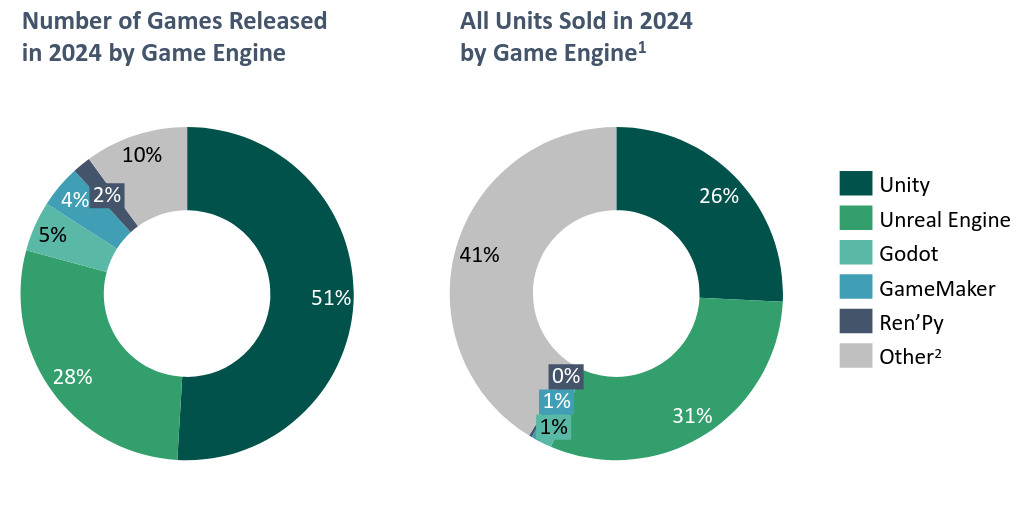
Now, if we zoom in on that data, we can see that for games with fewer than 1,000 copies sold, Godot's share rises to 13%; for small games (1,000–100,000) and mid-range games (100,000–1 million), it holds a 5% range; and for large games (1 million+), it drops to 1%. This gives us a fairly clear picture of how Godot is distributed across the ecosystem.
Godot is published under the MIT license, charges no royalties, and allows you to license your game however you want—it only requires including the engine's license text in your distributions. Operating as an open source tool in the vein of Linux and so many other projects, it becomes a favorite among small studios that don't have time to develop their own technology and for whom paying a Unity-style license could create financial stress that kills the game. On the other hand, as we climb the pyramid to the top, it's the AAA studios that have the resources to build a custom engine tailored to their needs.
Godot is Argentine. As we mentioned, it's a creation of Juan Linietsky and Ariel Manzur. But the exponential growth of recent years led its creators to move to Europe to keep up with the demands of so many clients and projects. Today it is sustained by a nonprofit foundation in the Netherlands with global funding.
Much of Godot's adoption is due to the fact that it's a multipurpose engine. That is, you can create games in 2D, 3D, and virtual reality, with the ability to deploy them to Windows, macOS, Linux, iOS, Android, and the Web. Since its latest version, it has a set of features that make it quite solid for VR.
This has an impact in several ways. For instance, Tesla's mobile app uses Godot to run 3D visuals. This means it's also entering industrial and corporate applications. For Godot, it's a strategic validation: if a company like Tesla trusts the engine enough to integrate it into a global product, it demonstrates that its technical maturity extends beyond the indie world.
In AAA video games (those considered the top tier of the industry in terms of resources, marketing, and expectations), the remaster of Sonic Colors: Ultimate used a modified version of Godot (Acorn Engine) as part of development.
Finally, for Battlefield 6, DICE confirmed that the spatial editor for Portal mode uses a custom build of Godot, while the game itself runs on Frostbite. It's a milestone for Godot as AAA tooling technology. While the video game industry has always been characterized by high levels of secrecy hidden under mountains of NDAs and the potential for monumental lawsuits in case of leaks, there are more than a few rumors circulating about major companies using Godot in the coming years. It will be a matter of waiting to see what happens.
A prophet in its own land
While the overall outlook for Godot is genuinely very positive and everything seems to indicate that the trend will continue on this path, it also faces some challenges. The main obstacle to overcome is that, currently, programming in Godot has a smaller job market than doing so in Unity or Unreal. However, the adoption dynamics generated by the engine's explosive growth (+144% between 2020 and 2024) could overcome this hurdle through sheer momentum.
On top of this, Godot is ideal as a teaching tool. In Argentina, its use is expanding thanks to its free access and low resource requirements, which even allows making video games from mobile phones. For example, Image Campus offers a game development specialization using Godot, and national universities such as Quilmes (UNQ) and Tucumán (UNT) host events and diploma programs.
These are just some examples of Godot's potential to reshape the direction of the video game industry. Shifting from a closed model to an open one could have an impact similar to what Android did for phones or Linux did for global internet infrastructure and personal computers. There are many aligned factors that could drive a massive global impact in one of the largest entertainment industries of all. And in the middle of it all, as always, the pride of knowing that all of this was achieved with Argentine ingenuity.
Las notas de 421 no tienen paywall
Y a cada colaborador se le paga por su trabajo. Las dos cosas dependen de los suscriptores.