Knotfest at Parque de la Ciudad: the deathcore circus and vegan choripan
Knotfest at Parque de la Ciudad: the deathcore circus and vegan choripan
In the era dominated by franchised festivals (Lollapalooza, Primavera Sound, the return of Creamfields), Knotfest stands out as a band's effort to maintain certain margins of autonomy. Slipknot, which can easily be considered one of the three or four most important bands of Y2K nu metal alongside Limp Bizkit, Linkin Park, and Korn, landed with their own festival in Argentina for the second time, but this time outdoors. The previous edition, right as we were coming out of the pandemic, had been at the Movistar Arena with the presence of none other than Judas Priest. Both bands played on separate days.
This time, however, Corey Taylor's band chose none other than the ruins of Parque de la Ciudad for their show, with everything on the same day. It seems hard to find a better location for the masked band than an amusement park destroyed by neglect, the passage of time, and rust. The setup emulated the organization of other major festivals with a main stage, a museum of Slipknot's tours in a very fitting circus tent, and various commercial offerings: parking, a beer garden, food stalls, and official merchandise booths.
While the food offerings were quite wide-ranging (including vegan choripan), the purchasing system imposed for festivals is more than cumbersome. The day before, the organizers announced via their official Instagram account that a prepaid card was needed to buy food. Beer and merchandise could be paid for with a regular QR code. The only somewhat bizarre thing was that beer could only be consumed within a designated perimeter, after purchasing a cup. To be fair, this is the same format repeated at many large festivals -- their series of bureaucratic requirements for an entertainment event -- but it feels even stranger at a festival organized by Slipknot.
The lineup also featured local bands, with the always thankless task of opening the festival. Under the tremendous spring sun of Buenos Aires, the band Nvlo kicked off the concert, playing deathcore with all the necessary ingredients: guttural vocals, blast beats, and the essential breakdowns or drops so characteristic of "core" genres. The band is also in the midst of significant growth with three studio albums, a live album, and the not insignificant appearance at Germany's Wacken festival, the most important of its kind in Europe.
Next up was Arde La Sangre, the band featuring two former Carajo members, Corvata Corvalan and Teri Langer, who displayed their typically sky-high stage presence and played through their discography. It's quite telling that there's nothing specific to highlight above the rest, in a band so polished and with such skilled musicians in this genre: it's almost the routine of perfection.
Then it was the turn of NATO's latest invention, Babymetal, a group of Asian idol performers in metal garb who drew in the younger audience members who participated in the show with full-on choreography. They brought a significant amount of K-pop culture into a rather reluctant crowd, though it's worth noting that metal fans have historically been close cousins of otaku culture. And not only did the audience show up for the heavy version of these manufactured idols, but there were many couples consisting of a metalhead guy with an otaku girl dressed as a maid. A great crossover that helps debunk the myth of the eternal virginity of metal fans and also introduces new elements with plenty of cool factor for the local audience.
By mid-afternoon, as the golden hour approached (that moment of the day when sunlight takes on amber tones and becomes a natural Instagram filter), it was time for the festival's heaviest act: Meshuggah. The Swedes, formed in 1987, unleashed all their musical power through the ultra-technical death metal that defines them. A label that proves somewhat useless given the influence, variety, and range the band of Jens Kidman commands. It's incredible to think that the group shares its country of origin with Abba. Actually, what's incredible is the breadth of Swedish music, also the birthplace of the most prominent pop producers of the 21st century and of Spotify (worth keeping in mind). In any case, the band closed with Bleed and Demiurge, two tracks capable of pummeling you into the hot cement that served as the floor. After that, the festival could have ended right there.
But it was Amon Amarth's turn, another classic of extreme metal, in their case with clear Nordic undertones. They also delivered a flawless performance, but as one gets older, all the neo-Viking paraphernalia increasingly falls lower on the authenticity scale and starts to resemble more of an adolescent gesture. Beyond that, the band delivered.
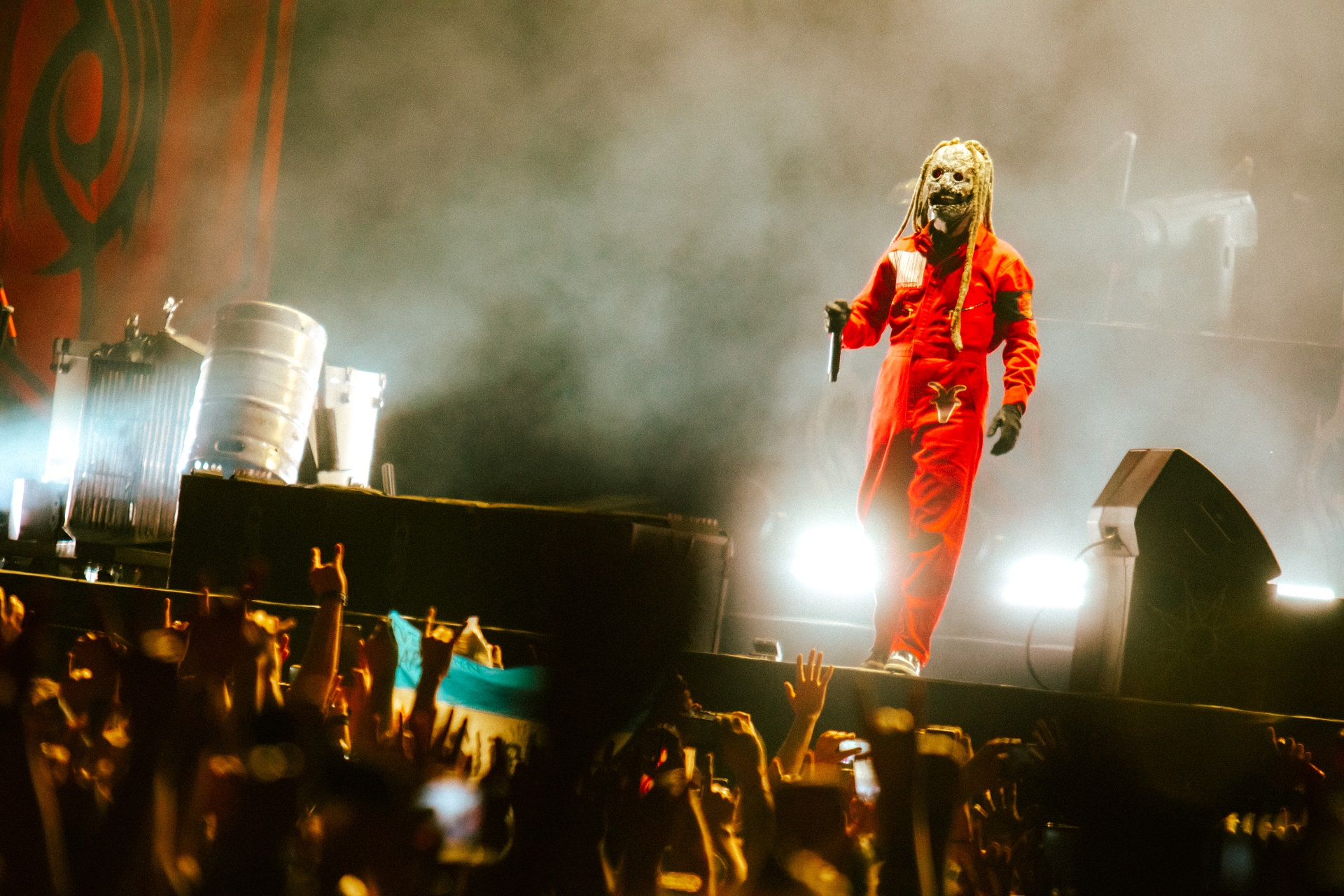
And last but not least, the hosts closed the show. Corey Taylor's band took the stage in their classic red jumpsuits, displaying all their performative and theatrical side, in addition to the musical prowess we've come to expect. The novelty was the debut of the new drummer, Eloy Casagrande, the second since the departure of the legendary and late Joey Jordison. The highlight of the show came when the vocalist announced that since their debut album, Slipknot, was turning 25, tonight would be like hearing the band in 1999.
It was a welcome surprise for fans of the group from Des Moines, Iowa, who got to hear live tracks they may never have been able to before. It was also a surprise for the casual attendees who may have come to the show expecting to hear the superhits Duality and Psychosocial, which were left out of the setlist. Combined with the somewhat out-of-the-way location of Parque de la Ciudad, by the midpoint of Slipknot's set, an early exodus of part of the crowd was noticeable, having endured an already long and exhausting day.
Perhaps that was the reason the band left the stage without saying goodbye to the audience. Or maybe it's just another risky conjecture from this imaginative chronicler. Either way, the group still went hard and steady for 90 minutes during which they did not disappoint, unleashing all their musical and stage power. With the benefit of hindsight (or of today, Wednesday), one wonders what the bottom line was for Slipknot and the local promoters. If it was successful, one can speculate about a next edition and perhaps, little by little, achieving a stable festival on Argentina's musical calendar. Something as necessary for this genre -- almost always so forgotten and marginalized by major organizers -- as Parque de la Ciudad itself.
This article was originally published in Pagina/12. It is reproduced here with the author's permission.