Nacion Urbana: Call El Doctor, Bardero$ Have Arrived
Nacion Urbana: Call El Doctor, Bardero$ Have Arrived
The Buenos Aires asphalt is unforgiving, and the 30-something degrees on the thermometer feel like 40 without shade. As almost never happens, the Nacion Urbana bunker has an excellent stock of drinks to fight the inferno: water, Coke, beer, and lots and lots of ice. The festival will take place this Tuesday the 21st, a public holiday, at Estadio Obras, featuring established and emerging artists from the various genres of the scene. From artists used to the sold-out routine like Bardero$ to others returning to show what they're up to now, like Lucho SSJ, as well as El Doctor and Soui Uno.
Vacation in the Chaos
Homer el Mero Mero is the first to arrive for the press conference alongside C.R.O, with whom he formed Bardero$ to produce, perform, and tour. They show up in full chaos mode and explain that they set up a house to live together and produce nonstop. They already have an album in full recording (Vacaciones en el barrio), while warming up to kick off the year at Obras. They also have sold-out shows in Mexico. Chaos for the whole continent.
"We spend all day recording, like locked in a time machine. We eat and keep recording, we're fully immersed," says C.R.O. "We want to crush it like never before, we have bombs ready to blow up, this year is going to be ours." In the background, the cicadas howl with the same weary tone as an episode of Evangelion.
Break It Kid, Break It
Wearing a regulation Chicago Bulls tank top with Jordan's number 23, Ronpe 99 appears, enthusiastically describing how his year begins: Cosquin Rock, Mar del Plata, and Obras; and if he could fit in more shows he would, he says. Of all the artists arriving, he's the youngest and the one with the fewest tattoos: a clean face, as clear as his goals. "We've been training a lot for this live show, we started last year and realized that three-dimensional sound was the way to go," he says.
"I always did my own thing, because of my own stuff. Everyone started making RKT and I started making rock," says Ronpe, who respects everyone but doesn't hesitate when it comes to following his own path without looking at what others are doing. Coming from the bottom is a plus, he argues: "Everyone's so fragile these days. Just having a plate of food and a roof over your head is more than enough to be grateful for."
The Good Doctor
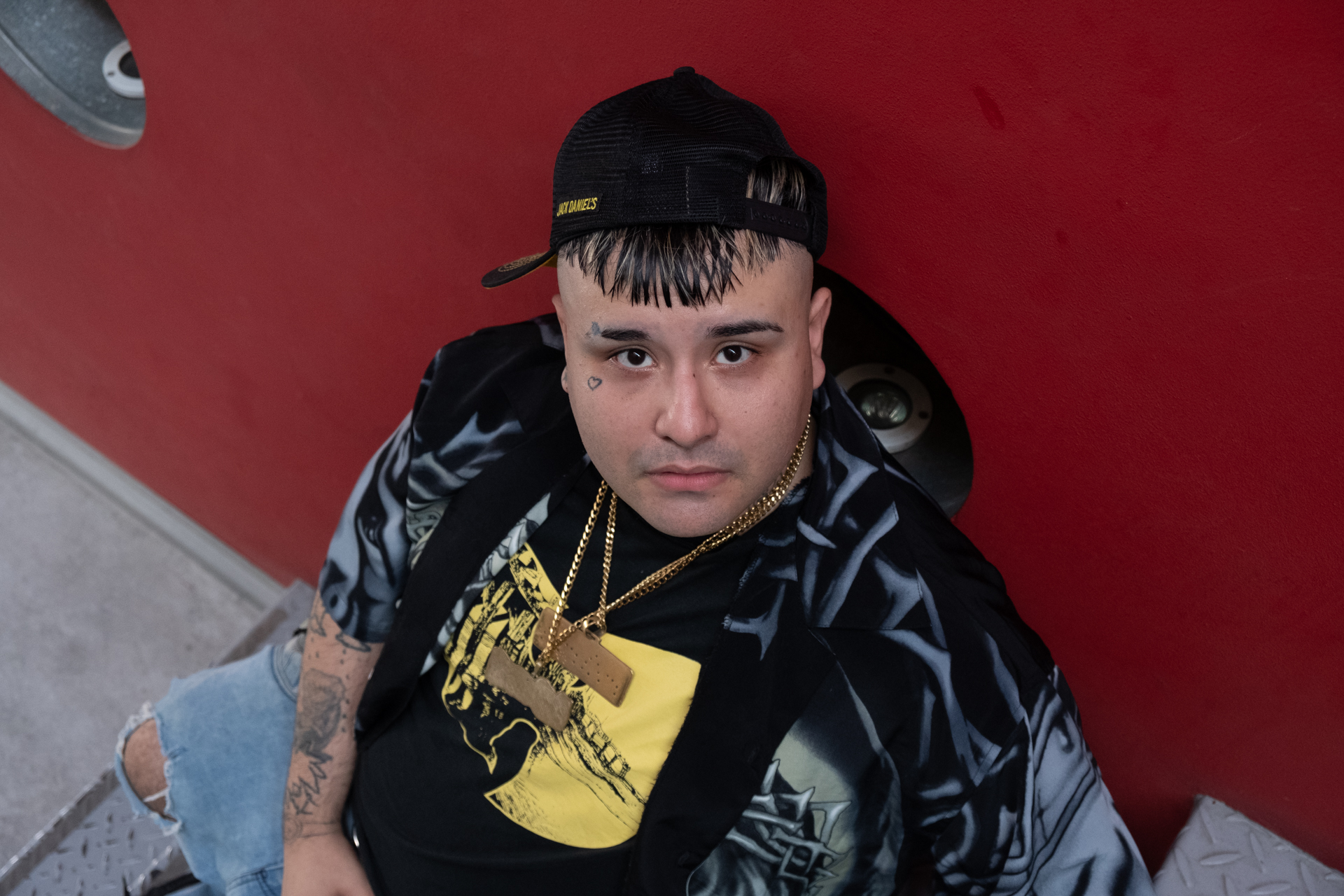
A couple of Coke bottles are already gone, not a single finger sandwich remains, and the beer cans are starting to pile up when El Doctor arrives with his unique style, freshly showered and perfumed. Against all intuition, he's a sweetheart. A veteran of trap, drill, and hip hop who, despite not being among the most well-known artists, is by far, by far, one of the best in the scene.
"The thing is, I was always ahead of the game, but since I was a kid, you know... it happened to me in school, people copied my haircut, my clothes," he says with the confidence of someone who knows he's different. Light-years ahead of the rest, but without losing humility. El Doctor has always performed with a live band, a format that since last year a bunch of musicians in the scene have started to adopt. El Doctor live looks more like a hardcore band than a rapper. "Trap unites heavy metal, cumbia, and punk," he says calmly, as if it were obvious.
El Doctor rose to fame with 30 mil pe$os and its low-budget music video filmed on some random corner of the Buenos Aires suburbs. The hit already foreshadowed everything El Doctor's lyrics would bring: cocaine, paco, theft, guns, and women, the whole basic combo of West Coast American gangsta rap but adapted to Argentina's budget constraints, first and foremost, and those of Buenos Aires province, secondly. A gesture as simple as it is radical.
El Doctor recalls that at the time of recording the track, even a few years before uploading the video to YouTube, "30 grand was a ton of money." Using the video's publication date as a reference (February 16, 2017, exactly 6 years ago), at the exchange rate of the time it came out to something like 1,842 USD, which at today's unofficial rate would be about 700,000 pesos. "The real life of a real man, earning cash by his own means," El Doctor says at the beginning of that track, in a leitmotif that repeats throughout his songs and on his album FAFA. "A testimony of negativity to extract something positive," he says.
This year, El Doctor is getting ready to play his best game, trying to grow more as an artist and in public recognition. Contrary to what one might perceive from the outside, El Doctor is not a wreck. He stays away from drugs, says he doesn't want to use anymore, and that while composing he at most lights up a joint. As a kid he recorded a whole album while high, but now it doesn't even help him produce.
There is something irreducible in El Doctor's prose: a hard core of marginal poetry that makes him impossible to reduce; impossible to turn into just another product of the market. What he himself defines as "raper panqui" can be seen as a line of continuity — or another fold in the fracture — of an emblematic figure of local punk like Ricky Espinosa. There is a current maxim that holds that anything, even rebellion — or even more emphatically, rebellion — can be sold as just another product. It's capital swallowing everything and reconfiguring everything as just another commodity. But it's hard to imagine El Doctor as the next Tini Stoessel.
That line of convergence between heavy metal, trap, and punk also carries a total (and unaffected) contempt for the moral values of Argentine common sense. And perhaps what makes him unique is also a kind of curse. El Doctor knows that his lyrics, his staging, his band, and his aesthetic have no rival. And that, nevertheless, it is built in such a way that it resists becoming a commodity.
The oppressive heat has exhausted even the cicadas, who aren't even singing anymore. And in that brief instant of silence, El Doctor says that what saved him from his hard life wasn't art or music: "What helped me was the love of the audience", he says, just like that. "There are fans who look out for you and toxic fans," he declares, drawing a line between those who want to see him do well and those who push him to recreate the stories or experiences he sings about in his songs.
El Doctor is at his peak, preparing a new album, a double, which he says is better than FAFA. "This one is going to surpass it and it has everything: stuff for the haters, stuff for the groupies, love, jokes, sad stuff. I'm done making mistakes. I've perfected myself in a ton of things as an artist and as a person I'm ready," he says as the cicadas return.
This article was originally published in Pagina/12. It is reproduced here with the author's permission.