"Las cosas donde ya no estaban", an independent case of possible cinema
"Las cosas donde ya no estaban", an independent case of possible cinema
Fabio Vallarelli was born in Sarandí, a town in the southern area of Greater Buenos Aires, within the district of Avellaneda. At age 14, a friend of his brother lent him a bootleg copy of A Clockwork Orange by Stanley Kubrick, and that's when he realized cinema was something more than just movies. "At home things were fine but always on the edge," says Fabio. So, as soon as he finished high school, despite his love for cinema, he went to study law, graduated, built a career, and today works at CELS.
In parallel, and without forgetting his first love, he enrolled at the Instituto de Arte Cinematográfico de Avellaneda (IDAC). It was right in the middle of a conflict between the institute, the municipality, and the then newly founded Universidad de Avellaneda. The students took over IDAC and kept it under student control for four months. Given his personality, Fabio became his class delegate and attended every assembly.
At the end of the conflict, IDAC not only maintained its autonomy but also secured a better building on Calle 12 de Octubre. Fabio graduated, shot his first feature film (Tierra2), a short film (¿Por qué te vas?), and became a teacher at IDAC. Along that path, he forged a working group. Until last month he premiered the film Las cosas donde ya no estaban, which continues screening at the Gaumont and other Espacios INCAA.
The parable of the possible film
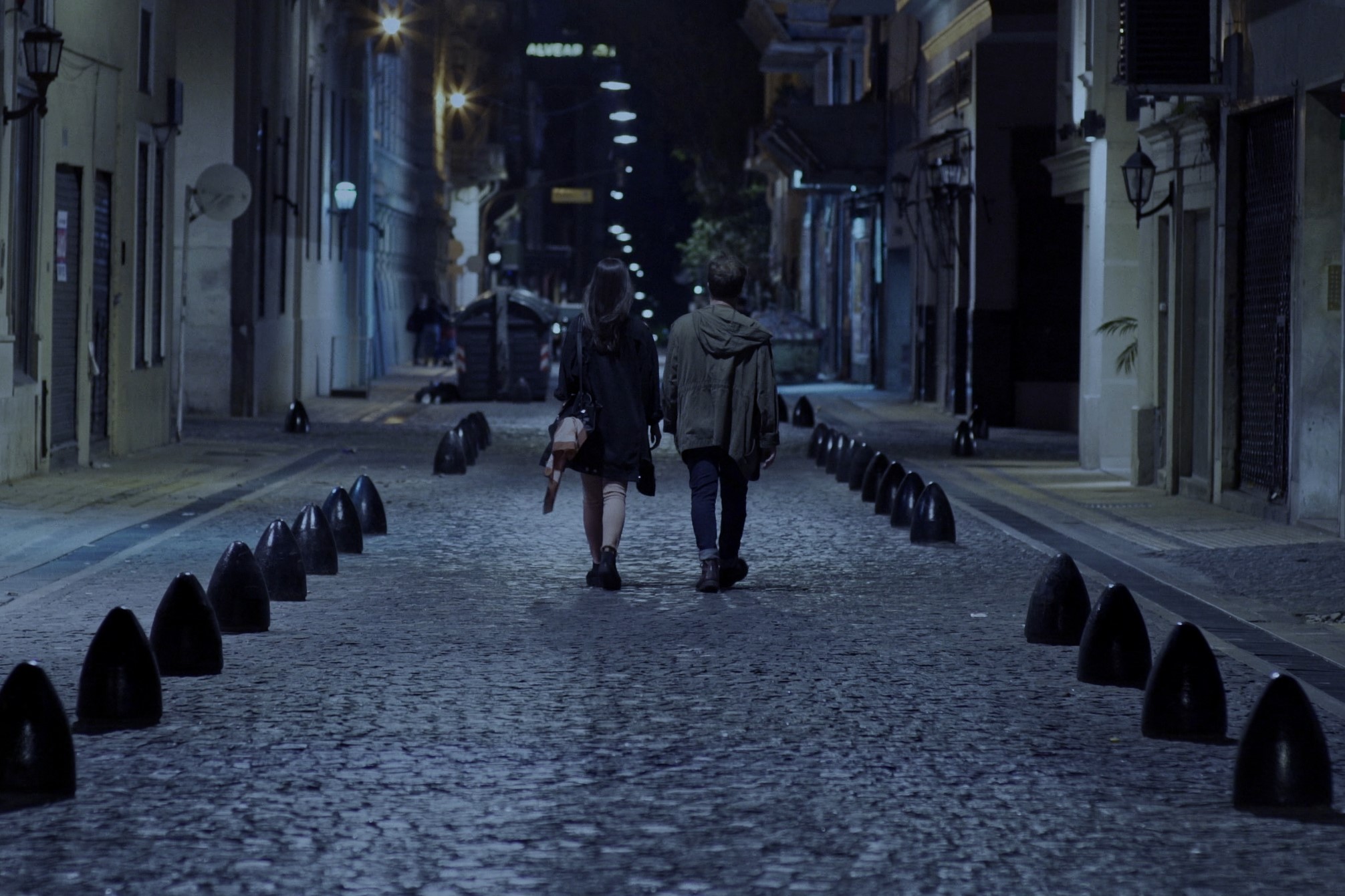
Las cosas donde ya no estaban is a film about a couple who reunite after one of them emigrated abroad as a result of the 2001 crisis. And they get to know each other again, at least for one night, in the city of Buenos Aires, almost twenty years later, with Argentina once again in a state of permanent crisis. It's a film with many nods to the generation that lived through their adolescence in the 2000s, shot in a Buenos Aires that is recognizable, everyday, and yet cinematic.
It is an independent film in the most precise sense of the term: it was filmed, produced, and post-produced without any subsidies. It cost around 7,000 dollars, of which a third was raised through crowdfunding platforms.
Its premiere was rejected by Bafici and the Mar del Plata festival. It's clear: Vallarelli doesn't belong to the cinephile aristocracy. Despite everything, the film won a festival in Peru whose prize helped finish the sound post-production. Against what the tradition of Argentine independent cinema would suggest, Las cosas donde ya no estaban has excellent sound.
On June 16th it premiered at the Gaumont. There, in just one week it climbed to third place among the most-watched films in Espacios INCAA. A kickoff that continued with screenings at various Espacios INCAA across the country. An entire strategy designed and executed by the director himself, who despite supporting the existence and role of the Instituto Nacional de Cine y Artes Audiovisuales knows the system still needs a bit more refinement.
Vallarelli argues that "since the INCAA subsidy is more focused on making, collecting, and making a living, exhibition is not part of the everyday concern." Exhibition — meaning having audiences actually watch the films the institute funds — becomes more of a technical problem for producers to collect the full subsidy than an incentive for the industry. "The system needs to be more virtuous and take charge of exhibition," Vallarelli argues, while also emphasizing the need to strengthen and democratize INCAA, as well as to have a national cinematheque that educates audiences on the rich tradition of Argentine cinema.
Las cosas donde ya no estaban also works as a beacon for IDAC students and as a way to challenge the idea that "other places give you more prestige". For Vallarelli, a faithful representative of the Buenos Aires school of filmmaking, another cinema is possible. With the premiere of this film, the humble yet no less hardworking IDAC dares to claim a space among local film schools such as ENERC or the FUC itself. Vallarelli wants to convince his students that to make their own film and see it screened in a cinema, "they don't have to go somewhere else, they don't have to be millionaires, they don't have to come from a wealthy family." Although "they do have to work a ton."
And since no one is a prophet in their own land, Las cosas donde ya no estaban won its second festival, but this time in Italy, and the prize was 8,000 Dogecoins: the famous meme cryptocurrency whose life began as a joke and which has reached a value of 60 cents per dollar. An unusual prize for an unusual film and an unusual director. If Lady Luck keeps smiling on him, perhaps the next crypto bull market will fund his next film.
This article was originally published in Página/12. It is reproduced here with the author's permission.