A chronicle of digital art that spans everything from the speculation surrounding the Bored Ape NFTs to the cultural revolution of HEN, where tokenized art finally found its place. Or, at least, before it was ruined by venture capital.
Brief pedagogical disclaimer: An NFT (Non-Fungible Token), in the context of digital art, is essentially a digital certificate of authenticity. It’s not the multimedia (the JPG, GIF, etc.) itself, but an immutable entry on the blockchain that states: "this piece is the original, created by X." It’s what allows a digital file (which anyone can copy with a click) to have verifiable authorship and, thanks to that, value in the art market.
It's 2022, and I'm sitting in an office in Belgrano decorated with merch from Bored Apes and other popular NFT projects of the moment. My conversation partner knows that I'm "into NFTs" and speaks to me with complete confidence, almost conspiratorially. He explains without filter how they artificially inflate the prices of certain projects by paying influencers on X and how they coordinate purchases to create the illusion of demand for the projects launched by their clients, all of whom are Bored Apes owners. I listen in silence. I mentally take note: what he’s describing is a market manipulation scheme, more precisely a pump and dump perpetrated by a marketing agency exclusively for holders of Bored Apes. I’m getting firsthand information that confirms my suspicions. I sip a complimentary coffee, smile, we chat for a while, and then I leave. I know I’m going to use this anecdote; it has pedagogical value for the workshop I’m putting together.
We’re still in 2022. While some are scheming on how to extract as much money as possible by leveraging the general public's ignorance about NFTs, I’m busy thinking about other aspects related to this technology. I’m not interested in it as a tool for speculation or scams. I see (like so many others) something more innovative developing, albeit niche: a digital art ecosystem is emerging that moves real money, without intermediaries, without needing to have inherited a family fortune to belong to it, or knowing the right curator to get “validated.” It all boils down to a simple artist, their digital work, and someone on the other side of the world willing to collect it. For the first time, digital art has something it always lacked: a market. And largely decentralized and validated by the artists themselves, meaning it is self-determined and sovereign.
It all comes down to a simple artist, their digital work, and someone on the other side of the world willing to collect it. For the first time, digital art has something it always lacked: a market.
The thing is, from the public's perspective, digital art has always had a problem of existence and circulation. Not of quality or legitimacy, but of material existence. Where does a piece with untraceable authorship live, one that you can’t hang on a wall or that anyone can copy with a right-click? Where is the community that validates it as art and generates a consensus on its value?
The blockchain, through NFTs, provided the answers.
"That’s just talk. I was told NFTs are silly images selling for astronomical prices. That monkey isn’t art!" they might say, and not without some reason. The art in those popular projects back in 2021 and 2022 known as PFPs, for "profile picture," was mostly used (with legitimate exceptions, especially projects founded by non-opportunistic artists) as a narrative excuse, taking advantage of the benign mantle of art to hide their true dishonest commercial dynamics: generating FOMO so you buy and become the exit liquidity for those who bought in first at cheaper prices, often thanks to insider information. Sound familiar? It’s the same logic as the $LIBRA case.
The truth is that scams are not exclusive to the blockchain: cheating is an ancient practice that thrives on knowledge asymmetry. And, since outrage sells better than education about new technologies, the “million-dollar monkey” is all the mainstream has known to report, avoiding the challenge of seriously discussing blockchain until now.
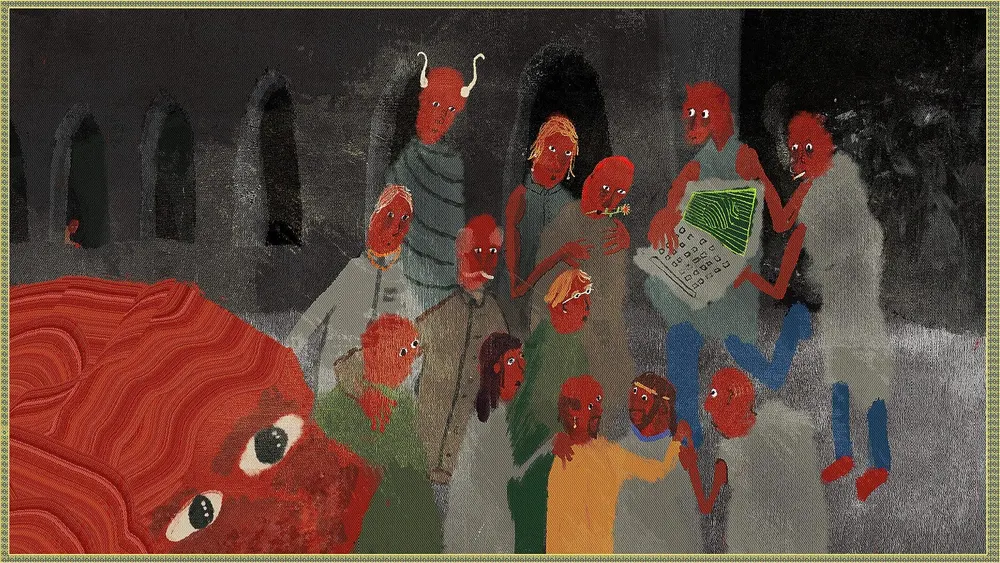
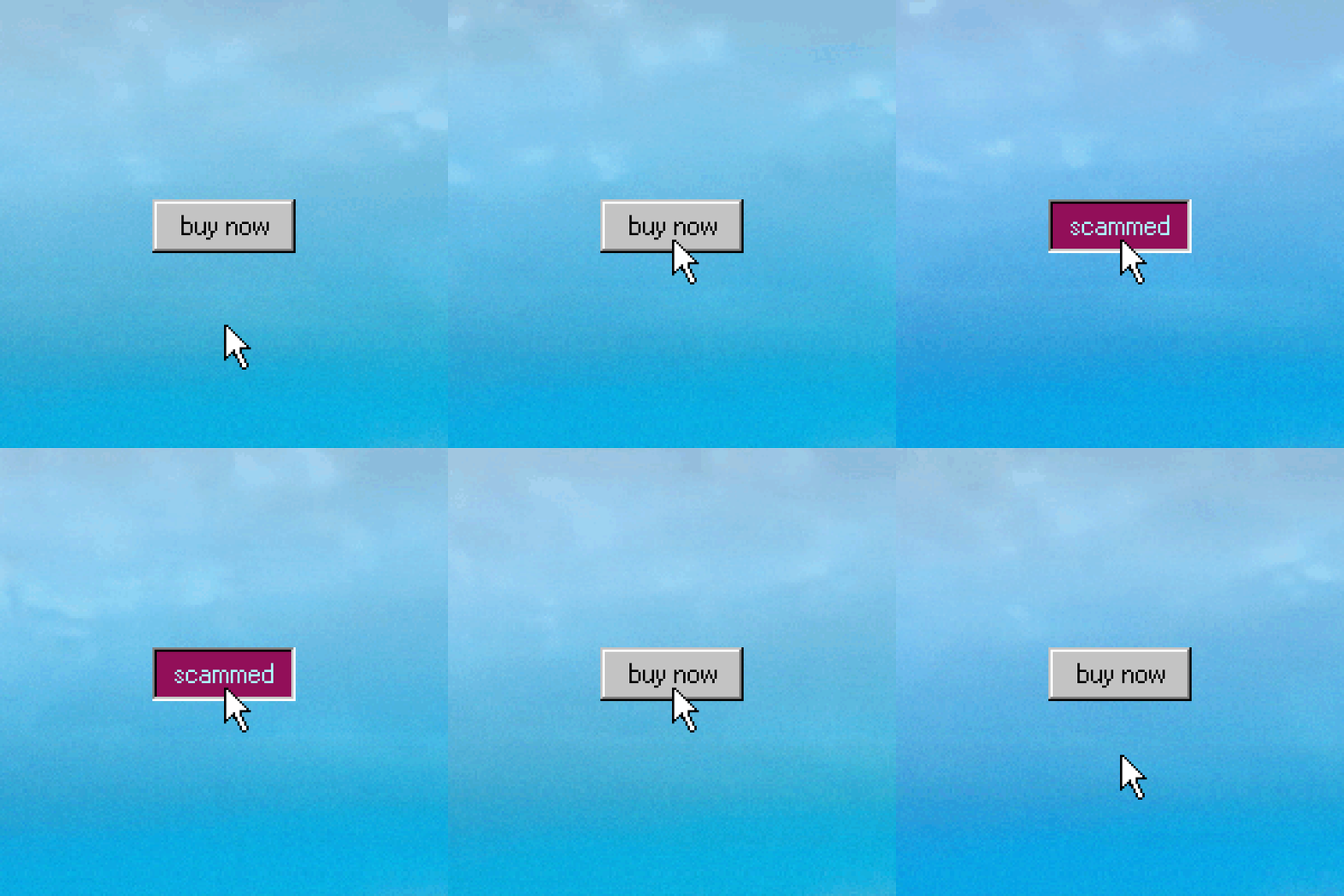
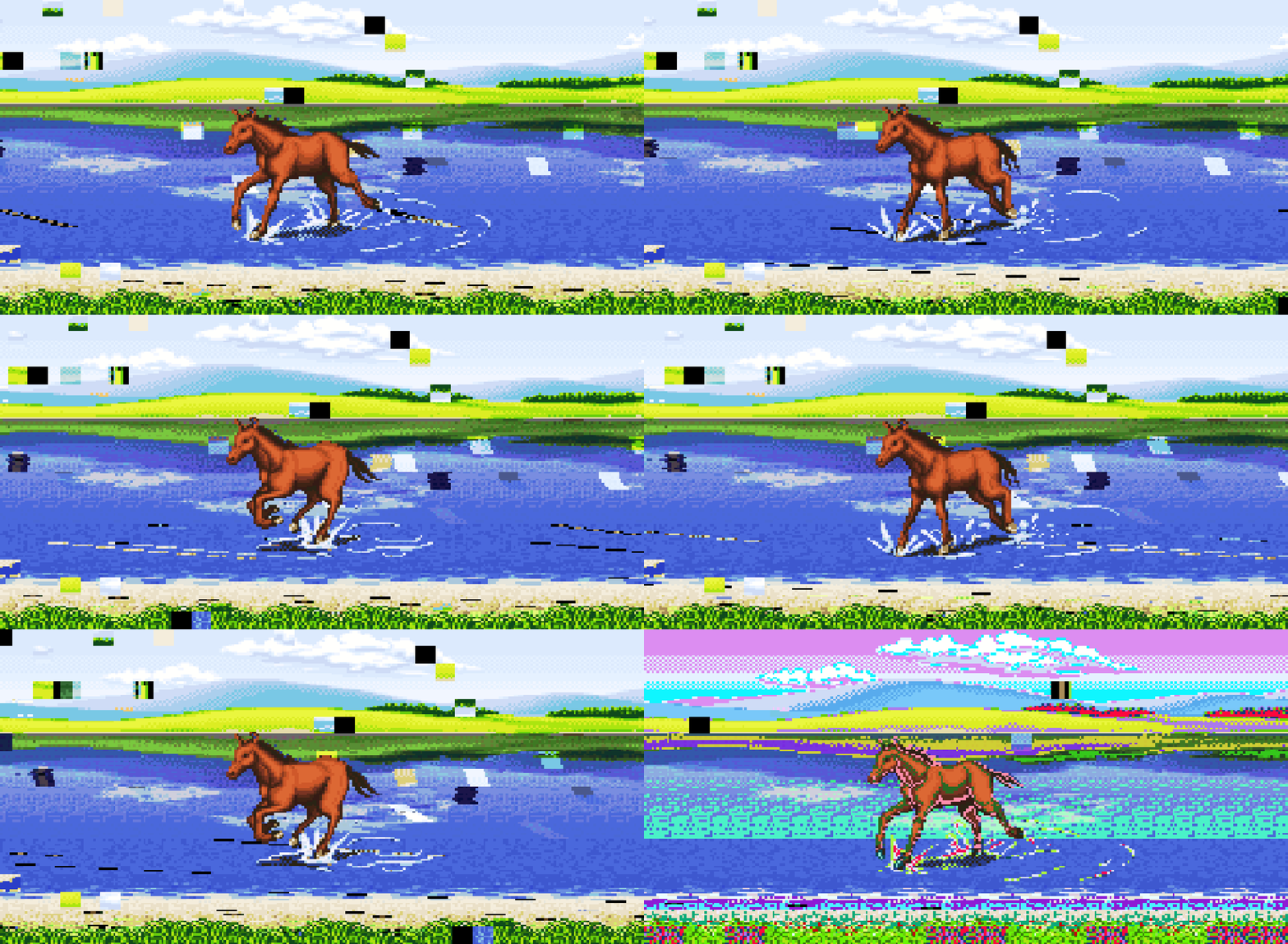
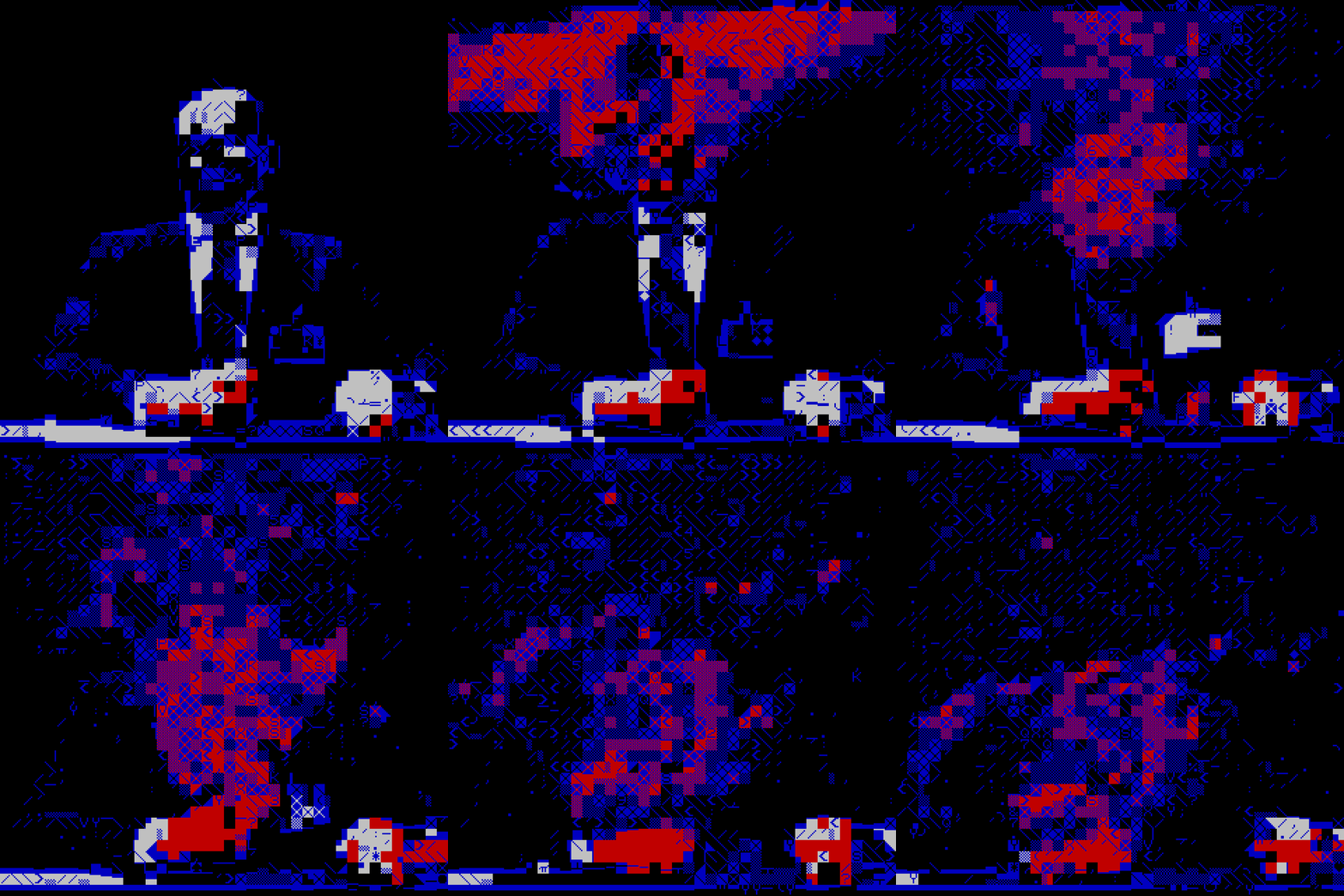
“Scammed” by @renatoxmarini
The reality is that all that media noise ended up obscuring the revolutionary nature of the tokenized art world.
But first, let’s answer a question that seems obvious but isn’t so straightforward. Why would someone collect a tokenized digital work? One possible answer is "for speculation." But that answer doesn’t cover all bases: we’ll see that in the less publicized spaces of the blockchain, there exists a market for authentic digital art supported by real artists and art collectors.
An NFT is not just a mere file. It’s a sign. And like any sign (taking the concept of semiocapitalism as a backdrop, as understood by philosopher Franco Bifo Berardi), its value doesn’t reside solely in its technical properties, but in the consensus of the community that interprets it (if you want to learn more about this topic, I recommend the book and thesis by Gabriel Londonio, available here).
When you collect a tokenized digital work, you’re participating in an act of cultural validation. You’re telling an artist, "this has value," and that “saying,” multiplied by a community, becomes a conversation, which is what builds a real market. A consensus on the value of something. Essentially, it’s the same thing the art world has always done: agreeing, based on transactions that build discourse, on the material and symbolic value of a piece. But while in the “offline” art world, only a handful of curators and collectors generate the consensus (which sets the conditions for a market that can be easily manipulated when establishing the value of a work of art), in blockchain, on the other hand, it’s hundreds of people who participate and generate the consensus, making it a broader and more collective agreement.
This was the conceptual core of what we worked on for four years in the free workshop we held from the collective of Latin American digital artists I founded, Newtro, along with my colleagues Lucasoxx and the aforementioned Gabriel Londonio, under the premise that information should be a public good and free from corporate biases. Hundreds of Spanish-speaking artists attended these workshops. The question wasn’t "how do I get rich selling NFTs" (there were plenty of snake oil salesmen who took care of that), but something deeper: what are you tokenizing and for which linguistic community are you doing it?
When that question is lost, art becomes content. And that’s exactly what happened.
But let’s not get ahead of ourselves.
Hic Et Nunc: sovereign and self-determined artists
In 2021, you couldn’t mention tokenized art in Latin America without also mentioning HEN.
Hic Et Nunc (here and now in Latin), or HEN, as it was popularly known by its initials, was a marketplace (an e-commerce platform for digital art) on the Tezos blockchain. HEN was created on March 1, 2021, by Brazilian Rafael Lima (a noteworthy detail, this isn’t Silicon Valley, buddy). It was conceived not as a product but as a community good, and thus, its smart contract (its “programming,” to make it simple) was public, for everyone. The choice of the Tezos network was also significant; moreover, it had enormous consequences: while on Opensea, the most popular marketplace at the time, which only worked with the Ethereum blockchain, creating an NFT could cost tens or hundreds of dollars in fees (transaction costs on the network), on the Tezos network, those costs represented mere cents. That difference in access changed everything.
The underground of digital art quickly gathered on Tezos. Artists (especially from emerging countries who wanted to experiment with technology but didn't have hundreds of dollars to do so on Opensea) found their place in HEN, drawn by the good news: there was an international market they could access instantly, without lobbying, online.
HEN exploded.
To my personal delight, the Brazilian and Argentine scenes were enormous, and even some less familiar ones, like the Turkish scene. The platform's popularity manifested primarily in underdeveloped countries facing economic issues, where every dollar counted to make ends meet.
As an experience, HEN's interface was based on a minimalist philosophy, presenting works one by one in order of publication, without price graphs or statistics for speculation. While other marketplaces cluttered your screen with numbers for trading, HEN was designed for viewing art. A revitalizing checkpoint amidst the visual and auditory clutter of this shitty internet we inhabit.
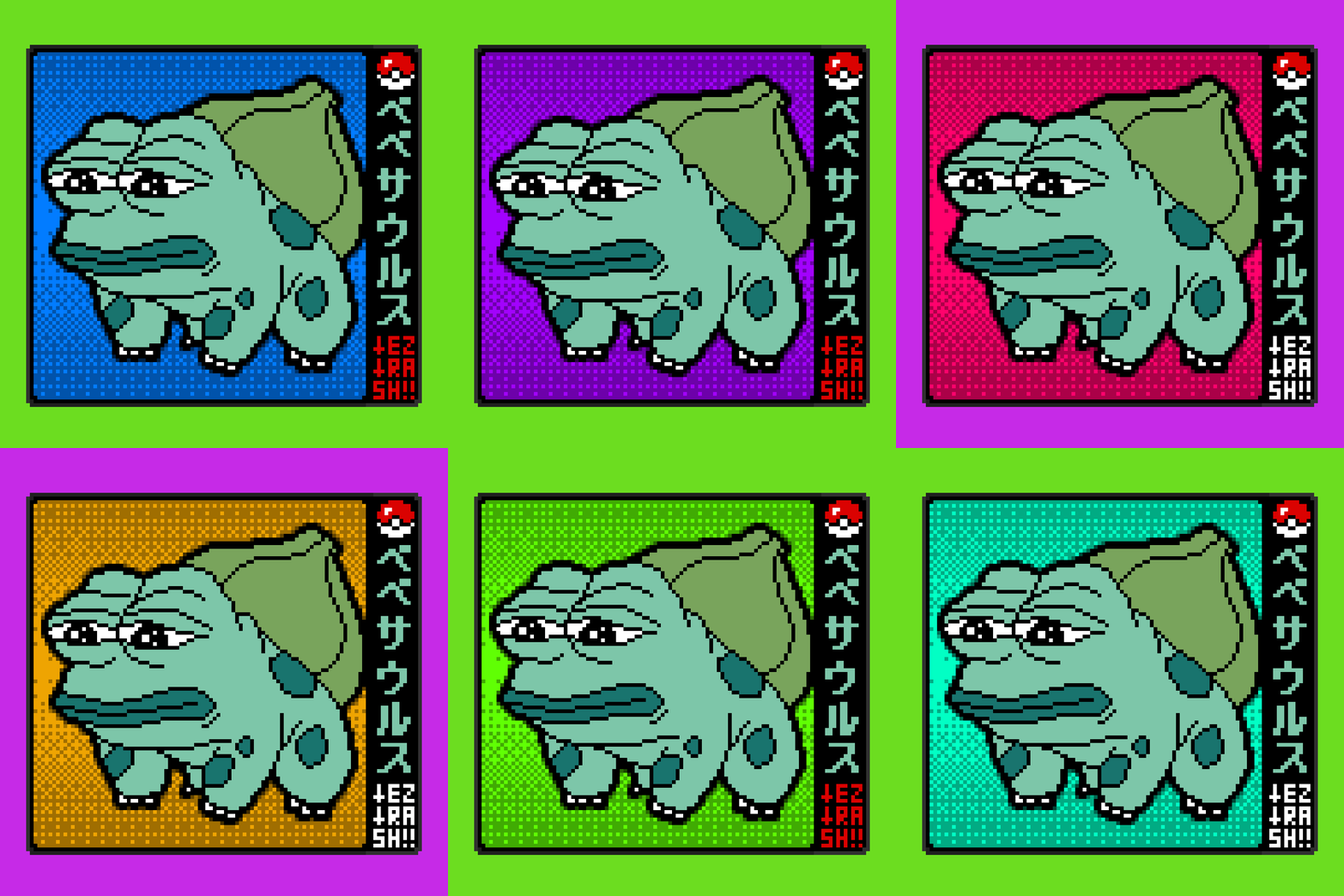
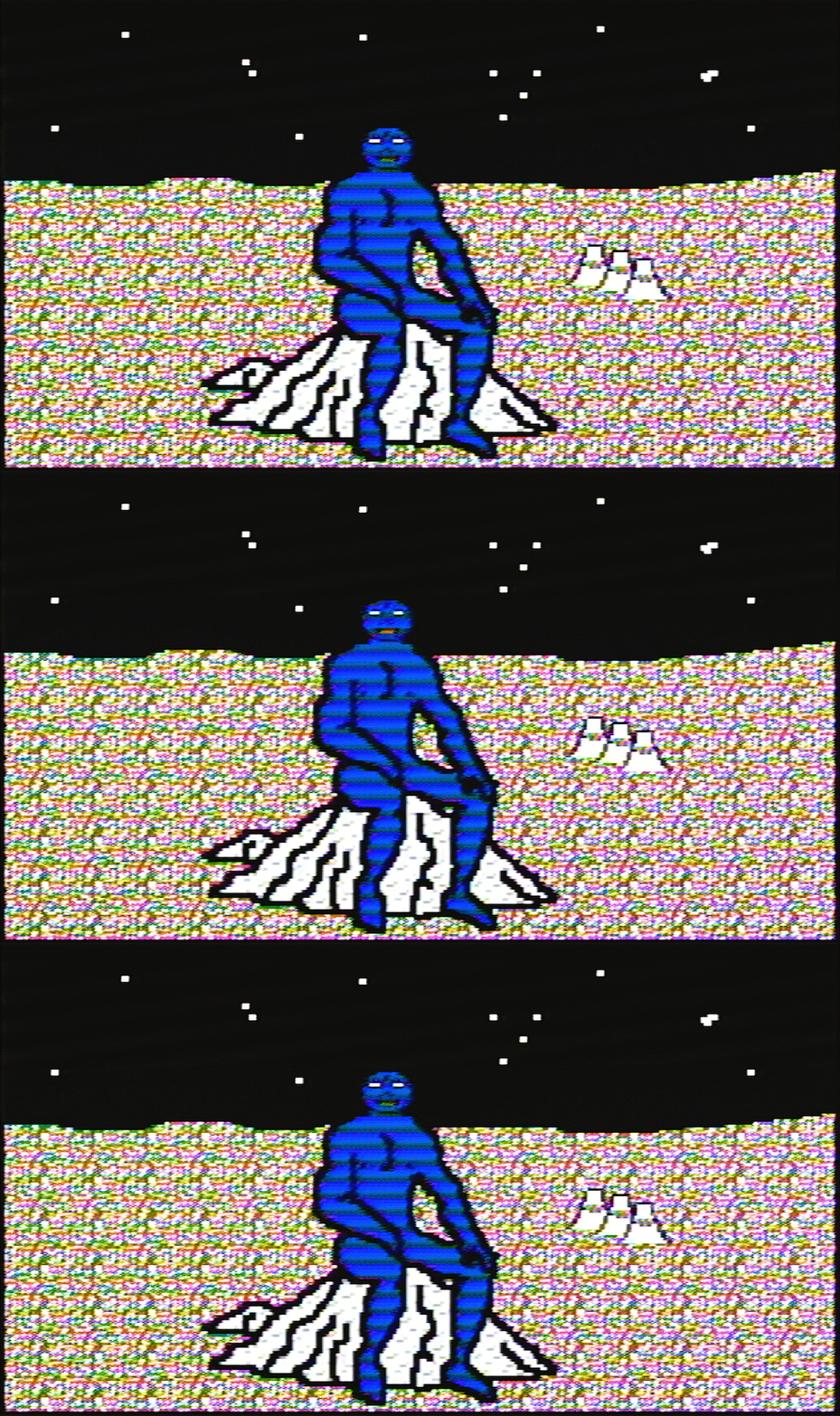
“Pepesaur” by @BerSektor
The tokenized art scene was growing rapidly, artists were minting (uploading) art daily, making money creating works for themselves (which led to significant evolutions in their bodies of work), not for commissions or the contemporary art establishment, which was busy taping bananas to walls. They experimented, shared their techniques, and many became collectors themselves thanks to their new income, alongside the digital art collectors who multiplied day by day. People bought computers, drawing tablets, synthesizers to make music, beds, refrigerators, and sometimes even cars. The exposure one could have to innovative artistic proposals was enormous.
But everything was too good to last. On November 11, 2021, after a symbolic 9 months of gestation, what felt like an absolute tragedy occurred. In the communities and Discords, a question began to circulate, accompanied by growing desperation: “IS HEN DOWN?”
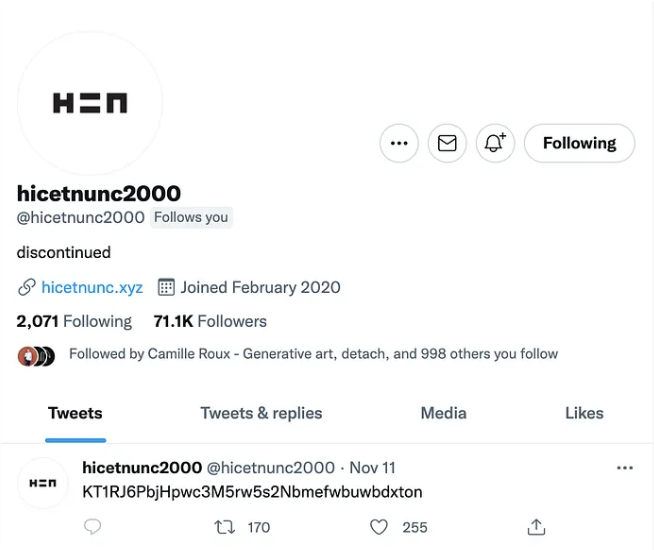
The HEN website was down. Worse still, Rafael posted: “Hic et Nunc has been discontinued.”
There is no official version of the reasons. The most shared theory is that Rafael Lima, overwhelmed by the mountain of complaints and demands he received from artists and collectors alike regarding the platform's management, finally got fed up and decided to discontinue it.
Sadness has no end.
But the last tweet posted on HEN's profile emitted a ray of hope: as Rafael shut down HEN, he shared the contract, a nod to the community. Let's remember that HEN was created as public infrastructure, so what Rafael had discontinued was its interface, not its contract. The data remained intact on decentralized servers. The frontend? Replaceable. And so, what initially seemed like the worst outcome turned out to be the most complete sign and manifest expression of the power of technology as a public good: just one day after HEN's fall, on November 12, 2021, TEIA was born to succeed it, thanks to the same users of HEN now self-organized.
While the first step taken on blockchain for many non-first-world artists was on the Tezos blockchain, the reality is that they were not limited, in most cases, to a single marketplace or blockchain. In fact, the smartest move was to seek out new ecosystems of collectors, artists, and experiences.
The period from 2022 to the end of 2025 was extremely important, as we saw a certain market model mature (currently in crisis, more on this later) defined by the aforementioned marketplaces. During these years, we witnessed the transition from a small scene to an authentic subculture, with its geeks, mops, and sociopaths, as understood in this article by philosopher (not academic) David Chapman.
Now, these marketplaces differ from one another in their nature, especially regarding funding. This created a contrast between two distinct models: one embodied in the Tezos blockchain (which was starting to be known as the “Art Chain”), more associated with the logic of “public good” and where the artist scene gathered more organically; the other embodied in the Ethereum model, a scene more governed by speculators, commercial projects, and associated with corporations, especially markets created with venture capital.
Am I saying that Ethereum is “the corpo”? Not at all. It's important to understand that one thing is the blockchain (an infrastructure), and another is the nature of what is built on that infrastructure. So am I saying that “the corpo” is something bad? Not either. “The corpo” (in this context, venture capital, VC) can do something that a community of artists can hardly do alone: scale infrastructure quickly and attract mass users. The problem is not that VCs exist. The problem is that a VC needs exponential returns in about 5-7 years, and art is a complicated species; it can take decades to build its value. Moreover, the return usually comes from the company's IPO.
Do you know of any gallery or even auction house that operates on the stock market today?
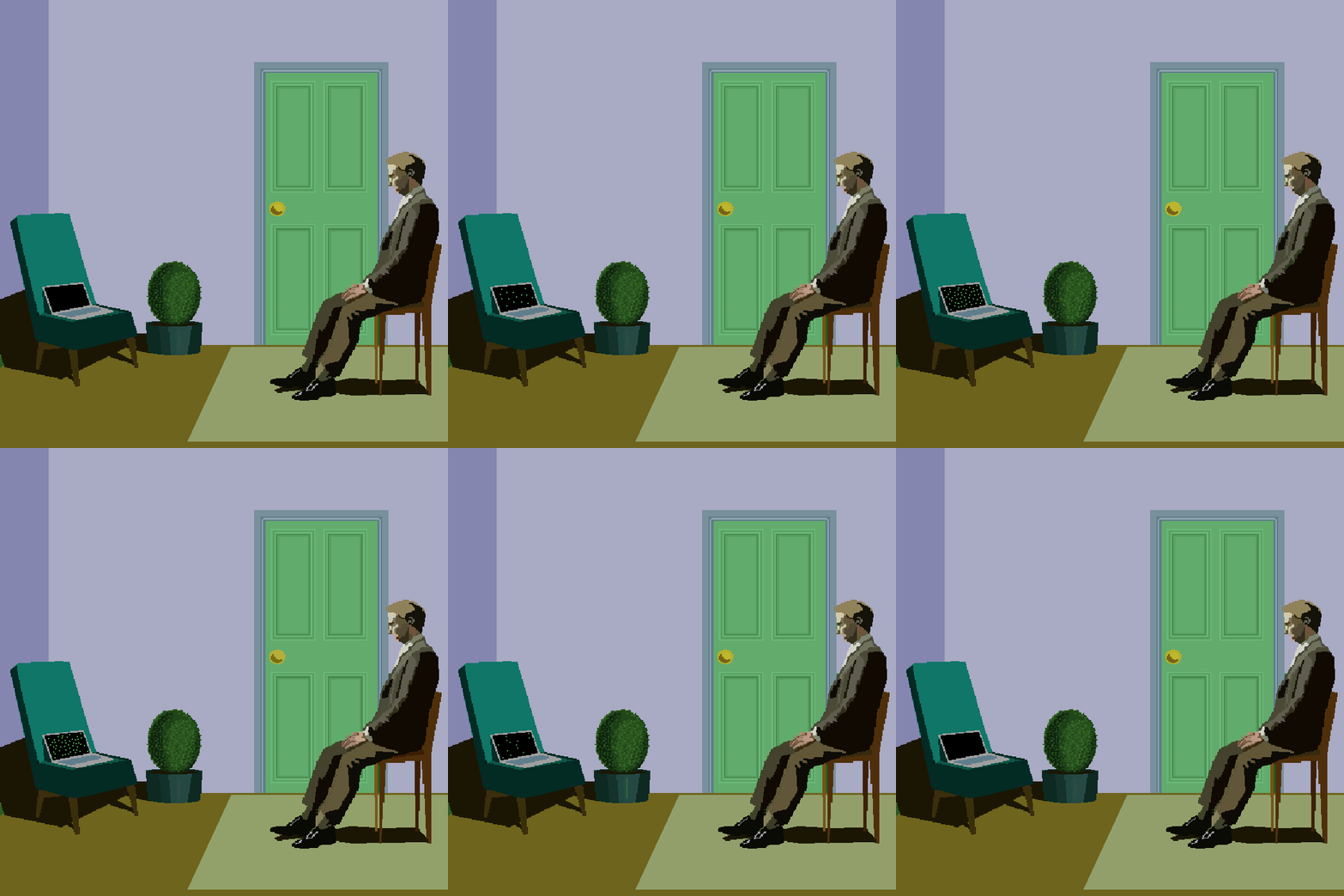
“The purple room” by @RJ16848519
It is these kinds of incompatibilities (there are many others) that turned Ethereum marketplaces funded by venture capital into a poor partner for tokenized digital art.
The truth is that the whole Tezos and Rafael Lima situation was a glitch in the Matrix. The fact that Tezos has always been a "minor" blockchain, further away from the spotlight of speculation and big money, combined with its low fees (which made prices more accessible compared to what was happening on Ethereum during the 2021-2022 bubble), and in addition to the public good gene inherited from HEN (which would completely color the art ecosystem in Tezos even to this day), all of this created the conditions for an autonomous zone,a space-time largely forgotten by the market that allowed for the organic development of the scene. In other words, for the blockchain market (with a capital M), the art niche in Tezos didn’t generate enough cash to attract large numbers of mops and consequently the sociopaths (in the terms of Chapman’s article).
In Tezos, everything was 100% organic, and the money an artist could make there while fully dedicating themselves to their digital creative work was enough, back then, to survive in a country like Argentina. The numbers might not have added up for an American, but not everything is first world.
What did Tezos lose in the absence of the large volumes of money seen in Ethereum? Let’s take the four most relevant Ethereum marketplaces during that period as a reference: Opensea, Foundation, SuperRare, and Zora. What they have in common, as we’ve mentioned, is that they have all been funded by VCs (a16z, Paradigm, Coatue, Y Combinator, Kindred Ventures, Velvet Sea Ventures, among others), venture capital located geographically in Silicon Valley or belonging to its ecosystem. This fact is key to understanding the behavior of these platforms, which have adopted, at one point or another, anti-artist measures in pursuit of increasing their profits and valuations, even falsifying, if necessary, transaction volumes to inflate numbers.
In Tezos, everything was 100% organic, and the money an artist could make there while fully dedicating themselves to their digital creative work was enough, back then, to survive in a country like Argentina.
Among other things, they reduced the royalties that artists received from sales in the secondary market; raised their commission fee above the average; designed "bubble contracts" where, if the market closed its doors, access to the work was lost, directly undermining the artist's sovereignty; favored insider trading (with legal cases) and wash trading while modifying their interfaces so that works appeared as mere financialized assets or, worse, as disposable "content" for social media; focused on traders and flippers, diluting the conceptualization of art until it became a currency for rugpull scams and market manipulations.
The degradation is not foreign to the financing model.
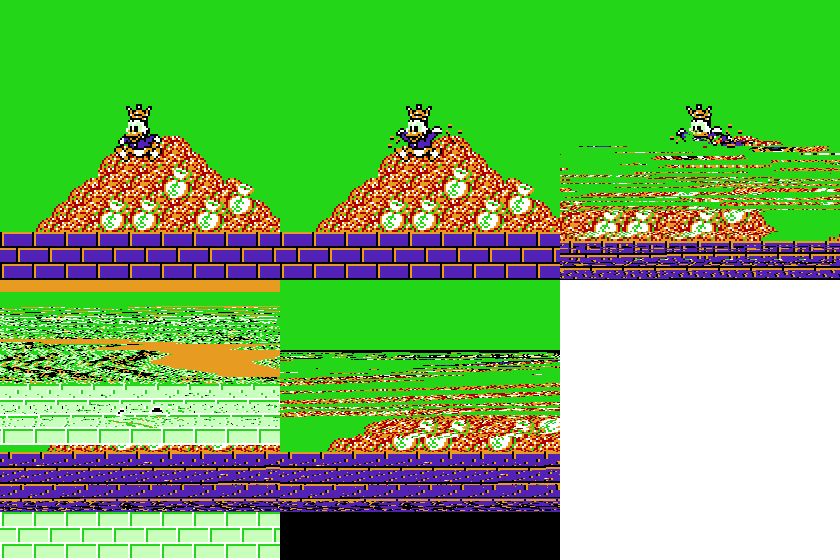
"ABUNDANCE MINDSET" by @WildMissingNos
The magic words “crypto” and “NFT” were sounding less convincing to potential investors. The narrative of tokenized digital art did not meet the excessive expectations set during the 2021 bubble, companies were not being valued, and a new story had to be invented. And the low-hanging fruit that could more easily seduce investors was to transform into social networks like Instagram with artists and everything included, but mixing in a bit of blockchain slang... full retarded circle achieved. Barthes would have had a field day with what was to come next.
When art becomes content and artists become “creators”: or how to empty a sign of its meaning
We now delve into what I consider to be the most disastrous phase for our already battered and unjustly bastardized digital art market. The moment of profanation.
By mid-2023, a not-so-well-known marketplace called Zora was evolving. The important thing about this new version of the market is that it introduced certain redistribution mechanisms on the sales of each work, which made it highly popular.
Throughout the second half of 2023 and part of 2024, Zora seemed to functionvery well. Newtro itself had become a major promotional agent for the platform. The Newtro digital artist collective generated deferred income for exhibitions and residencies, artists sold works in dozens and sometimes hundreds of editions, the redistribution worked, the model made sense. But upon closer examination of the transactions, something unsettling was noticed: a large part of the volume being handled on Zora was fictitious. The platform was rife with bots deployed to collect en masse. Deployed by whom? I don’t know. By Zora to inflate their numbers? I can’t confirm that either. But I can confirm the words of its founder:
To be honest, botting your own platform, especially if you’re experimenting with your model and want to attract new users thanks to the volume you handle, doesn’t seem like a terrible crime; somewhere you have to allocate the marketing budget. But the botting contradicted the promise that a viable economic model had been found, which is no small matter for the end of 2024, when it was already evident that several markets were struggling to balance their accounts. There was movement, but not enough, and the money from eager VCs was running out.
What was really damaging to digital art was what happened next, due to this lack of results within the timelines set by the VCs. Overnight, Zora, which had once been a digital art platform, literally turned into Instagram, seeking to appeal to mass audiences and betraying the interests of its entire user base. Generative art, pixel art, glitch art, HTML art, illustrations, and digital paintings among other techniques now coexisted and were placed on the same level as a photo of a mocha latte frappuccino, the dachshund of some New York girl, or clickbait AI-generated waifu hentai.
The platform became inundated with noise, the signal became untraceable.
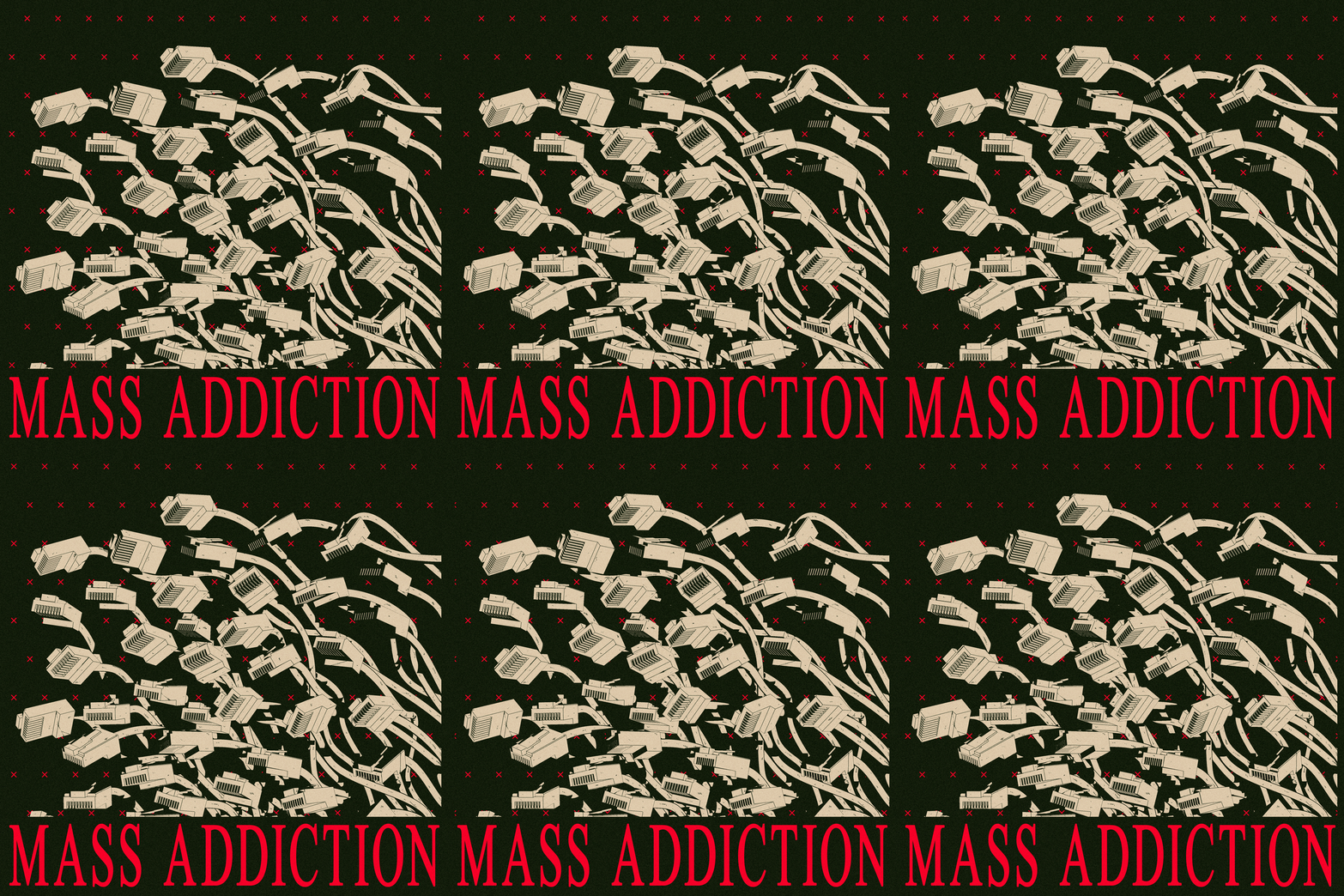
“Mass Addiction” by @6taccc
Since then, it’s been all downhill. Most artists left or continued to participate reluctantly on the platform (since there were still bots distributing pennies), now uploading “content.” Because they were no longer artists, but “creators,” part of the new narrative. Art or content, user or artist, it didn’t matter. Other projects like Base and Rodeo (formerly Foundation) would imitate this in 2025, without hitting the mark with the “creators” narrative as a gateway to mass audiences either.
Amidst all the chaos and semiotic war between artists and corporations, the truth is that for two years these startups made in Silicon Valley, in pursuit of a user base of millions and the mass appeal that never came, managed to drain the meaning from the sign of digital art, putting the artist and a TikTok reel in the same bag, diluting them, and making us drink the resulting smoothie of crap while they tried, with little success, to convince a horrified audience that this was the new cool.
“sCaN” by @haydiroket
Meanwhile...
Flashforward to 2026.
Most marketplaces closed, to the surprise of few. Those who only saw business were opportunistic (and spiritually impoverished) and emptied the sign. Those who only cared about art were romantic and naive for not being interested in the viability and expansion of the market and the less-than-rosy aspects of the real world.
Today, the marketplace model seems quite exhausted, but embers still burn. Among the relevant ones, Teia remains standing, an authentic sanctuary technology (which, as public infrastructure, is unlikely to disappear); Objkt, a Swiss private capital marketplace (apparently not VC) on the Tezos network; and SuperRare on Ethereum, funded by VCs.
The last two will hold a joint exhibition in New York this April. It's a groundbreaking move that aims to connect the Tezos and Ethereum ecosystems, which have struggled to communicate until now. I'm all for it.
“I Am Tired Of Earth” por @____elbi
Digital art is currently lying low, biding its time. It’s quietly retreating to build its new version. The pulse may be weaker, but it’s still beating. Its arrival is inevitable. The generations that have developed in and with the digital world are increasingly occupying spaces in culture and the zeitgeist. Screens are multiplying. Pixels are becoming cheaper. Will access to digital fine art be as democratic as access to its medium? That’s a story for another time.
For now, the question of where digital art belongs is exploring new answers. But the mystery is no longer whether it can happen, but who, how, and where will perfect it.
✦ Suscribite
Las notas de 421 no tienen paywall
Y a cada colaborador se le paga por su trabajo. Las dos cosas dependen de los suscriptores.