Today, AI detects connections that are invisible to the human brain, revolutionizing the scientific method. As we delegate pattern recognition to software, the “why” matters less than the result. Will this spell the end of theory, or will a new form of hybrid truth emerge?
What is information? A difference. Something that is not the same as another thing that comes before, or after, above or below, or even superimposed in time and space. The letter “a” is an informative unit that stands out from other letters, but also from numbers, meaningless graphs, or blank space. But for there to be a difference, there has to be someone, or something, capable of perceiving it. It could be an animal, but it could also be a fungus, a plant, a thermometer, a calculator, or a microprocessor.
Claude Shannon was one of the pioneers in theorizing about information, and he is famous, among other things, for explaining it in mathematical terms. Anthropic's AI, Claude, is named after him. The differential units that make up information are subject to quantifiable laws. The more unexpected the difference is for the device (animal, vegetable, technical: it doesn't matter) that processes it, the more informational weight it carries. If the reader of this text (whether a human or an AI agent) reads A, B, C, D, and then “E”, the informational weight of that letter is minimal. If instead it were “P”, the weight would be greater. The gears have to start turning when something that is not absolutely predictable appears. We see this in everyday life when someone responds to the question “How are you?” with something other than “fine.”
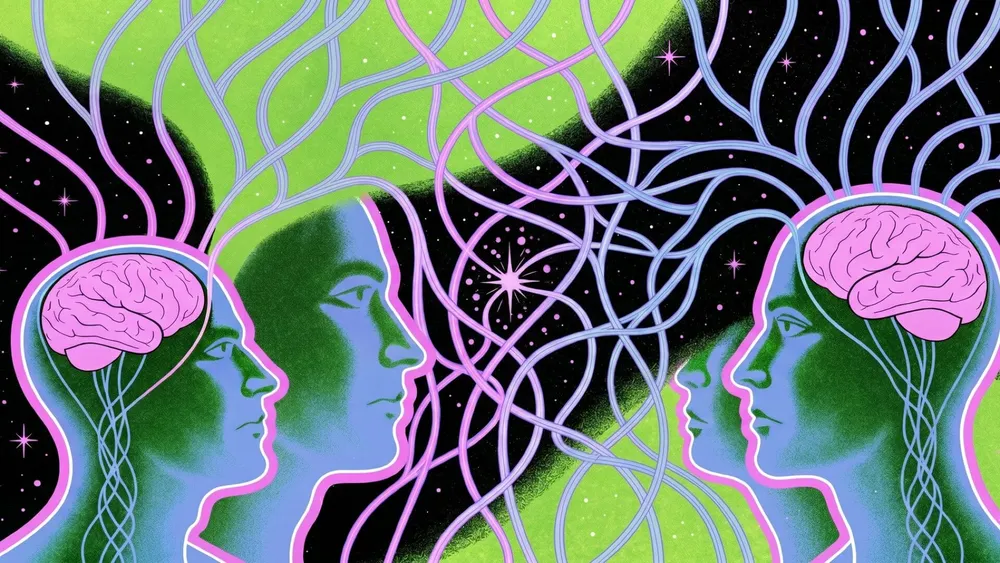
Our brain is excellent at recognizing patterns. That is, in making those minimal and seemingly chaotic differences group together coherently.
This is not the only way to conceive of information. In his book Nexus, the popularizer Yuval Harari proposes something different, though not necessarily contradictory. Information is defined by its ability to produce groupings, precisely, “nexuses,” connections between different entities. For Harari, information is not necessarily a “mirror” of reality, but a mechanism of order. A tax list or a religious myth functions as information not because it describes an external truth, but because it enables thousands of people to coordinate under the same structure. This perspective shifts the focus from content to function: information is what allows for the creation of complex networks. However, this brings us squarely to the problem of truth that we will explore next, since if the primary function of information is to connect and organize, how important is it that the data supporting that nexus is actually true?
The transition from what we call information to what we call “knowledge” is enormously complex. Much of logic, epistemology, and gnoseology has been built around this problem. How reliable are human senses as processors of information from the external world? And even if they were, how many observations of a phenomenon allow us to draw any kind of conclusion from it? David Hume, the prince of empiricists, famously proposed that causality, being imperceptible, is nothing more than an unprovable construction. I see the white billiard ball hit a red ball; the red ball moves, but can I really assert that it is a “consequence” of the white ball's hit? Kant picked up on that idea and posed the famous division between what we construct of the world as transcendental subjects and that thing-in-itself that we can never grasp in its essence. The movie Matrix, so often used in philosophy classes since its release, served to illustrate the famous thesis that everything around us could be the consequence of some kind of evil genius. There is nothing true out there if everything is a simulation.
The less metaphysical problem of how the human brain processes information, how it converts the inputs it receives into the outputs it produces (whether these are actions, ideas, statements, or whatever) is a key topic for neurology and its various branches. But for the purposes of this article, we can appeal to the most general: our brain is excellent at recognizing patterns. That is, in making those minimal and seemingly chaotic differences group together coherently. The hunter, whether primitive or contemporary, can detect tracks in the middle of a forest without all the other stimuli that the forest involves preventing him from recognizing the trail. “To investigate,” etymologically, is this: in vestigium, to follow the “vestige” or the trace.
Of course, animals also have this ability to recognize patterns, and they are often biologically hyper-adapted to it as a result of natural selection. But there is a difference in objectives because, as far as we know, humans are the only animals interested in seeing patterns in the stars.
A little help
Generalizing and without delving into the lengthy debates regarding the “scientific method” that spanned the 19th and 20th centuries, human knowledge, the acquisition of information that can be accepted as “true” and on which one can act consistently and effectively, has always been based on this human capacity to find patterns. Let’s not just think of Linnaeus, Darwin, or Newton. Philologists and literary critics like myself do this too. We see, for example, that in a corpus of texts from a period, or from an author, something is repeated that does not appear in other authors or other periods, and we build hypotheses based on that. We say, for example, that the Italian Renaissance saw a revival of Epicureanism because we can recognize a pattern of recurring statements about Epicurus in the corpus we read, and we attribute a meaning to that repetition, that is, some kind of causality: Epicureanism was revived in the Italian Renaissance as a consequence of the revaluation of earthly life, for example. This is how articles, theses, and lectures are written.
Human knowledge, the acquisition of information that can be accepted as “true” and on which one can act consistently and effectively, has always been based on this human capacity to find patterns.
Humans have been prolific in inventions that help make this pattern recognition process easier. One of the earliest is writing. Writing allows us to visualize and systematize information in a way that is easily retrievable, independent of individual or collective memory, and that lasts much longer than a lifetime, sometimes even longer than the life of a civilization. Writing also enabled more complex calculations to be made even before calculating machines were invented, like the abacus and eventually mechanical and electronic calculators.
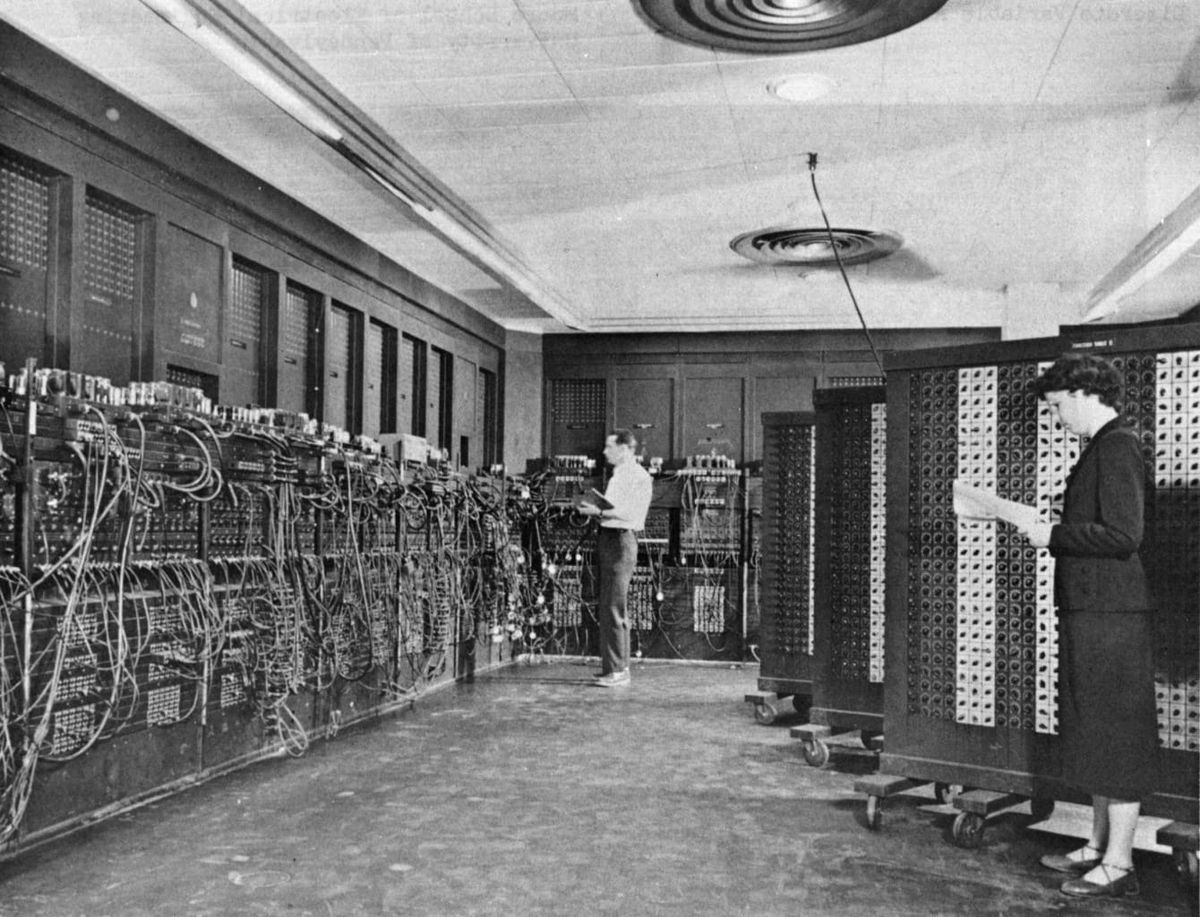
It could be said then that pre-machine learning computers were the most sophisticated form of this. Tools like Excel spreadsheets (to name a well-known one) allowed people to handle enormous amounts of information to detect patterns with an ease that was unimaginable just a short while before. Text databases in .html or .pdf with OCR enabled many of us to use simple commands like Ctrl + F (search) to find words like “Epicurus” in texts of thousands of pages in just a few minutes. Then what we found could be transferred to bibliography management software like Zotero, creating constellations that would have taken months if we had relied on traditional reading and handwritten notes (or typewriting). Not to mention the time saved on relatively complex mathematical calculations. Is something lost with these practices? Undoubtedly, but it seems that what is lost (the habit of doing mental calculations or encyclopedic memory, for example) is not so tragic or essential.
One could imagine that this is how the story of humanity would continue: increasingly efficient machines to manage information and present it to the human brain, the only one truly capable of finding patterns and designing causal models to explain it. But, a few years ago, something happened: machine learning.
Unlike traditional computing, where a programmer dictates explicit rules ("if A happens, do B"), machine learning is a branch of artificial intelligence that allows systems to learn and improve through experience and data. Its history dates back to the 1950s, but it wasn't until the explosion of Big Data and the increase in processing power that it made a qualitative leap. Instead of executing instructions, these models process massive volumes of information to identify statistical patterns on their own. This marks a fundamental break: the machine is no longer just a fast calculator, but an architect of correlations that can detect links that the human brain is incapable of perceiving, thus connecting pure data processing with a new form of artificial 'intuition.'
A typical example of this is bank loans. Until recently, the banker had a wealth of detailed information, loaded into a multi-layered database, and based on that, they would analyze, according to their judgment and experience, whether or not to grant a loan. Perhaps several of these processes could be automated in their database program, where at their or their team's request, a programmer had set up a basic condition: if the applicant does not have a formal salary at least equivalent to 500 USD, do not grant any type of personal loan. Then the banker would see this notice on their screen, and the decision was easy. But the decision was theirs and was based on information that was only pre-processed by some very basic computational operations, easy to explain, reproduce, or even annul. Even if there were 100 such rules in the database, or 1000, they would be nothing more than shortcuts that do not fundamentally change what is happening.
Now, what if the decision to grant a loan does not arise from the ability to detect patterns and reproduce them in clear rules, but from the machine learning capability performed on a massive and seemingly chaotic dataset? Even if the final decision to grant or deny the loan remains human, the process by which the 'true information' indicating that so-and-so is eligible for a loan of a certain amount is discovered (or produced) is no longer a direct consequence of human capacity to reach that conclusion. It is also very likely that data were involved that a human would never have noticed, even after centuries of accumulated banking culture.
The machine is no longer just a fast calculator, but an architect of correlations that can detect links that the human brain is incapable of perceiving, thus connecting pure data processing with a new form of artificial 'intuition.'
The implications of this are potentially enormous. Long before the popularization of LLMs, Chris Anderson theorized about this topic in his controversial 2008 article for Wired, titled The End of Theory. Anderson argued that, in the face of massive volumes of data, the traditional scientific method (based on hypotheses, models, and causality) became obsolete. According to him, 'with enough data, the numbers speak for themselves,' and correlations replace causal explanations. The often vilified (and not without reason) French philosopher Eric Sadin speaks quite a bit about this in his Artificial Intelligence or the Challenge of the Century, which was also written before ChatGPT burst into our lives. There, he questions the emergence of a new regime of truth, of 'uncovering' (aletheia, the Greek word that Heidegger revived).
Could it then happen that we no longer have to hypothesize causal relationships? If an AI receives all Argentine literary texts from the 20th century, could it reach its own conclusions based on machine learning that render the small and incomplete patterns found by people like Ricardo Piglia or Beatriz Sarlo obsolete and useless? Will all human research, all production of true statements from information then arise from machines, which, as Sadin anticipates, will also make decisions about them in which our role will be reduced to nothing?
Personally, I wouldn't go that far. But the fact that as of today, 2026, different ways of producing knowledge coexist, one of which is unlike anything humanity has produced so far,is quite stimulating. Will this division accentuate the difference between hard sciences and human and social sciences, or will it, on the contrary, bring them closer together? One might imagine that machine learning will change biology and physics more radically than literary, artistic, historical, or social studies, since in the latter, the criteria for truth are often tied to different kinds of factors. As Harari says, what makes information function as such is its ability to cohere, and in that sense, the type of knowledge produced by AI could simply be less cohesive, less engaging than what we produce by analyzing patterns and building causal models.
Perhaps this division between forms of research will end up producing a third form that is, at some point, above them and includes them, following the famous dialectical movement. Or perhaps we will develop a sensitivity, a taste, for more speculative knowledge, less susceptible to being extracted from any type of machine-processable data.
✦ Suscribite
Las notas de 421 no tienen paywall
Y a cada colaborador se le paga por su trabajo. Las dos cosas dependen de los suscriptores.
Humanista. Profesor de literatura e investigador en CONICET. Editor de la revista de teoría literaria Luthor (revistaluthor.com.ar). Hago videoensayos y streamings caseros en el canal de YouTube "Hotel Abismo".