What's Up, Machine?
The age-old duality surrounding robotics is being rewritten now that the human fear is no longer devastation but unemployment. But how far can you reject a branch of science that carries such a high degree of fetishism?
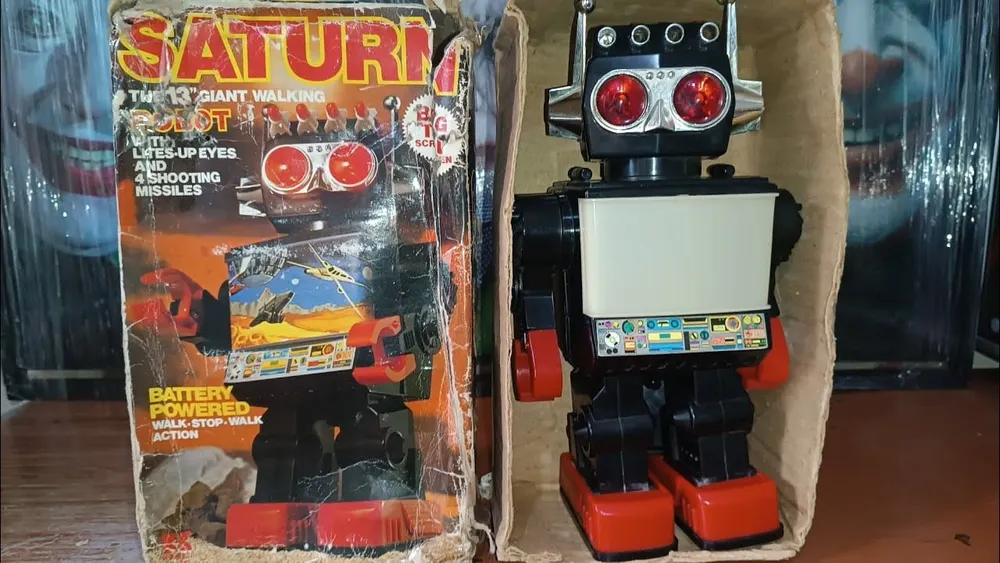
Saturn hit toy store shelves on Christmas of '92. It was a cute little toy with a family resemblance to the robots of the '50s. It had a screen embedded in its chest that projected images of space, ran on batteries, walked on its own, and when it bumped into a wall it turned around and went back the other way. Any kid who saw it in action believed it was a full-fledged robot.
Around the same time came Terminator 2: Judgment Day. No kid exposed to the legendary film by an action-movie-loving father ever forgot it. Among men aged 25 to 30 it has mythic status. It's hard to forget the relentless liquid metal killer robot, the Cyberdyne T-1000. Or that opening, with Schwarzenegger butt-naked walking into a biker bar while Bad to the Bone by ZZ Top played.
But what truly blew that generation's minds was the idea of Skynet: a defense software that becomes self-aware five minutes after being turned on, and in response to being shut down unleashes a nuclear apocalypse. The survivors of the holocaust are hunted and exterminated by a new generation of killer robots created by Skynet. Nobody doubted for a second that the future would be like that, that it would be about surviving a war against the robots. John Connor was the prophet.
Since then, two views on robotics have prevailed. One of trust and another of distrust, the poles between which the pendulum of acceptance of technology in human life swings.
A robot is a machine designed to replace human tasks that combines mechanical, electronic, and computing elements to perform tasks automatically. The quintessential robot is the mechanical arm, and not on a whim but because it is by far the most versatile limb of the human body.
In 1959, American engineers Joseph Engelberger and George Devol founded Unimation (an acronym for Universal Automation Inc.), the first company dedicated to manufacturing robots. In 1961 they installed their flagship product, the Unimate, on General Motors' assembly line. Eight years later, General Motors created the world's first automated plant, doubled the number of cars manufactured per hour, and revolutionized the automotive industry.
But the robot immediately became a consumer object and pop fetish, and even more so during the '90s, with the rise of cable television and VCRs: Mazinger Z, Grandizer, Voltron, and Daltanias filled the afternoons of cartoon watching. These robots, unlike Terminator, were the primary tool for ensuring humanity's survival.
In other '90s classics like The Centurions or SilverHawks, the machine was an extension of the human body or functioned as armor and exoskeleton.
The curious thing is that this type of technology already exists, and there is a branch of engineering called mechatronics that studies and applies it. For instance, Ekso Bionics, a California-based company, sells an exoskeleton designed so that people with paralysis can walk again with assistance. But the flashiest developments in this field include MEMS (Micro-Electro-Mechanical Systems), devices ranging from a millimeter in size downward that can, for example, navigate through the bloodstream in search of diseases, analyzing cell by cell, like the Magic School Bus.
In the year 2000, once again robots showed up on the small screen. The children of the '90s were entering adolescence, the final stretch of Argentina's convertibility regime was rough, the Alianza government had far more capacity for damage than the feared Y2K, and two products set the apocalyptic tone of the era. The Matrix was the prized find at video rental stores; Evangelion was the darling of the lucky kids who, on top of having cable, had the channel dedicated to Japanese animation, Locomotion.
Evangelion takes place in Neo-Tokyo in 2015. The secret agency NERV builds giant "robots" called EVAs to fight against twelve angels that God, yes God, sends to annihilate Humanity.
In The Matrix, Humanity is once again a victim of its own creation. After the film, a series of shorts was released under the name Animatrix. One that stands out is The Second Renaissance, which tells how humans and robots went to war after people tyrannized and enslaved the machines.
However, these two poles between which the problem is framed are sterile. If the destiny of robotics is total cooperation with Humanity, then there is no problem. And if on the other hand the only outcome is annihilation, the dilemma is useless because it has no solution. That is why, once again, an equidistant third position emerges: the real problem we will have to deal with lies in the middle of the extremes, and its name is "automation."
The terms in which speculative fiction poses this problem are either that technology is good or that it is bad. It is not possible to make a value judgment about this. The only thing known is that technology is irreversible: once it begins to be used in some area of everyday life, there is no going back.
John Connor was not alone in his crusade against the machines. In the late 18th century, the worker Ned Ludd entered the factory where he worked and smashed two machines that were replacing the work of several laborers. Thus arose a movement called Luddism, which holds that the use of technology in industry will lead to mass unemployment.
Economists called it the Luddite Fallacy, because according to them historical evidence shows that workers displaced by machines became operators of those machines and at the same time these were tools to increase their productivity. However, we have already reached the point where the machines themselves are beginning to do the work without anyone needing to operate them. Just think, for example, of the large-scale impact on the transportation industry of a self-driving car, like the one Google is developing. Or another example, an algorithm that replaces accountants. Or another that reads things on the Internet, copy-pastes, and replaces writers and journalists. Where would that workforce be absorbed?
Creating new jobs implies more specialization, and more specialization implies more education, but not all sectors can access those levels of education. So the consequence would be societies in which the gap between rich and poor is accentuated. This seems to be the not-so-long-term challenge for this generation: no longer surviving mass annihilation but surviving obsolescence, surviving unemployment.
This piece was originally published in Página/12 on May 7, 2015.
Las notas de 421 no tienen paywall
Y a cada colaborador se le paga por su trabajo. Las dos cosas dependen de los suscriptores.