TechGnosis: Is the machine a vehicle for the soul?
Is technology the new opium, or a gateway to the divine? A psychedelic chronicle of raves, silicon “pills,” technology, and liturgy. This is how we explore TechGnosis.
We were sitting next to each other, so close that I could clearly hear the murmur of her headphones: Terence McKenna's voice saying that the only difference between a computer and a drug is that the computer is too big to swallow.
Yet there they were, girls and boys chewing on silicon, in their uniforms, never two alike, with violet lips and sunken eyes, ready for any heterotopic rite.
Cauterize
There's nothing secular about a sound system or an audio mixer.
A Sacristy: she purifies her body with water, carefully chooses her fabrics (colors and textures, accessories and inks for her mask), sprays synthetic flower extracts into the air and walks through the cloud. She faces the street, waiting for that myth called bondi to bring her to her trusted acolyte. Eucharist under the tongue for a few electric, mercurial steps into a luminescent, neon forest.
The history of communication technologies is inseparable from the mystical creations of human consciousness. Media machines and popular mythology are thus juxtaposed territories.
Can you hear it? The pulse of sub-bass that tenses the air at regular, complex intervals.
All this machinery (devices that interpret and distribute information), all this technology… Books, cables, and buses: could they also be vehicles for the soul?
With a body (motor center) in phase, I can't stop thinking about the voice of the cartographer of machinic subconsciousness, Erik Davis, repeating like a mantra a concept: TechGnosis. The history of communication technologies is inseparable from the mystical creations of human consciousness. Media machines and popular mythology are, for him, juxtaposed territories. Immediately interrupted by his shadow (also called Erik Davis) who replied: it's a kind of illness or process, a return of the gnostic problem, the dualistic drama of the ideal plane versus the material, spirit and body, the real and the virtual.
 Roberto Chuit Roganovich
He also argues that the desire for transcendence, to reach Gnosis, did not disappear with the rise of science, technology, and industry. If the destiny of enlightened reason was to distance us from mystical enchantment, it has only managed to translate, mask, and at times repress that human drive.
A technology complex enough becomes indistinguishable from magic. It brings its own liturgy, its practices.
And here we are, where the virtual and the real relate in an apparent ontological equality. With a terrible taste of déjà vu. Borders shifting, the distant and the near mixed together. And a recurring response to crises of meaning: Eschatology, a doctrine of last things.
Pull on that thread and you'll surely come across those aesthetics of collapse, with singularities of messianic AI, different forms of millenarianism, or, as I prefer to call it: the Great Cosmic Game of the Eskhaton, and its two forces that stretch, seeking to accelerate or slow down the apocalypse.
In any case, the map is not the territory. And if the real is a desert, nothing guarantees that the virtual is a garden.
Juan Ruocco 🧙♂️
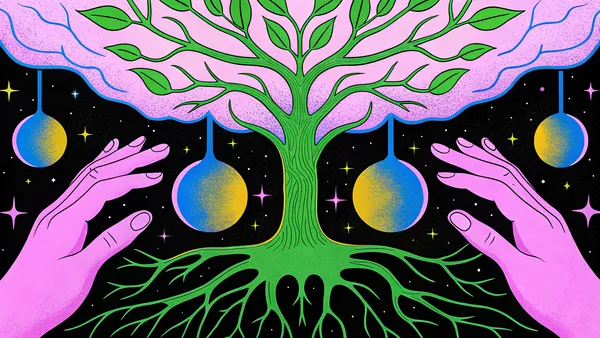
A serpent among the branches of a tree reveals itself, claiming to be *** and offers a fruit that, when eaten, illuminates, according to some, with the knowledge of good and evil. You extend your hand, take the fruit, and bite into it. For the first time, you dissociate on a cosmic level. You observe even the pupils of God and return to your natural state. But something has changed: you find yourself there, suspecting a kind of simulacrum in reality. And with that idea of perfection, shivers of intuition rise from the distance to the divine.
A cognitive schism, an epistemic yawn.
What changes here is perception. In this confusing state (where the Pneuma does not recognize itself as such within matter), the act of self-observation arises, triggering anagnorisis: a self-conscious gesture that lasts only an instant before closing again.
This displacement implies a symmetry. The example is merely a form of the drama, but it always exposes a possibility of return or salvation; a soteriological process of union, though also of radical separation. If we believe we see a key in myth and its symbols, the pivot is cognitive. If the fall is epistemic, so is the return. We would call that experience Gnosis. And its perversion, the archons' trap, the rulers of information flows that monitor or design what you see.
Because while the fable of the garden may be suggestive, there is as much of the forbidden fruit as there is of the trickster in the matter. For the Gnostics, that peculiar branch of early Christianity, reality was a kind of prison created by the demiurge, a second-rate deity. And information, the data: a divine spark that had to be liberated from matter.
Now, this last concept was shared by another school, hermeticism, but with somewhat different consequences. In both traditions, that return (that awakening) does not imply something new but rather a remembering (anamnesis). But precisely here they diverge: a spark imprisoned in a body of flesh or metal, matter. Does it embark on an escape or seek to operate within the confines of its confinement? Spiritualization of matter or materialization of spirit?
Mariano Vilar
Perhaps the reduction is a license, but where the Gnostic navigates (infonaut) following the signal of the Logos amidst all the entropic interference of the material world to reach the Pleroma, the hermetic with its techne seeks to create order and beauty in the material (neguentropy). Here lies the sacred trap. The culmination of the hermetic path, unlike the Gnostic who ends in dissolution, is to bring into existence a total work (a palace of memory or theater of the world, where all the information of the cosmos is contained) thus equating oneself with God. The trick executed by the trickster lies in the amputation: externalizing our mind into devices would turn us into cyborgs with quasi-magical abilities, but at the cost of losing natural faculties.
That ability of know-how that the amputated objects turned prosthetics promise (both their creative power and the indistinguishable simulation of the impossible) is closely related to Hermes, the god of boundaries, patron of inventors and translators, as well as of thieves and liars. An evident relationship then emerges between the ideas of communication, commerce, cunning, manipulation, and business, ultimately all forms of a dance of truths, lies, and appearances. A dance that does not occur in a vacuum, rather it unfolds in that layer of collective thought, a stage for the Great Cosmic Game of Eskhaton.
Externalizing our mind into devices would turn us into cyborgs with quasi-magical abilities, but at the cost of losing natural faculties.
Thus, the hermetic wager always implies an illusion.
Hermes gives you a prosthesis that expands your technical ability, and in return (even without you noticing) you give up the part of you that naturally knew how to occupy that role. Little by little, you offload into matter, like Theseus' body, where in the end, at the omega point, the terrible singularity awaits you with drooling teeth peeking out from its maw.
Post Hoc Ergo Propter Hoc planetary in any case. Consensual hallucination.
Rocco Fregoti
Dissolve
One of the headphones hung from my chest; the other, still attached to my ear, hummed the psychedelic data, with that nasal, meditative tone typical of Terence.
Then his hand shook the sleeve of my jacket. Cybersigilism from head to toe: leather, layers, buckles, and impossible hair. His gaze was oblique but his attention was fixed on the small screen that shot photons at his face. Synthetic mirror. With the precision of a goldsmith, he distributed black lines from his tear ducts, contouring organic, almost ergonomic symbols.
—Come on, we’ll get off at the next stop.
Dazed by the bus's vibrations, I stood up and followed her. My skin against the hot metal of the machine, limbs stretched out, bodies jostling indistinctly and tightly in a wet mouth moving at 69 km per hour. It chewed and swallowed. It pleasantly spat us out.
A buzz of anxiety, stops at a corner. My eyes vibrated, warning me that three blocks away, an acolyte of the urban dwellers was closing the door of his house and walking towards us.
Juan Ruocco 🧙♂️
Ten impersonal minutes later we were back. The cold on our skin hurried our steps, the silence so emphatic it made me uncomfortable, so I had to ask.
—You noticed it too, didn’t you?
—Yeah, I don’t like these androids. I don’t know how to put it, grotesque. Like they’re not really there.
—I found it strangely harmonious. Very altered. Layers that go to one extreme but…
He interrupted me right away.
—Look, friend, I don’t know what exactly you saw, but it doesn’t matter.
His fiery eyes fell toward his open hands, which offered a small door (maybe a joke, maybe a trick). I couldn't help but bite my lip in suspicion.
—It's a gift, we should celebrate it —he told me.
He brought his index, middle, and ring fingers to his forehead, left hip, right shoulder: a sign in musical notation. Clearly, he had chosen his response. The gift was a portal. I shrank in size and crossed the threshold with an almost domestic disposition, a reflection. The discomfort of feeling like an automaton dislocated reality for me; I noticed myself observing myself, a cloudy and permanent iteration. A body looking at a body, looking at a body.
Luis Paz
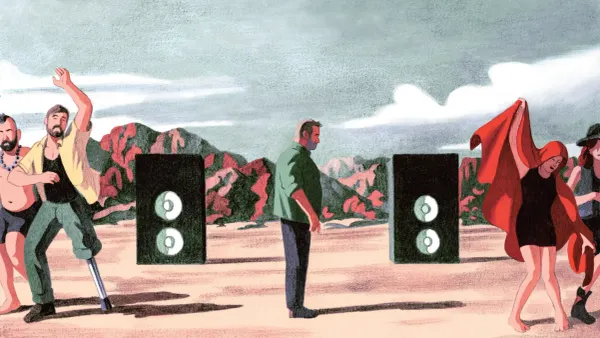
Steps on the grass. Deep pulses grow among the trees, stumbling forward as if my head were disproportionately large. My hand fused with another hand. I see those monoliths of wood wrapped in black fabric, pressure hammers and rhythm; multiple iridescent shadows as if drawn in by the wind venerating them. In the center, electric patterns and the current monk merge in the grace of time, dynamic architecture in the air. Chronesthetic invocation, convulsively entering and exiting the now. Because a rave is practically a time machine.
What kind of awakening was this? Successive and constant. Repetitive.
It was surely a joke. A setup. Pure performance.
The gift was a portal. I shrank in size and crossed the threshold with an almost domestic disposition, a reflection. The discomfort of feeling like an automaton dislocated reality for me; I noticed myself observing myself, a cloudy and permanent iteration. A body looking at a body, looking at a body.
Make it, make it, don't fake it! Those monsters scream in Korine's movie. Performance: believing oneself to be something, but not being it. A circus of artifacts where the magician and the madman are the same card. Binding myself to that evanescent flow of perception. Arranging it as otherness in those common fields of information, ephemeral points of open questions. Social interaction as an antidote for the infomaniac. Who, in their slippery slope, confuses the exquisite nature of experience with the archon that monitors the structure of their hyper-ubiquitous pleasure.
Praying to God in the other, to be sacred food for worms. Conjugating beauty and terror. Like someone devouring a mountain to extract fragments of rare metals, transporting them across oceans and vast fields of land. Involving planetary-scale engineering. Suburbs that segregate microchips and centaurs on the road like veins supplying a beastly structure. To end up receiving the photons bouncing off a face towards a small lens. Entry to a digital brain that translates them into an ultra-specific light spectrum, that imitates, that prints in real time eyes that delineate tribal patterns at the corners; on a bus heading to a party.
Juan Ruocco 🧙♂️
It can only be a joke. A bridge to the irrational. To what exists where it shouldn't. Transrational and thresholded in its drift, so familiar. The oddity is on the rise. They are those living machines that dream of looking at me from every possible angle. An externalized eye, a persistent observer outside, a converging lens. Symmetry or mirage. Either way, a kind of paranoia or faith that knows how to find its many names.
So complex is the simulacrum that it only inspires liturgy. Thus, a sound system, an audio mixer, is nothing secular. Sacred games for sacred imaginations. And as many fetishes as there are coins of exchange or condemnations.
Thresholds
Fire in a flower and I wonder: What the hell did I just read? Aesthetic terrorism. Every character and its corresponding imago. Magic tricks and suggestions from Hermes Thoth. A pose.
The very act of will is a form of rite, of invocation, an attempt to point to something that isn't there. The whole play of agencies and archons, winged-footed gods and confused demons. An electric ebb and flow of contractions and reliefs.
And here I am, with a map and no ground. Better to pause for a moment by the side of the road and light a cognitive cigarette flavored with dreams, full of oddity and intimacy, like someone writing, before entering the forest where the music awaits.
Las notas de 421 no tienen paywall
Y a cada colaborador se le paga por su trabajo. Las dos cosas dependen de los suscriptores.