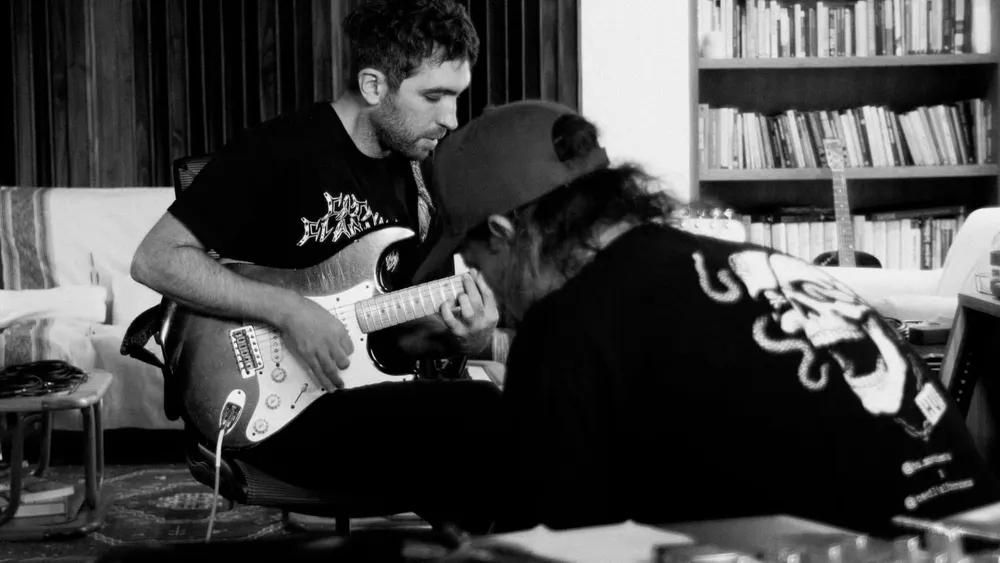
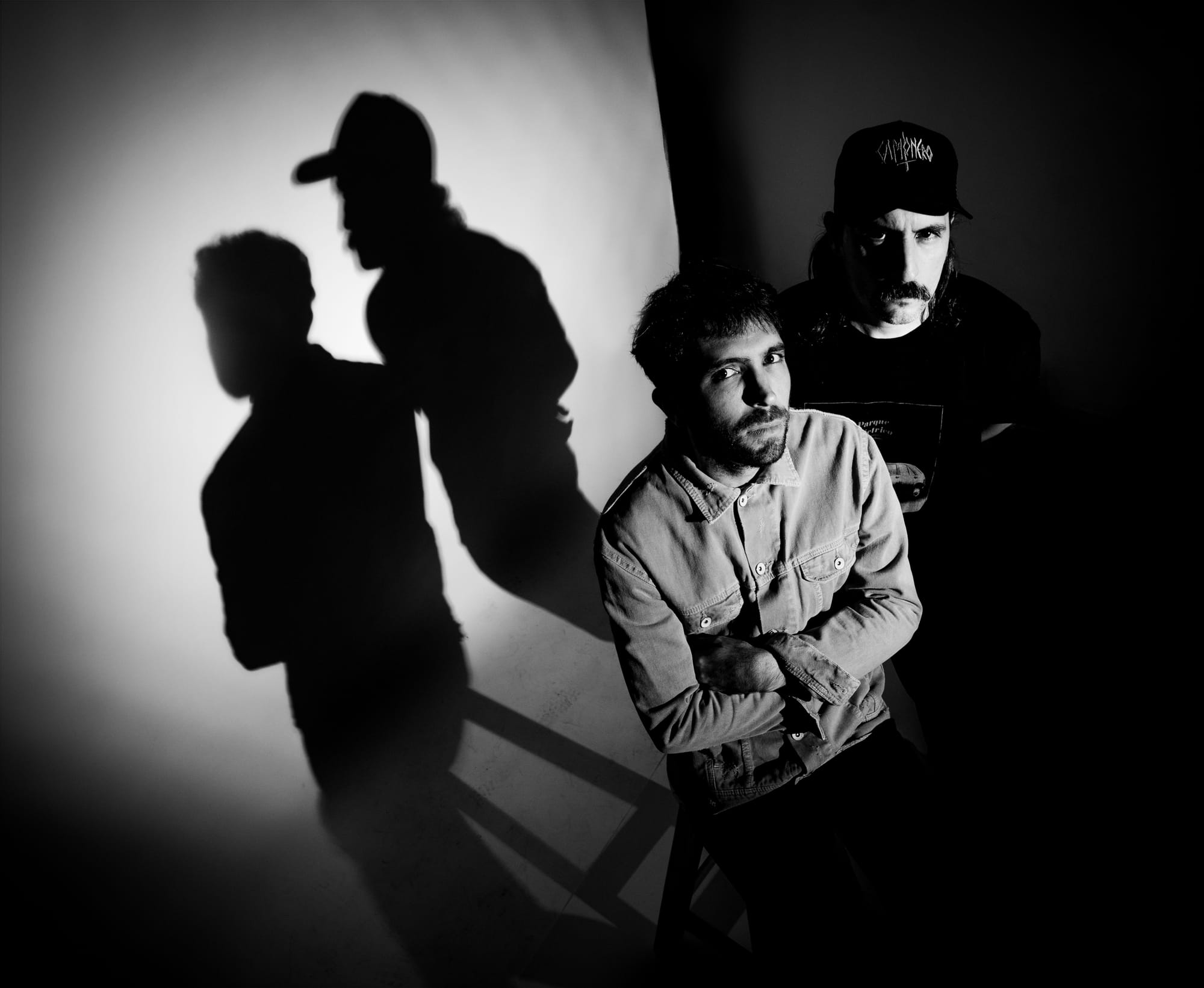
Camionero isn't just a duo; it's the band that shook up Argentine rock. With heavy riffs and a working-class spirit, Joan Manuel Pardo and Santiago Luis achieve a perfect blend of classic blues and the future on Pruebas de contacto (2026).
For a few years now, a ghost has been roaming Argentina: Camionero.
The duo, made up of Joan Manuel Pardo on guitar and vocals, and Santiago Luis on drums and backing vocals, released two debut EPs (EP 1 and EP 2) in 2018, followed by a mid-length album, Confianza en ti solo, and three full-length albums, the latest of which just came out a few days ago: Club Camionero (2021), Todo lo sólido se desvanece en el aire (2023), and Pruebas de contacto (2026).
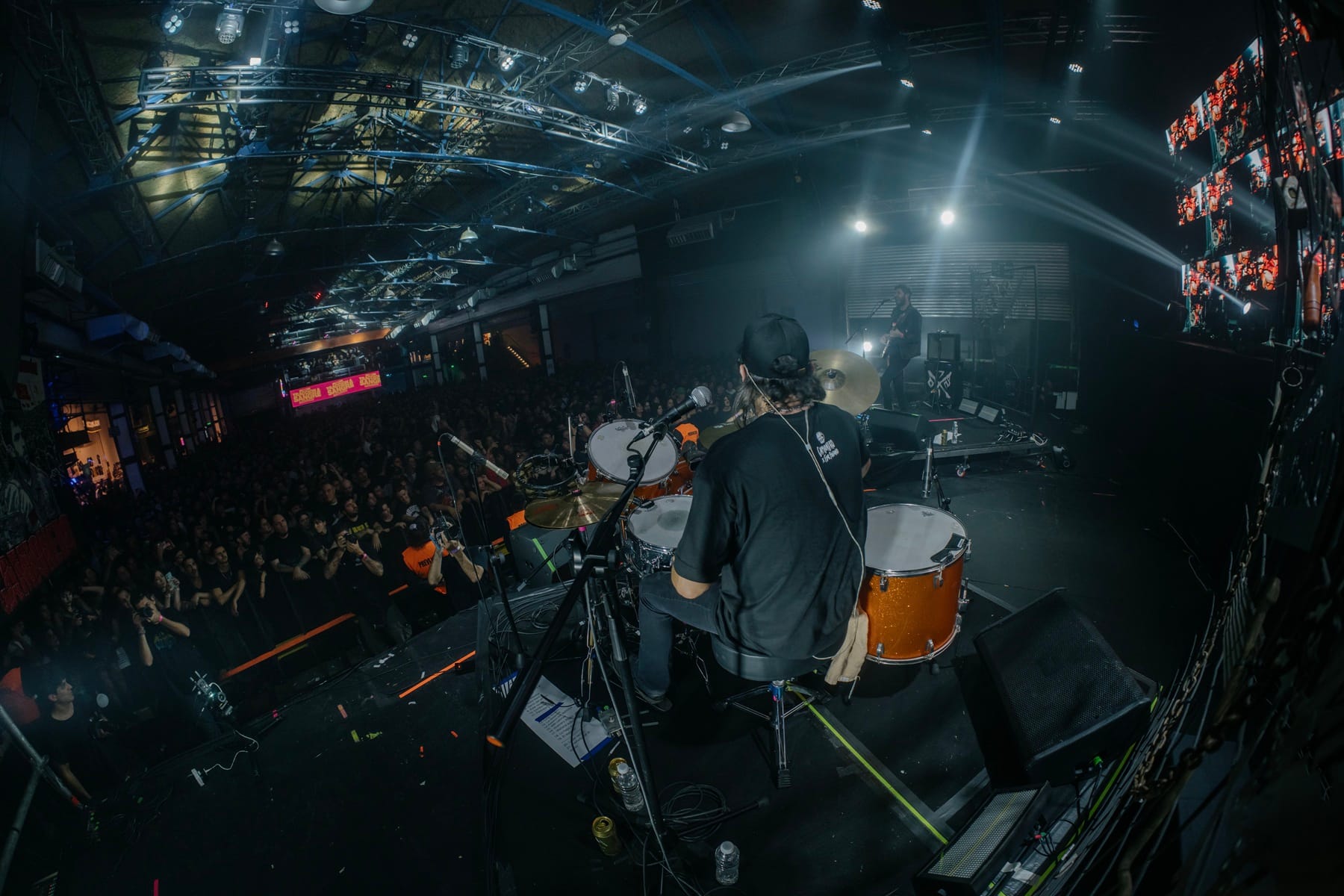
Their community also deserves a mention. Over the past two years, the Tracción a Sangre cycle has become a meeting point for “Camión,” the nickname used by the band's fans. The idea of a band-vehicle fits the project well. The concept is more than just a brand, and the duo, along with their audience, taps into the trucker semantic field to expand their world: a cooperative of artisans sells patches, beer cans, t-shirts, and other items printed with the group's graphics: the trailer. Another group of fans organized to call for and manage solidarity initiatives in response to shortages or disasters: the spare wheel.
But beyond their journey and their fans, why is Camionero so important? What does their emergence tell us about the current moment in national rock? These are two questions we will try to address in this article.
Bluesy rock and roll music
In Camionero, the influences are traces that arrive at a wink, and at times, an intertextuality made of structures, sounds, and cadences.
In the first two EPs lies the essence of the band: the truck carries heavy riffs, sometimes punctuated by sharp leads and lyrics where, although much is already said, the first thing the listener receives is how the syllable behaves in the verse and the chorus. Camionero starts where heavy rock began: melancholic blues, virtuosity, and a dialogue between percussion and melody.
Beyond their journey and their fans, why is Camionero so important? What does their emergence tell us about the current moment in national rock?
The formula is self-sufficient in its apparent minimalism. Joan Manuel's pedalboard (the fourth member, if producer Dylan Lerner is the third) already showcases its possibilities: a range of lows and highs contained between the kick drum and hi-hat, mic'd with precision. The guitar is processed with the textures each song demands. The rest of the atmosphere is completed by the other voice of the guitarist: his vocal apparatus, capable of sweetness and that popular singing that can captivate large audiences and summon the chorus. The White Stripes and the Black Keys would smile if they heard their living legacy singing along.
They are just marks in the memory from there
Confianza en ti solo, the third EP, is a kind of dark transition that already contains a maturity in the swing crowned by Juanse's participation in the song “Agua Asesina.” An honorary invitation that places them in a tradition that, at that time, seemed to look more to the past than to the future. Sometimes, music has no time.
In Espectros de Marx (1993), Jacques Derrida coins the term “hauntologies,” playing with ontology, the study of being. In English, “haunt” means to haunt, which in French is “hanter.” The neologism means, then, the study of that which, like a specter, lurks in the unfolding of a world order that had chosen its model. The specters of Marx, after the fall of the Soviet bloc, would haunt, neither alive nor dead, Western capitalism.
Mark Fisher, in The Ghosts of My Life (2014), takes the term, reads it in the context of the gradual cancellation of the future that Bifo Berardi pointed out, and states that the ghosts that truly haunt us are those of the futures that fail to exist because we do not dare to imagine them.
The theoretical framework for thinking about culture is brilliant, but I’m going to slightly shift gears. When Fisher talks about music, he states that the last quarter of the 20th century was one of the periods in the history of music that was least inclined to look towards the future. For Fisher, this is the opposite of making art without constraints.
But the old works, Juanse. Inviting the leader of the Ratones Paranoicos to play guitar and sing a few verses was a gesture that valued a tradition (which might have seemed outdated) and created a musical present.
Simon Reynolds quotes in Retromania (2011) a phrase from Norman Blake of Teenage Fanclub: "Any music that doesn't sound like something else in the history of rock always sounds terrible." The music critic disagrees with the quote, clarifying, but we could assert that ignoring one’s own tradition doesn’t automatically position you in the future. There are avant-garde movements that sought novelty in the past. At the same time, it’s clear that disruptive gestures require courage, but these don’t always end up being understood many years later as ahead of their time. Or, as the Argentine band Placer would say: The novelty is not the future / the novelty is the past that was covered up.
And whatever stands in the way will take the form I decide
Club Camionero (2021) was then the celebration of the mythological rebirth of rock and roll, synthesized in “Genio del Abasto,” which narrates an urban knife duel and speaks to us of the necessary violence for a paradigm to fall, making way for the new.
“On Lavalle, the / knife shone before speaking / Let’s be strangers: / let’s not measure damages.”
A portrait of an anonymous genius who meets a friend turned stranger, a knife duel with Abasto as the stage and a work chanted until the mosh pit, and for some lucky ones, its consequent mosh.
Thus we arrive at All That Is Solid Melts into Air.
Oh, I won't wait until tomorrow
All That Is Solid Melts into Air (2023) adds to an intertextual tradition initiated by Marshall Berman, who found in Marx and Engels' phrase an image illustrating how modernism builds upon the shoulders (and rubble) of the old world.
In the Communist Manifesto (1848), it is stated that each stage of history is built upon the foundations of the previous one. The bourgeoisie managed to overthrow feudalism, and from the depths of its system, from crises, overproduction, the expansion of trade, and property, another class emerges. The first part of the Manifesto addresses the issue of the modernization process and the approach to the revolutionary climax.
The bourgeoisie has played an essentially revolutionary role in history.
Enslaved to the factory owner and capital, the proletariat is both the protagonist and the direct recipient of the Manifesto.
It is a fundamental text and a diagnosis that still resonates due to its relevance:
The less skill and strength work requires, that is, the more modern industry progresses, the easier it is for men's labor to be replaced by that of women and children. Age and gender distinctions hold no social significance for the working class. There are only instruments of labor, whose price varies according to age and gender.
Marshall Berman's operation in All That Is Solid Melts into Air (1982) consists of using Marxism as a theoretical framework to think about modernism. From Goethe's Faust, understood as 'the first expression of modern spiritual quest,' pivoting with Nietzsche, Dostoevsky, and Baudelaire's poetry, which served him, as it did Walter Benjamin in his Book of Passages (written between 1927 and 1940, and posthumously published in 1983) to think about the constitution of modern man's subjectivity.
Camionero's penultimate album contains even more conceptual density. From the cover, articulated with the Marxist evanescence to the poetic denunciation of oppression, but also open to melancholy, urban mythology, and the full awareness that cultural commodities contain a fetishization with which the artist grapples. In 'Anonymous Films,' Joan Manuel sings:
Particles by cell phone / Anonymous films / Slowly explode in the air.
Shared images that could be (and, upon closer inspection, are) films.
Like the bourgeoisie and urbanism, rock is a palimpsest. The new is written over the old.
A violent torrent shakes my body
During and after the pandemic, do it yourself, one of the banners of punk, shifted composition through software. The endless possibilities of recording made music production more accessible. But, at a certain point, digital demos stopped being replaced by more sophisticated productions, and a sector of popular music experienced, once again, a period where attitude, message, and persona were the most important. Demos began to be published (again) as final versions.
At the same time, rock was seen as something expensive and difficult to transport, and many venues and festivals preferred not to pay or to pay considerably less for fees. But a lo-fi period was emerging and proliferating among the youth, in public squares, on stages, and especially on digital platforms. There was a sudden surge of rock and roll bands that filled venues and seemed to constitute a movement, still without a name.
I found that various Artificial Intelligence programs, especially text and image processors, led me to appreciate even more what is produced by humans. I imagine others may have experienced this too, because I am a social creature who talks, reads, and understands as part of collective events. Just like rock and roll.
And the first time I went to a Tracción a sangre show, I felt as if Camionero had captured that sensation. The cycle had opened the door to artisans, reclaiming the most important part of popular music: its humanity.
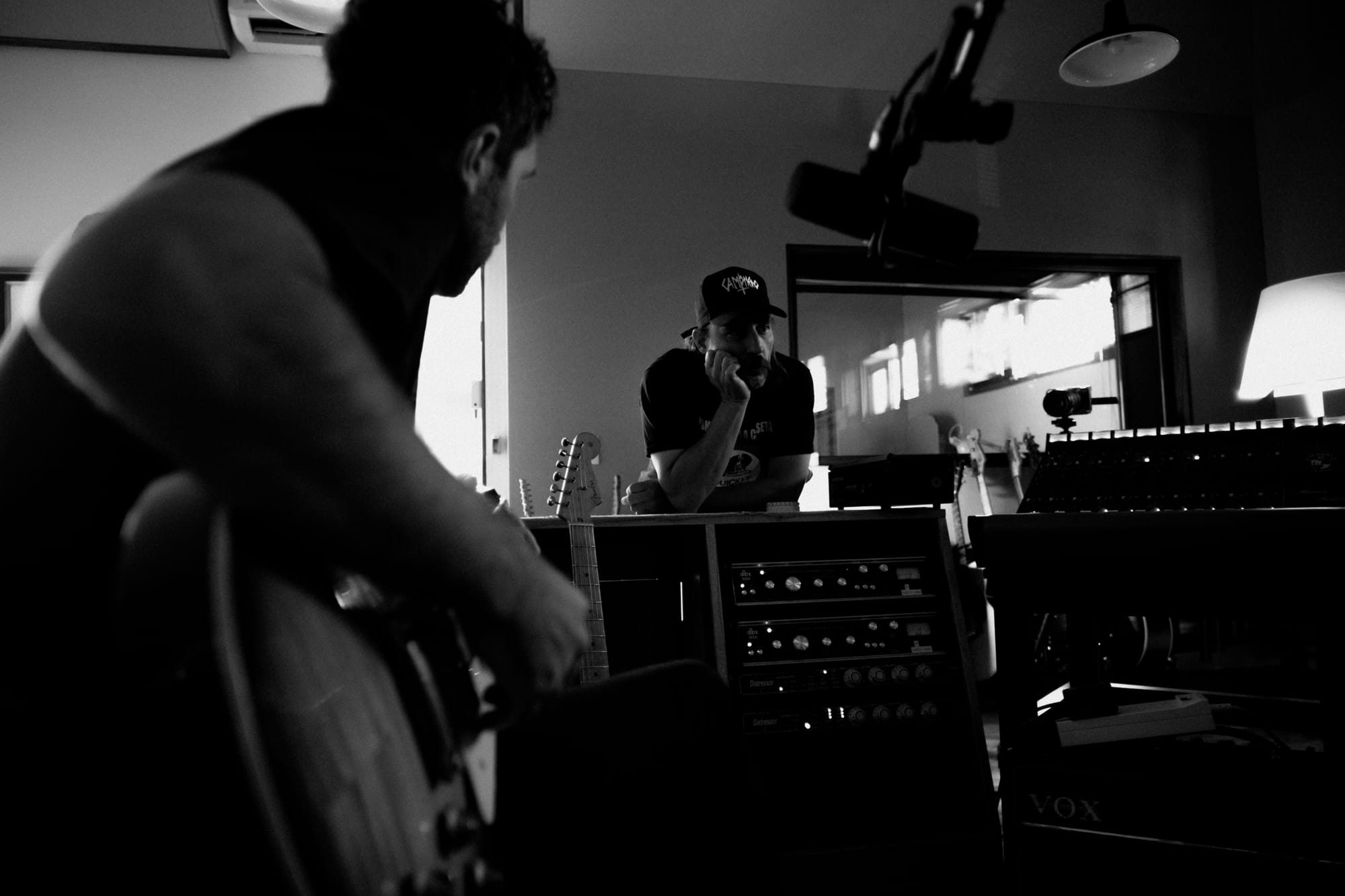
Let’s appeal to ellipsis: on May 12 of this year, the group released their third LP, mixed by Dylan Lerner and mastered by Brian Lucey, who has worked with Depeche Mode, Arctic Monkeys, and Black Keys, among several other bands.
Contact Tests is an approach to the wires. Also, one must listen to the lyrics many times to understand each verse, like a musical mystery that says a lot, hidden in ambiguity. Joan Manuel and Santiago come into contact, in their closed circuit. The source always feeds the chaos, electrons travel their path, and the current flows into that infallible charge that is the rock song.
On May 12 of this year, the group released their third LP, mixed by Dylan Lerner and mastered by Brian Lucey, who has worked with Depeche Mode, Arctic Monkeys, and Black Keys, among several other bands.
"Putting debt at Christmas" is the opening line of "Bad luck, man," the song that kicks off the album. After a strum on the acoustic guitar, the electric channels open up to create a fantastic album opener: a denunciation of the traps of power, a touch of mischief, a blend of irony and sordidness; trained swing, punchy sound, and a growing momentum.
The next stop is "Amulets." In the record industry language of this strange decade, there are four priority songs on an album: the first two singles (this album didn’t have those), the first song on the album (referred to as a "covert single"), and the focus track, which is the song that encapsulates the essence of the work. If the artist or group works with a distributor, they will try to position the main track on playlists. Well: "Amulets" could have been a single, but it could also be a focus track. If it had been a single, it would have contained a sort of deception regarding what the album communicates. Let me explain: Joan Manuel uses an octave pedal that emulates the bass's low frequencies. Many times when that pedal isn’t present, the kick drum carries the weight of the lows, interacting with other textures provided by the guitar. The thing is that in "Amulets," the guitar line processed by the octave pedal is so similar to what a bass would play that a listener could easily think the band has incorporated a new instrument and perhaps a new member. I was quite surprised when, taken aback by the sound, I heard the lines:
We used to be the same / Now we sound so different / What happened?
I wouldn’t have been surprised if the guys had questioned the fact that there are two musicians doing the work of a bunch. Abandoning the amulets as an iconoclastic gesture, willing to do anything to connect with the ghosts of the future. And all while leaving the door to mystery ajar, because it could well be a simulation: the image of the audience in the cinema jumping from their seats as the train approaches from the back of the perspective. Let’s be clear: we are the spectators and the bass in Camionero would be the train.
Or maybe it’s something more chill. It’s almost always something more chill.
The next song, "One Last Offer," could also have been a focus track. "Ricotero and Camionero" is the most dominant song on the album. Melodically complex, the riff is charming and kicks off with the sound of "La Distancia," intertextually linking to the band’s own work, which is something only the greats can pull off well.
The second half of the album allows for darkness and beauty. If we stick to the theoretical framework of the record industry, "Hot Creatures" could have been a single or a focus track. The bridge of melody and celestial singing that seems to invoke the sacred is a sort of trademark of the duo. It’s a way to smooth things out before an explosion that works brilliantly live.
The guitar in "Cathedrals" is very similar to that of El Mató a un policía motorizado in "La síntesis O’Konor," that album that changed their career. Although the song talks about death, memory, distance, or transcendence, I choose to interpret it as a tribute to that foundational sound that set the limit in the sky. Acknowledging masters and citing them with devotion and intellectual honesty is also the mark of greatness.
The analysis could go on, but it would be futile.
The important thing is that the album was already presented at the Teatro de Flores on Friday, May 22, and Saturday, May 23.
See you on the road.
✦ Suscribite
Las notas de 421 no tienen paywall
Y a cada colaborador se le paga por su trabajo. Las dos cosas dependen de los suscriptores.
Un entusiasta nacido el 17 de octubre de 1992. Es licenciado en Letras (UBA), magíster en Escritura Creativa (UNTREF), productor discográfico y periodista.
Escribe todo lo que puede: poesía, ficción y notas como las que podés leer en 421.