A Proposal for the UBA. Vaca Muerta Lies Between Ciudad Universitaria and Plaza Houssay

UBA has piled up decades of first-rate research. With AI agents we can comb through all of it and find technologies and companies we haven't spotted yet, so that some of that value goes back into funding science. First at UBA, then across the whole country.
The bottleneck moved
Artificial intelligence is making the work of writing software, building prototypes and automating processes cheaper. If building costs less and less, what matters is choosing what to build. In When Civilization Slips Away from the Human I wrote that AI keeps getting better at execution, but it doesn't decide what's worth pursuing. That decision is still ours, and to make it well we need to know what we've got.
And a tech company is not the same thing as a software company. A good chunk of software is going to end up a commodity thanks to language models. What you can't copy with a prompt is a new material, a test that diagnoses a disease in minutes, or an algorithm that makes a technology viable when until now it was too expensive.
Those companies need frontier science and engineering, labs, experimentation and knowledge built up over decades. Asking an AI to write an app won't cut it. And that's where universities have a huge advantage: they produce knowledge that can't be replicated just by hiring programmers or using better AI models, and that can turn into entire industries.
Argentina has thousands of researchers and decades of accumulated scientific knowledge. A massive amount of that work ends up published in journals and repositories without anyone systematically checking what technologies, discoveries or companies could come out of it. And we can't ask researchers to do it on their own: their careers are measured in publications, they don't know the markets, and they don't have time to study every possible application of their work.
If we don't go through it, someone else will. Reading got cheaper too, and for everyone. A fund in Boston or a lab in Shenzhen can set agents loose on every paper with an Argentine affiliation the day it comes out, without setting foot in Buenos Aires or knowing the researchers. Publishing is fine; open science is one of the best things we have. The problem is other people finding the applications of our research before we do. It's like having oil in your backyard and finding out the day some foreign company shows up asking for the concession.
We're late. Every year we let slip by is another year in which research paid for by Argentines can turn into technology and companies in other countries, while we still aren't systematically analyzing what we produce.
UBA needs to build a system of agents that reads its scientific output, finds connections between pieces of research and is constantly searching for what can be discovered or built with that knowledge. The idea is to speed up discoveries and turn some of them into technologies, companies, patents and licenses that bring new resources to the university. First at UBA; then, across the whole country.
A disclosure before I go on: I'm pushing for UBA's new Bachelor's in Complex Systems and I'm one of the owners of 421. That way nobody has to waste time digging into my interests.
Someone already started
Casey Handmer, a Caltech-trained physicist who went on to found companies, published an experiment. He used Claude to audit the scientific literature of his old specialty, theoretical astrophysics: he built an index of some 150,000 papers, examined more than 50,000 and ran much deeper checks on hundreds of them.
He found close to a thousand errors, many in highly cited research. It took him 41 days, about 44 hours of human work and around $2,720 in model costs, by his own count. The methodology and findings are at science.caseyhandmer.com/physics.
One person with AI agents audited a good chunk of a scientific discipline. Someone still has to validate his findings one by one, but the ability to sweep through that much literature has already been proven.
What Handmer did to hunt for errors can be done to hunt for discoveries and companies.
Hunting for companies is harder than hunting for errors. An equation can be checked: the math either works out or it doesn't. Knowing whether a piece of research can become a company depends on markets, costs and technologies that often don't even show up in the paper. Handmer showed you can sweep an entire discipline on the cheap; what still needs measuring is whether the agents have a good eye for business.
A map of what we know
UBA has researchers in Exact and Natural Sciences, Engineering, Medicine, Agronomy, Veterinary Science, Pharmacy and Biochemistry, among many other schools. Decades of publications, labs and teams working on wildly different problems. It also has researcher registries, repositories and tech transfer mechanisms. But that information is scattered, and the whole transfer apparatus works the same way: it waits for the researcher to knock on the door.
The foundation is a knowledge graph connecting researchers, papers, methods, results, scientific problems, technologies and companies. A graph organizes information as a network of relationships. Instead of storing each piece of research as an isolated document, it records who wrote it, what problem it studied, what methods it used, what results it got and which other research it's related to.
The agents start by reading the papers already published. They extract that information, build the connections and keep the graph up to date. Every time a new piece of research comes out, they look for what changes relative to what they already knew.
On top of that map, other agents look for opportunities. Some analyze commercial applications. Others link methods from different disciplines, find open scientific problems or look for technologies that could be developed by combining results that already exist. If they find a connection between two pieces of research that solves an open scientific problem, the system has already produced something valuable, even if no company comes out of it.
They also work the other way around: they start from a concrete problem, like a hospital that wants faster diagnoses or a plant that needs to cut its energy consumption, and they search the graph for which researchers, methods and technologies could help.
Opportunities go to the researcher first. They see the report before anyone else, they can correct it, and the system gives them priority to pursue the opportunity, or to say they're not interested. If the paper has coauthors from another university or a company, nothing moves without everyone's agreement. When research generates revenue, UBA already has mechanisms to recognize the inventors' share. The system doesn't change those rights: it aims to multiply the opportunities so they stop being, almost always, a percentage of zero.
The system stores the hypotheses, the sources and the reasons each opportunity was accepted or discarded, and revisits them when new information shows up. It keeps running permanently: it adds publications, improves the agents when more capable models come out and tracks which connections end up being useful.
The graph works from day one. If a good opportunity shows up tomorrow, it reaches the researcher tomorrow. Evaluation is ongoing too: you take historical research that has already spawned companies and test whether the agents manage to rediscover those opportunities without looking at later information about those ventures. Their reports are compared blind, continuously, against those of human specialists from different disciplines. It also tracks how many new scientific connections the agents find and how many end up being useful to researchers. There are no quantity targets, because a target pushes you to invent opportunities.
The university we need
The internet, GPS, semiconductors and much of the medical technology we use every day come from decades of research funded by the state, universities and public labs, long before there was a market for them.
Argentina's next big tech company could come out of a biology lab, an applied math group, a medical research institute or a team developing new materials. That knowledge pays off when it runs into real problems at companies, hospitals, industries, public agencies and the armed forces.
The state has to guarantee funding for the public university. Research needs continuity, labs and people who can spend years on problems with no immediate commercial application, and no company is going to foot the bill alone for the basic science a country needs. But guaranteeing funding doesn't mean a ministry deciding what thousands of scientists should research. The graph and the agents connect the people who produce knowledge with the people who can use it, without imposing an agenda on anyone.
If publicly funded research gives rise to a technology that generates millions of dollars, part of that value has to come back to the university, through patents, licenses, royalties or equity in companies, to pay for labs, fellowships and new research. That revenue doesn't replace the public budget: it adds to it. And the research that does make it to market helps pay for the research that doesn't.
The stars and the harvest
A computer science researcher develops an algorithm for an optimization problem, publishes it and moves on. In another school, a group of agronomists is trying to solve a resource allocation problem that the algorithm would solve. They don't know each other. They publish in different journals, go to different conferences and never cross paths. A system that links methods, results and problems finds that connection.
Multiply that by decades of research in math, physics, biology, medicine, economics and engineering. There are entire companies hidden in combinations of work that, separately, never seemed to have a commercial application, plus new methods and solutions to problems that have been open for years.
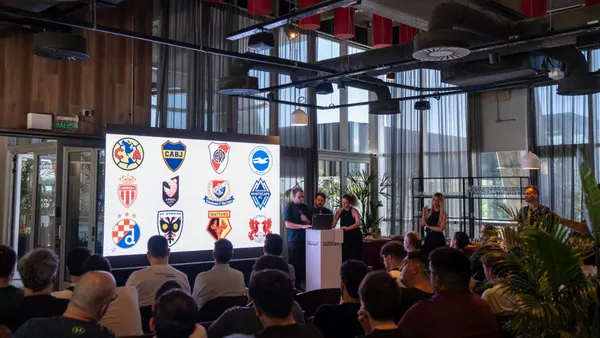
On November 11 we presented the new Bachelor's in Complex Systems at the School of Economics. In 421, Juan Ruocco and Felipe Vega Terra published two pieces explaining what we want to do. In It's More Complex, Ruocco argues that language models are changing the value of intellectual work: as intelligence gets cheaper, choosing problems and deciding what to do with it becomes the core of it. Felipe, in How It Was Designed from the Inside, explains why the degree combines math, computing, economics, and the natural and social sciences: to train people who can work on problems that don't belong to a single discipline, integrate knowledge and build things.
The last year and a half of the degree consists of workshops where students develop projects. Some of those projects will come from the opportunities the agents find: students working with researchers from different schools and with interested companies, learning to evaluate opportunities, negotiate, build products and make decisions about real problems.
Ruocco ends his piece with Thales of Miletus. According to Aristotle, Thales foresaw a big olive harvest thanks to astronomy, rented the presses before anyone else and made a killing. At UBA we have tons of people looking at the stars. What we're missing is someone to take care of the presses.
Reading it again
AI is going to keep getting better. The agents of five years from now will find relationships today's can't see, and we can reanalyze UBA's entire scientific output every time a better model comes along.
But AI doesn't even need to improve. An algorithm published twenty years ago becomes useful because now there are computers capable of running it. A biology discovery gains value thanks to a new technique. Two pieces of research thirty years apart end up solving a scientific or industrial problem together.
That's why the agents review new work all the time, connect it to older work and go back over discarded opportunities when technologies, costs, markets or the science itself change. Every new paper triggers a search across thousands of old studies, and every generation of models sweeps the graph again. UBA's scientific library gains value without a single new paper being published. In the piece on civilization I described it as intelligence distributed over time; the university holds a huge share of that intelligence, and the graph makes it searchable.
A datacenter in the closet
The second stage needs something more: the ability to analyze unpublished research without it ever leaving the university. That work can contain patentable inventions, confidential results or data that shouldn't be circulating yet, and whatever gets uploaded to some outside company's servers can be leaked or stolen. For that, the models have to run on in-house infrastructure. Until recently, running models capable of doing this work required very expensive infrastructure. That's changing fast.
In November 2026, Thinking Machines released Inkling 2 Mini, an open-weights model that runs on a laptop. It has about 26 billion parameters, the values it learned during training, and compressed it takes up around 20 GB: it fits on a MacBook with 32 GB of memory. Alibaba is heading the same way with Qwen, and projects like Ollama, MLX and Exo are squeezing more and more out of ordinary hardware.
Open-weights models can be downloaded and run on your own computers, with no internet connection and without sending a single document to another company. UBA can install them on its own machines and use them to process research, analyze data and give its scientists tools. To get started, a few machines at a few thousand dollars apiece will do. No data center required.
With that in place, researchers can voluntarily deposit their manuscripts before submitting them to a journal, and the system searches for applications and patentable inventions while the work is still confidential.
That's a head start of months. Publishing is disclosing, and in many countries whatever has been disclosed can no longer be patented. Law 24,481 gives Argentine inventors a one-year grace period, but Europe has nothing of the sort. Depositing before publishing keeps the option open.
The first objection will be "my journal won't let me." The major publishers already allow preprints to circulate, with conditions. Elsevier lets you share the preprint anywhere, anytime, and for Springer Nature posting it on a public server doesn't count as prior publication. A private vault is in principle compatible with those policies, as long as it respects each publisher's conditions and the rights to the manuscripts. And Law 26,899 already requires that anything published with public money be deposited in open access, but it leaves out unpublished work: exactly the gap the vault fills.
Looking at what's ours
In 1961, UBA switched on Clementina, Argentina's first scientific computer. Two years later, the Scientific Computing degree was born. That experience brought together researchers from different disciplines who started solving problems they couldn't tackle before.
The Complex Systems degree trains people who can integrate disciplines, work with researchers and build technologies and companies. The agents give them something to work with. Once it's up and running at UBA, the software gets released so other universities and CONICET institutes can do the same, and Argentina ends up with a network that combs through decades of research and returns part of the value to the institutions that made it possible.
UBA should start now: formally establish the system, appoint a team in charge, integrate its repositories, build the graph of researchers and scientific knowledge, put the agents to work and open the results to whoever can make use of them.
Then, leave the machine running. Every new paper, every discovery and every generation of models will give it new things to find.
The oil is in the backyard. Time to get to work.
Sources
- Juan Ruocco, Es más complejo, 421
- Felipe Vega Terra, Nueva Licenciatura en Sistemas Complejos: cómo se pensó desde adentro, 421
- Federico Carrone, Cuando la civilización se escapa de lo humano, 421
- Casey Handmer, audit of the scientific literature in astrophysics
- UBA: regulations for technology-based companies, 2023
- UBA: PREINC-UBA
- Elsevier: sharing policy
- Springer Nature: preprints
- Patent Law 24,481
- Law 26,899 on open-access institutional digital repositories
- Thinking Machines: Inkling 2 Mini
- Alibaba: Qwen
- Ollama, MLX and Exo
Las notas de 421 no tienen paywall
Y a cada colaborador se le paga por su trabajo. Las dos cosas dependen de los suscriptores.