California waves, punk, and video games: the soundtrack of skateboarding
From “Sidewalk Surfin'” to Tony Hawk's Pro Skater 2, via California garages, VCRs, and joysticks, this journey explores how music and skateboarding forged an unbreakable bond.
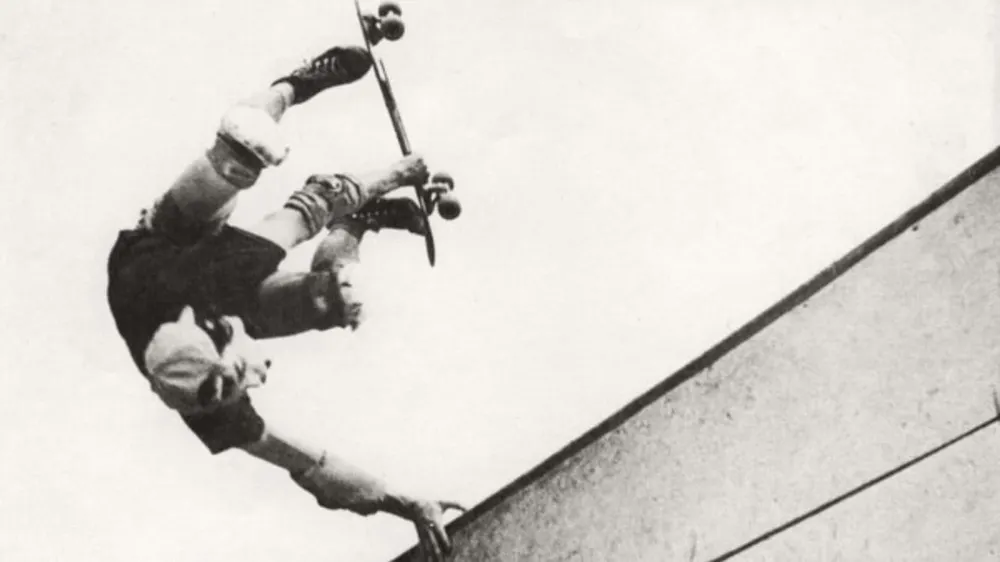
There’s a connection between the adrenaline rush that floods your bloodstream when the wheels scrape against the concrete and the distorted guitar riffs of Brett Gurewitz, the sharp thud of Pete Finestone's kick drum and snare, and the commanding voice of Greg Graffin. While we could be talking about many songs from that California hardcore punk stronghold known as Bad Religion, in this case, we’re focusing on "You," one of their anthems. Originally released on No Control (1989), this genuine punk slap in the face had a second, very successful life a decade after its release, thanks to its inclusion in the soundtrack of the video game Tony Hawk’s Pro Skater 2 (2000), the second volume of a franchise that spanned the years, marking a turning point in the gaming industry, skateboarding, and, of course, music related to this wheeled discipline.
The issue is almost always generational. There are those who lived through the VHS era, magazines, and fanzines. And then there are those, like the author, who entered this universe through the joystick. Let’s be clear: when we say universe, we’re referring to the vast, borderless territory where this connection we mentioned earlier takes place. No matter the age, music and skateboarding almost always go hand in hand: Sound and skateboard. Video part and soundtrack. Or, as in this case, video game and song.
There’s a connection between the adrenaline rush that floods your bloodstream when the wheels scrape against the concrete and the distorted guitar riffs of Brett Gurewitz, the sharp thud of Pete Finestone's kick drum and snare, and the commanding voice of Greg Graffin.
Back then, I hadn’t yet seen the logo with the crossed-out cross, nor was I aware that the band’s singer is also a well-known natural sciences teacher specializing in evolution. Consequently, I also didn’t know that their songs had already been part of the soundtrack for essential skate videos like Questionable, by Plan B (1992), where you can see a very young Danny Way (the same one who would later ollie… the Great Wall of China!) tackling stairs and rails amid the pounding drums of “Heaven is Falling,” creating a fusion of image and sound that felt as surprising as it was natural. So much so that it seemed like hardcore punk was made for skateboarding. Or that skateboarding was made to provide spectacular visuals for that fast and loud music that, I insist, back then I didn’t quite understand, but it definitely caught my attention.
While there was the option to play without music, the best part of Tony Hawk’s Pro Skater 2 was the playlist that played in the background while you maneuvered your character (you could be Tony Hawk himself, Steve Caballero, Rodney Mullen, or the super cool Chad Muska, among others) through an airplane hangar filled with ramps and rails. Plus, the challenge was a lot of fun: in a span of two minutes, you had to skate around the place and complete a series of missions to discover hidden corners without ever getting off your board, racking up as many points as possible by combining every trick you could imagine, making every surface of the level skatable. All of this while Bad Religion, Millencolin, Papa Roach, Lagwagon, Rage Against the Machine, Public Enemy with Anthrax (a great experiment, I must say), Naughty By Nature, and Fu Manchu, among other names that, of course, I also didn’t know, set their own rhythm for the game.
 Fede ‘okelfo’ Lo Giudice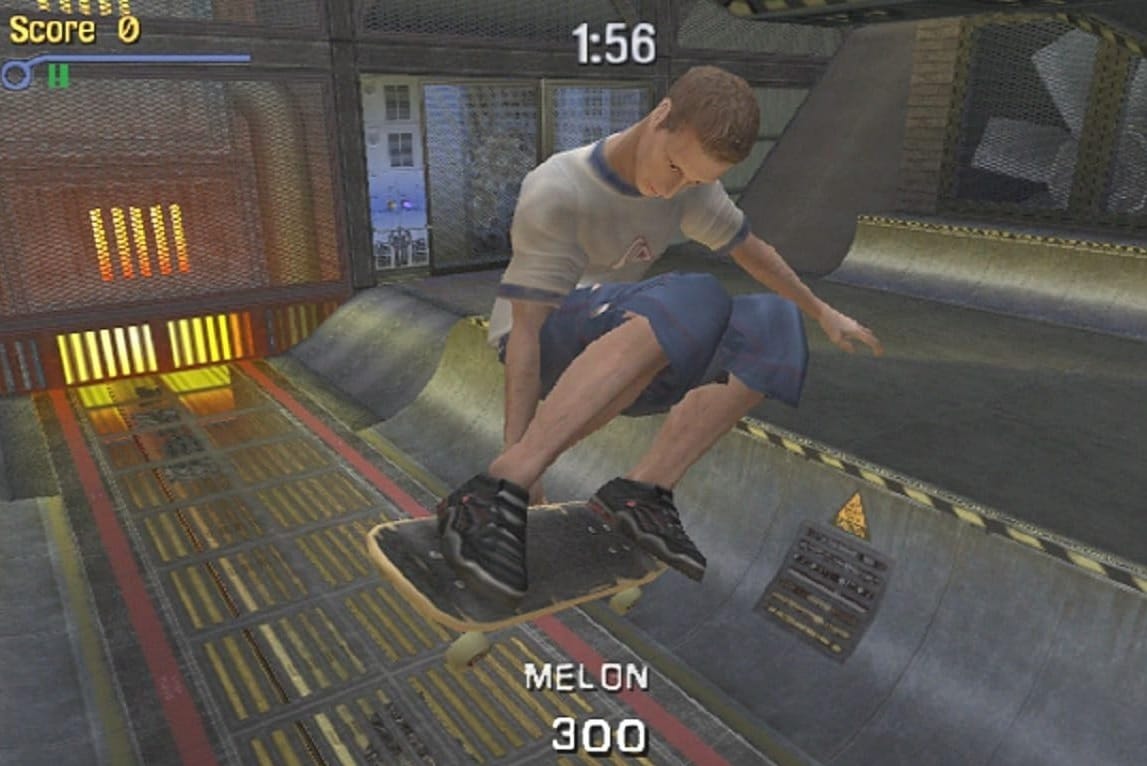
Over time, the soundtrack of this particular edition became an icon for an entire generation. With its solid PlayStation 1 graphics and its refined musical taste, Tony Hawk’s Pro Skater 2 was responsible for planting a seed that led to all sorts of sprouts and branches, from the revival of forgotten bands and works, the consolidation of burgeoning musical careers, to the very creation of new musicians and skaters (and skater musicians, a topic we’ll address later). As Tony Hawk told Keanu Reeves (!) on the podcast Hawk vs Wolf: “Music was a fundamental part of skating, especially in the formative years, the seventies and eighties. When I had the chance to make a game, I wanted to represent the culture, and above all, I wanted to include all aspects of it, including music. So I just started suggesting bands I listened to while growing up.”
Although there is some debate about it, when discussing the emergence of skateboarding, it is generally placed in California, and its older brother, surfing, is mentioned. A very romantic transition, but nonetheless real, that goes from the ocean waves to the edges of empty pools, the contours of dry drains, and the streets. Interestingly, that same transition, in some way, was also reflected in music. While it wasn’t their biggest hit, “Sidewalk Surfin’” (“Surfing on the sidewalk,” 1964), by the obscure California duo Jan and Dean, was probably the first explicit connection between skate and music. And it’s nothing more than a literal adaptation of “Catch a Wave,” by the Beach Boys, but with lyrics dedicated to the “newest sport,” saying things like “it’s becoming popular in all cities and towns” and “you can do the tricks that surfers do,” with the typical vocal harmonies of the genre.
However, over time, the connection between skate and music proved to be so close that, while the discipline gained its own autonomy, it also found its own sound. Again: the adrenaline, the speed, and also the guts required to ride the concrete waves forged a punk aesthetic (not always necessarily sonic) that inevitably spilled over into a multitude of references, nods, and links that, over the decades, transformed into solid bridges between two worlds that continue to feed off each other.
If we were to trace the origin of this carnal union, we could start with The Faction, the hardcore punk band of Bones Brigade legend Steve Caballero, inventor of seminal tricks like the Caballerial, a 360° ollie done for the first time on a vertical ramp at the age of… 16! Steve, along with skater friends like Gavin O'Brien and Craig Bosch, inadvertently inaugurated the title of skater musician. And also the skate punk genre. Formed in 1982 in San Jose, California, their motto was: “Music by skaters for skaters.” While they didn’t stray too far from the park and competition circuit, their song “Skate and Destroy” remains an unavoidable reference. But they weren’t the only ones.
The first show of The Faction was at San Jose City College on December 3, 1982, as the opening act for Social Distortion (its leader, Mike Ness, never turned professional but skated well into his forties) and Los Olvidados, a typical cult band that broke up before recording their first album but left their mark on the early American skate scene with their sound that combined speed, rawness, and a street aesthetic that directly spoke to the skater culture of the time. Something similar to what Agent Orange, from Orange County, had done a few years earlier, blending elements of punk with its older brother, surf (their album Living in the Darkness, released in 1981, is the best example).
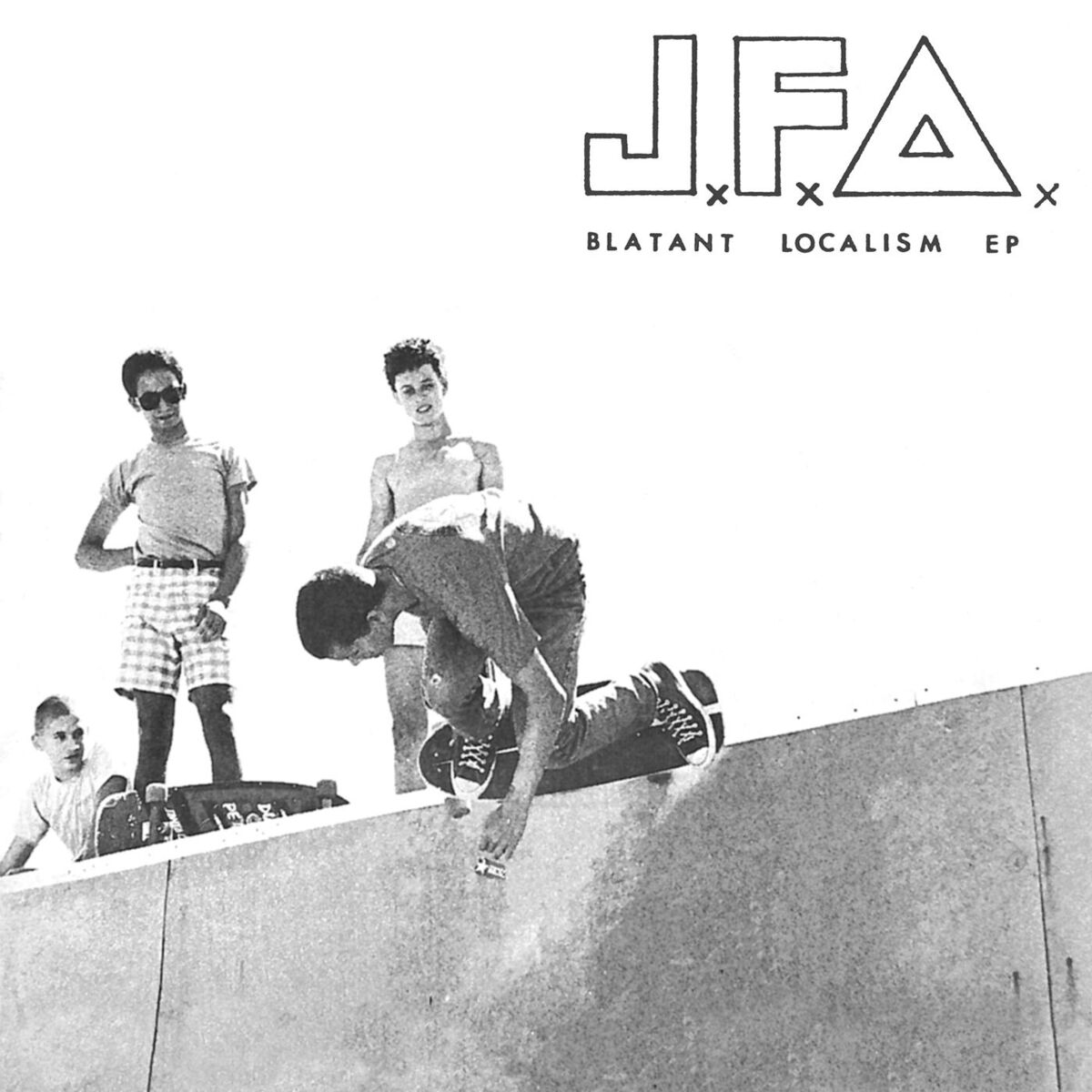
We could keep marking points on the geographical map of the United States with Agression, a hardcore punk band formed in the early eighties in Oxnard, California, that was part of the scene known as “Nardcore” alongside groups like Dr. Know or Ill Repute. Not far away, in San Francisco, a fleeting project that was part of the first wave of the rawer and more politicized California punk was Code of Honor, which shared scene and ideals with Black Flag and Dead Kennedys. The cover of their first single, What Are We Gonna Do?, features a photo of a local skater about to enter a giant inverted ramp. Not too far from there, in Phoenix, Arizona, was JFA (Jodie Foster’s Army), another hardcore punk band that depicted a typical scene of a vertical skate session on the cover of their debut EP, Blatant Localism (1981).
If we start traveling to the other coast, we’ll pass through Washington D.C., where a true skateboarding enthusiast like Ian MacKaye (The Teen Idles, Minor Threat, Fugazi) would apply the DIY ethic of this culture radically to his way of life. A definition of skateboarding by him that circulates constantly on social media serves as a manifesto: “Skateboarding is not a hobby. And it’s not a sport either. Skateboarding is a way to learn to redefine the world around you. It’s a way to get out of the house, connect with other people, and see the world with different eyes.”
From the Californian waves to the dry drains. From fanzines to joysticks. From punk to jazz and then to rap. The connection between skate and music lies in the same DNA: speed, the street, risk.
Further east, in Philadelphia, Pennsylvania, we have another skater musician, Chuck Treece, the first African American to appear on the cover of Thrasher, back in May 1984. Around the same time, Chuck formed his band McRad, which, unlike the more rigid sound of California hardcore punk, incorporated groove, funk, and other nuances, while never losing the energy of skate. His track “Weakness” became a classic when it appeared in the iconic video Public Domain (1988) by Powell-Peralta, which defined the link between music and skate in the VHS era.
In the article “A Visual Language for Skate”, published in this very medium, Juan Ruocco not only provides a good summary of the emergence and consolidation of the discipline but also lists a series of videos (and video games, of course) that were key in shaping the aesthetics of skate as we know it today. He mentions The Bones Brigade Video Show, Future Primitive, The Search for the Animal Chin, and, of course, Public Domain. All released in the eighties, they somehow laid the groundwork. For the most part, these pieces, endlessly replayed on VCRs around the world, feature original music composed specifically for the occasion. A lot of punk, hardcore, some blues, and also quite a bit of experimentation. An early demonstration that skate, beyond its natural connection with the tupá-tu-tu-pá, can blend with all kinds of genres.
Juan Ruocco 🧙♂️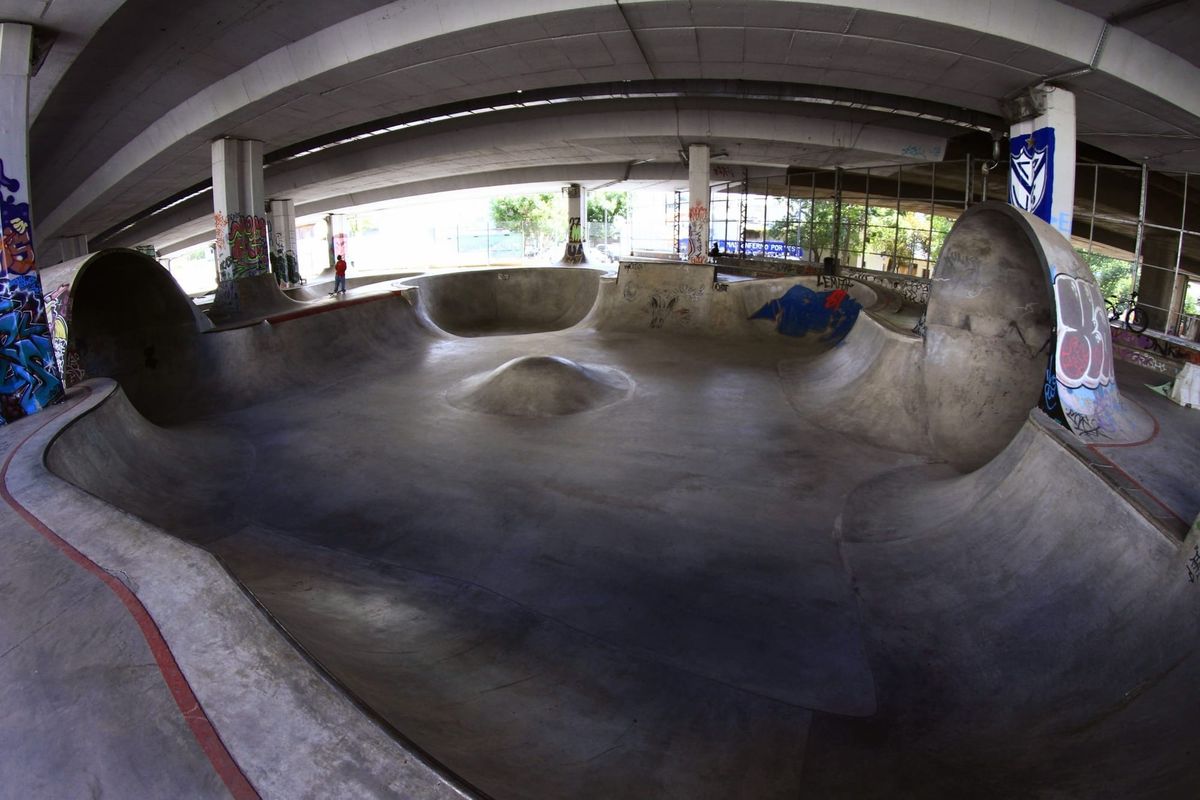
Around that same time, the film Trashing (1986), directed by David Winters, was released, marking a turning point for the skating discipline, with a soundtrack that would forever be etched in the memory of an entire generation. The most iconic track is undoubtedly “Blackeyed Blonde” by the Red Hot Chili Peppers (who still had guitarist Hilel Slovak and drummer Cliff Martínez in the lineup). The band even appears playing in one of the film's most significant scenes, representing one of the first direct intersections between a real band and skateboarding. Also featured are Circle Jerks, Fear, the brilliant Devo, Meat Loaf, Scorpions, and even Bon Jovi.
In the following decade, in the essential Video Days (1991) made by Spike Jonze for the brand Blind, Dinosaur Jr. (whose frontman, J. Mascis, is a well-known skate enthusiast) contributed a very fitting cover (because they literally made it their own) of “Just like Heaven” by The Cure, which accompanies a wild street routine by Rudy Johnson, a true specialist in the field. But jazz also makes an entrance through John Coltrane's sax with “Traneing In,” a song that pairs perfectly with Mark Gonzales's incredible 360° spins, another skateboarding hero. Fast forward another decade to Yeah Right! (2003) by Girl, where we see Paul Rodriguez, an inspiration for current legends like Olympic medalist Nyjah Huston (who is also a DJ), flipping down stairs and grinding edges while “Get Down” and “Made You Look” by Nas play in the background. Probably the best combination of hip hop and skateboarding ever captured on video up to that point.
From the Californian waves to dry drains. From fanzines to joysticks. From punk to jazz and then to rap. The connection between skateboarding and music lies in a shared DNA: speed, the streets, risk, expression, and the constant quest for a new way of doing things. The genre changes, the latitude changes, the generation changes. What doesn’t change is that feeling that certain sounds were made to be heard in motion, with the wind in your face and concrete beneath you. Skateboarding found its music. And that music, for the good of all, found it back.
Las notas de 421 no tienen paywall
Y a cada colaborador se le paga por su trabajo. Las dos cosas dependen de los suscriptores.