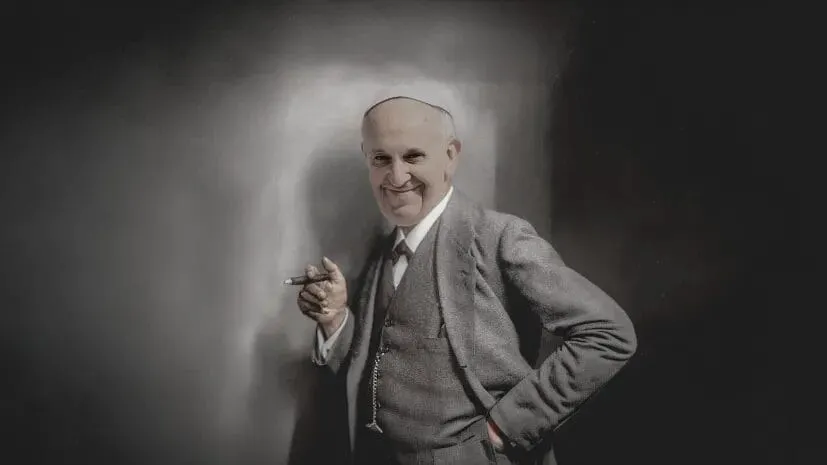
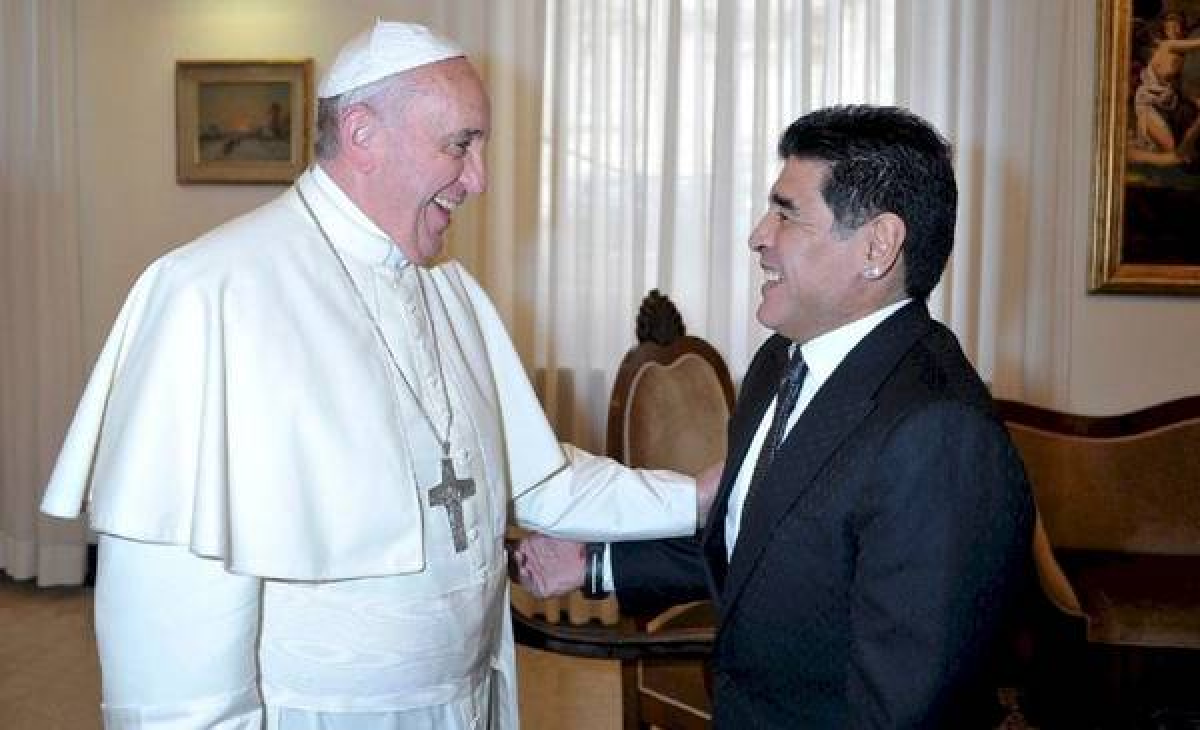
Did you know that the Pope underwent psychoanalysis? This article explores the connection between Bergoglio and psychoanalysis, revealing how his experience with a Jewish analyst shaped his perspective on mercy, humor, and the suffering of others. A dialogue between faith and the unconscious.
I consulted a Jewish psychoanalyst. For six months, I went to her house once a week to clarify some things. She was both a doctor and a psychoanalyst, and she always maintained her position. Then one day, when she was about to die, she called me. Not to receive the sacraments, since she was Jewish, but to have a spiritual dialogue. She was a very good person. For six months, she helped me a lot when I was 42 years old.
Habemus Papam (2011) is an Italian dramedy in which a cardinal is elected Pope against his deepest wishes. The College of Cardinals calls in a psychiatrist/psychoanalyst to help him overcome what appears to be a panic attack. Reality surpasses fiction: not only did we have an Argentine Pope, but he also underwent motu proprio psychoanalysis.
It was the early days of September 2017 when various news outlets around the world reported that Francis was sharing (or perhaps confessing?) this. Notably, the topic arose when the interviewer asked him about the women who had marked his life. That’s when he referred to his analyst, right after talking about his mother, his grandmothers, and his friend Esther Ballestrino de Careaga.
I will try to delve into both the parable of the treatment he underwent and the traces of Freudian thought that exist in his ideas, texts, and pastoral acts. To extract (in)voluntary contributions from his encyclicals and canonical texts.
He underwent psychoanalysis for six months, between 1978 and 1979. At that time, Jorge Bergoglio, the Jesuit provincial superior, lived in Buenos Aires. This led me to suppose, or rather fictionalize, that Francis underwent analysis in the Villa Crespo neighborhood, forming a chapter of my book #PsychoanalysisInVillaCrespo and other essays (2020).
From here, additionally, it became what we call a construction in Freudian terms. But not the construction of a clinical case about Bergoglio in analysis. The abstinence from speculation forced me to consider something else, which is the psychoanalysis of Francis. I will try to explore both the parable of the treatment he underwent and the traces of Freudian thought that exist in his ideas, texts, and pastoral acts. To extract (in)voluntary contributions from his encyclicals and canonical texts. The horizon is to think of the “Francis effect” as a crossroads between Catholicism and Argentinian popular culture, between politics, religiosity, and psychoanalysis.
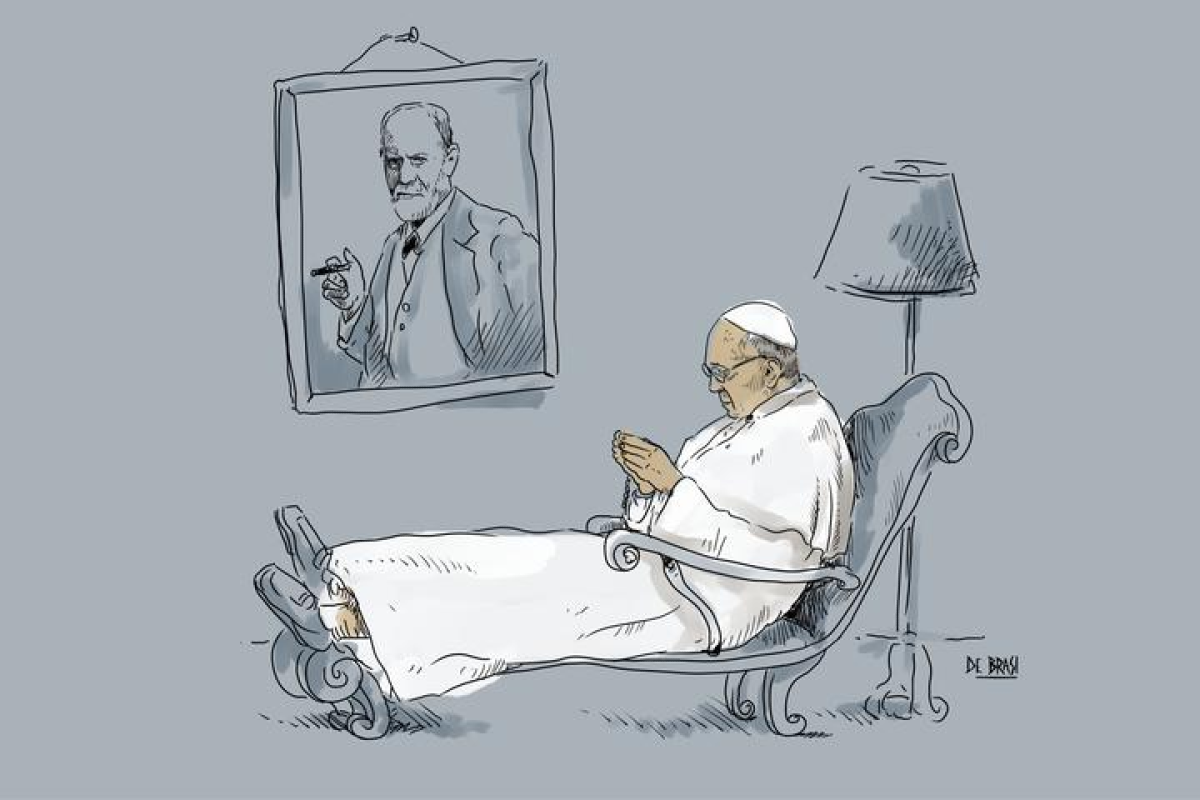
Ilustration: Matías De Brasi.
A priest and a cure
In 1961, during the papacy of John XXIII, the Holy Office prohibited priests from practicing and/or undergoing psychoanalysis. But in 1992, John Paul II opened a door to understanding between religion and the psi disciplines. It is said that during a speech before a group of psychologists gathered in Rome, he acknowledged his deep esteem for those who work to maintain the psychological balance of others, but he insisted that "no authentic therapy or treatment of psychic disturbances can conflict with the moral obligation of the patient to pursue the truth and believe in virtue."
Wojtyla promoted a balancing psychology, moderating conflict, perhaps an issue inherited from the Cold War that saw him emerge as primus inter pares. An intelligent distribution of spiritual tasks with a therapeutic approach conditioned to leave the pursuit of virtue and truth to religion. A clever way to dissociate cure and truth, normalizing at least two directions: an idealistic and benevolent religion that is unconcerned with suffering, and a sacrificial, welfare-oriented therapy, but deeply alienated/alienating. Any resemblance to the current state of certain psychoanalysis and certain religions (such as neoliberal evangelisms) is purely divine coincidence.
Following the historical data, we can affirm that Jorge Bergoglio underwent psychoanalysis during its official prohibition by the Holy See. We wouldn’t classify this as a transgression, as Jesuits have never been particularly obedient to the Holy Office. It is significant that he analyzed during the time of State Terrorism in our country.
Was he seeking refuge? What did psychoanalysis offer him that a classic confessional device did not? What was it about allowing himself to be taken by the word (his own and not that of God) that called to him? Perhaps the possibility of being heard by someone else, that female analyst who was also Jewish, felt more hospitable to him.
Father, son, symptom
In 2018, an Italian boy named Emanuele participated in an audience where children asked the Pope questions. When it was his turn, the boy tried to ask his question but couldn’t. At first, it seemed like embarrassment, but then his tears indicated a blockage caused by deep anguish.
Noticing this, Francis suggested he come closer and forego the microphone. Without shedding his embarrassment, let alone his pain, the boy approached until he collapsed in his chest. They embraced for a moment until he could whisper in his ear.
The boy returned to his seat to heartfelt applause. After asking for permission, Francis shared the peculiar question with the audience, not without exclaiming, “I wish we could all cry like Emanuele when we have a pain like the one in our hearts.” The boy’s father had passed away recently and was an atheist. The boy's anguished question was whether his father, who, although not a believer, had baptized him and his three siblings, and who was above all a good man, could go to heaven. Without dodging the question, but through an interesting detour, the first thing the Pope said to the audience was, “How beautiful that a son says his father was good.” He then addressed the boy directly:
Do you think God would be capable of keeping him away from Him? Do you think that? Let’s say it loud, with courage: No! God does not abandon His children, especially when they are good. There you have your answer, Emanuele. God is surely proud of your dad because it’s easier for a believer to baptize children than for a non-believer to do so. God must have liked this very much. Talk to your dad, pray for him. Thank you, Emanuele, for your bravery.
The boy’s question was spontaneously theological, and asking it of the Supreme Pontiff made perfect sense. But I dare to assert that, in addition to including a straightforward conception of morality and the transcendent, the response that Francis gave was spontaneously analytical.
A response accessible to a child, yes, but it was by no means a childish reply. First, due to the hospitable cleverness of inviting him to speak in his ear, dignifying the necessary intimacy to formulate true questions. Second, because he didn’t tell the boy anything he didn’t already know; rather, he inverted the words about his father. In other words, he made “atheist” not a determining factor, downplaying that detail; more accurately, he positivized his negativity, revitalizing the morbid stigma.
In 1961, during the papacy of John XXIII, the Holy Office prohibited priests from practicing and/or undergoing psychoanalysis. But in 1992, John Paul II opened a door to understanding between religion and the psi disciplines.
He introduced the particular bond of the symptomatic, bridging that curious child eager to know and the father who had given him a baptismal name. He didn't settle for a canonical, politically correct, benign, or confirmatory answer. He rescued the child's bravery as an agent questioning [the goodness of] his dad, and also pondered the apparent contradiction that this atheist father created by baptizing his children.
He presented a God interested in the contradictions and peculiarities of benevolent actions. He downplayed being and emphasized the ethical act, going beyond the logic of debt and charity.
He did all this on a tile, with the cleverness and sensitivity of tango, showcasing his Creole identity, reminding us of his fondness for Borges, Marechal, Kusch, and undoubtedly, his Freudian gestures.
"I never underwent analysis?"
After the confession of having undergone psychoanalysis, he made an eloquent rectification in 2021, where he clarified/obscured that he "did not undergo analysis." He was categorical yet ambiguous, and thus it is legitimate to read his rectification not as a closure but as an opening to a field of problems with clinical, philosophical, and spiritual implications, much more fruitful than the historiographical-celebrity affair of whether he was analyzed or not.
In the second statement or contrafesión, he stated that the woman was not a psychologist but a doctor and that it was not an analysis. However, as he elaborated, he did more than just deny or unfold an autofictional testimony: he directly referred to the psi in the formation of a priest. Or, with Lacan, he spoke about the Seminar:
"I am very open, and at that point (...) I am convinced that every priest should know human psychology."
From the above, one could say it was a more or less politically correct generality. However, what follows outlines the formulation of a problem that greatly exceeds common sense: "...what I don't see entirely clear is that a priest should practice psychiatry, due to the issue of transference and countertransference; there the roles get confused, and then the priest stops being a priest to become the therapist, with a level of involvement that later makes it very difficult to take a step back."
It is not about proving or falsifying what was said, but not everyone is aware of the risks of transference; one must have navigated those waters. Nor is the terminological obsession of interest, as it is not necessary to name psychoanalysis for a treatment to be one: its effects can occur even in the face of its denial. Did Peter stop being a Christian for having denied Jesus three times? One can choose to omit the name "psychoanalysis" to refer to a device confined to the transference neurosis that Freud invented. But if it has four legs, wags its tail, and barks...
Confessional device
Francisco recalled that confession serves "to move from misery to mercy." Is there not a familiar, Freudian echo regarding "transforming neurotic misery into everyday misfortune"? Mercy as methodology rather than as morality: passing the miseries of others through one's own heart, thus allowing a reunion and conversion of one's own miseries.
"Remember" comes from the Latin re-cordis: to pass through the heart again.
In Dilexit nos, his latest encyclical, he posits that the heart "makes any authentic bond possible, because a relationship that is not built with the heart is incapable of overcoming the fragmentation of individualism." He continues with his reading of the current emotional flat-earth theory, stating that "anti-heart is a society increasingly dominated by narcissism and self-reference", a degenerative social diagnosis leading to the "loss of desire" where "the other disappears from the horizon and we lock ourselves in our own selves".
In addition to reminiscences of Social Doctrine and the Theology of the People, there is an echo of the care of self from ancient times, unearthed by Michel Foucault: the confessional device as a precursor to the paths of self-knowledge of the past century (psychotherapies) and as an heir to the Hellenic tradition (parrhesía). This genealogy enlightens us about the updates and appropriations of syncretic practices.
Where morality triumphs at the expense of mercy, we would find the genesis of flat spiritualities/therapies, devoid of communion or subject: pure individuality.
One of the four principles of the now-famous polyhedron, presented in Evangelii Gaudium, argues that time is greater than space. Beyond its philosophical and political implications, this principle also has analytical power and applicability, as our profession seeks to free associate to unleash processes (memories, sayings, ideas, echoes, and questions) rather than occupy spaces, coagulate meanings, or overwhelm with answers.
“Listening space” is a euphemism that refers to the time needed to engage with silence rather than with words. The re-signification a posteriori is more important than the curative confirmation in situ. Knowledge is produced through a listening that floats and refrains from fixing itself as appropriation, creating a horizon of truth rather than temporary certainties.
Moreover, another principle posits that reality is more important than the idea, that is, the real as a condition for discourse. A warning or critical elucidation, Francis pointed out, against the various ways of concealing [psychic] reality:
-angelic purisms; -the totalitarianisms of the relative; -declarative nominalisms; -projects more formal than real; -ahistorical fundamentalism; -ethics without goodness; -intellectualism without wisdom;
All of these are classic and postmodern forms of neurosis, which also serve as a warning to avoid the degradation of psychoanalytic discourse into petty bourgeois moralism and/or a vending machine of “tips”.
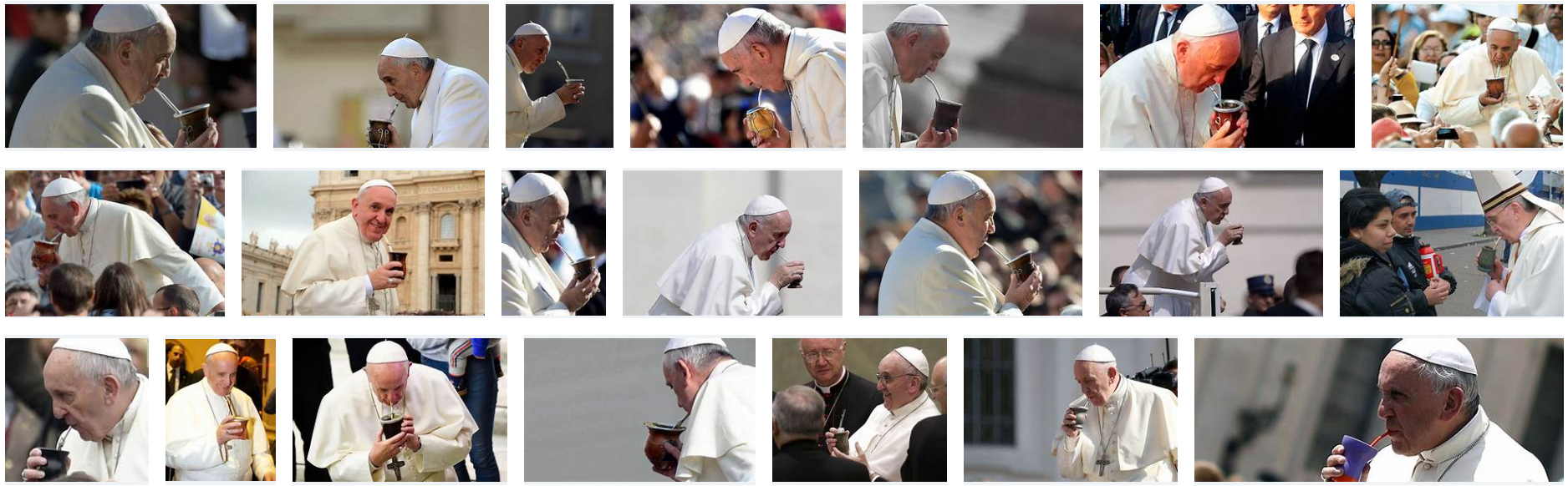
Neuroses need to be nurtured with mate
It was neither casual nor infrequent to appeal to images, tones, and beautiful parables with criollo inspiration, such as:
Neuroses need to be nurtured with mate. Not only that, they also need to be caressed, cared for. (…) The person must be attentive to the neurosis, as it is something constitutive of their being, (…) they are companions throughout life.
Those who analyze themselves have experienced that words can caress and also lash out. We refer, rather than to an erudite saying, to the transmission of the impossible from simplicity. It is never trivial for a priest to testify about the power of listening: that aspect of humanity that reminds us of our mortality as speakers.
Reading his discourse literarily, we catch a whiff of something akin to the experience of psychoanalysis: what is important often tends to be that which seems less significant, the fragments of speech, the “secondary”. The treatment of neurosis focuses on the small to pave the way for significant choices. Was it God or the Devil who was in the details?
Francis insists on the importance and difficulty of assimilating one’s own history, and how this leads to major social, political, and spiritual problems. He also preaches that “when conflicts are not resolved, but rather hidden or buried in the past, there are silences that can mean becoming complicit in serious errors and sins” (Fratelli tutti, 224). It is not an aphorism overflowing with originality, but when stated by the highest representative of the greatest religious institution of all time, it is at least eloquent: the vicar of Christ referring to the quasi-divine value of history as a means to dignify conflict. He speaks to us, in his words, of the analytical symptom.
“And those who tell you that everything starts anew now, laugh in their face! They are clowns of history.”
The colloquial use of phrases like “that left a mark on my subconscious,” very present in the interviews he gave for the tenth anniversary of his pontificate, reminds us of his porteño proximity. Moreover, we can say that his humanist Christianity included the habit of appealing to those Freudian rudiments that shape our Spanish… And it is well known that habit makes the monk.
In an interview with Corriere della Sera, he was asked if he disliked anything about his public image. His response:
A certain mythology of Pope Francis. Sigmund Freud said, if I’m not mistaken, that in every idealization there is an aggression. Painting the Pope as a sort of Superman seems offensive to me. The Pope is a man who laughs, cries, sleeps peacefully, and has friends like everyone else. An ordinary person.
More Freudian than that: “one can defend oneself against attacks, but against praise one is defenseless.”
Discernment and listening
There is consensus in positing that, in addition to the emphasis on mercy, discernment and synodality are two contributions of his pontificate for posterity.
Discernment, of Jesuit tradition, is defined as the art of knowing how to decide, and aims to access the truth of God. For this, reason and faith would not be opposed but rather the opposite, as it would be a form of “spiritual intelligence.”
But even when discernment leads to The Truth, the very art and its evangelizing counterpart self-limit: to discern does not mean to impose that truth on others, an excess that often characterizes emotional psychoeducation, suggestive evangelisms, and post-secular hypnosis.
Confiding and whispering would remain the means, promoting a reciprocal knowledge that is not necessarily mimesis. More than trust and intimacy, it is an extreme closeness that may require acculturation. A sort of transferential ethnography. What is whispered is not the mundane but the precious and exceptional, what is considered will significantly help the other: a true revival. Confiding allows one to approach in order to convey the incommunicable.
If changes are processes, and processes are slow, an imposed change does not produce effects, as the good shepherd would say, but also the good clinician, who is aware of the inherent difficulties in psychic work, with obstacles such as the viscosity of libido, the compulsion to repeat, and the death drive.
The cardinal-poet José Tolentino de Mendonça, appointed prefect by Francis, described discernment as a process that "requires distance, freedom, indifference; one must accept that it makes no difference whether something is A or B: what matters is that the will of God is done. This availability, this complete openness is fundamental for discernment. Without it, I am seeking my taste, my pleasure, my interest, my will; however, if I achieve this total openness, this perfect indifference, then I create the space in which God manifests His will."
This total availability, which is neither condescending nor rushes into forcing, can also be traced in the Taoist tradition with the notion of Wu Wei. This delineated zone between distance, indifference, and proximity is the same field where a psychoanalyst operates their listening, the evenly floating attention. For this, we rely on principles that are both technical and ethical, such as neutrality and abstinence. On the opposite sidewalk, we would find the evangelizing crusades and the fervor of curandis, which often leverage what Lacan called "doing good."
To avoid the latter, we have synodality. Derived from the Greek concept of "walking together," it was Francis's commitment to return to the roots of the early Church: horizontality, community, co-responsibility.
On October 17 (!!!) of 2015, Francis stated that the synod "is the appropriate interpretive framework for understanding hierarchical ministry," showing us the relevance of the matter and bequeathing a powerful thesis to think about, no more and no less than the relationship between knowledge and power. A technology as old as the Church itself but which curiously still seems advanced to us: inventing a device that allows for and organizes around the word.
Discernment and synod as pairs that mix reflection, discussion, introspection, and listening. Not a demagogic and false "horizontality," but rather an asymmetric parity, like what happens between transference and interpretation. It is not a democratic relationship, with majorities/minorities or debate of ideas, but a reversed verticality where the primus inter pares and all his curia are at the base serving the most marginalized of the faithful. The analyst, with their power and attributes, serving as support and object of transference.
Once again, the Theology of the People and an anti-clerical invitation that we would do well to take within the analytical movement that is, always but now also via streaming, rife with pharisaical dogmas, false prophets, converted crossovers, untouchable popes, and sectarian armaments.
Grace and its relationship with the unconscious
The Madman of God at the End of the World (2024) is an essential book by Javier Cercas, an atheist Spaniard who allows himself to be touched, if not by faith, at least by the beyond of his own prejudices. There he confronts several collaborators of Francis about what the Romanian poet Cioran said, that "every religion is a crusade against humor," who do not respond by evasion but in a resolute negative, quoting our Pope: "the sense of humor is the human expression that most resembles divine grace." Moreover, in an official document dedicated to holiness, Francis postulated that one of the traits of a saint is the sense of humor, as it is the fundamental grace. Humor, grace, as synonyms of fraternal love.
Let us remember that in The Name of the Rose, whether the book (1980) or its film adaptation (1986), the issue of humor, laughter, and ironic distance is at the center of the political-theological drama: prohibiting it for satanism or liberating it as secularism. Francis's position was to reintroduce it into the domain of the divine.
Francis, who was Jorge de Flores and spoke in porteño, inhabited the linguistic metonymy where gracia is close to gracioso. For us, "to make a grace" is to make a joke, which is always a vehicle for social bonds. In The Joke and Its Relation to the Unconscious (1905), Freud makes the Witz ("joke," "grace," but also "clever saying") the very model of the unconscious, a word that always disarms towards another scene.
Lacan, who had a similar conception of holiness, making the saint an analogy of the analyst, would say that this clever exit involves a dazzling sharpness that "stuns the entire order of language in an instant," as it allows for a fleeting revelation of the inconsistency of the Other. But all this he said while speaking his own language, where joke/grace is mot d'esprit: something like "spiritual phrase."
Taking another metonymic step, "spirited" is also an intense alcoholic beverage, which intoxicates us and brings us closer to grace in both senses: the clever-spiritual, that fleeting and ingenious, sharp yet elusive and at the same time forceful, just like the joke, the soul, or the subject of the unconscious.
Even less coincidentally, in Greek "grace" (charis) has the same root as "humor, merriment, joy" (jara). Metonymy, rather than metaphor and alongside metanoia, is divine.
La gracia de D10S.
Francis's humor is related to the Hippocratic conception of humors. Greek humorism was nothing other than its medical model, and we are entitled to record it, along with Freud, as heirs of this ancestral tradition of treating the/soul through the word. The only fundamental rule of psychoanalysis, formulated by its inventor, is not limited to intellectual occurrence nor necessarily to "saying what I have in my head," but something much beyond: "say everything that comes to your spirit."
In the name of the Pope
Let up keep in mind that it is the signifier of the father's name that orders the symbolic order. A Pope does not adopt just any name for his pontificate. It is a baptism but also the first act of governance. In Francis's case, this baptismal act of self-naming implied a change in political position. If he was analyzed as Bergoglio, why not think that it was this experience that allowed him, a posteriori, to go beyond his name, beyond his worldly dilemmas as Argentine archbishop, caught up in cliques and small narcissistic-political differences?
He maintained the confidentiality of the analyst until his death and preferred not to reveal his identity. Did he perhaps recall his role as confessor and that common trait of professional secrecy? Perhaps he simply preferred the gesture of communicating it but without the intent of fostering gossip. Or perhaps it slipped out, and this lapse led him to an interesting fact: that towards the end of a treatment, the name of an analyst becomes the least important, even somewhat anecdotal. This in no way implies the burial or renunciation of the person, but rather the opposite: a transference is dissolved at the moment one goes beyond the proper name, including that of the analyst, to reposition it in the place of person, affection, peer, mortal, etc.
If he was analyzed as Bergoglio, why not consider that this experience allowed him, a posteriori, to transcend his name and worldly dilemmas?
While still Bergoglio, after completing his treatment, he spoke again with his psychoanalyst when she was on her deathbed. It was she who reached out to him, and according to him, it was a warm, tender, and strictly spiritual exchange: neither to analyze him nor to receive sacraments that did not align with her beliefs.
Wisdom to avoid clichés and uphold the incomprehensibility: not only the one that exists between psychoanalysis and Catholicism, but also the distance that any discourse, including religious ones, presents in the face of death. Her clarity and the depth of her response must have allowed them a dialogue beyond words.
More than comfort, there is in the latter a political-spiritual indication we can gather: to navigate the difficulty of an encounter to provoke common and a priori incalculable processes. We psychoanalysts call this desire.
✦ Suscribite
Las notas de 421 no tienen paywall
Y a cada colaborador se le paga por su trabajo. Las dos cosas dependen de los suscriptores.
Psicoanalista, docente en Psico/UBA. Compilé "Neurocientismo o salud mental" (2019), escribí "#PsicoanálisisEnVillaCrespo y otros ensayos" (2020) y co-escribí "Psicoanálisis, Feminismo, Peronismo" (2022).