Asimov: Optimistic Science Fiction for Imagining the Future
In the face of the nuclear pessimism of the 20th century, Isaac Asimov emerged as a prophet of optimism. While others imagined the end of the world, he introduced the concept of psychohistory and believed in science as humanity’s salvation.
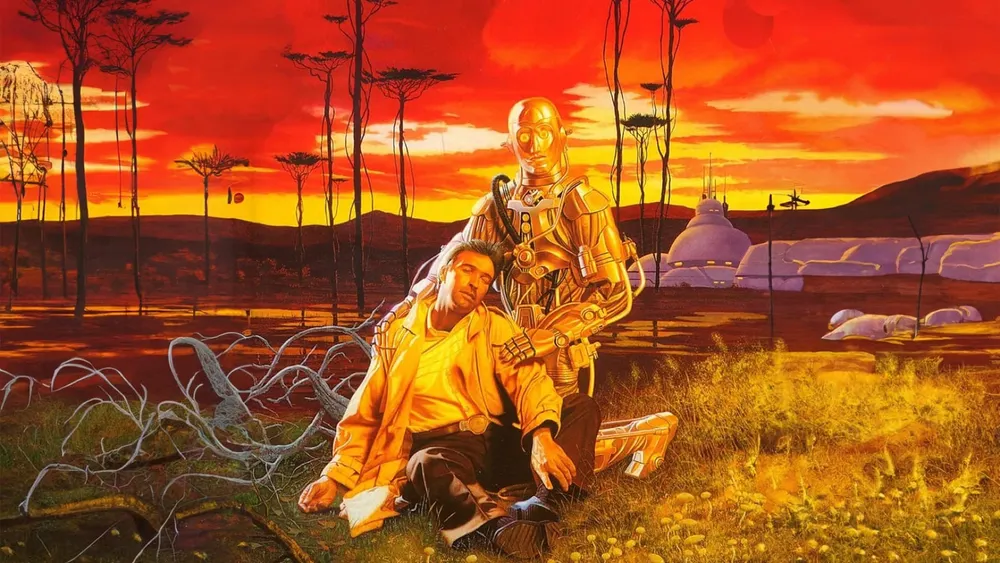
The Cold War was one of the most tense periods globally. Nuclear technology threatened to blow up a world where humanity competed among hyper-militarized opposites. However, none of the 'big three' of science fiction (Asimov, Clarke, and Heinlein), a genre that is precisely characterized by imagining the future, engaged with apocalyptic fantasies. In particular, Isaac Asimov actively chose not to participate in 'that procession of pessimism and death' that was the publication of story after story about nuclear disaster.
Science fiction editor and writer Ben Bova thought of writers as explorers sent by humanity to watch over the future and return with recommendations to improve it. Asimov was right: he always trusted humanity and science to prevent nuclear collapse.
None of the 'big three' of science fiction (Asimov, Clarke, and Heinlein), a genre that is precisely characterized by imagining the future, engaged with apocalyptic fantasies.
Isaac Asimov emigrated at the age of 3 from the Soviet bloc (without any persecution, according to him) with his Jewish family. At 18, he published his first story, 'Marooned off Vesta' (1939). While training as a chemist and anxiously waiting for a call to arms to fight in the Pacific War, he published what would become the first stories of a saga that would manifest confidence in human progress: Foundation.
Published in installments since 1942 and compiled as a novel in the 1950s, the saga (which, depending on who you ask, has three, seven, twenty-one, or more central volumes) centers on the work of 'psychohistorian' Hari Seldon, who through his revolutionary discipline can predict the movement of major social events, foresee macro-level crises, and devise the most plausible ways to confront each one. From this, he anticipates a civilizational collapse and promotes the creation of a colony, the 'Foundation,' to preserve knowledge and the physical integrity of humanity.
 Emilio Méndez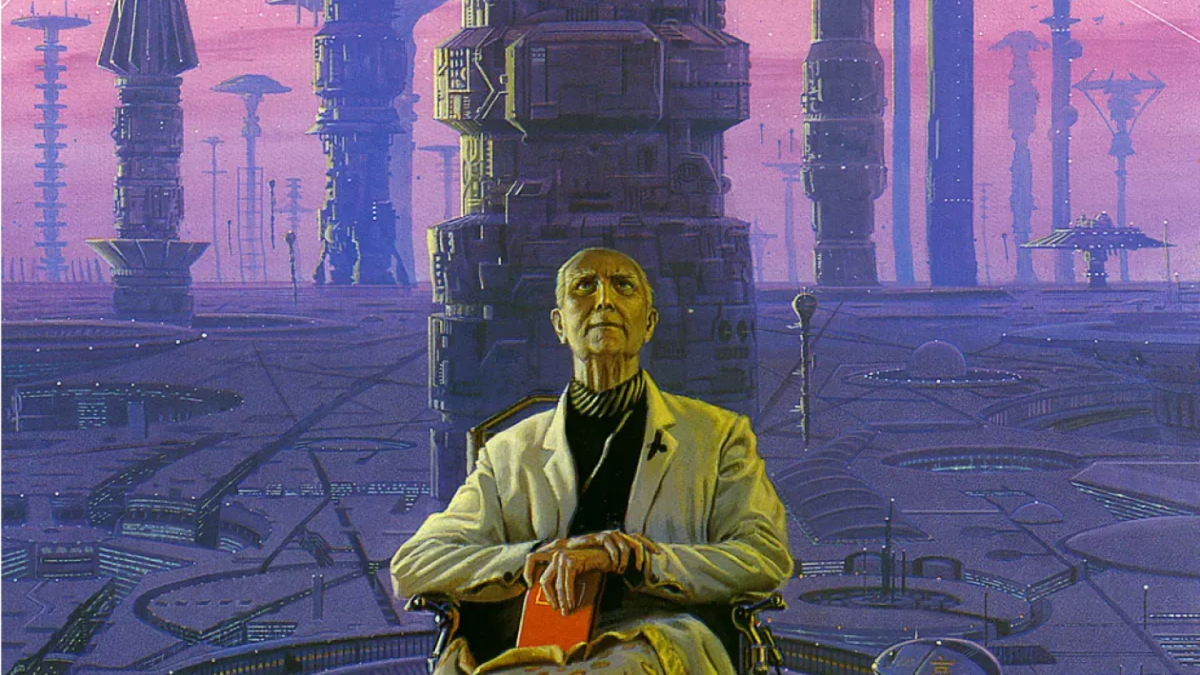
Asimov conceived the idea of psychohistory after reading historian Edward Gibbon, who in the 18th century wrote one of the most comprehensive accounts of the fall of the Roman Empire. Asimov decided to tell the story of the fall of a galactic empire, but this time it could be saved thanks to a science capable of predicting and shortening the era of 'barbarism.'
Except for exceptions like 'A Pebble in the Sky,' where planet Earth is devastated by a wave of radiation, in every apocalyptic scenario Asimov presents, humanity survives, even if it means abandoning its home to expand into the universe. He responds to everything with the science of his time and the potential of supercomputers. He didn't consider himself an exceptional scientist either. He failed a thousand times before graduating in chemistry and, once involved in academia, wrote popular science books on topics for which he was often criticized. But that education surely made Asimov trust in a power greater than any other: intelligence. And especially, the intelligence of specialists.
Silly Asses
Whether referring to antisemitism (Nazi or American), the violence of the Zionist project, or the ethnocidal background of Azerbaijan's independence movement, Asimov understood that the problem of tyranny lay in the inequality of power. He believed in the possibility of balancing wills and needs. In "Silly Asses", one of his most well-known and charming (and instructive) short stories, a tribunal of 'the long-lived Rigelian race' discovers that planet Earth has achieved thermonuclear knowledge and records it in a registry of species that will soon contact other advanced civilizations sharing the cosmos. Until the leader, Naron, discovers that humanity has not yet developed intergalactic travel and that they conduct nuclear tests on their own planet, and for the first time in their long (likely as long as the universe) history, he strikes the species' name from the record while shouting indignantly, 'silly Asses.'
A brief, powerful, and endearing tale about the childhood of human 'technological progress.' Perhaps due to his Jewish background, perhaps because of his Soviet heritage, or perhaps because his own intelligence was the trait he was most proud of, Asimov couldn't help but think of a tribunal of superior scribes, guardians of peace and knowledge. Law and what is right were above humanity, embodied in some alien entity.
Asimov wrote very much in line with the progress of his time, one that was linear and positivist. But, as Polish writer and theorist Stanislaw Lem advocated, biological evolution and technical evolution share logics of trial and error, selection, adaptation, and extinction. There is a decoupling between intention and consequence, a central drama of technology. We can create technologies whose consequences we do not understand or create new problems that may be more destructive than those we had before. How do we process our place in the multiverses through string theory? What impact have social networks had on our ways of connecting? For now, we have been smart enough not to make cyberpunk a reality.
Towards the end of his life, Asimov acknowledged that the science of the 1940s and 1950s changed drastically with quantum mechanics and computing, admitting that in certain fields he felt 'overwhelmed' or like a 'living fossil' in the face of new waves of knowledge. But if there is a reason we continue to read him attentively, it is because the relationship with science is, in many cases, through tenderness.
Biological evolution and technical evolution share logics of trial and error, selection, adaptation, and extinction. There is a decoupling between intention and consequence, a central drama of technology. We can create technologies whose consequences we do not understand.
That tenderness can be found in several of Asimov's stories, such as 'The End of Eternity' or 'Child of Time.' Personal tales that involve time travel. In the first, an agent from an 'out-of-time' institution introduces small changes to prevent catastrophes in human history, falls in love with a 'non-eternal' woman destined to be erased, and hides her in the Hidden Centuries (a period in the distant future that the Eternals cannot access). Go find her in the corner of Eternal Sunshine of the Spotless Mind. In the second, Edith, a nurse (scientist, of course) from an agency that 'fishes' organisms through time, grows fond of a Neanderthal child who had been separated from his family in a snowstorm and captured by the company. In the end, she escapes with him in a time bubble to care for him in the Ice Age, where she prefers to face death rather than continue relating to a dehumanized present.
What triumphs, always, is human will. That which imbues technology with warmth. If Peter Thiel is a villain, the motives go beyond Palantir as an instrument. Peter Thiel wants to classify and control human beings as if they were spark plugs in a massive machine. But technology has room for the sensitive. The ending of Neon Genesis Evangelion retains a glimmer of optimism precisely because the 'project of human instrumentalization' allows (thanks to Shinji accepting the discomfort of coexisting with others) for us to reclaim the human aspect in every technology we create.
 Javier Pallero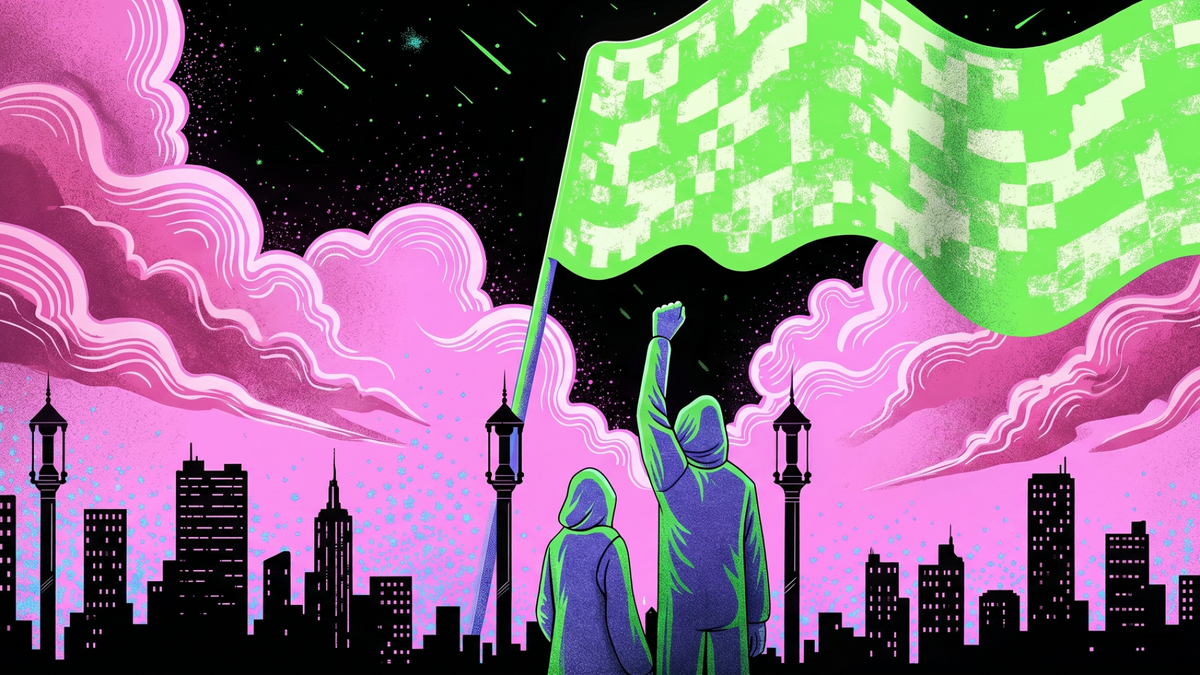
In fact, to avoid the “Frankenstein complex” (the creator is destroyed by their creation), Asimov created the Laws of Robotics which, if you think about it, are nothing more than a way to rationalize millennia of social conventions and apply them to robots. Something we already summarized in Hobbes' natural laws: “do not do unto others what you would not want done to you.”
Reading Asimov often leaves us with a warm feeling in our hearts. With the sense that, even when the sun consumes half a solar system, we’ll all be okay. Not all technology leads to genocide and homogenization. Setting aside the Deep State's desire for control, we live in a society as heterogeneous as it is wonderful.
Asimov spoke of “The Last Question” as his favorite story. One in which he trusted that humanity was capable of creating (almost by chance!) something better than itself. In this little tale, the supercomputer Multivac ends up reversing the entropy of the universe, one of the most terrible laws we’ve formulated: that everything tends toward dispersion, toward death, toward extinguishment. The resolution of the story, where the computer finally finds the answer to regenerate the cosmos, epitomizes his belief that the machine will retain a trace of human intelligence.
If there's one thing said about this era, it’s that it struggles to imagine a future. That it doesn’t even express optimism about the present. Some attribute this to an excess of relativism. But Asimov is different. We know the Foundation was invaded, we know there were battles with thousands of human losses. But that play of lights and explosions like Star Wars (great movie, no one can say otherwise) is not what interests him. Resistance to horror is possible, and it is achieved through knowledge. Because, as the quote by Salvor Hardin that is repeated throughout Foundation says, “Violence is the last resort of the incompetent.”
 Ana Iriarte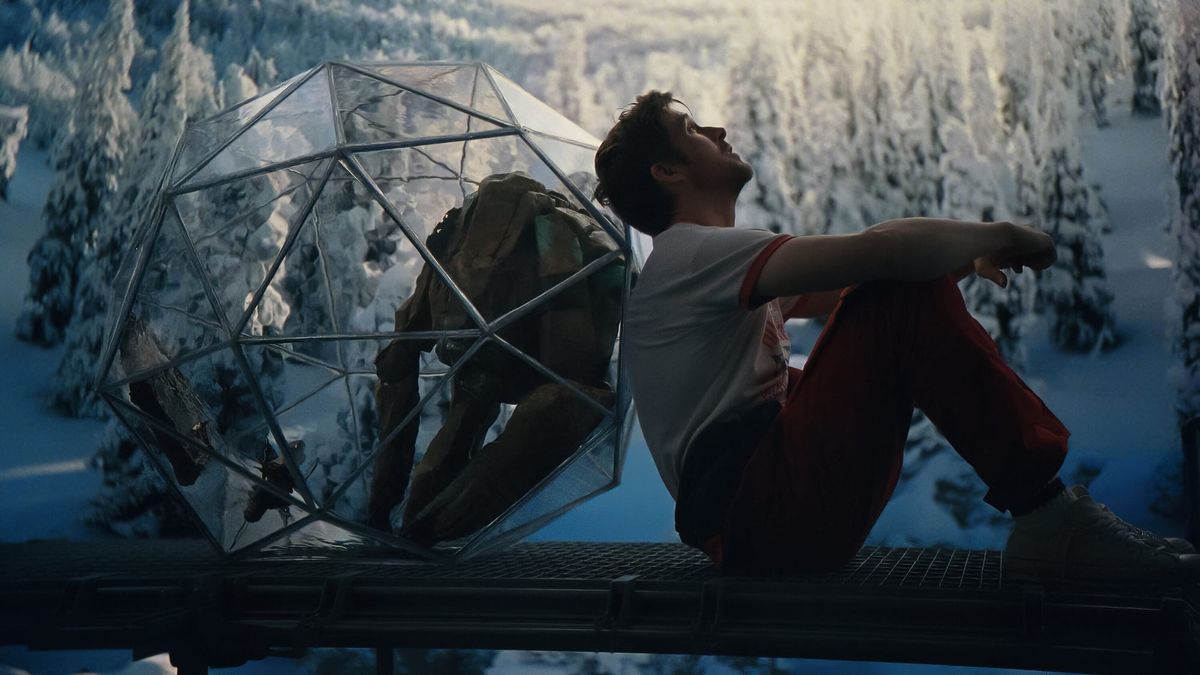
But, as anyone who has read the original trilogy knows, even psychohistory fails. And, as we know in our 21st century, science is not a guarantee of any linear progress. Things sometimes don’t turn out, indeed, as optimists believe they will.
And yet, we need them.
Sometimes life may not find its way. But even in the worst apocalypses, Asimov places hope in humanity.
Against an apocalypse narrative
Asimov is the counterpoint to other geniuses, like H.P. Lovecraft. While the Wizard of Providence saw the others as the greatest threat, Asimov had faith that, despite the universe hating us, human will is more powerful. Lovecraft wrote against the world, against life, while Asimov was a happy storyteller. What does it matter if humanity is an accident of the cosmos?
There’s a reason Asimov wrote humorous stories and H.P. Lovecraft did not. And, by the way, Asimov's humor often revolved around attractive women, somewhat stingy friends, and the horrors of having to work. Chad.
Perhaps Asimov was looking at something else. He said:
“There’s a story in Jewish moralistic literature where God refrains from destroying this wicked and sinful world out of consideration for the few righteous men born in each generation. If I were religious, I would believe in it devoutly, and I will never be grateful enough for having known so many righteous men and so few wicked ones.”
Asimov finds happy endings even where they shouldn’t exist. Even in his own personal story. The memoirs he writes while dying of AIDS from a contaminated blood transfusion read like the most grateful testimony of a full life, with post mortem comments from his last wife and nearly 20 chapters in which he remembers and honors the writers and editors he shared his journey with. In that sense, Asimov is the absolute opposite of Lovecraft. Optimistic, confident in the future and humanity, open, friendly.
 Facundo Dell Aqua
Since the seventies, it has become increasingly difficult for us to imagine a future that isn’t dystopian. A city that isn’t like Night City from the Cyberpunk role-playing game or Los Angeles from Blade Runner.
There’s no longer a collective idea of what it means to be human (as there is in Asimov's work). There hasn’t yet been a space mission proposing to plant the flag of humanity on the Moon. That flag doesn’t exist. Saying it feels ridiculous, in fact. NASA doesn’t accept citizens from any country other than the United States in its ranks, and private initiatives are heavily tinted with a strong personalistic, individualistic, libertarian (bootlicking) component. Something more akin to what Kurt Vonnegut saw in The Sirens of Titan, where humanity is invaded by Martians at the hands of a sybaritic tycoon (if there’s a God, bless Kurt Vonnegut).
The problem (and the solution) of the fractal
Asimov opts for hope. His optimism is possibly a rational defense mechanism against the trauma of the twentieth century, which crystallizes into a deliberate humanistic proposal. He said:
"I believe that scientific knowledge has fractal properties; no matter how much we learn... it is as infinitely complex as everything was at the beginning."
For Asimov, science hadn’t failed. Rather, its complexity was infinite, and thus, each new discovery opened new layers of mystery. The problem that concerns us, of course, is the power dynamics. What we live on. Whom we entrust our destiny to.
A current problem with technology is who got to the post-capitalist process of primitive accumulation first. Who planted the flag in what we came to know as the Internet (which is still very much alive). The issue today is who has access to that technology that classifies and reclassifies us. Not that market studies, phrenology, pure and simple racism, or opinion polls didn’t exist before. But the algorithm functions as something depersonalized that also absorbs our creative capacity and returns it chewed up by the infosphere. And not even for our benefit.
 Leonardo Mangialavori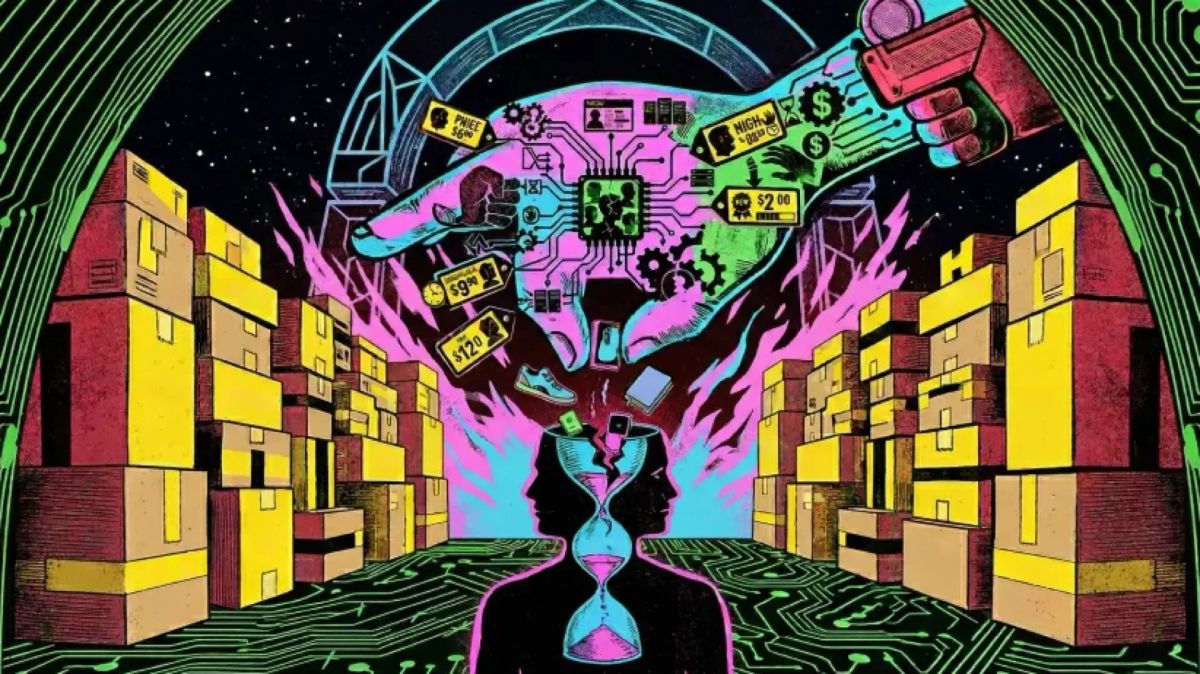
The problem with current language models, in particular, is their coldness, detachment, and permanent residence in the uncanny valley, that place of perception where something feels familiar yet retains an inhuman quality that disturbs us the more we look at it. An alienated entity tries to pretend it isn't, while a human being tries to alienate a part of their daily life into a robot that solves things for them.
Today, "everything is more complex." Asimov saw himself as a generalist. If he had ever wanted to ride a pseudo-messianic rhetoric, he could have been a prophet of progress, a champion of science (like Neil Degrasse Tyson was for a couple of years, now considered by many as an insufferable blowhard who won't stop talking about atheism and marijuana).
The problem is that, indeed, everything is more complex. Research issues collide with funding issues, which clash with what we conceive an ideal society should be, which intersects with individual feelings, which meet the challenges of the masses, the emotional landscape, and the unspeakable.
The issue with current language models is their coldness, their detachment, their permanent residence in the uncanny valley, that place of perception where something feels familiar yet retains an inhuman quality that disturbs us the more we look at it.
Technological potential is limited. We tend to think of progress as a borderless realm, but creativity shouldn't only be applied to how we formulate codes and questions, but also to how we assemble our tools. Moreover, the processes of adopting technologies are lengthy, as is currently happening with artificial intelligence or cryptocurrencies.
But while Lem anticipated debates about the potential and meaning of technologies, Asimov surprisingly foresaw discussions about the ethics and utility of science. I doubt he read Camus (maybe he did, who knows), what we do know is that he preferred to dive into the typewriter and complete over 400 books of fiction, non-fiction, and popular science, to have a significant voice in the 20th-century science debate.
It's very simple. How could you not love Asimov? With his sideburns. With his nerdy jokes. With his faith in all things beautiful and his rejection of power abuses. With his universalism, his outsized ego, and a clear understanding of his limitations.
 Fernando Bogado
Yes, Asimov was aware that the apocalypse was two minutes away, as Iron Maiden says. And yet, he chose not to be a prophet of doom. Instead, he flipped the Gramscian leit motiv of "pessimism of the intellect, optimism of the will." His optimism was almost entirely placed in intelligence and the human will to live. Just like those of us today who fight to ensure that not everything we love is vampirized by that world that demands we monetize our passions.
If there was one thing that worried Asimov, it was having to work. He could write for hours on end without stopping, but the thought of depending on a paycheck, adhering to schedules, and dealing with bosses was one of his greatest horrors.
Totally understandable, Isaac.
After all, when a reader asked Isaac Asimov what he would do if he knew he had six months to live, his response was: "type faster."
Las notas de 421 no tienen paywall
Y a cada colaborador se le paga por su trabajo. Las dos cosas dependen de los suscriptores.