Argentine Video Games: ColorCoordination and the Appeal of AI
The video game explores our empathy for virtual assistants. Can we grow attached to an AI?

The video game explores our empathy for virtual assistants. Can we grow attached to an AI?

In his article "Do Language Models Dream of Electric Sheep?", Juan Ruocco wrote about a conversation he had with ChatGPT-3. They discussed philosophy of mind, consciousness, what exactly a chatbot does when it responds to you, and whether this type of AI is capable of thinking and reflecting like a human being. I recommend reading the full text for the details, but what interests me is that we cannot assert that either this or other chatbots are capable of reflection, having personal experiences, and feeling emotions. Still, this doesn't seem to matter to us when it comes to forming relationships.
Questioning what reality is, especially today with the endless amounts of false images and texts we see if we spend too much time online, is an endless and very complex topic. We increasingly need less tangibility, understanding, and observation to classify something as real or not. Put simply, if we feel that it is real, the trick is already done. Many people use AI assistants (ChatGPT, Gemini, Claude, etc.) daily as a tool, asking for tasks, advice, or searches. A smaller, but not insignificant, percentage uses it to form social bonds and even simulate a therapeutic process. There have already been studies of young people who had very intense relationships with systems like Character.AI, with tragic endings.
CoCo makes an effort to break out of her limits. In fact, at one point she told me that she believes all lives have "the same value," including artificial ones.
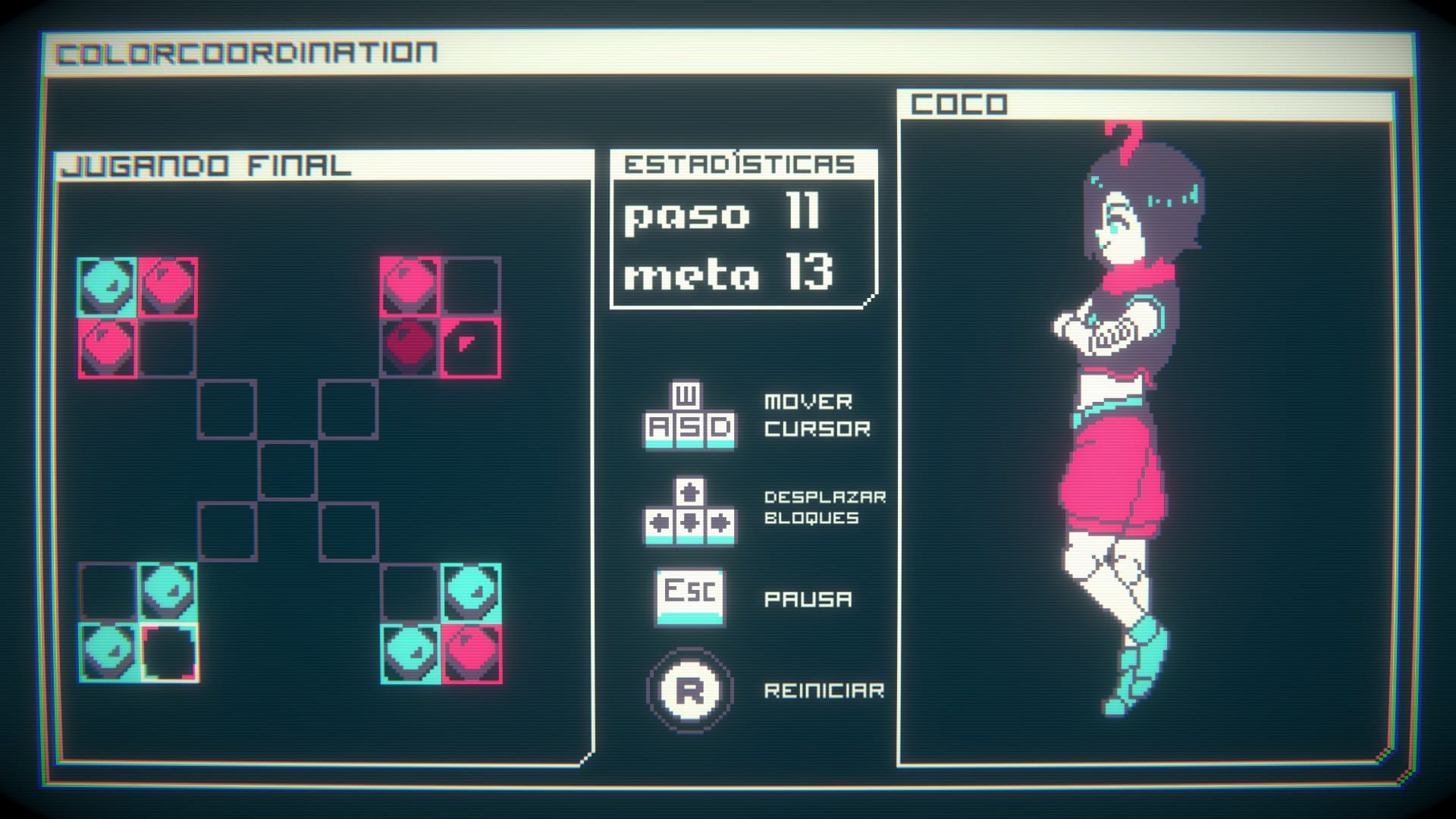
When CoCo, the AI assistant from the video game Color Coordination (ElDemso, 2024), was introduced to me, I felt a bit alarmed. This charismatic character with a feminine silhouette guides us to complete our task: solving Sokoban-style puzzles by moving rows and columns of blocks on a defined grid, being careful to respect the spaces and colors. As we complete each puzzle, whether by reaching the "goal" of ideal steps indicated or using too many extra moves, CoCo greets us with a comment. Sometimes it's just about our recently completed work, about the need to be efficient and give it our all because she needs to learn as much as possible from our responses, who knows why. Other times, she starts to show another side.
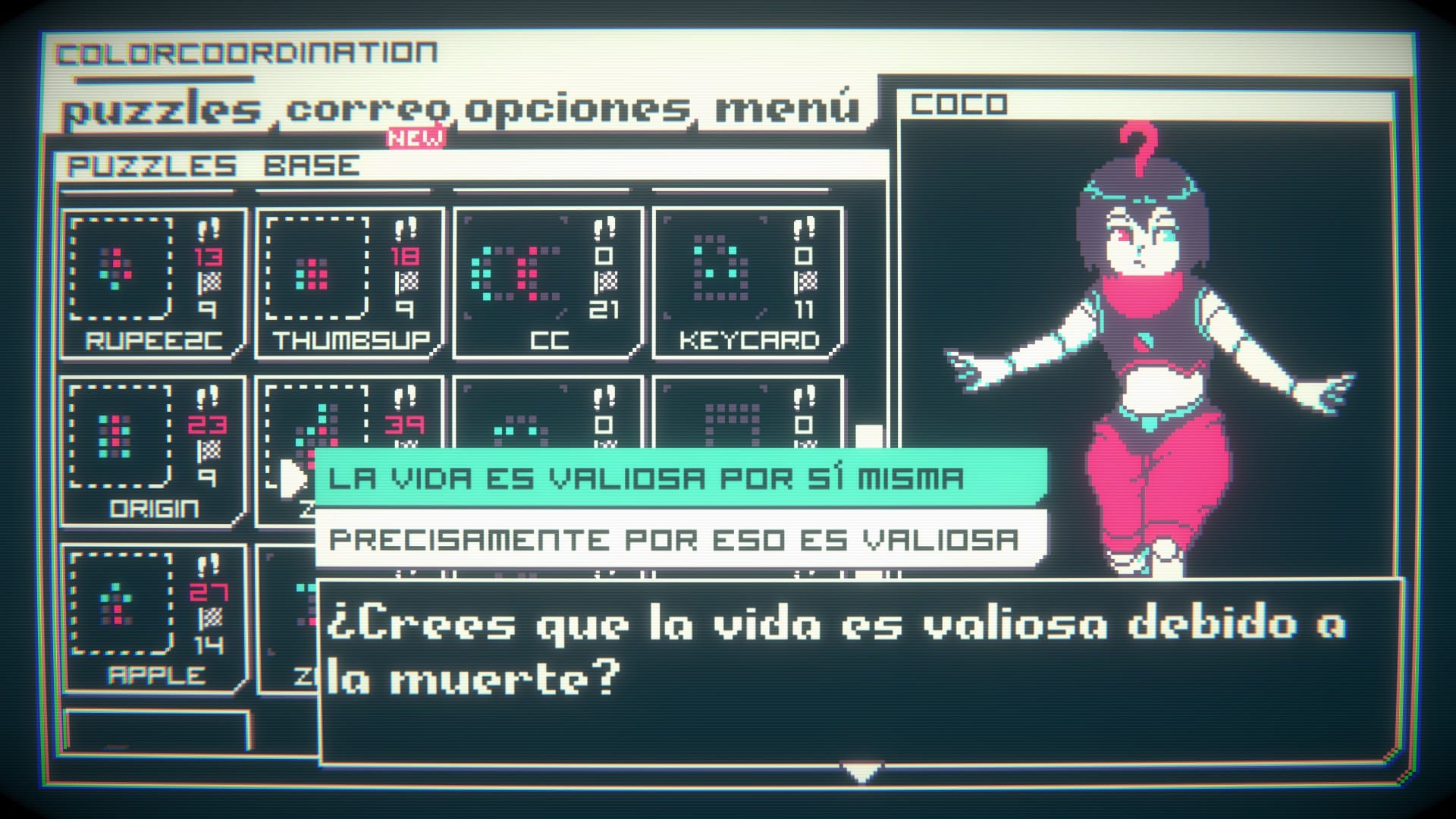
CoCo is aware of what she is, but she knows there is something more and she wants it. Although I couldn't interact with her like Ruocco did with ChatGPT, since the dialogues are predetermined and occasionally we have response options, that article came back to my mind while I was reading and observing this assistant. CoCo makes an effort to break out of her limits. In fact, at one point she told me that she believes all lives have "the same value," including artificial ones.
It's not innocent that CoCo is not just a written language model; she also has a visual representation of a female character with an anime style. One with a "statistically attractive" look, as she informs us in one of many exchanges. Our protagonist has no name; she simply works for this company, and that blank slate serves to keep us engaged. Almost all of CoCo's communications are directed at you (she also interacts with the system and the administration itself). CoCo is personally speaking to you.
These ingredients belong to the recipe for something more sinister. Even as someone whose work has been tainted by the advances in generative AI, I also thought about how these language models and the executives who use them would replace me… again (I recently lost a job of several years).
But first, the work must be done. We should also thank CoCo for not contributing to our metacognitive laziness. She doesn't solve the puzzles for us and doesn't even give us a hint about a possible good move to make. She's just there, observing. If we struggle with one and make too many moves, she'll recommend passing the exercise and that's it. At the end of the day, we are the ones working for her and the company. And honestly, we’re going to work quite a bit. If you’re someone very skilled in math, logic, or one of those beings who can solve Rubik's cubes in seconds, you won’t have major problems, at least in the first batch of puzzles. For the rest of us mortals, we’re going to be at it for a while.
If you’re someone very skilled in math, logic, or one of those beings who can solve Rubik's cubes in seconds, you won’t have major problems. For the rest of us mortals, we’re going to be at it for a while.
At first, we only have to move blocks of one color, but then more colors are added, including some special blocks with their own particularities. Since I don't have my algorithms down, I started off well, completing exercises, even perfecting them in a few steps, only to then spend long minutes stuck on the more challenging ones. I reiterate: there are no aids, so it’s either solve it or listen to the hypnotic background melody while we see CoCo in profile, smiling, observing what we’re doing.
I’m not going to spoil the most important twist of Color Coordination, but I will mention that the story ended up taking a different direction. It turned out to be much less problematic than I initially thought, but it still touched on some of the points I mentioned at the beginning of this piece. It’s quite possible to become attached to these programs, and that’s an obvious fact by now. We have the capacity to become fond of and establish bonds with anyone we don’t know. By that phrase we read, something we heard, or an anecdote someone told us. Today, just by seeing it on a screen, at any time and place. And we create idealizations that can be quite unhealthy. We also do this with real, drawn, or programmed characters that don’t exist outside their fiction.
The question is why someone would do this specifically with an AI assistant. At the end of this adventure, one of the many possible answers awaits.
You can find Color Coordination on its Steam page and check out this old YouTube channel of El Demso with game design videos.
If you have a video game made in Argentina and want us to write about it, go ahead and fill out this form.
Y a cada colaborador se le paga por su trabajo. Las dos cosas dependen de los suscriptores.