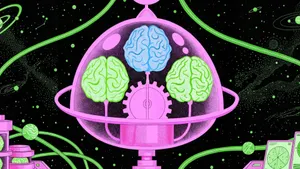
Leaving your thinking to the screen leads to “metacognitive laziness”: the result looks great, but your brain atrophies. We reviewed the key studies on the topic to find out how to follow your own rules, not those of the algorithm.
There's something we've started doing, almost without realizing it. Before we even know what we think about something, we ask a interface. There's nothing wrong with asking. What I want to explore here is something else: what happens to us when that question begins to replace our own thought process instead of accompanying it. Because the difference between the two doesn't show up in the outcome. It appears within us, in a layer that we almost never perceive.
Language Models and Learning
I've selected some studies that conclude, at first glance, that the use of Artificial Intelligence enhances learning:
A review of sixty-nine experimental studies found that ChatGPT improves academic performance and the propensity for higher-order thinking.
A subsequent meta-analysis, covering thirty-five studies and over four thousand participants, measured a moderate positive effect.
At the level of measurable outcomes, using Language Models (LLMs) as cognitive prosthetics works. But the first of those two studies, which reports improvement, also highlights a detail we need to put on the table: the use of Language Models "reduces mental effort."
The cleanest experiment to observe that contrast, I believe, is the following: a team took one hundred seventeen university students and divided them into four groups (assisted by ChatGPT, by an expert human tutor, by a to-do list, and finally, a control group, meaning a group that did it without any assistance). The group that used ChatGPT wrote the “best” essays. Not only did they outperform the control group: they also surpassed the group that had a human expert assisting them. But, and here’s the most important part: "there was no transfer of knowledge or increase in intrinsic motivation." The authors straightforwardly name the phenomenon "metacognitive laziness": the group that used Language Models to create their essay produced a better text in the eyes of their reviewers, but its members ended up learning less about the topic.
There's nothing wrong with asking. What I want to explore here is something else: what happens to us when that question starts to replace our own thought process instead of accompanying it.
Physiological measurement points in the same direction. In a pre-print study from MIT Media Lab, fifty-four students wrote essays while their brain activity was monitored. "The group that used Language Models showed the weakest connectivity of the three, their texts increasingly resembled each other, and cognitive debt persisted when they were asked to write without assistance." The more assistance, the worse the learning. At the population level, another study involving six hundred sixty-six people found a negative correlation between frequent use of AI tools and critical thinking, mediated by cognitive offloading.
I don’t want to bore you any longer with empirical data, and I want to move on to bore you with my reflections: I believe a pattern is emerging. The cognitive prosthetic works, and that’s why it’s dangerous: "it works so well at the outcome level that it obscures the atrophy at the process level." And atrophy is precisely what makes us cognitively useless over time without the prosthetic. Rapid improvement of certain standards, at the cost of cognitive dependence for their representation and evolution.
I also think it’s very important to highlight that almost all this evidence is about the university population, "about adults with a more established but still developing cognitive capacity." In primary and secondary education, the samples are small, and studies are scarce. We are pushing the use of a prosthetic without yet knowing what the impact might be on those developing cognitions.
The sovereign decision
Juan Ruocco has been discussing cognitive sovereignty as the ability to keep the act of thinking active, filtering what is received, and resisting manipulation. If learning is fully delegated, we don’t just lose a skill. We lose degrees of sovereignty. "And those with less sovereignty over their own thinking have less room to imagine, decide, and represent the world in their own or a consensual way."
A few months ago, I conducted an experiment in a Design class. There were about six groups, each with five members, and we had little time to work, so essentially the idea was: given a concrete idea (“Help those who can’t sleep to fall asleep”), they had 20 minutes to develop a solution using Generative AI, and, on the other hand, 20 minutes to think without a phone or computer about how they would approach the problem. When it came time to present, the students were unanimously thrilled with the beautiful landing pages, with animations worthy of an award, that Claude or Figma had created for them, and they were quite disappointed with their roadmap of 15 or 20 connected ideas on paper.
Interestingly, to close, none were aware of the decisions made in the first case, and they couldn’t grasp the richness of having made experimental decisions on that paper that, on the surface, seemed like a poor result, but contained something very important: they had decided and reached a consensus. What they had in hand was not a poor result. It was the record of a multitude of decisions: why this and not that, what they discarded, where they disagreed. The same group had a beautiful landing page, and no learning about why it was that way. They had received answers, not questions.
Hyperreality and the ex-designer
There's a twist I want to introduce here, because it feels the most uncomfortable. Baudrillard spent his time showing how signs detach from reality until they refer to nothing but other signs: copies without originals, what he called hyperreality. The Language Models are the literal version of that. They don't copy an original. They generate an average of everything they've digested, patterns of patterns, echoes of echoes in an empty cathedral. Something that seems new but is pure iteration.
The problem for cognitive sovereignty runs deeper than it seems. The classic idea of sovereignty assumed there was an authentic 'you' behind the manipulation, something to defend. But what if that 'you' also starts to resemble the average?
We are slowly, but not so slowly, becoming ex-designers and ex-programmers. People who choose from a menu created by someone else. And choosing from someone else's menu is not agency: it's the easiest way to obey.
You can see this happening in the productive sphere every day: for example, the designer who approves the model's output doesn't decide: they validate. The one who accepts the proposed change in the code doesn't write: they fix. We are slowly, but not so slowly, becoming ex-designers and ex-programmers. People who choose from a menu created by someone else. And choosing from someone else's menu is not agency: it's the easiest way to obey.
The metacognitive laziness measured by studies and the hyperreality described by Baudrillard are the same thing viewed from two sides. On one side, the student submits a text they don't understand. On the other, the designer signs off on a result they didn't decide. In both cases, the product is flawless and the process is empty.
New modes of interaction, and the taming of the horse
The LLMs, as a technology, open up a range of construction and design modes. The problem isn't the tool: it's the default way of using it, which delivers a result and absorbs the process. The minimum standard has to be different. Knowledge exists when there is understanding of the tool and its uses, not when there is an output delivered. A tool that isn't understood isn't a tool: it's a tacitly directed oracle. And in front of an oracle, you don't learn: you believe and obey, or you abandon it.
This is already happening with hardware. The cyber-surgeons have been showing this with the idea of "low tech, high life". The operation has two parts. The first is low tech: discarding what doesn't work, assessing the real cost of each technology before adopting it, preferring simplicity when complexity doesn't add value. The second is permacomputing: building and repairing what does work, extending the life of hardware, using only what's necessary, treating computing like permaculture treats the land. It's not nostalgia or ludism: it's strategy, it's trying to decide, as much as possible (and desirable).
Not long ago, a new way of thinking about software construction with Language Models began to circulate: "harness engineering". For idiomatic and literary style reasons, I'll call it Cabezada. If the cyber-surgeon decides what to repair and what to discard in the hardware, the Cabezada controls what is allowed to enter and what is tamed from the verbosity of the Language Model, a runaway horse that easily loses its footing. Everything that isn't the model is part of those limits, that control: the prompts, the tools provided, the persistent memory, the reasoning loops, what portion of the world enters as context and what is not allowed. All of this helps those writing software to structure how they use a Language Model so they don't lose their human role or learning along the way.This is where human decision-making lives. The model, at least in the opaque trend of the most popular commercial models, remains a black box for the user, but you decide what to do when it opens. Sovereignty isn't about not using the model: it's about being the architect of the device instead of just a mere consumer.
And this isn't just my intuition. There is a place where it can be measured. SWE-bench is a testing ground that evaluates how well a system solves real software problems taken from open repositories. When we started to seriously look at what moved the needle, an uncomfortable fact emerged for those who expect everything to be resolved with the next model: a good part of the improvement didn't come from the model, it came from the scaffolding around the model. From the Cabezada. Changing the structure that organized the code yielded as much or more than changing the model. It’s wise to take this with caution and properly contrast it before making it dogma, but the direction is quite clear: how you structure the use weighs as much as the raw power of what you use. Agency isn't in the horse. It's in the Cabezada, and in its rider.
The tools and structures themselves
I think it's important to emphasize that one of the best things we can do today is to seek alternatives for how we build tools, or at the very least, to be aware of what and how we are using them.
Some time ago, I began to propose a mini-framework of four steps for creating prototypes that can iterate into solutions. In short, it involves taking (1) a Context, in which certain (2) People participate, proposing a (3) Hypothesis of solution to the problem, and choosing a series of (4) Expected Outcomes against which to contrast. By taking these four parts, what we can obtain is a way to build iterations of solution hypotheses. This can be applied to almost any situation to a greater or lesser extent. Of course, it’s not the most exhaustive or definitive method; in fact, it’s quite abstract and minimalist, but it allows for a better foundation upon which to stand when defining what we are doing and making decisions.
I'm not proposing to stop using Language Models. Far from it, I'm not a ludist. I'm proposing something more uncomfortable: treating each use as a decision and not as a reflex.
It doesn't matter so much whether this framework is the one you use or if you use another. What matters is that there is one: that between you and the Language Model, there is a structure you intentionally put in place, and not the default way it comes out of the box. That structure is, nothing more and nothing less, the place where you can once again be the one who decides.
The window
I'm not proposing to stop using Language Models. Far from it, I'm not a ludist. I'm proposing something more uncomfortable: treating each use as a decision and not as a reflex. Asking yourself, before delegating, if you ever did that by hand, if you'll be able to recognize when the result is yours and when it's the average disguised as your own idea. Without that memory of the craft, you can't validate, let alone create.
Ruocco closed his foundational text with Hakim Bey's Temporarily Autonomous Zones: pockets of freedom outside the gaze of the system. I like to borrow that image and twist it a bit. The Temporarily Autonomous Zones that remain are no longer geographical. They are cognitive. They are the few minutes when you think without an assistant, sketch without autocomplete, write without a model. Increasingly brief. Increasingly valuable. That window, as long as we can keep it open, is all the sovereignty there is.
✦ Suscribite
Las notas de 421 no tienen paywall
Y a cada colaborador se le paga por su trabajo. Las dos cosas dependen de los suscriptores.