How did Luffy end up at protests in Chile, Iran, and Brazil? One Piece has transcended the realm of anime to become a symbol of protest. Human rights? The fight against corruption? You’ll see the pirate flag flying there.
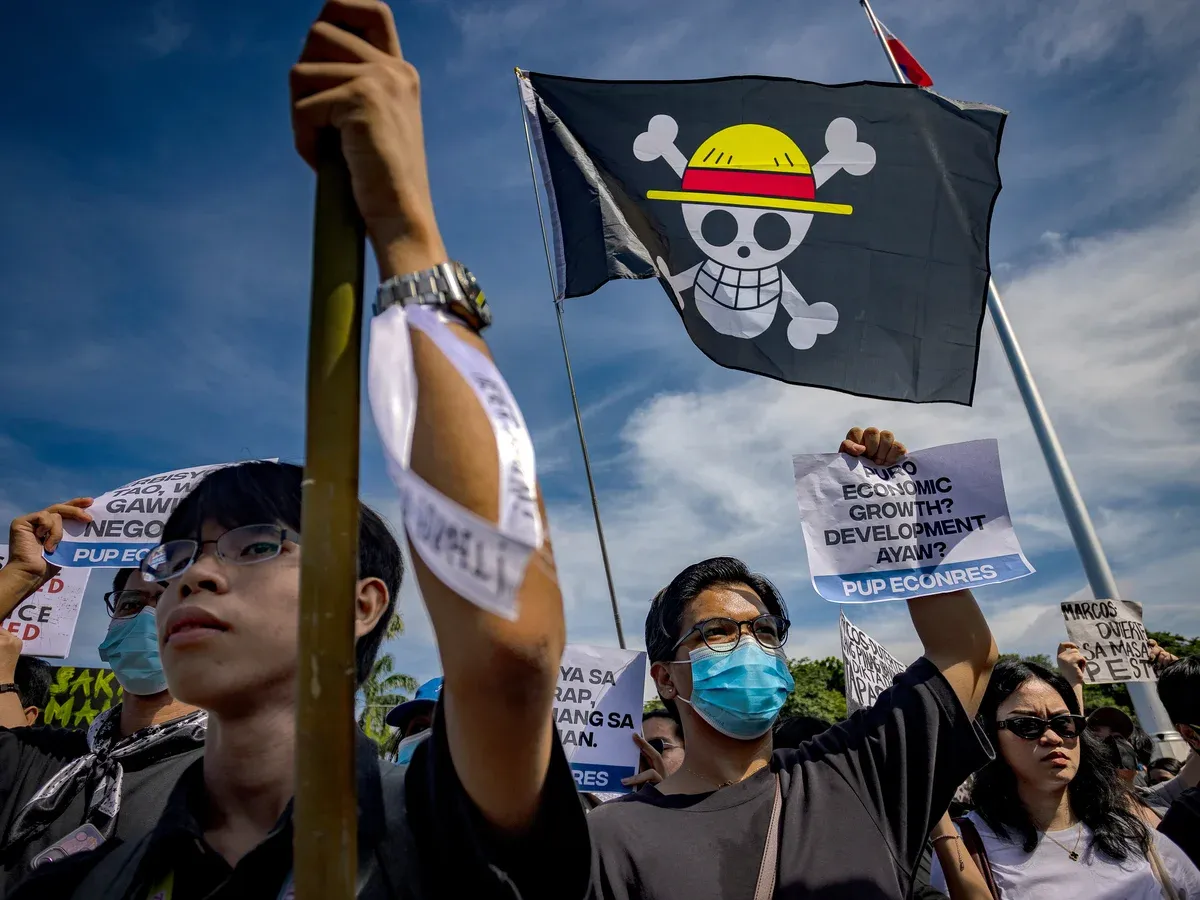
In the last decade, the left has taken on an unexpected symbol that has sparked countless discussions: the “Jolly Roger,” the flag of Monkey D. Luffy, the captain of the Straw Hat Pirates and the protagonist of One Piece. Images have popped up on social media: Santiago de Chile in 2019, Bangkok in 2020, Iran in 2022, and even on the streets of Brazil during Lula's election against Bolsonaro. It’s not necessarily something huge and prominent. Sometimes it’s just a little dot in the crowd, among the handwritten signs, slogans, or national flags. But the fan notices the detail and smiles. There’s another follower of the captain, the one and only Monkey D. Luffy, now a symbol of the fight against some government.
The first time these images appeared, it seemed like a charming coincidence. An otaku marching? That can happen. But it started happening more frequently. On different continents, in political movements that have no relation to one another, with different causes or languages, it keeps popping up. Human rights? Democracy? The fight against corruption? There you see the flag, waving bravely.
It’s worth pondering: a somewhat poorly drawn cartoon of a guy stretching as a symbol of revolution? Yes, and there’s a very specific reason for it. Think about the last 30 years of history, the disillusionment with the system, the distrust of politicians, the hopes and betrayals you’ve experienced in your democratic life. One Piece has a flag that doesn’t belong to any party and is recognizable as soon as you see it. It’s based on the best-selling comic in history, more than Superman, which is almost three times older. Its iconography is a global language. And when someone raises it at a march, they’re saying something very specific: “if this is the government, I’m going to be a pirate.”
It’s not necessarily something huge and prominent. Sometimes it’s just a little dot in the crowd, among the handwritten signs, slogans, or national flags. But the fan notices the detail and smiles. There’s another follower of the captain, the one and only Monkey D. Luffy.
This is something Eiichiro Oda surely didn’t expect when he started serializing in the almost 60-year-old anthology magazine Shōnen Jump. He never imagined that one day he would become a media titan inspiring card games, a live-action series, anime, movies, and more, and that’s because One Piece is not a normal manga. Oda has a somewhat naive way of writing comics where, yes, there’s action, but it’s clearly a secondary element compared to the adventure, the real heart of the work. If someone reads One Piece, they’ll find themselves wanting more if they come in looking only for the classic anime where the protagonist gets stronger in each saga until he gets angry and his hair changes color.
Possibly because of this, even though it has been published since 1997, for years One Piece was mostly a Japanese phenomenon, and in the West, it was known more as “the other one of the Big Three.” Naruto and Bleach resembled Dragon Ball Z much more, which made them easier to penetrate the already Goku-obsessed Yankee market. One Piece, with over 110 collected volumes and 1200 anime episodes, not only resembles Dragon Ball without the “Z” but also comics more in the style of Asterix or the series Vickie the Viking, which the author himself acknowledged as inspiration.
They draw you in with a story
One Piece starts off simple, innocent. A 17-year-old boy sets sail in a little boat and declares he wants to be the “king of the pirates,” something achieved by finding the One Piece. What does this mean? No idea, we’re talking about 1000 episodes here. Along the way, he makes friends, and they all work together as they hop from island to island, solving problems for the people who live there. However, as the episodes progress, we begin to see hints of the underlying tapestry. There exists a World Government that, of course, is incredibly evil, and it’s a supranational entity that maintains a monopoly on force through the Marines and Justice.
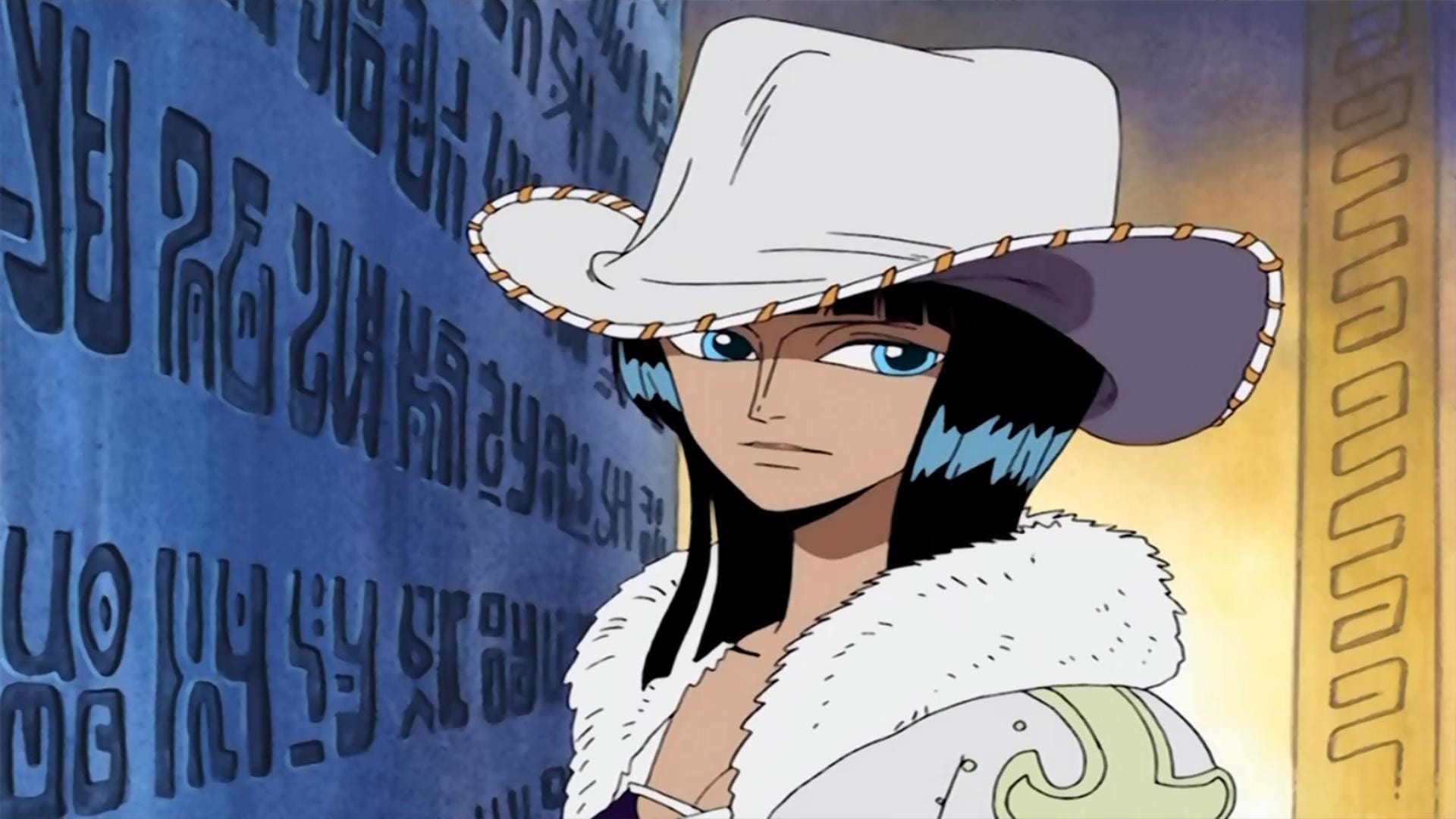
Comic villains are usually “a guy,” not “a system,” and that in itself is already innovative. But with the introduction of Nico Robin, things get even more complicated. It turns out she can read poneglyphs, mysterious stones inscribed with the history of the Void Century, a suppressed period of known history meant to prevent revolutions. Literally, collective memory is erased. Thus, we learn that the World Government, the institution that presents itself as the guarantor of order and peace, was built on a lie to protect twelve noble families, the so-called “Celestial Dragons,” who are an elite that wears helmets to avoid breathing the same air as the commoners.
Even worse: when we see the flashback of Nico Robin's childhood in Ohara (one of the most devastating moments of the series), we learn that the World Government massacred an entire island of scholars just for having the audacity to read about that forbidden era. In the end, it turned out that One Piece was a cartoon, yes, but it also had teeth. So, first, they draw you in with a story: Luffy and his friends arrive at a place, eat, make friends with other people, and beat up a bad guy. But the “big” story is in the background, slowly advancing in a plot that has been unfolding for decades and surprisingly doesn’t lose quality. This leads us to ask: “who writes the story?”
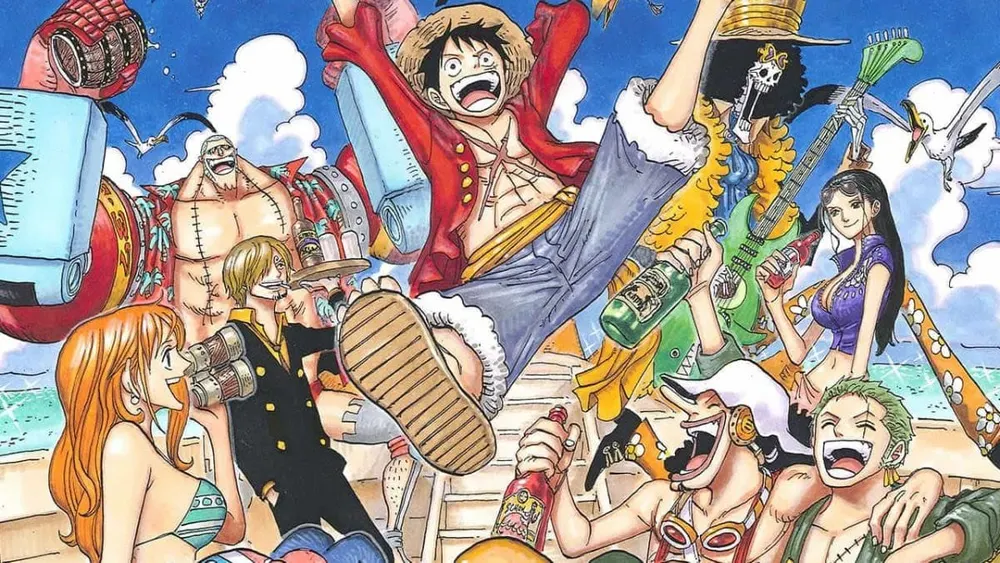
The rest of the Straw Hats also have powerful backstories that round out the work. A thief who spent years betraying those who trusted her, a guy who dismantles ships because his murdered father figure built them, a musician who lives as a skeleton and after the death of his crew only wishes to see the whale they adopted again... These characters don’t have much in common except that Luffy taught them to dream again. No one signed anything, nor did they take an ideological purity test. That resonates in a very specific way with Generation Z that distrusts parties, vertical structures, and politics. Luffy's crew is, without anyone having planned it, a model of how to organize people who don’t want to be told how to organize themselves.
One of the things that makes One Piece special is that Luffy is not Goku: yes, he may be the one who delivers the final punch to the current villain, but it’s true that local factions, heroes from each village, ordinary people, and the rest of the crew are all inspired by him. He doesn’t paternalize: he inspires collective effort.
The power of ambiguity
Let’s throw out an obvious stick: the right is trying to cling to Borges with all its might because otherwise, they have to settle for Dipy. We can assume that Asimov’s work is somewhat classical liberal due to Foundation (though we’d be reading it wrong, because he doesn’t use terms like “market forces,” but rather draws from sociology and psychology). We can also concede that the ultranationalist Japanese Yukio Mishima made significant contributions before his failed coup that led him to commit ritual suicide through seppuku.
Generation Z distrusts parties, vertical structures, and politics. Luffy's crew is, without anyone having planned it, a model of how to organize people who don’t want to be told how to organize themselves.
However, the art that truly transcends is usually, at some point, rebellious and anti-establishment: Charly García, Picasso, the Beatles, Godard, almost all culturally significant movements of the 20th century (punk rock, man). In this context, the right responds by devaluing 'art' in general, or by saying: 'Well, but look how Tom Morello/Bad Bunny/Roger Waters/Pablito Lescano live like capitalists' or 'a lot of blah blah, but it’s just a silly drawing/book/comic.'
But there’s a reality: openly partisan art tends to be pretty terrible. It’s not about being anti-political; rather, when art is too direct in its message, it becomes paternalistic. Umberto Eco argued that the best works are structurally designed to allow for a margin of ambiguity, with a certain tension between the author's intent and the reader's freedom. Even more interestingly, in The Limits of Interpretation, he states that not every reading is valid, and there are some that the text simply cannot support, and that’s where the real debate happens.
It’s not that Oda (or any other artist) is consciously aware of this while working, but it’s something that helps enhance the reading experience. At that point, something happens that is no longer under the creator's control. Roland Barthes called it 'the death of the author': meaning is not given by the writer, but constructed by the reader. Oda can be as naive and commercially cautious as he wants. That doesn’t change what people do with his work when they read it.
In One Piece, the government is the 'bad guys,' and there’s no doubt about it. They are an elite: the billionaires? This resonates with the claims from any 'side.' Both left and right accuse the media of selling out to the current power through advertising, thus controlling the narrative. There’s also criticism of corruption.
However, 'Luffy is right-wing' sounds, in some circles, like a repeated and nonsensical phrase because the text of One Piece doesn’t support it. The right has tried to appropriate the idea of effort as opposed to equality, and from there, latch onto any anime protagonist they can, including Luffy. But effort isn’t incompatible with being left-wing; rather, the political pursuit of equity was, more specifically, about leveling the starting conditions.
Luffy's flags are not necessarily politically partisan. He’s more defined by his stubborn optimism, the pursuit of his dream (to find the One Piece and become 'the freest man on the sea'), and his blind trust in his friends. That’s what makes him naive: he seeks 'happiness,' and that definition is vague enough for anyone to identify with it. But at the same time, he’s not a selfish person: it’s wrong for the government to have slaves, it’s wrong for civilians to be oppressed and go hungry, and above all, he always sympathizes with the underdogs and never with the powerful.
Would we say these are leftist ideals? Not necessarily, but in the ultra-polarized world we live in, where the right is becoming increasingly reactionary, this discourse resonates. In any other world, Luffy would be seen as moderate: in ours, he’s a symbol of struggle, a guy whom his government tries to label as a 'leftist who plants bombs,' but who is genuinely a great guy. The symbol wasn’t consciously sought; it emerged in marches in Santiago, Bangkok, Iran, Brazil… and in Argentina, where it was used on March 24, in front of a government that, like One Piece, wants to erase history (of the dictatorship). How can you not identify with Luffy? The skull isn’t there because someone thought One Piece is the Communist Manifesto or that Oda is Perón reincarnated. It’s there because someone, at some point, felt it described exactly what they were living: a system that hides its own history, an elite that breathes a different air, and the (naive, stubborn, indestructible) idea that the underdogs can win if they don’t give up and trust those beside them.
✦ Suscribite
Las notas de 421 no tienen paywall
Y a cada colaborador se le paga por su trabajo. Las dos cosas dependen de los suscriptores.
PR con vocación de periodista. Punk, videojuegos, anime, y una bomba en cada pie que te obligue a dar el extra.
Escribo Fantasía Inicial porque Final Fantasy es mi cosa favorita del mundo.
Rock lobster.