What do Spaghetti Westerns and punk have in common? More than you might think. How Leone’s grime, low budget, and contempt for order planted the seeds of rebellion in the Ramones and the Sex Pistols. The Good, the Bad and the Ugly is a seminal work for the punk movement.
The masterpiece by Italian director Sergio Leone influenced various artists, especially in the rock world: Eddie Vedder promoted shows with posters referencing his characters, Oasis watched the film on the TV featured on the cover of Definitely Maybe, and James Hetfield participated in the documentary about the restoration of the Sad Hill cemetery.
I could list hundreds of artists influenced by Leone's cinema, but in punk, that generation of young people from the late seventies who came to challenge everything, the connection seems even deeper. Leone's film, with its grit, irony, and disdain for any form of established moral order, acts as a seed that planted one of the strongest roots from which one of the most diverse and significant cultural movements of the twentieth century grew. As if, before punk found its sound, there already existed a visual language capable of expressing the same thing. And that’s where I ask myself: why does that world, so distant in time and form, feel so close to punk?
Leone's film, with its grit, irony, and disdain for any form of established moral order, acts as a seed that planted one of the strongest roots from which one of the most diverse and significant cultural movements of the twentieth century grew.
We could consider the Spaghetti Western as a protopunk. A true DIY effort. Making films without budgets and thousands of miles away from the United States, where the plots take place, just out of a desire to tell their own version. A fanzine turned into a movie. Director Alex Cox, creator of Sid & Nancy and the eccentric punk western Straight to Hell, defined the Spaghetti Western as a “huge transgression.”
“It's very interesting, like the punk movement or the surrealists. As a viewer, it was obvious to me that these films had something important. And they were so successful! For decades, fans of Sergio Leone, Sergio Corbucci, and other lesser-known directors preserved and cherished their VHS copies, sometimes of terrible quality, but keeping the flame of the genre alive.”
“When the legend becomes fact, print the legend” is one of the vital phrases from The Man Who Shot Liberty Valance by John Ford. That’s exactly what Leone did, deciding to create his own version of the foundational myth of the United States, but referencing not history books or scientific research, but the films and novels of the western genre, mixing them with Italian peplums (films about Greek or biblical myths) and Japanese samurai films (especially those of Akira Kurosawa). A good story could be set anywhere because the inherent problems of being human have no geography.
Leone decided to tackle a taboo subject for Americans: the Civil War. Even Orson Welles, whom he met in a bar in Burgos, Spain, advised him against it because it was “poison for the box office.” For a young anarchist who grew up in fascist Italy, nothing motivated him more than challenging control and the official history. “The United States was built on a violence that neither literature nor cinema has ever adequately shown,” explained the Italian director, who also sought to question the tropes of the genre:
“I always thought that the ‘good’, the ‘bad’, and the ‘violent’ did not exist in any absolute, essential sense. I found it interesting to demystify those adjectives in the context of a western. A killer can exhibit sublime altruism, while a good man can kill with total indifference. A person who seems ugly can, as we get to know them better, be more valuable than they appear, and capable of tenderness.”
The recordings of the entire "Dollar Trilogy" (as the films A Fistful of Dollars, For a Few Dollars More, and The Good, The Bad & The Ugly are known) were chaotic. American actors, an Italian director, and Spanish extras. None spoke the other's language. “I could say ‘goodbye’ and ‘buongiorno’, and (Leone) could say ‘goodbye’ and ‘hello’, and that was it,” Clint Eastwood recalled about those days on set. “Then he learned a bit of English and I learned a bit of Italian, and in the meantime, a bit of Spanish, and we managed as best we could.”
We have chaos, we have the desire to create, we have a small budget, we have the urge to subvert not just a genre, but also history. We have punk.
Punk outlaws
The three protagonists of The Good, The Bad & The Ugly coexist in a society in the midst of the Civil War, but they do not get involved; they only try to survive. There are no good or bad guys. No honor or epic. They are all trapped in a hostile world. All wars look alike: they only change names and locations. The Civil War served as a backdrop to express what Sergio Leone felt during World War II, and it was also a point of identification for those living, in the late seventies, in the midst of the Cold War. All uniforms look alike when they are covered in dirt.
That nihilism and disillusionment with the political class in a world at war were expressed by young punks, who had seen that the generation of Woodstock and the flower power ended up being a scam. Unemployment was rising at the same time as police repression, and the arrival of Margaret Thatcher to power in 1979 would worsen the economic and social crisis in Britain.
We have chaos, we have the desire to create, we have a small budget, we have the urge to subvert not just a genre, but also history. We have punk.
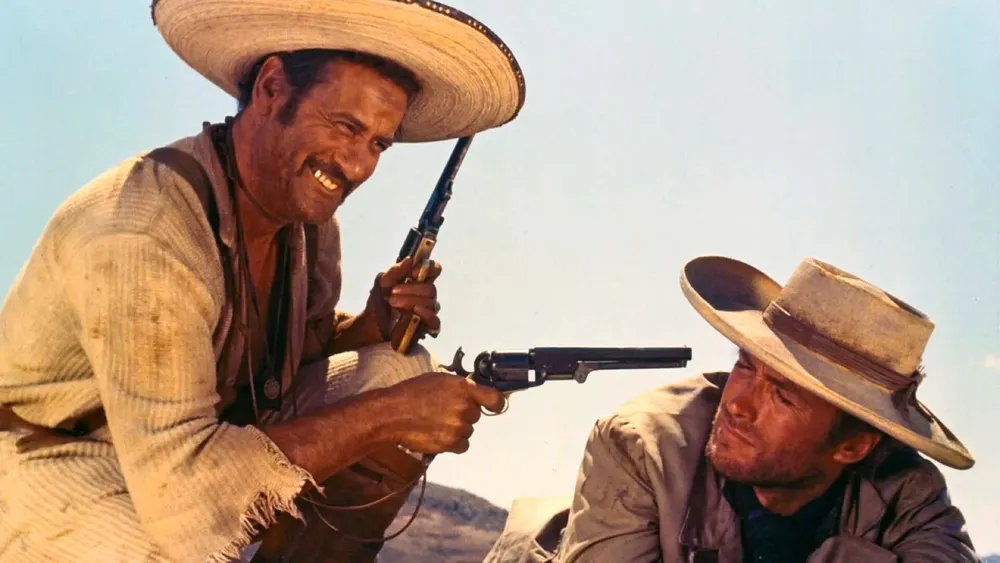
Clint Eastwood realized, as soon as he read the script, that while his name was bigger on the marquees, the true star of the film would be Eli Wallach. The character of Tuco is the one we will learn the most about and who will not just be a comic relief, but will bring humanity to the story.
Tuco had two choices in life: to become a priest like his brother Pablo, or to be a bandit... and he wasn't exactly a believer. "You chose your path, I chose mine. Mine was tougher," he replied when he came face to face with him. Social inequality is timeless. The chances of a person born into poverty climbing the social ladder are practically nonexistent. The 'American Dream' has always been a sham, and the slogan 'No Future' encapsulates the sense of weariness felt by a British youth that found no solutions. For John Lydon, leader of the Sex Pistols:
“They raised everyone in an education system that made it crystal clear that if you came from the wrong place, you had no fucking hope or any job prospects at all.”
If Tuco was the soul, Blondie, played by Eastwood, was the personality, the face, or rather, the armor. “He needed a mask more than an actor, and at that moment, Eastwood only had two expressions: with hat and without hat,” Sergio Leone joked. Young Clint went to Europe to make some money with no hopes of becoming a star. It was precisely his tough face and the rustic nature of his poncho that made him so iconic. I’m sure many have seen the photo (or at least the “meme”) of a kid touching the studs on a punk’s spiked jacket, symbolizing the kindness hidden beneath a bad-boy facade.
Punk is, as my friend and colleague Gonzalo Penas says, the sentimental education of many of us. The “Man with No Name,” with that defiant, carefree, and confident air, was embraced by punks to face the fucked-up daily life: the bad-boy attitude, intimidating, yet with enough tenderness and humanity to give one last shot of whiskey to a general or a puff of a cigarette to a soldier before dying.
Leather jackets, studs, mohawks, colorful hair, black makeup, tartan. The punk aesthetic is rough, defiant, and provocative: it works both as a statement and a shield. It was the way the marginalized made themselves visible, bursting onto the scene. It broke the dress codes of the prim and proper English society, the same one that, even today, is scandalized if you don’t wear white at Wimbledon. The architect of that aesthetic was designer Vivienne Westwood, who, from her shop Sex in London, gave identity to the nascent movement. In 1984, she presented her Clint Eastwood collection on the Paris runways. The garments absorbed influences from Japan, a new frontier that punk was beginning to peek into (Public Image Ltd had recorded Live in Tokyo in 1983). Futuristic neon with a western soul: a synthesis of a world that was ending and another that was being born. “Sometimes you need to transport your idea to a world that doesn’t exist and then populate it with fantastically looking people,” Westwood explained, who with her outfits turned the streets of London into a parade of characters as eccentric as those in a spaghetti western.
Equally important as Sergio Leone was the maestro Ennio Morricone. Friends since childhood, classmates, they grew up together in the Roman neighborhood of Trastevere and began their professional collaboration with A Fistful of Dollars. The unique creative symbiosis between them worked for Morricone in a simple way:
“When he wanted to indicate one of my themes, he would just say to me: ‘the one that goes tititi,’ humming very vaguely. All my music could be reduced for him to a titití, and for me, it was always a tiring task to identify which one he was referring to exactly.”
In The Good, The Bad & The Ugly, music becomes a key element of the action. From the “cartoon” sounds of gunfire to the leitmotifs. Leone needed “crescendos and particular calls to attention that, despite everything, sounded in unison with the general spirit of the story. So music had a central importance: it had to be complex, with humor and lyricism, tragedy and baroque.” Morricone created a whole rough, wild, and unsettling soundscape. Just by closing your eyes and immersing yourself in the music, it transports you to a barren desert full of dangers.
For Bernard Sumner, guitarist of Joy Division and leader of New Order, “that simple whistled theme, the honking sound of the guitar, the coyote howl in the vocal parts, the echo effects, the large spaces between the notes that made the music fit perfectly with the rough and bare setting of the film… everything was incredibly evocative, and I loved it.” That coyote howl was two male voices singing in overlap: one shouting “Aaaah” and the other “Eeeeeh.”
Aaaaah, Eeeeeh! Hey, ho, let’s go! The Ramones took the stage with the band’s theme song. They stood like the fastest guns in the county, ready to draw. The song also served as a prelude to what was about to begin, marking that from that moment on, they were in a lawless place. Authority was left outside, and chaos erupted to the sound of Johnny’s chainsaw guitar. Decades later, the Californians of Green Day would also use it as an introduction, alongside Blitzkrieg Bop, as a testament to the inseparability of the film and the “Monchos.”
The suburbs, beyond the border
What is referred to as “national rock” is actually porteño rock. Belgrano, Barrio Norte, Recoleta, Once are some of the neighborhoods that saw many of the great bands of the local rock scene born and develop. Within their cosmogony, nothing existed beyond the margins of the Federal Capital. For Walter Lezcano, author of the book A Gift from the Devil: 2 Minutes, Valentín Alsina, and the Reinvention of Argentine Punk:
“Until 2 Minutos named it, which was Valentín Alsina, the suburbs were always described by others, by the porteños. In fact, ‘Avellaneda Blues’ is the porteño going to see what’s happening; the suburbs appear as an inhospitable territory.”
For decades, life in the Buenos Aires suburbs was told from a “foreign” perspective. It was a place where porteños went when they got lost, when a doctor prescribed going to a country house to “get some fresh air,” or when they fell off the map on some adventure, like Erdosain, the protagonist of Los siete locos by Roberto Arlt. Beyond the border, it was a territory without asphalt, wild and dangerous. An image that still persists among the most conservative sectors of the capital. Punk came to expand that border. In the epistolary exchange between Pedro Braun (Hari B), a kid from Belgrano who returned from London soaked in the scene, and Sergio Gramática from Bernal, who could say “I am punk” even without that background, lay the primal essence.
By the late eighties, from leather-clad kids looking to have fun to skaters, passing through anarchists, rockers, or simply curious souls with a thirst for destruction, found in The Ramones' concerts a place to build community. The Ramones’ essence, which didn’t seek virtuosity, encouraged hundreds of kids to save up their pocket money to buy used instruments and start a punk band. Sons and daughters of workers, shop employees, who finally found a place to express themselves, without needing to be conservatory-trained musicians or children of middle-class professionals with inherited cultural capital.
Trains are one of the main elements in westerns, as they carry civilization and progress from the east of the first colonists to the wild and underdeveloped west. Punk traveled in the cars and freight trains of the Sarmiento, Roca, or Mitre. From the trains named after conquering oligarchs, the urgency to narrate in the first person, without condescending mediations, was incubated. Stories of workers, employees, cracks, hustlers, transvestites, whores, musicians, or simply a group of friends getting together for a beer. Characters that could inhabit any Sergio Leone film.
The Ramones’ essence, which didn’t seek virtuosity, encouraged hundreds of kids to save up their pocket money to buy used instruments and start a punk band. Sons and daughters of workers, shop employees, who finally found a place to express themselves.
In the late eighties and early nineties, bands like Flema and Dos Minutos translated punk into a local key. They drew inspiration from New York and London, but mixed it with their neighborhood experiences to build a unique identity. Thus was born the so-called “punk cabeza,” a label applied from a porteño-centric and elitist perspective, which looked with suspicion and a certain disdain at the children of the “cabecitas negras” who had marched with Perón in ’45.
Valentín Alsina is a declaration of intentions. “We have some bars, with their typical drunks,” sings Walter Mosca Velázquez, leader of Dos Minutos, in the song that bears the album's name. We (the “barbarians”) have traditions, customs, vices, fun, meeting points, routines, etc., just like on the other side of the Puente Alsina. We exist. Mosca didn’t need grand rhetoric or poetic flair, but the punk simplicity of someone who barely finished high school, yet knows what and how he wants to tell it.
On the margins, the neoliberal Menem era didn’t shine. The famous “give me two” and trips to Brazil were a fable in a territory where factories were closing and the police would stop you for “having the wrong face.” If the western was the genre that represented the “other,” that border that “civilization” feared to cross because that’s where the law ends and savagery reigns, “punk cabeza” (also “barrial rock”) came to assert the presence of those who were tired of being invisible.
From The Pogues to Jim Jarmusch. From London to Lanús. Leone’s dusty film crossed punk culture, inspiring both those with a noose around their necks and the children of puAHAHAH wah-wah-wahhhh.
✦ Suscribite
Las notas de 421 no tienen paywall
Y a cada colaborador se le paga por su trabajo. Las dos cosas dependen de los suscriptores.
Escribo sobre deporte y música como territorios culturales, atravesados por lo social, lo político y la identidad. Coautor de “Nunca caminarás solo: La revolución de Klopp en Liverpool” y “El día que nos cortaron las piernas”.