Hunted for 20 years, Juan Bautista Vairoleto went from being a rural bandit to becoming a folk legend. The “Robin Hood of the Pampas” stole from the rich to right wrongs, until a comrade’s betrayal cornered him. His final act: refusing to surrender alive.
The men arrived before dawn on September 14 in San Pedro del Atuel. It was still dark when the ranch was surrounded. For twenty years, the police had been chasing Juan Bautista Vairoleto through mountains and towns. They were looking for the fugitive or his body. Whatever it took to finally capture the most elusive bandit in the region.
Juan lived there under the false name of Francisco Bravo, alongside his wife and two daughters. It was 1941. By that time, he had been imprisoned and on the run several times; he knew the sounds of pursuit, but that morning, he wasn't expecting them.
For twenty years, the police had been chasing Juan Bautista Vairoleto through mountains and towns. They were looking for the fugitive or his body.
Driven by the words of a traitor, the Pampas police traveled to southern Mendoza to rid themselves of the burden they had carried for twenty years.
In the dim light, inside the ranch, Telma Cevallos and her girls. Outside, sixteen men on guard.
Vairoleto had been a shadow, a rumor that always stayed one step ahead of the police. But that morning, the end seemed inevitable. When he realized there was no way out, that any confrontation would put his family at risk, he made his decision.
"I was Vairoleto the bandit in those distant times I left no one forgotten and I was never lost I always felt Argentine even being of Italian descent I felt like a brother to all but not to the wealthy. I took from the rich what they had stolen before."
Born on November 11, 1894 in Santa Fe, son of Piedmontese immigrants. The family, in search of work, moved to Central Pampa, Eduardo Castex, where they became tenant farmers under abusive contracts, within a system that concentrated wealth in a few hands and distributed precariousness among the children of immigrants.
The death of his mother in 1907 hastened a forced adulthood. That country boy became a laborer, a day laborer, a cart driver, a waiter, a fence builder, and a park caretaker. While one might feel moved, Vairoleto's life until then had no spark of legend.
For a long time, he was just another man.
Perhaps that's why his figure allows for belief.
When rural bandits are born from the mist of the impossible, imagination fills in the gaps. We mold them in the image of our desires. When their lives are documented, however, recognition comes from the mundane, from finding equals, from sinner to sinner.
But those who knew him well were the State.
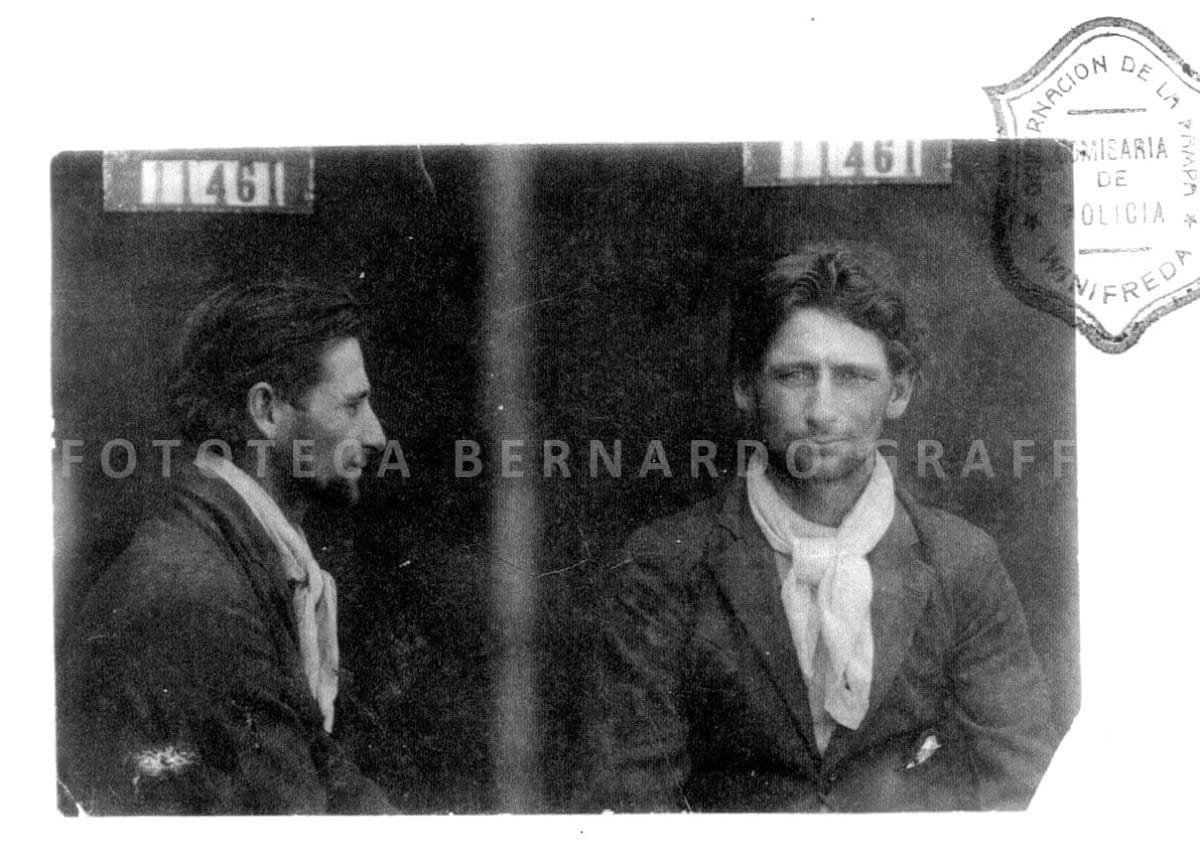
Photograph from Vairoleto's police record. Winifreda Police Station. Source: “Prof. Fernando E. Aráoz” Provincial Historical Archive – Bernardo Graff Photo Library.
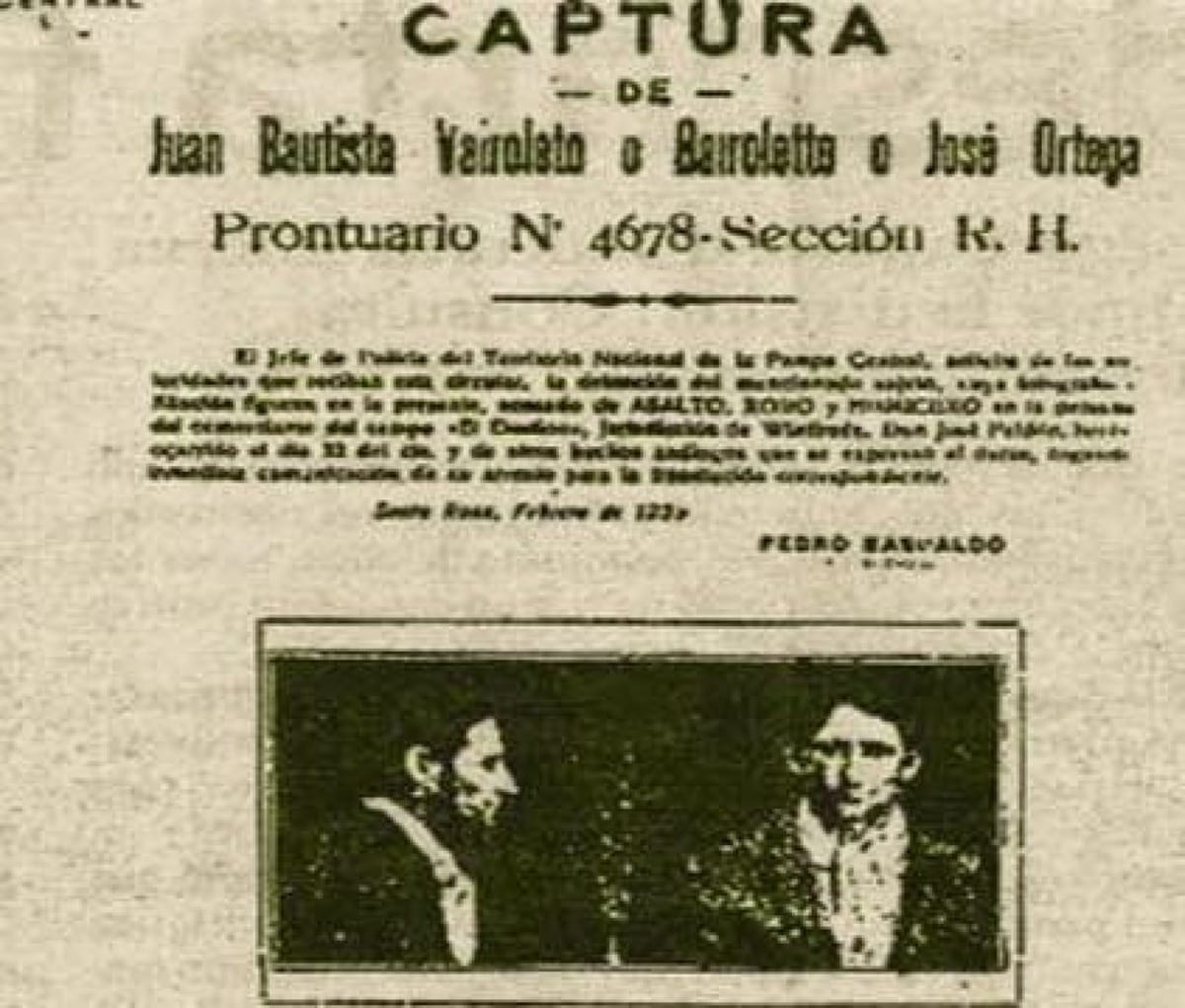
His police record, number 4679, describes him as a man who always dressed as a gaucho, with greenish, penetrating eyes, a slight build, and two tattoos: a woman on his right arm and a triangle with his initials JB and the number 13.
How could someone so meticulously documented find room for mysticism?
For Dora
At 24, Vairoleto was known in town for his charisma, his skill in dancing and playing the guitar. He frequented the local brothels and fell in love with a young girl named Dora.
That romance sparked the enmity of Corporal Elías Farach, who was after the same woman. In a region marked by the so-called "brave police", the uniform served as a tool for discipline and abuse. Farach seized every opportunity. He arrested Vairoleto for crimes he didn't commit, blamed him for stealing animals, and once even subjected him to being ridden like a horse in the jail cell.
Unbeknownst to him, an hatred was brewing in the eyes of that humble gaucho, one that would be returned.
"I put my love forward I challenged them all whether mounted or standing with knife or whip the people knew well that woman was mine."
On November 4, 1919, they faced off outside a diner in Castex. Farach tried to subdue him once more. This time would be different. Vairoleto had prepared himself. He fell to the ground, but this time he drew his weapon and fired. Elías died on the spot, in front of several witnesses.
A limit crystallized against the hostility that had taken root in all the laborers of the area. A fugitive was born there. And, alongside him, a web of silences and complicities that protected him.
Following Hobsbawm, Vairoleto began his life outside the law not out of intrinsic malice, but as a victim of state persecution. The farming community interpreted the act as a just revenge.
He spent some time hiding in the hills, visited and saved by friends and fellow countrymen. His brothers recounted that he had to disguise himself as a woman, holding a borrowed child, to say goodbye to his father who died while he was living in hiding.
He surrendered on April 14, 1920. But before that, he showed what he was made of: in a dispute between two political factions, he was offered money to kill a doctor and prominent politician, Pedro Cometta. Vairoleto not only rejected the job, he warned Cometta, and together they set a trap for the one who made the initial offer. They turned him in, and right behind him, Vairoleto as well.
In his surrender, witnesses say there was a search for peace: he was tired of living in hiding. He longed to clarify what had happened because he understood that God and he already knew the reasons that had pushed him to the limit.
A year and three months later, the prosecutor's ruling declared him free of blame and charges: Vairoleto's attitude towards Farach was considered a logical reaction. However, the murder never stopped haunting him: the law acquitted him, but the State still did not recognize him as innocent. Vairoleto understood that for men like him, justice rarely acted as such.
"The strength of a surname goes hand in hand with the courage of those who have witnessed the outrage. In a country poorly born many came with me and I wandered through the provinces seeking favorable fortune in the fields of the powerful where businesses flourish thanks to injustices."
In the hills, anarchism
By around 1930, tired of the petty arrests aimed at teaching him a lesson for living freely, he took to the hills and forged a new path by connecting with other men who gave new meaning to his life.
Pedro Virgilio Moroni, mechanic and spiritualist. Juan Chiappa, carpenter and spiritualist. The Catalan Ildefonso Folgueral. All anarchists.
Under those influences, crime took on a new meaning for Vairoleto: the reparation of inequalities. The loot circulated among woodcutters and indebted settlers, the promissory notes returned to the hands of those who had signed them under usury. Suddenly, his assaults on moneylenders solidified an image of a benefactor bandit who disarmed the machinery of interest by restoring dignities.
Through horseback journeys, the bond with his fellow anarchist wanderers became very close. Moroni even saved his life during a robbery at an estate, forging a brotherhood that could withstand any test; the same would happen with Ildefonso, who provided shelter and hid him in countless circumstances.
In this way, they also began to embark on another kind of adventure: they were known among their fellow countrymen for preaching the idea of revolution and anarchist principles.
The recognition of others who viewed life through the same lens as he did brought him together with them. He stopped thinking of escape as a means of survival and understood that there was a cause greater than himself.
Argentina ends where La Forestal begins
His wandering brought him closer to the Masonic lodge Sons of Labor, who introduced him to another good thief of the time, Segundo David Peralta, alias Mate Cocido.
Thus, the two most wanted bandits in the country met at the lodge's mansion in Barracas, a space for political sociability where Italian workers and resistance societies converged. There, they were proposed to rob La Forestal.
The company operated in Santa Fe and Chaco, dedicated to the exploitation of quebracho wood to produce tannin, functioning like a state with 400 km of its own railway system, towns, ports, and even its own currency. Such was the wealth it generated that they even had their own security force: the Gendarmería Volante.
The situation for the laborers was nothing but terror. Strikers were hunted down and listed. Theft was an act of justice. Moreover, it would leave Vairoleto and Mate Cocido with enough to retire.
They set off for Chaco and, through ambushes and dense woods, arrived in Resistencia.
The situation for the laborers was nothing but terror. Strikers were hunted down and listed. Theft was an act of justice. Moreover, it would leave Vairoleto and Mate Cocido with enough to retire.
They pulled off a heist on the manager of La Forestal who was moving money in his car, and it went well. But there was a second robbery at the company's administration that went wrong. They were sold out. They were met with gunfire, and in the exchange, a steward of La Forestal was killed.
The context did not help calm the waters. In those years, the National Gendarmerie was beginning to organize to confront banditry and labor organization.
Vairoleto was cautious, unlike Mate Cocido. They argued and decided to take different paths. Juan settled in Mendoza with Thelma, his wife, whom he had met while his parents were hiding him during the time of the heists with Pedro. They had two daughters. The birth of the second convinced him to abandon his adventures.
He contacted a journalist, Carlos A. Ruiz Rojas, and lawyer Francisco Gallardo with a clear proposal: to sell his story and seek a pardon. He wanted to live without being pursued by the forces of five provinces. Gallardo explained that showing himself would mean the provincial police would drag him back to their territory. The plan did not progress. Rojas later recounted that he felt the fate of that gaucho who confided in him was already written.
"But the fate of death was already written then as the clapper of fate resonates in bronze. That woman suddenly was love and was dispute was the beginning of the path and the end on the slope was a burning flame and a shadow that does not flinch."
Shortly after, the betrayal of an old companion condemned him: Ñato Gascón negotiated his freedom with the police using information about Vairoleto's whereabouts as a bargaining chip.
Sixteen armed men surrounded the ranch.
Vairoleto used two bullets. He fired the first at the police. He saved the other for himself and his last wish: not to surrender his wounded body.
His wife later recounted that he fell onto the grass, and the police finished him off on the ground.
Vairoleto used two bullets. He fired the first at the police. He saved the other for himself and his last wish: not to surrender his wounded body.
His friend Pedro made the same decision without knowing what had happened to him. They shared the same fate. Both responded to a libertarian logic, characteristic of their anarchist past. They gifted themselves the freedom of never having to flee again.
What turns you from fugitive to saint?
"Vairoleto, friend, loyal companion,don't forget us, help us,for it is the wish of those poorfor whom you gave your heart." Prayer to Vairoleto - Collected in General Alvear, Mendoza, by Walter Cazenave, in 1972.
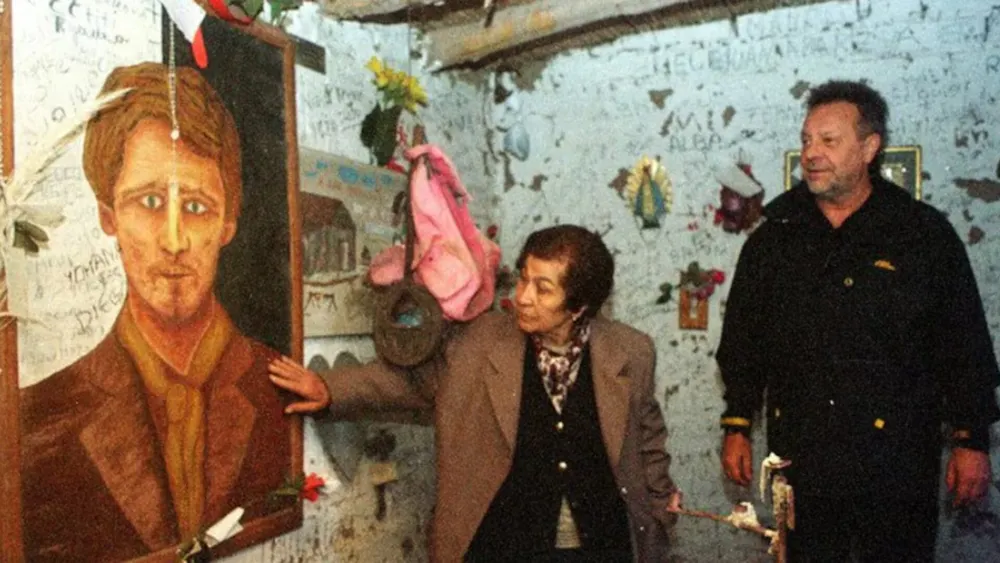
The people kept him alive. It's hard to say if Vairoleto ever imagined such loyalty from those ranches that let him see the mountains through their windows. Perhaps he would be surprised to see how, at those tables today, prayers are offered to him.
The sin of theft, always present, served more as a recognition, a badge on the chest of a brother: how can I be indifferent to the one I share torment with?to the one who achieved what was dreamed of in moments when courage was sought. Juan found strength in his escape, discovered his purpose in the journey, embodied himself in the absence of certainty, and found a place among lovers and anarchists.
✦ Suscribite
Las notas de 421 no tienen paywall
Y a cada colaborador se le paga por su trabajo. Las dos cosas dependen de los suscriptores.