Don't let your wallet beat you at the game! Magic is all about strategy, but the cost of the cards can often be a barrier. Discover how proxies make the game more accessible, letting you test out top-tier decks and compete on equal footing without having to sell a kidney.
Magic: The Gathering was the game that laid the groundwork for everything: formats, rotation, editions, metagame… All that jargon that any enthusiast recognizes right away. But let's be honest, it's also a game that historically demands more than just enthusiasm and brains: it asks for a hefty amount of cash. And that's where things start to get tricky. Because sure, learning to play, understanding how the stack works, knowing when to cast a removal spell or when to hold onto that counter like it's gold is one thing. But being able to build a competitive deck without having to sell a kidney or constantly check prices like you're watching the dollar is something else entirely. That's where many people find themselves on the outside looking in. Not for lack of desire, but because access to that cardboard, that damn painted cardboard, isn't always within reach.
Over time, the community has found inventive ways to turn the situation around. Because if there's one thing this hobby has, it's a community that knows how to make things work. More accessible Magic formats, house rules, and game modes designed so anyone can sit at the table without feeling like they're at a disadvantage from the get-go have emerged. Digital versions like Magic Arena have also popped up, where you can grind, complete missions, gather resources, and build something decent without spending a dime. Every little bit helps. But there's one tool that remains the most straightforward, the most honest, the most noble: proxies.
Learning to play, understanding how the stack works, knowing when to cast a removal spell or when to hold onto that counter like it's gold is one thing. But being able to build a competitive deck without having to sell a kidney is something else entirely.
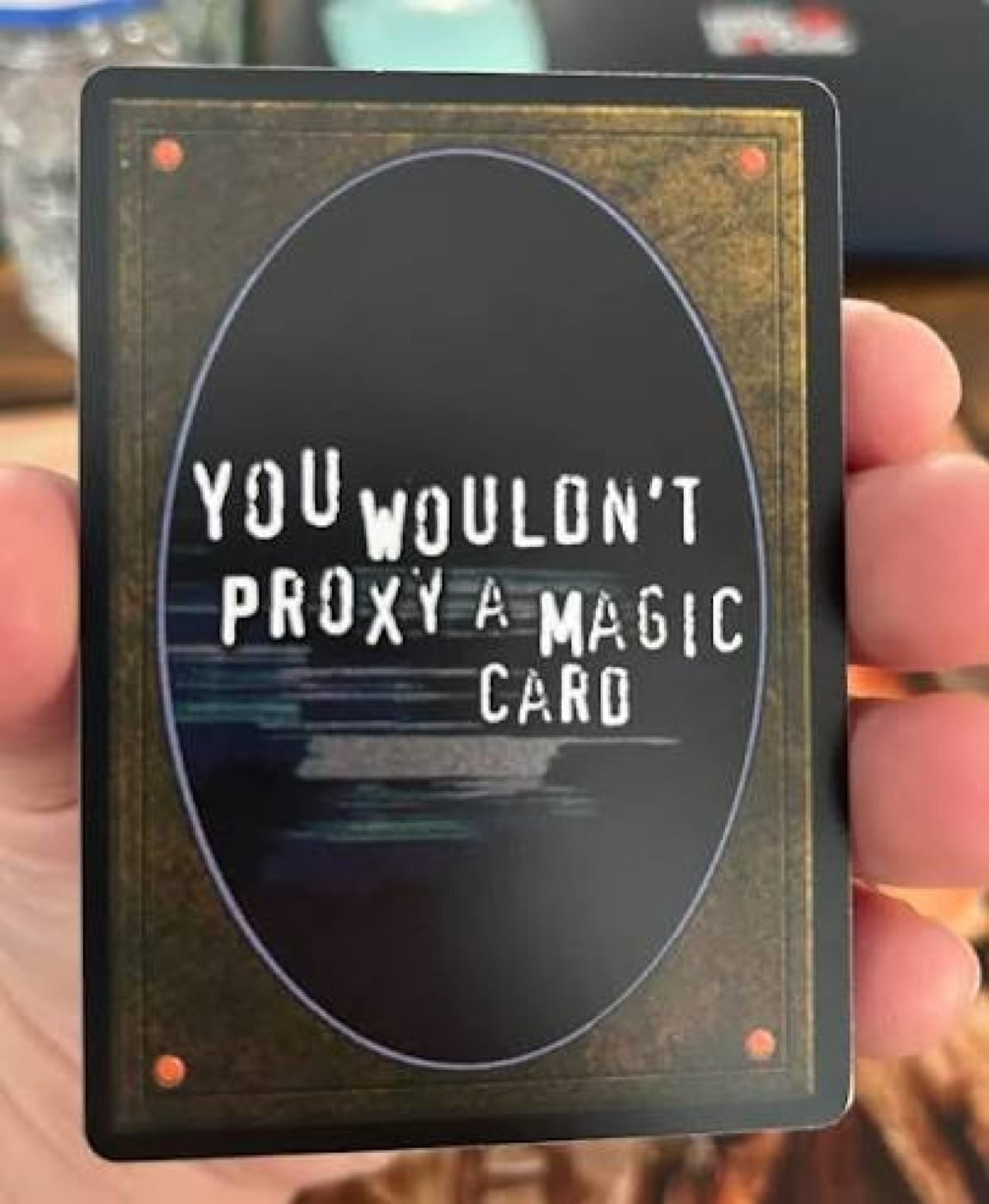
Now, let's get to the basics. What is a proxy? Simple: it's a card that isn't “official,” but serves the exact same function in the game. It can be a piece of cardboard with the name handwritten, a neat print with included art, or even an old card recycled with a sticker slapped on. The form doesn't matter; what matters is the substance and content. If it says what the card does, and everyone at the table agrees, that's it. That's a proxy.
This is where the real magic happens. Because the game, at its core, is just that: a set of rules and effects written on cards. It's not about the foil, it's not about the white border, it's not about the price on thesales pages. It's about what the card does when you play it. And what's the saying, folks? “Reading the card explains the card.” And that's all there is to it.
This isn’t some modern heresy or a clever trick by the community. For years, people within the game have been discussing this topic. The practice of using proxies to test decks, ideas, or interactions has always existed. Because when you're trying something out, the last thing you want is to spend a fortune on cards that might not work as you thought. That's when you grab a piece of paper, write down the effect, slip it into a sleeve, and play. Simple, practical, effective.
But, like everything in life, when something starts to gain popularity, discussions arise. Is it right? Is it wrong? Is it legal? Is it ethical? And here we need to draw a line. One thing is playing at home with friends, having a good laugh, testing decks, experimenting. And another entirely different thing is going to an official tournament with proxies. These are two completely different worlds.
The “official” stance, so to speak, has always been quite clear: in casual settings, at home, with your friends, do whatever you want as long as everyone agrees. No one is going to come to your dining table and say, “hey, that cardboard doesn't count.” Now, in organized events, with prizes, and strict rules, that's where things change. And it makes sense. Because if there's something at stake beyond pride, you need a common framework for that competitive space.
So, let's answer the question everyone asks at some point: can I play with proxies at home? Yes, of course, kiddo. Not only can you, but you should seriously consider it if you want to enjoy the game without your wallet dictating every decision.
Because let's think about this: Magic has a vast universe. We're talking about tens of thousands of cards. Interactions you didn't even know existed, janky combos, strategies that range from the most aggressive to the most control-heavy and frustrating possible. Are you really going to limit yourself to what you can buy? Isn't that a bit sad?
Proxies break that barrier. They allow us to explore the game in all its glory. Did you do some netdecking and realize it costs a fortune? Build it anyway. Want to try a weird and wacky idea that popped into your head at three in the morning? Go for it. Want to play with old cards that are impossible to find? Go ahead, no excuses.
And this is where the real benefit comes in: equality. Because when you play with proxies, the economic difference stops being a factor. It's no longer about who spent the most, but who plays the best, who builds their deck the smartest, who reads the game the best. It becomes a game of skill and creativity, not budget.
That doesn't mean the desire to have that shiny, painted card disappears. Let's be honest, there's something special about owning that card. The smell, the art, the collection... all of that has its charm. But it shouldn't be a requirement to play. It should be a bonus, a pleasure, not a barrier to entry.
Using proxies also has an educational side, if you want to get a bit serious. It forces you to understand the cards better, to read them, to write them, to think about what they actually do and how they interact with everything else. It's not the same to copy a name as it is to explain the effect in your own words. That's where you really start to internalize the game.
It's no longer about who spent the most, but who plays the best, who builds their deck the smartest, who reads the game the best. It becomes a game of skill and creativity, not budget.
And let's not even talk about the social factor. Because at the end of the day, Magic is that: “The Gathering”, getting together to throw down some cards, laugh, discuss plays, and curse when someone hits you with that removal at the worst moment. The gathering is what makes that possible. And proxies allow more people to join in, so no one is left out for not having this or that card.
Nowadays, it's also easier than ever to make them. You have websites that generate cards ready to print, graphics that create almost professional-quality stuff, communities that share resources, tools, and tips for putting them together. But even if you don't want to complicate things, a marker and a piece of paper will do. The essence is still there.
Source: u/MilesFassst (Reddit).
A community that supports proxies
What happens when we gather four guys and turbo decks made up of 100 cards that together cost at least $3500? The result is Competitive Elder Dragon Highlander (cEDH), the complete opposite of EDH in terms of philosophy and ways of playing. If EDH is about hanging out with beer and laughs, cEDH is stepping into a table where everyone is ready to tear each other’s eyes out by turn three but with a smile and a “well played.” It’s the pinnacle of stack management, where every trigger matters, every priority is respected as if it were law, and a wrong decision sends you straight to reshuffle for the next game. There’s no room for chill play or the typical politics and negotiation of commander; here, one card can change the game, losing a resource that prevents someone from winning gives an advantage to another. Only optimized plays exist, invisible mathematics, and a sick obsession with reducing the margin of error to zero.
The finesse of play is obscene, completely on another level. It’s not just about knowing what your deck does; it’s about knowing what the other three do, what cards they might have in hand based on timing, and when it’s worth going all in with a combo or waiting another turn. In that hyper-competitive ecosystem, where everyone wants to win but no one wants to lose because they don’t have that expensive card, the most honest phenomenon of all appears: the proxy.
Because yes, in general, it’s the most proxy-friendly format there is. And it’s not a coincidence or an act of teenage rebellion against the system, but a logical consequence of the format’s own design. cEDH seeks the maximum power ceiling in Magic, playing the best of the best, without concessions.
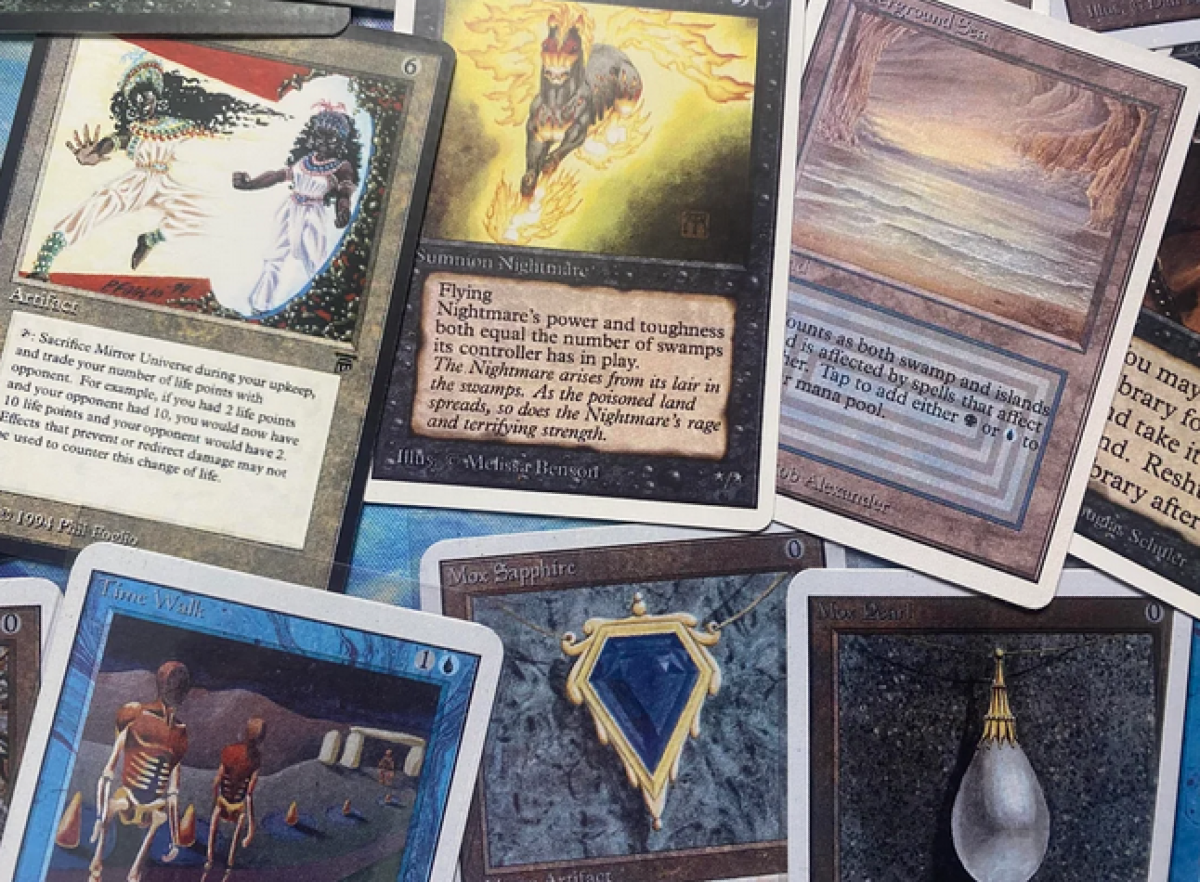
A big part of that problem comes from the famous reserved list of Magic (an official policy from wizards of the coast that guarantees that very old Magic: The Gathering cards, mainly from Alpha to Urza's Destiny, will never be reprinted, with the aim of protecting their collectible value), many of those cards are the ones that define games, enable combos, or outright break the game, but they are absurdly expensive.
So the community did what it does best: adapt and break the mold. Because if the goal is to compete at the highest level, it makes no sense for the difference to be marked by who could pay for a card and who couldn’t. That’s where the proxy philosophy comes in: print, cut, sleeve, and play.
And the most interesting part is that this isn't something marginal or hidden. In cEDH, proxies are, in many cases, completely normalized. Tables where three players have printed decks and one has all originals, and it makes no difference. Because what matters isn't the cardboard; it's the play. It doesn't matter if your card came from a printer or a pack from 25 years ago; what matters is if you played it at the right moment.
This has created something that other formats envy: a real democratization of competitive level. Anyone who understands the game, studies plays, and wants to dive into the craziness of cEDH can sit at the table with the same tools as everyone else. There are no excuses. It’s not 'I lost because I don’t have that card'; it’s 'I lost because I mismanaged a trigger.' And that, even if it hurts, is much more honest.
The community did what it does best: adapt and break the mold. Because if the goal is to compete at the highest level, it makes no sense for the difference to be marked by who could pay for a card and who couldn’t. That’s where the proxy philosophy comes in: print, cut, sleeve, and play.
With the emergence and popularity of the format, where there’s more and more content on YouTube, more tournaments in stores, and more presence at conventions, this mindset has been solidifying. cEDH not only accepts proxies; in many cases, it needs them to survive as a real competitive space. Because without them, the format would become an elitist club for a few, losing exactly what makes it so appealing: the chance to play at the limit and without limits.
And how do I suggest them in my group?
Of course, like everything, it has its codes. It’s not about showing up with a deck full of ultra-broken cards without warning and ruining the experience for everyone else. The key is agreement. Discuss it beforehand, the 'zero rule'; let’s agree on what we’re going to play with the group, what power level they want, what’s allowed and what’s not. It’s the same as any casual format.
It’s worth mentioning that this isn’t just tied to kitchen table Magic: you can proxy any card game to encourage you to try it out; they’re a transitional tool. You try a deck, see if you like it, and if it really hooks you, then you decide if it’s worth investing in the real cards. It’s a smart way to spend, not blindly. This way, the game becomes more accessible, fairer, and more creative. It gives you back control over how you want to play and with what tools. And that, in a hobby that often feels tied to your wallet, is a huge win.
So the next time you hesitate because that card is super expensive or because you can’t build the deck you wanted, remember this: you’re not obligated to play against anyone’s wallet. You can choose to play against your friends, against their ideas, against their strategies. And that’s where the game really shines.
Grab a piece of paper and a marker, build that deck you have in mind, and sit down to play. Because in the end, that’s what it’s all about. Having fun, sharing, competing healthily, and enjoying a game that, regardless of the price, remains incredible.
✦ Suscribite
Las notas de 421 no tienen paywall
Y a cada colaborador se le paga por su trabajo. Las dos cosas dependen de los suscriptores.