Ocarina of Time not only redefined 3D gaming with Z-targeting and fluid camera work, but it also perfected the epic adventure. It’s a journey that explains why, decades later, it remains the greatest video game of all time.
The Legend of Zelda: Ocarina of Time (1998) needs no introduction. Many call it “the greatest game of all time”, followed by “the best Zelda of all time”, and sometimes “the most influential action-adventure game of all time”. It holds the title of the highest-rated video game in Metacritic history; it was the first game to achieve a 10/10 on IGN; named the best of all time by magazines like Edge and Game Informer, and the list of accolades could go on and on. There’s no denying it, there’s an overwhelmingly broad consensus. In this article, I’m going to gather some of the reasons why it has been awarded all these honors.
The first of us
The first thing to understand (especially if, like me, you were born after '98) is that Ocarina of Time is the first Zelda made entirely in 3D, making it one of Nintendo's first games to leap into the third dimension, as well as one of the first major gaming icons to be seen this way (preceded by Lara Croft, Crash Bandicoot, and Mario, among others). With this in mind, standing on that boom of the fifth generation of consoles that changed everything, OoT wasn’t the first to innovate in some of the features listed below, but it was the one that perfected them: z-targeting, the third-person camera, and button/action mapping.
It holds the title of the highest-rated video game in Metacritic history; it was the first game to achieve a 10/10 on IGN; named the best of all time by magazines like Edge and Game Informer.
The system dubbed z-targeting is probably the most important aspect that Miyamoto and his team contributed to real-time action-adventure combat, and perhaps the one you’re most familiar with without even knowing it. Based on chambara (a type of Japanese fencing), the system consists of targeting or locking onto an enemy so that the player's camera automatically orbits around that target. It was named with the letter Z simply because it was the button on the Nintendo 64 controller that activated this lock-on, but today it might be better known as the R3 button on both PlayStation and Xbox, or by pressing the mouse wheel on PC. And yes, the most significant example that you and I are surely thinking of is From Software's Souls series.
The third-person camera was another aspect of the three-dimensional world that Mario 64 couldn’t quite perfect. With a character floating above Mario with questionable player agency, the camera movement was very floaty and could make you dizzy at times (or at least, that was my experience). Ocarina of Time, while still relying on the exact same N64 controls, has smoother and more guided camera movement: the camera stays firmly behind the player's neck and pans as you move, predicting and hitting the area of vision you need to see before you move. A camera system that, while it would become obsolete once the second analog stick was introduced by PlayStation for free camera use (Alien: Resurrection being the first in the 2000s), OoT's improvement laid the groundwork for where and how to position the camera for a 3D action-adventure or platforming game.
Lastly, there’s the use of a single button for different actions within the game. In the first two Tomb Raider games, for example, while the “action button” was somewhat contextual (with X you could shoot, push objects, and grab edges), there was no on-screen indicator that explicitly told you how Lara would interact with the environment in the way you wanted her to. In Ocarina of Time, not only is there a wide variety of actions that vary depending on the context (triggered with the A button, in this case, to grab, roll, talk, dive, etc.), but it also introduces on-screen text that explicitly indicates this for the first time. This eliminates the frustration of having to guess if you’re close enough to the wall for the character to climb with the jump button, for example, while also doubling the notion of actions that can be programmed for a single button. Introducing on-screen text near the action point would then become a practice that the vast majority of games after OoT would imitate.
Did that NPC just say what?!
The first thing that caught my attention when starting OoT was encountering some of the characters in the game explicitly telling you, just like that, how to move Link, how to use the map, or how to use the item menu, etc. In the game’s first area, the Kokiri Forest, you meet all your Kokiri friends (elf children who live in the forest) and if you approach them to talk, many will serve as tutorials while still belonging to the game’s fictional world. If we think about today’s tutorials, and how games increasingly seek to make you forget you’re in one, the solution many developers find is to make that informative voice an “other” that exists outside the game world, a floating text that appears at the side of the screen or, as a bonus, a video showing you how to perform a certain movement/action. This might seem to help keep the game’s diegesis intact on paper, but it builds a perhaps worse habit: looking for answers outside the game, having to navigate menus and interfaces that are neither fun nor part of the experience.
This stems from the complexity and scale that modern video games have taken on, of course, and I’m not saying that all games using this paratextual logic fail to avoid breaking the experience, but it’s interesting to think about how OoT (and many Nintendo games from that time, for that matter), using the reverse logic, manage to make you as a player understand that you need to look for all the answers within the game itself. At one point, I didn’t quite understand how to dodge using z-targeting, for example, and I had to return to the Kokiri Forest to find the NPC who could explain it to me. My mistake was expecting the game to inform or remind me at that point, instead of doing what the game wanted me to do, which is explore and find the solution by playing.
In line with this, OoT also uses two key characters from the game, the great owl Kaepora Gaebora and your fairy companion Navi, to 1) give you a word of encouragement if the adventure gets too tough, and 2) advise you to take a break if the game detects you've been staring at the screen for too long. This creates a disruptive effect when we think about current practices (why have video games stopped poking fun at themselves?), but above all, it's heartwarming and empathetic. The only time I remember seeing something similar was in one of the loading screens of Celeste (2018), where, using the theme of mountaineering, the game reminds you: “Did you know that most climbing accidents happen due to exhaustion? Remember to take regular breaks.” Personally, I always welcome these gestures, as I consider them a mature and eloquent decision by the devs, where, by slightly breaking the fourth wall, the game tells you it doesn't intend to keep you forever or make you forget that you're in a world that is neither that real nor that important to hold onto the controller for a second.
One of the surprises I encountered while interacting with its characters is how bizarre and extravagant they are. In an interview with Miyamoto back in 2011, he confessed to being inspired by Twin Peaks (1990) by David Lynch (yes, you read that right) to write the NPCs and the relationship the player has with them. He said he hadn’t realized that he was more interested in creating a bunch of characters around the protagonist than in telling a story, allowing players to build their own narrative from those fleeting interactions. I remember my astonishment when I first arrived at the market in Hyrule or at Kakariko Village: in the first, I found a somewhat emo kid asking me to sell him bugs trapped in bottles for 50 rupees (which in the game's economy is quite a lot of money), and in the second, a guy sitting by a tree explaining to me, without any context, how he found his parents “disgusting,” only to then tell me that I also seemed “disgusting” to him. Quite the characters, both of them.
It's the soundtrack, stupid
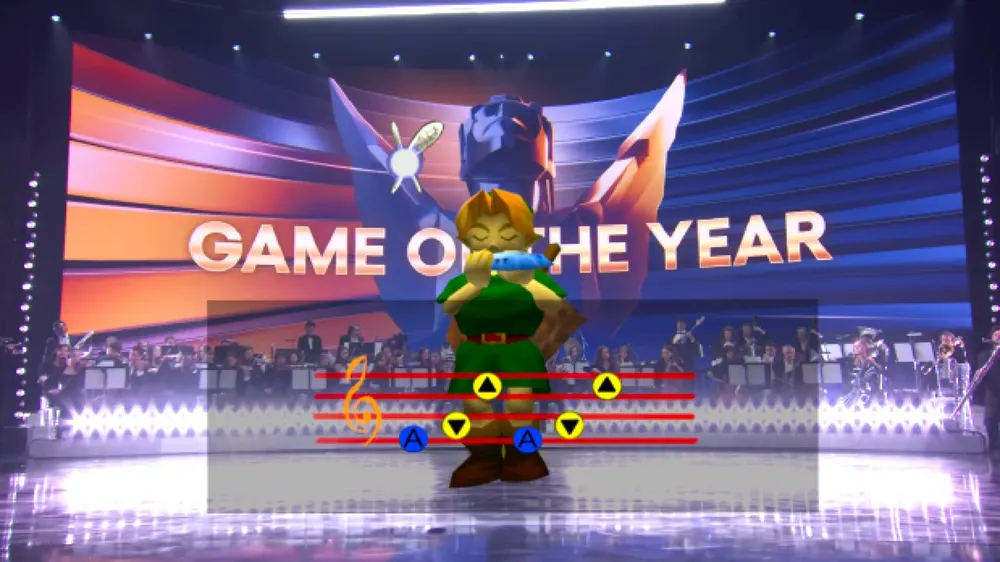
There’s no one on the internet who talks about Ocarina of Time without mentioning its music. I’m no exception. You can talk about everything: its technical innovation, its dungeons, its puzzles, everything. But there's no way to overlook the genius of its music producer Koji Kondo, who, with just five musical notes (the number of notes on the ocarina you use in the game), managed to create the foundation for a total of 13 songs, each more enchanting than the last, which function in the game as spells to change the time of day, make it rain, transport you to other locations, among other things. The idea of turning the N64 controller into a musical instrument is a kind of extravagance that, while characterizing the entire Nintendo development team to this day, I believe OoT is the best example of using a standard controller to transform it into something else (the choice of a quasi-circular wind instrument like the ocarina is a brilliant decision) and the push needed for the later invention of motion controls, touchpads, and other sensory extensions.
You can talk about everything: its technical innovation, its dungeons, its puzzles, everything. But there's no way to overlook the genius of its music producer Koji Kondo.
Thanks in large part to the soundtrack of Ocarina of Time, the music of The Legend of Zelda has been performed orchestral in renowned venues such as L’Olympia in Paris (ohlalá), the Barbican Center in the UK, Stephen Colbert's late-night show, and even the Coliseum Theater in Buenos Aires in 2017. The influence of Kondo's music (along with Nobou Uematsu's from Final Fantasy) has helped make it less strange to see video game soundtracks performed by violins and trumpets dressed in suits today. Personally, it's the theme from the main menu of OoT, the one I know I’ll be able to keep whistling until I turn eighty. It simply brings a tear to my eye and generates nostalgia for a game I finished less than a month ago. Such is the power of the music from this game.
A little bit of this, a little bit of that
Ocarina of Time is an epic fantasy adventure that borrows elements from Tolkien's universe, passing through that of Peter Pan, the legend of King Arthur, and even Japanese Shinto religion. The story revolves around a mythological power, the Triforce, which comes from three “natural” powers that fell to the land of Hyrule long ago. At the beginning of the game, these powers are separated, and whoever obtains the three elements of this triad (wisdom, courage, power) gains the authority to rule Hyrule and do as they please with the kingdom. The princess of the realm, Zelda, asks Link, the player, for help to stop the villain who wants to seize these powers, Ganondorf.
It’s not easy to detach from the literature of J.R.R. Tolkien, the entire medieval fantasy universe after the second half of the 20th century draws from the round trip journey of Bilbo and Frodo Baggins in the vast and complex world of Middle-earth. In OoT, this is evident once the Great Deku Tree (wise, ancient, bearded) asks Link to leave the Kokiri Forest (a peaceful land where the Kokiri live within trees), being the first of his tribe to do so, to embark on the journey that will save the entire kingdom of Hyrule from the “Dark King Ganon” (similar to Sauron or the Witch King of Angmar). While you can draw some parallels, like the Goron people sharing the same cavernous lifestyle and love for rocks as the Dwarves of Middle-earth, their designs and attitudes are more akin to the idea of being a stone-man people with a diet based solely on eating rocks (?), rather than the large mugs of beer and monumental chunks of meat enjoyed by the descendants of Durin and company.
Continuing with the tale of James Barrie, the game takes the almost identical figure of Peter Pan for Link and his Kokiri friends, who are not only children that cannot grow up or leave the forest, but also each carry a guiding fairy companion reminiscent of Tinkerbell (thankfully without the strange romantic suggestions between the two characters). It's also worth mentioning the similarities with the Master Sword embedded in the stone like Excalibur of King Arthur, and perhaps the least cited yet most sensible narrative trace considering the cultural origin of the game: Shinto religion.
Additionally, when we enter the first three dungeons as children, the final task can be interpreted as a purification of the place, where we face three bosses in order to “make the space safe” again: The Deku Tree asks us to eliminate Queen Gohma, a curse placed by Ganon within him. Danuria asks us to eliminate the infestation of dodongos and kill King Dodongo in the Goron cave. And, inside Jabu-Jabu's stomach, we must eliminate the parasite Barinade. The temples in the second half of the game can also remind us of Torii (the traditional red arch of Japanese culture) that separate the real world from the spiritual, and the quest to restore the Triforce can be understood as a way to regain the lost natural balance.
Additionally, there are the three sacred treasures of Shintoism: the kusanagi no tsurugi (a sword), the yata no kagami (a shield), and yasakani no magatama (a sacred jewel). These items, besides being part of Link's equipment, represent three virtues: courage, wisdom, and benevolence or generosity. In OoT, there are subtle changes where the sacred jewel could be associated with the ocarina and the virtue of benevolence through the Triforce of power (which is quite the opposite, curiously). These thematic similarities and stylistic particularities (the connections with Shinto culture are more than refreshing for Western players) are key to understanding what kind of fantasy characterizes the universe of The Legend of Zelda, which is perhaps the most vibrant and unique in the history of video games (where some even attribute sci-fi aspects to the franchise, though that’s debatable), and the main factor that drives me to attempt to answer the big question.
Why is it number 1?
We've already mentioned that it's the highest-rated game in almost all rankings. Now, I could get cynical and argue that this is simply because the people who have the power to express opinions or care enough about the medium to participate in rankings and public conversations are millennials over 30, who played OoT in their adolescence or pre-adolescence, and that experience has marked them due to the aforementioned revolution of the fifth generation of consoles and the paradigm shifts proposed by the game. But no, I think there's something else at play here, something that affects all gamers regardless of age or context.
Medieval fantasy is, on one hand, an easy setting for devs to explain (a rural village or kingdom doesn’t need much explanation, and the use of magic introduces countless twists to gameplay mechanics), as well as being easy to understand and desirable for players to inhabit.
Six of the twelve video games that have won Game of the Year awards since their inception at the Games Awards fall within the thematic spectrum of fantasy/medieval fantasy, and within the action-adventure genre in real-time. Twenty-one of the sixty-eight games nominated for the top award also belong to this category, where, if we segment these games by thematic category, we find that around 40% of the total nominations fall into this spectrum, and 50% of the total in the case of the winners. And, if we also count the turn-based RPG genre, both statistics only increase.
But wait, if that doesn’t convince you of anything, let’s head to Steam. If we check the “theme and environment” tag within the store’s search categories, we see that within the action-adventure genre, the fantasy category ranks second with a total of 5,486 games uploaded to the store, only behind the 6,726 in the “environmental” category (where the page mixes notably diverse games like Red Dead Redemption, Starfield, and even Spiderman, making the specifics of that category a total mystery). The same goes for games in the “third person” and indie categories, where fantasy comes in second, leaving themes like horror or sci-fi relegated to fourth or fifth place, or even further back.
While the ambiguity of how Steam classifies games in relation to their theme or environment is evident (the fantasy tag isn’t spared from adding inconsistencies, such as in the games of Dragon Ball, which, despite being a “fantastical” IP, is not at all what is normally associated with fantasy), this broad survey of Steam, along with the popularity of fantasy within the history of the GOTY awards, could lead me to a first point: within the action-adventure genre in video games, the medieval fantasy setting is the most desired to reproduce.
Beyond the fact that this idea of a world is deeply embedded in the heart of this industry, where the first RPG games are based on D&D, for example, and that, in turn, D&D is inspired by Tolkien's literature (how much more do we owe to the professor?), medieval fantasy is, on one hand, an easy setting for devs to explain (a rural village or kingdom doesn’t need much explanation, and the use of magic introduces countless twists to gameplay mechanics), as well as being easy to understand and desirable for players to inhabit.
Often, what we seek in a game is, let's face it, escapism. When we think about inhabiting virtual worlds, it’s more common for us to fantasize (pun intended) about an ancient, somewhat recognizable world. This is compounded by the fact (not to be overlooked) that the idea of wielding a sword is often tied to the concept of seeking justice, as well as the virtues of bravery and honor. This last point is important because, if we consider the most common “interactive objects” in the history of video games (a topic for another article, perhaps), the most frequently used elements tend to be a sword (or a sharp object) and a firearm (think revolver, shotgun, rifle, etc.). Given the bad press that firearms have in an increasingly mainstream industry (the most popular shooting game today is Fortnite, which features weapons, yes, but with a more cartoonish design than realistic), I predict that this trend seen at the Game Awards with medieval fantasy will only continue to grow in the coming years.
As a second point and as the cherry on top, one last reflection: OoT, besides everything we’ve discussed, touches a very sensitive and universal chord in every gamer's life, which is the transition from childhood to adulthood. At a certain point in the game, Link is granted the famous Master Sword (again, the importance of the sword), with which we can travel back or forward 7 years in the game’s story. The analogy of growth concludes when, at the end of the adventure (with Link being an adult), Zelda gives him the chance to return to his childhood and thus reclaim lost time.
What does Link's journey represent, if not that of a child wanting to be an adult for a while, with the reckless bravery of wanting to save the world? And what do we do when we play if not pretend to be children for a while, so we can save the world?
Now, I think I speak for everyone when I say that it’s very normal for us, as children, to sometimes want to “be adults” to do adult things, have adult money and adult powers, as well as a certain independence and freedom that are out of reach when we’re kids. What does Link's journey represent, if not that of a child wanting to be an adult for a while, with the reckless bravery of wanting to save the world? And what do we do when we play if not pretend to be children for a while, so we can save the world? In a current industry where the norm is to resemble serious movies more and more, with serious characters and serious dialogues, where it seems that major video games have stopped laughing at themselves and where all the world's problems are solved with gunfire, we should never underestimate the power of wanting to return to what we once were. It’s not nostalgia; it’s about identifying with the fundamental: a kid with a sword wanting to save the world.
How to play OoT today?
Aside from the logical option (which is to have a Nintendo Switch Online subscription plus the “expansion pack”), the reality is that accessing a Nintendo 64 or 3DS is not a viable alternative for most of us, considering that Nintendo's early hardware was never that accessible or popular in our region. With emulation being the best option available today, Citra is the easiest and most stable one I could find. With the right controller setup, you can play the “remastered” version from the 3DS (which I highly recommend unless you enjoy spending twice as long getting through the Water Temple) with minimal effort on your part.
✦ Suscribite
Las notas de 421 no tienen paywall
Y a cada colaborador se le paga por su trabajo. Las dos cosas dependen de los suscriptores.