Imagine a stork the size of a giraffe! The king of the Argentine skies was the Thanatosdrakon amaru. With a wingspan of 9 meters, this “dragon of death” patrolled the skies, hunting titan hatchlings.
When we think of the age of dinosaurs, our minds immediately travel to the great land reptiles. However, the Argentine Mesozoic was not only trembling under the feet of these great and iconic titans; its skies were also filled with large reptiles. It's a common misconception to lump them all together, but the airspace didn't belong to the dinosaurs, but rather to their closest evolutionary cousins: the pterosaurs (popularly known as pterodactyls). And although by the end of the Cretaceous period, birds were already flying and diversifying rapidly, the true rulers of the skies remained these winged reptiles.
The Argentine Mesozoic was not only trembling under the feet of great and iconic titans; its skies were also filled with large reptiles.
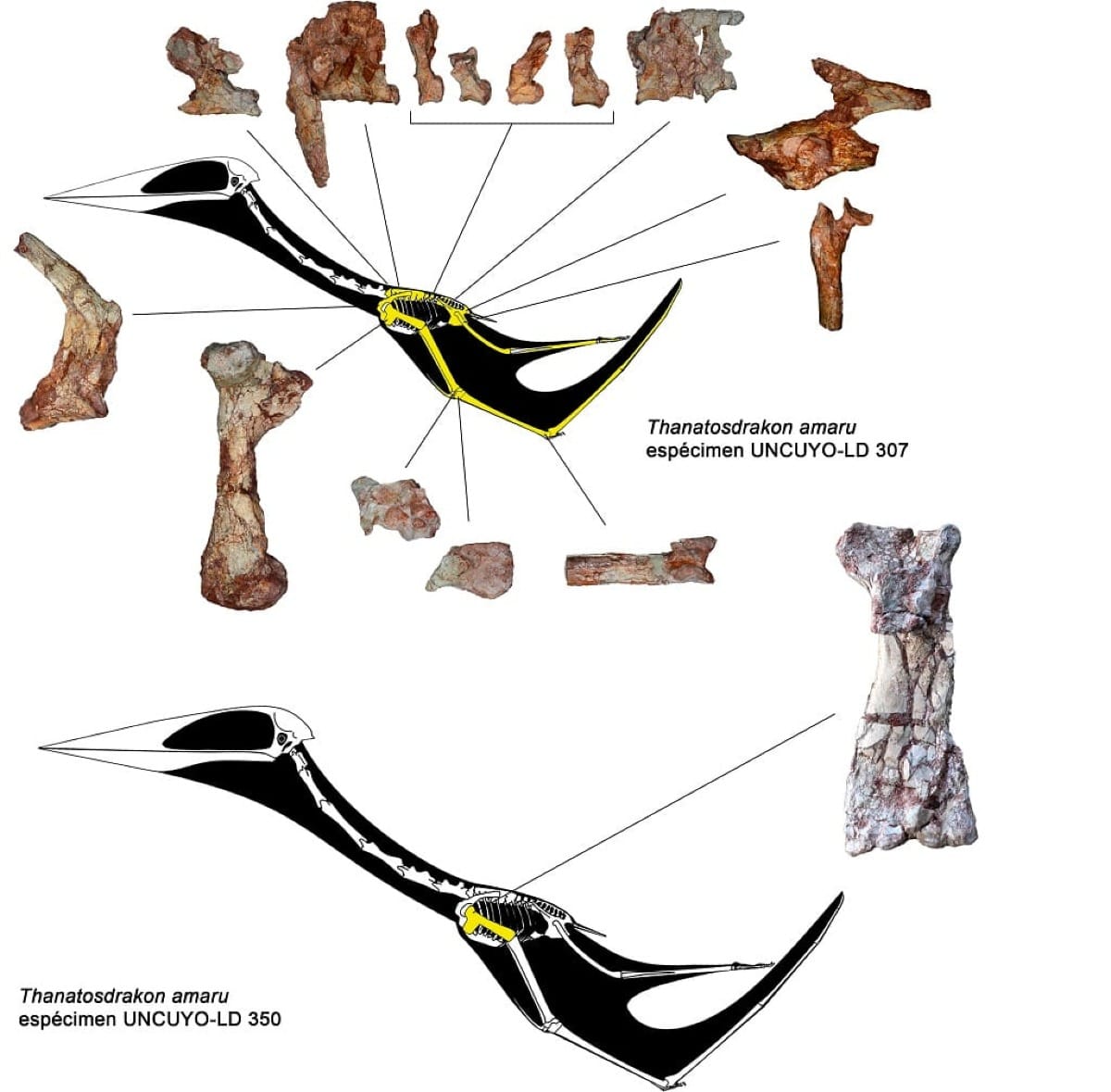
Our prehistoric skies were no exception to the rule of giants. In 2018, in the heart of the Neuquén Basin (one of the richest and most studied geological regions in the country), specifically in the sediments of the Plottier Formation in Malargüe, Mendoza province, the remains of two pterosaur specimens were unearthed that would change what we knew about the flyers of the region. Paleontologist Dr. Leonardo Ortiz David and his colleagues named this new species in 2022 as Thanatosdrakon amaru. The term combines the GreekThanatos (death) and drakon (dragon), with the word Amaru, which refers to the Inca deity that is a winged serpent. The name means "Dragon of the death of Amaru," which is, personally, one of the coolest scientific names out there.
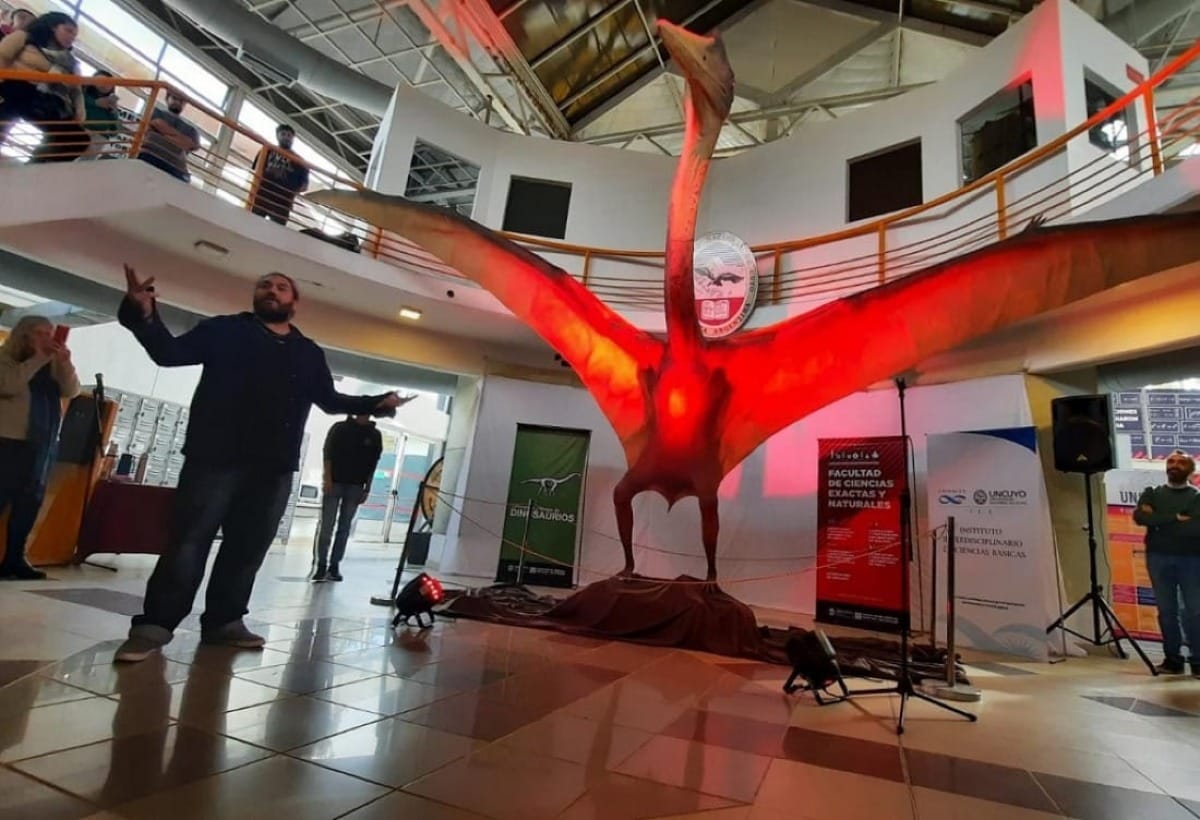
Leonardo Ortiz David presenting Thanatosdrakon amaru at the Dinosaur Museum of the Faculty of Exact and Natural Sciences (FCEN) at UNCUYO.
The two individuals found preserved part of the spine and limb bones. The smaller of the two, a juvenile specimen, contributed about 30 bones to the fossil record. The larger, on the other hand, was known through a single humerus measuring 45 centimeters long. Having an imposing name must mean something, right? Well, based on these remains, researchers estimated that the juvenile had a wingspan, that is, the distance from tip to tip of the wings, of about 7 meters. The larger specimen, for its part, reached about 9 meters wide. To put it in perspective, that's three times the wingspan of the Andean condor, which is one of the largest flying birds in existence (3-3.3 meters wingspan). This colossal size makes it, to date, the largest pterosaur ever discovered in South America.
The Thanatosdrakon belonged to a successful lineage of giants that conquered the skies at the end of the age of dinosaurs, the Azhdarchidae family (azhdarchids). True to the paleontological tradition of using mythological references, the name of the group comes from the Persian word Azhdar, which in Persian mythology is a being equivalent to a dragon or a huge winged serpent.
The azhdarchids achieved a worldwide distribution and lived during the Late Cretaceous, between 92 and 66 million years ago. What stands out first are their body proportions: long necks, stilt-like legs, enormous heads, and elongated spear-shaped jaws. In fact, their anatomy was so distinctive that many species in this family have been identified solely by the discovery of their characteristic cervical vertebrae.
And while they may not be snakes, they were indeed "feathered," as their bodies were covered with fine hair-like filaments known as pycnofibers. Their wings were formed by a broad membrane called the brachiopatagium, which stretched from the tip of an elongated and modified "wing finger" to the outer part of each ankle.
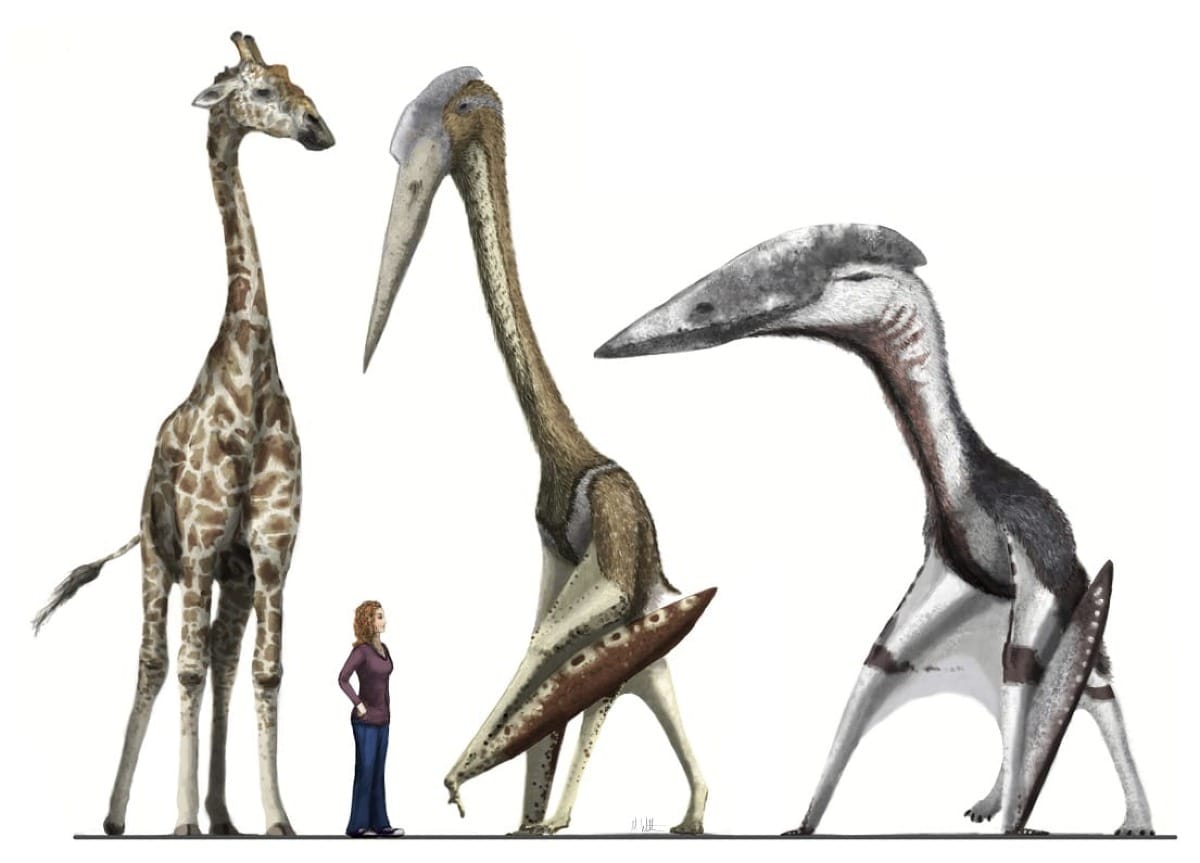
A size comparison image showing a giraffe and a human alongside two species of azdarchids: Arambourgiania philadelphiae (center) and Hatzegopteryx thambema (right)
One of the most complete and studied azhdarchid species is Quetzalcoatlus. Discovered in 1975 in the Maastrichtian sediments of Texas (United States), this genus is one of the most complete, and the species Quetzalcoatlusnorthropi is the largest pterosaur found to date. Following the family tradition, its name pays homage to Quetzalcóatl, the famous feathered serpent from Aztec mythology. Recent estimates suggest that the wingspan of Quetzalcoatlus northropi ranged between 10 and 11 meters, making it the largest flying vertebrate to have ever existed. To better grasp the size of this animal, an azhdarchid like Quetzalcoatlus stood between 2 and 3 meters tall at the shoulder, and when you add its long neck, it reached about 4 meters in height, which is as tall as an adult giraffe.
Flying or grounded?
Azhdarchids include some of the largest flying animals of all time, but understanding exactly how they flew (or if they actually did) remains one of paleontology's biggest headaches. The main issue of the controversy revolves around weight.
Estimating the body mass of Quetzalcoatlus, for example, is a challenge because there is no living animal today with a similar body structure. For a long time (and depending on the author), the weight varied from several dozen to several hundred kilograms, but most of the published estimates since the early 2000s agree that these giants weighed between 200 and 250 kg.
Understanding exactly how they flew (or if they really did) remains one of paleontology's biggest headaches. The main issue of the controversy revolves around weight.
Here you might wonder: how can an animal the size of a giraffe weigh only 200 kilos? The secret lies in its anatomy. Just like modern birds (and as we saw in previous notes about how the titanosaurs managed to be so gigantic), pterosaurs had a key adaptation called pneumaticity. Their respiratory system had specialized air sacs that penetrated the bones (vertebrae and girdles) and hollowed them out.
Additionally, there was a thinning of the cortical walls of the limb bones (arms and legs). Instead of having solid and heavy structures, their skeletons transformed into a network of hollow tubes, lightweight but internally reinforced by small bony struts (trabeculae). All of this created an extremely lightweight yet super strong skeleton, without compromising its structure.
At the limit of physics
Even with an "air skeleton," the debate about the flight of azhdarchids continues. Researchers have proposed various ideas: some suggest a slow and continuous gliding flight; others bet on a fast and dynamic flight; and there are even those who propose that their weight distribution only allowed for short flights ending in spectacular landings. On the more extreme side, some authors propose that they didn't fly at all.
Why so much controversy? Because azhdarchids were at the absolute limit of the possible size for an animal to stay airborne. For a vertebrate to achieve flight, the aerodynamic lift of its wings must overcome gravity. This is where wing loading comes into play, which is the ratio between the total mass of the animal and the surface area of its wings.
To take off, this value cannot exceed a critical threshold (approximately 25 kg/m²). An animal weighing 200 kg and having an 11-meter wingspan faces extremely high wing loads, such that a larger wingspan would require more muscle mass and stronger bones, but that increases the mass limit for takeoff. If the animal is too heavy in proportion to its wings, it won't lift off. And this creates a trap: to lift more weight, you need larger wings; but moving larger wings requires more powerful muscles, and having more muscle means... Exactly, more weight.
So, how did giant pterosaurs solve this problem?
Takeoff Tracks
The biggest challenge isn't staying in the air, but having enough strength to lift all that weight off the ground and produce the first flap. To solve the riddle of their takeoff, paleontologists first had to understand how they stood on solid ground.
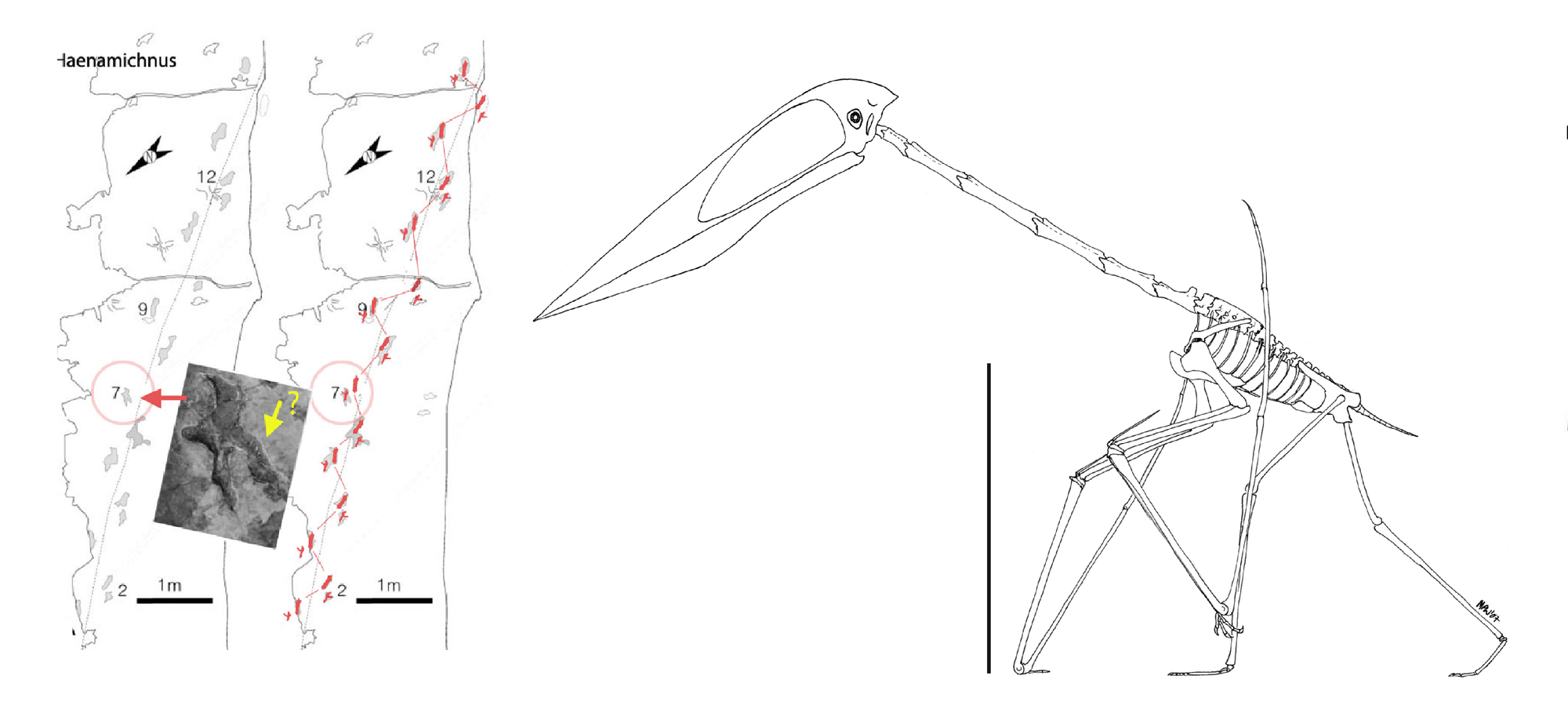
A clue came from South Korea in the form of fossil tracks, known as Haenamichnus. These footprints match the age, foot shape, and size of azhdarchids (it's estimated that those who left them had wingspans between 5 and 10 meters). These extensive tracks showed that, unlike other pterosaurs that walked “crawling,” azhdarchids walked with their limbs positioned directly beneath their bodies, making them very loose and agile walkers on land.
Traceways attributed to Haenamichnus (left), figure taken from Hwang et al. 2002. Reconstruction of the walking posture of an azdarchid (right), taken from Witton & Naish, 2008.
To avoid tripping over their own massive wings, they used a "pacing gait" (a rhythmic step similar to that of camels). To prevent their legs from colliding, they moved the legs on the same side of the body almost simultaneously, first both left limbs, then both right. Understanding this ground posture helps us formulate hypotheses about their takeoff.
Quadrupedal or bipedal takeoff?
The key lies in deciphering that takeoff. Currently, there are two groups of flying vertebrates, each with its own takeoff maneuver: birds and bats.
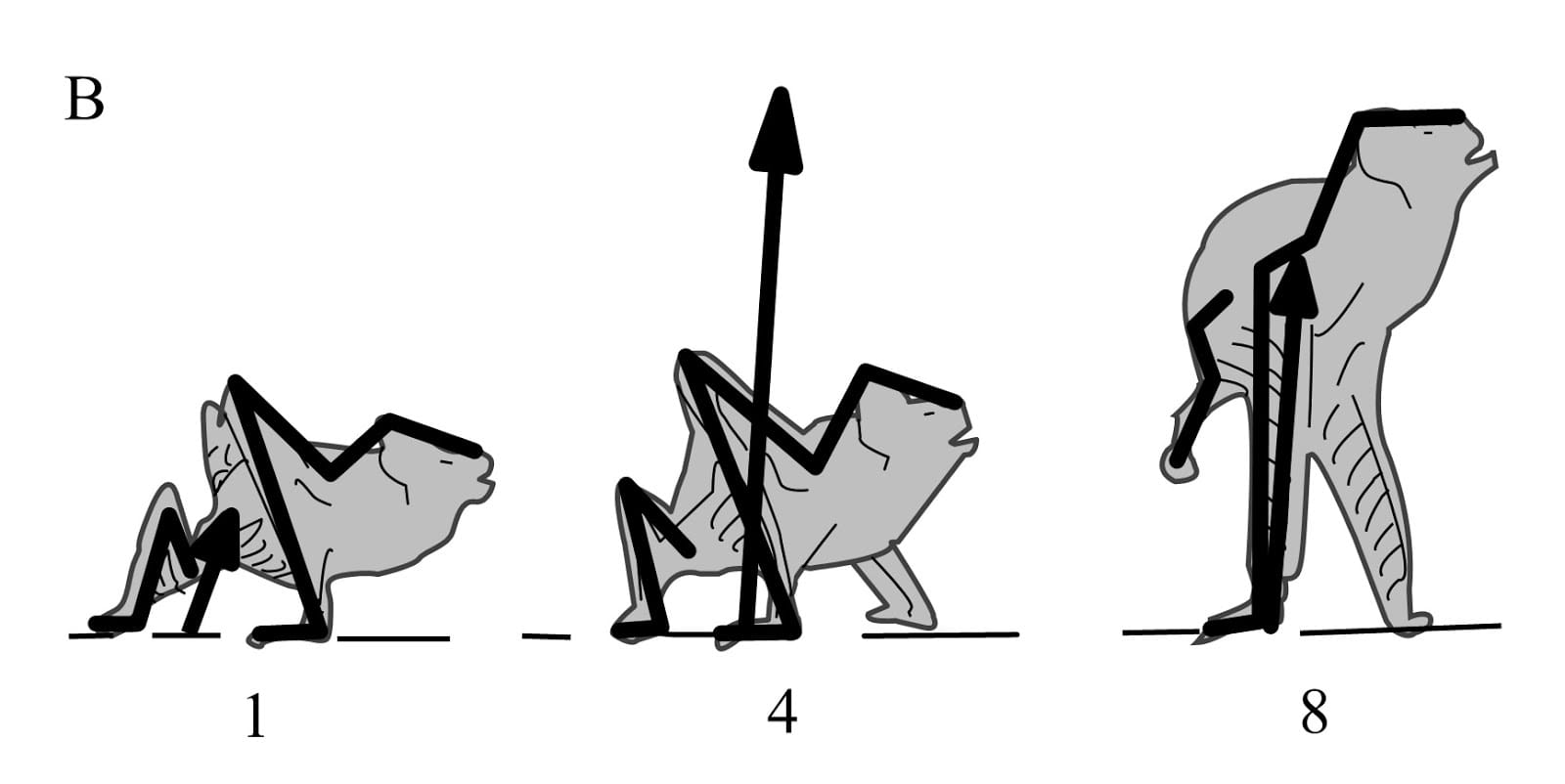
On one hand, birds use a strictly bipedal takeoff. If we observe a bird taking flight, we see that 80% or 90% of the initial effort comes from an explosive jump powered by their hind legs. Many of them actually need to take a short run beforehand to gain momentum and leap. On the other hand, there are bats. Their ground posture is similarly analogous to that of pterosaurs, walking supported on their folded wings. To take off, bats don’t jump with their hind legs; instead, they perform a sort of explosive flex, pushing off the ground with their arms and legs simultaneously to catapult themselves upward.
Model of bat propulsion. Figure taken from a paper on bat flight mechanics by Schutt et al. (1997).
If we apply the anatomical model of birds to a 200-kilo animal, we encounter the mechanical problem I mentioned earlier: the legs would have to be so massive to lift that weight purely by muscular force that they would become "dead weight" that the animal would have to deal with to take off. Birds need two large "waists": one in the shoulders for flying and another in the pelvis for jumping (with significant musculature in both). Azhdarchids possess an asymmetrical structure, where the shoulders and arms are large and massive compared to their hind legs. This is where the catapult model of bats fits better. By using the same front limbs for both takeoff and flight, they saved a tremendous amount of muscle mass and bone structure.
A giant azhdarchid had room for about 50 kilos of concentrated pectoral muscle in its chest. That muscular strength was more than enough to catapult a 250-kilo animal into the sky.
This is the key to understanding why azhdarchids could be so gigantic. By not having to carry an oversized pelvic skeleton and extra musculature in the legs just for takeoff, they could be lighter. According to estimates based on volumetric models, a giant azhdarchid had room for about 50 kilos of concentrated pectoral muscle in its chest. That muscular strength was more than enough to catapult a 250-kilo animal into the sky.
This anatomical efficiency is why we see such a marked difference in the fossil record regarding maximum sizes in flying vertebrates. Due to the limitation of their bipedal takeoff, birds reach an evolutionary ceiling of about 5-6 meters in wingspan and around 40 kilos in weight (like the extinct Pelagornithidae). Meanwhile, azhdarchids, due to their quadrupedal posture, reached wingspans of 10 meters and weights of 200 kg.
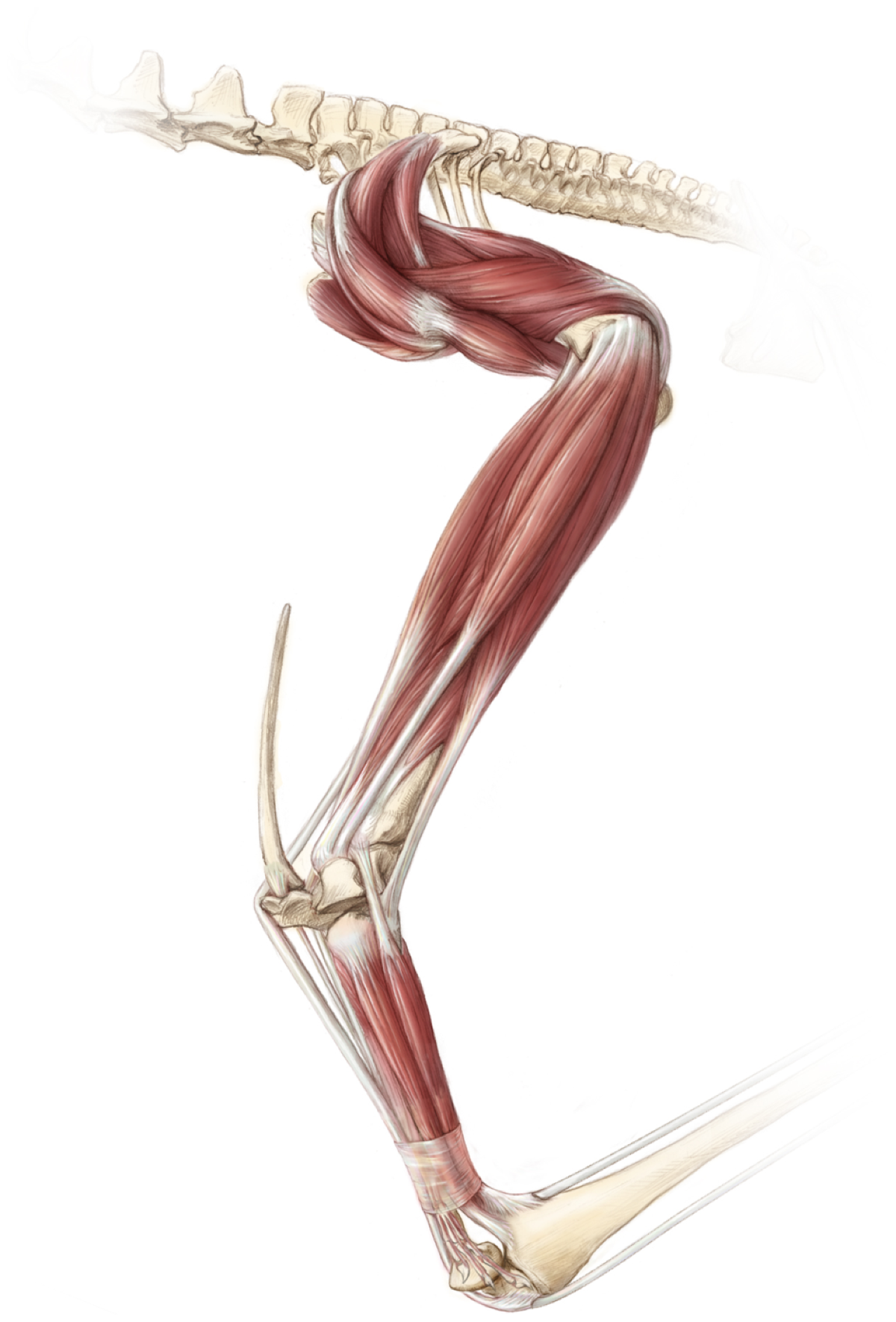
Reconstruction of a pterosaur's arm musculature showing how the muscles are distributed throughout the entire arm and are not as restricted as in birds. Illustration taken from the work of Witton & Habib, 2010.
This debate is still ongoing, because recently, other authors have argued that azhdarchids had enough strength in their hind legs, and continue to propose bipedal takeoff as a possibility. In response to this controversy, the same author who proposed quadrupedal takeoff, Mark Witton (on whom I based this note), has a blog explaining in detail why this theory doesn’t hold up, in case you want to go check it out.
Great flyers, but terrestrial stalkers
The flight and takeoff of azhdarchids aren’t the only things that sparked debates; discovering what they ate or how they did it also unleashed a flurry of hypotheses over the decades.
Initially, it was proposed that they were scavengers like vultures. However, their beaks are thin and fragile (some paleontologists even compared their jaws to a pair of “chopsticks”); meaning they lacked the strength or hook-shaped anatomy to tear flesh. Additionally, their necks were extremely rigid, while scavenging birds have very flexible necks to be able to insert their heads into a carcass.
In the 1980s, it was suggested that they were surface fishers, flying low over the water to catch moving fish. But to fish this way, you need a very sturdy beak that can absorb the impact against the water and a flexible neck, two things that these pterosaurs also lack. It was even suggested that they used their beaks to probe the mud in search of invertebrates. The problem is that animals that do this, like flamingos, have wide legs that prevent them from sinking. The tracks of azhdarchids do not show that anatomy; had they tried, they would have gotten stuck in the mud.
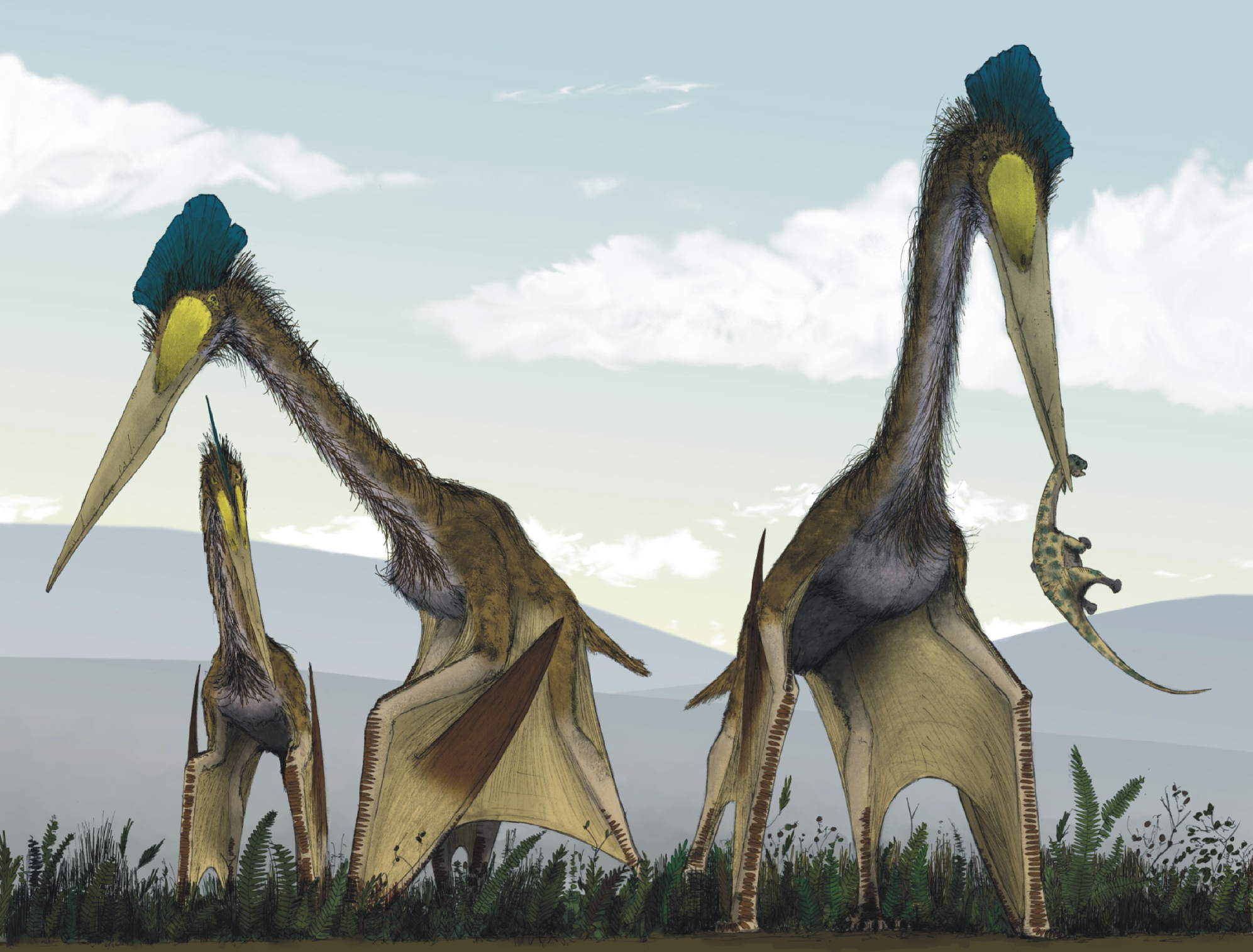
Reconstruction of an azdarchid feeding on a sauropod hatchling. Illustration taken from the paper by Witton & Naish, 2008.
Finally, in 2008, paleontologists Mark Witton and Darren Naish reviewed all previous theories, dismissed them, and proposed a new lifestyle, coining a term for azhdarchids: terrestrial stalkers (terrestrial stalkers). As we saw earlier, they were excellent walkers with a steady gait. Their long, rigid necks gave them an elevated position to scan their surroundings, and the ability to lower and raise their heads with quick movements, using their beaks like spears. And what was their preferred menu? Unable to chew, they swallowed their prey whole. Biomechanical studies estimated that a medium-sized azhdarchid could hunt animals weighing between 9 and 13 kilos. This range included lizards, small mammals, and unsuspecting juvenile dinosaurs. Their current ecological equivalent would be storks... But imagine a stork the size of a giraffe hunting small dinosaurs.
So, with all this information, we can picture our "death dragon" from Mendoza dominating the skies of Patagonia, patrolling the alluvial plains of the winding rivers of the vast Neuquén Basin, and descending to hunt the small and unsuspecting juveniles of titanosaurs that thrived in the area. A prehistoric image that truly honors its name, sowing terror among small titans. Once again, it reminds us that Cretaceous Patagonia was the stage for giants in all their glory, with titans walking the earth and dragons conquering the southern winds.
✦ Suscribite
Las notas de 421 no tienen paywall
Y a cada colaborador se le paga por su trabajo. Las dos cosas dependen de los suscriptores.
Paleontologa y doctora en Ciencias Aplicadas. Trabajo en investigación de cinodontes del Triásico. Hago divulgación en insta y tiktok sobre paleontología y evolución.