Homestuck was a massive, chaotic webcomic (2009–2016) that shaped today's internet culture. Rooted in post-irony and a narrative fragmented into thousands of pieces, it survives today thanks to its community's efforts to preserve it.
Have you ever played Undertale? Did you watch an episode of Adventure Time, Steven Universe, or Hazbin Hotel? Have you listened to any tracks by Car Seat Headrest? Have you read Gideon the Ninth or Kill 6 Billion Demons or any webcomic published in the last 15 years? Then, without knowing it, you’ve encountered Homestuck. The name might not ring a bell. It’s a webcomic from over a decade ago that never made it to the mainstream (though it’s about to get an animated adaptation by Vivziepop). However, its influence is everywhere: it’s your favorite artist’s favorite work if your favorite artist is part of the pop culture of the internet in recent times.
But what is Homestuck?
Homestuck is a webcomic developed between 2009 and 2016 by Andrew Hussie on a website called MSPaintAdventures. Every day, during those seven years, new pages were published that could include images, gifs, multi-minute animations, or even interactive video games with hours of content. The length is immense: finishing Homestuck is a process that can take several months of constant reading. It’s nearly impossible to summarize the story of the comic, not only because of its sheer size but also due to the structural complexity of the plot: it has at least 30 main characters, operates across countless parallel and contradictory timelines, and, above all, features a narrative style that intentionally antagonizes the reader, layered with infinite layers of irony and post-irony, something typical of the evolving internet language of that time.
The length is immense: finishing Homestuck is a process that can take several months of constant reading. It’s nearly impossible to summarize the story of the comic.
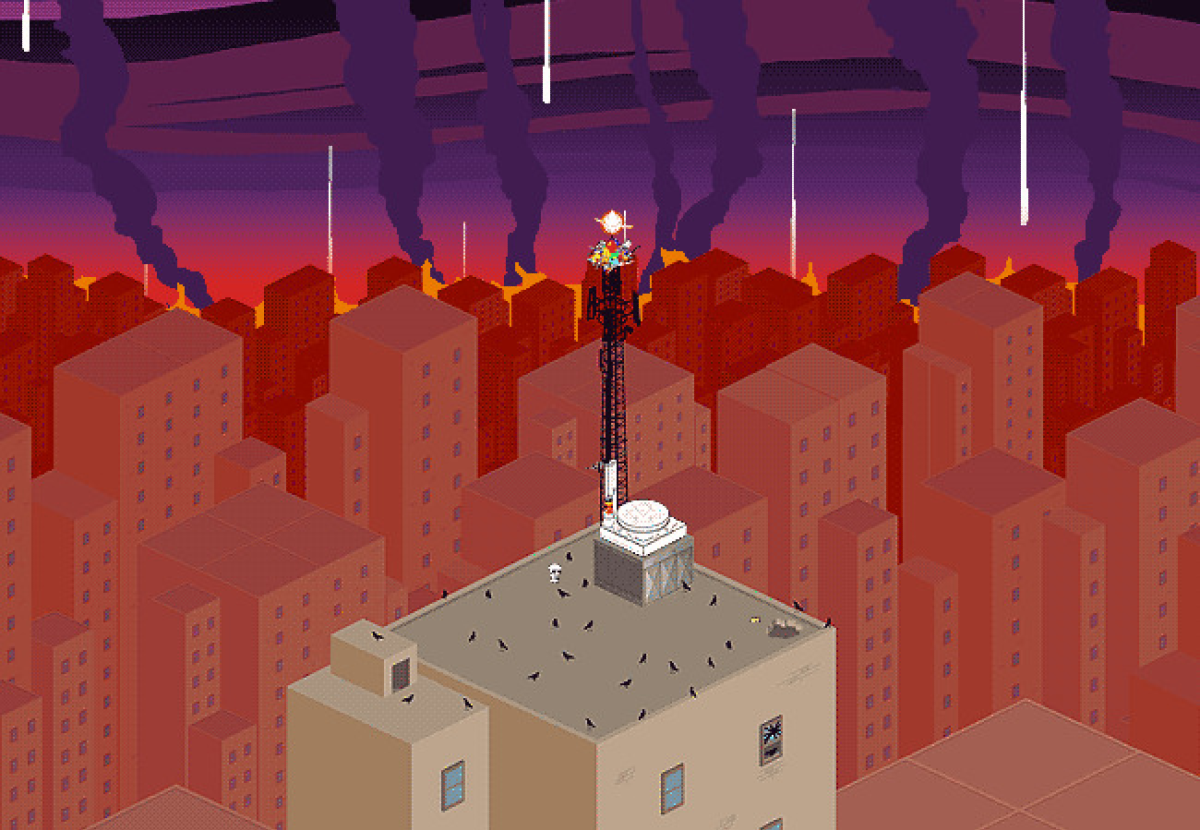
In very brief terms, Homestuck follows four kids (John, Rose, Dave, and Jade) who install a video game (“SBURB”) that not only works on their computers but also in the real world. Through the game’s interface, they can intervene in their friends’ environments, altering their surroundings as if reality had turned into The Sims. But, additionally, when they start playing, a meteor storm destroys Earth, and the protagonists must escape into the screen. In that virtual space, they will discover their goal: they have to create a new universe. Meanwhile, they interact with a group of aliens (“trolls”) who previously played SBURB and, as we learn later, by winning it, created our universe. The story is an elaborate gnostic-cybernetic creation myth that, over its more than eight thousand pages, mixes instances of life and death, dreamlike states, timelines, and alternate universes, as well as elements (satirized) from video games, science fiction, fandom, shitposting, esotericism, and metatextuality. And all this is viewed from the perspective of a teenager on the early 2010s internet.
The text is narrated mainly in the second person, by a narrator who describes actions as if they were interactive game commands, but seems to constantly mock the reader's expectations. The dialogues that appear are mostly chat conversations. Each character has their own username, associated color, and writes with particular rules (“quirks”), such as repeating certain letters or replacing them with numbers. This polyphony of voices creates a reading experience that reflects, like few other pieces, the precision of the online experience: from the euphoria of the limitless possibility of meeting friends to the stupidity of literally dealing with trolls trying to provoke you.
The plot of Homestuck is intrinsically confusing: the characters follow an absurd logic, sometimes humorous and other times surprisingly sincere; the stories overlap, and resolutions may not be explained for months, until suddenly, an animation with epic electronic music unifies them in three minutes. Sometimes a character's death only serves as the punchline to a bad joke, and other times an image of Obama’s face saturated with colors has cosmological implications that resonate for the next three hundred pages.
The first page of Homestuck was published on April 13, 2009, on the MSPaintAdventures forum, where Andrew Hussie had previously created other webcomics. In the early pages, the idea was for the forum to actually intervene by responding to “prompts” that indicated what the character should do (and the fun was to always subvert the result in the next panel), but the format was quickly abandoned due to the unexpected success that generated thousands of interactions. These interactions led to a fandom that, by 2010, had a symbiotic relationship with the material, producing not only fanfiction and illustrations but even entire music albums that were eventually incorporated as the official soundtrack (what other webcomic has a soundtrack?). Between 2011 and 2013, it was impossible to inhabit fandom spaces, both online and offline, where there wasn’t at least a visual recognition of “those gray creatures” from Homestuck. For some time now, that fandom seems to have disappeared: to find it, one must do web archaeology, and yet its traces persist.
Between 2011 and 2013, it was impossible to inhabit fandom spaces, both online and offline, where there wasn’t at least a visual recognition of “those gray creatures” from Homestuck.
Homestuck was contemporary to a particular process in internet history: the transition from blogs and forums to social media. This was a central factor in how the comic developed, but also in how it acted as an agent of such transformations, especially through the particular relationship between the plot and the fandom (a relationship that, like internet culture, has always been closely connected). The webcomic was born in the culture of forums but found its fame in a plethora of social networks, allowing us to trace a path through some that are even now extinct: the forums of Something Awful, Formspring, DeviantART, and platforms like Tumblr, Facebook, YouTube, and especially Snapchat, Instagram, and Vine. On these latter platforms, the subculture became so relevant that they were used by Hussie to tell part of the plot.
One of the reasons Homestuck caused such a stir and what distinguished it from other webcomics (to the point of being read by people who weren’t necessarily interested in this medium) is what was termed the “upd8” phenomenon [update]. New pages were released daily, sometimes many pages, other times just a few, sometimes with animations (with guest animators or illustrators), with extensive dialogues, with advancements in the plot or in the characters’ interpersonal relationships. Thus, there was always something new to discuss, a story to follow, a plot that more and more people were creating discussion forums about, fanart, cosplay, videos, jokes. It was its own daily effervescence from which to engage in conversation with others, many others, increasingly more.
Perhaps the most evident legacy of Homestuck in cultural terms is that it was the space where the name Toby Fox became known, who achieved even more fame than Homestuck through his video gamesUndertale and Deltarune. Rumor has it that the musician conceived the stories of these games in Hussie’s basement. Fox was one of the first and most active members of the Homestuck music team, formed in the early years of MSPA, and songs like Megalovania (which was played in front of Pope Francis in 2022, the same Pope who received a copy of Undertale from MatPat in 2016) appear in both Homestuck and Undertale.
But beyond a cultural legacy, Homestuck has an aesthetic inheritance: it anticipated and helped shape a typical imaginary of the internet from 2010 to 2020, linked to absurd memes, shitposts, and what is referred to as “post-irony.”
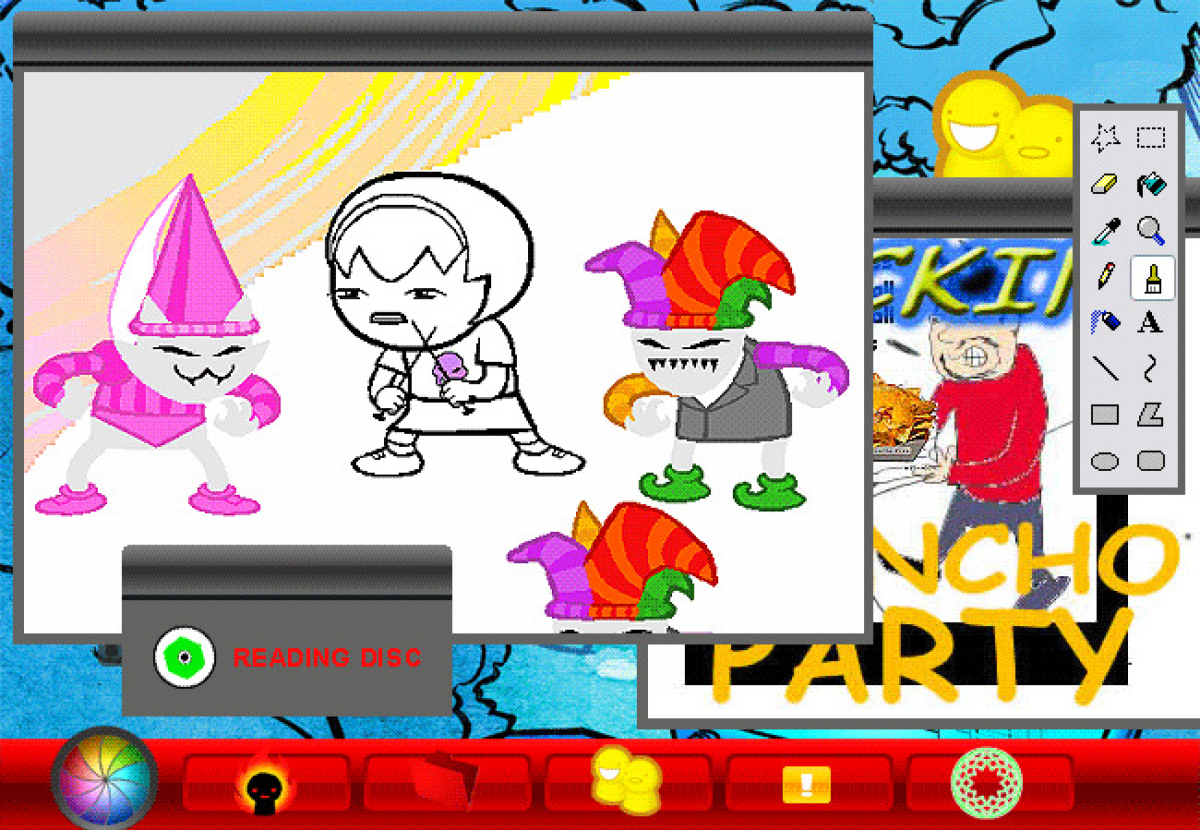
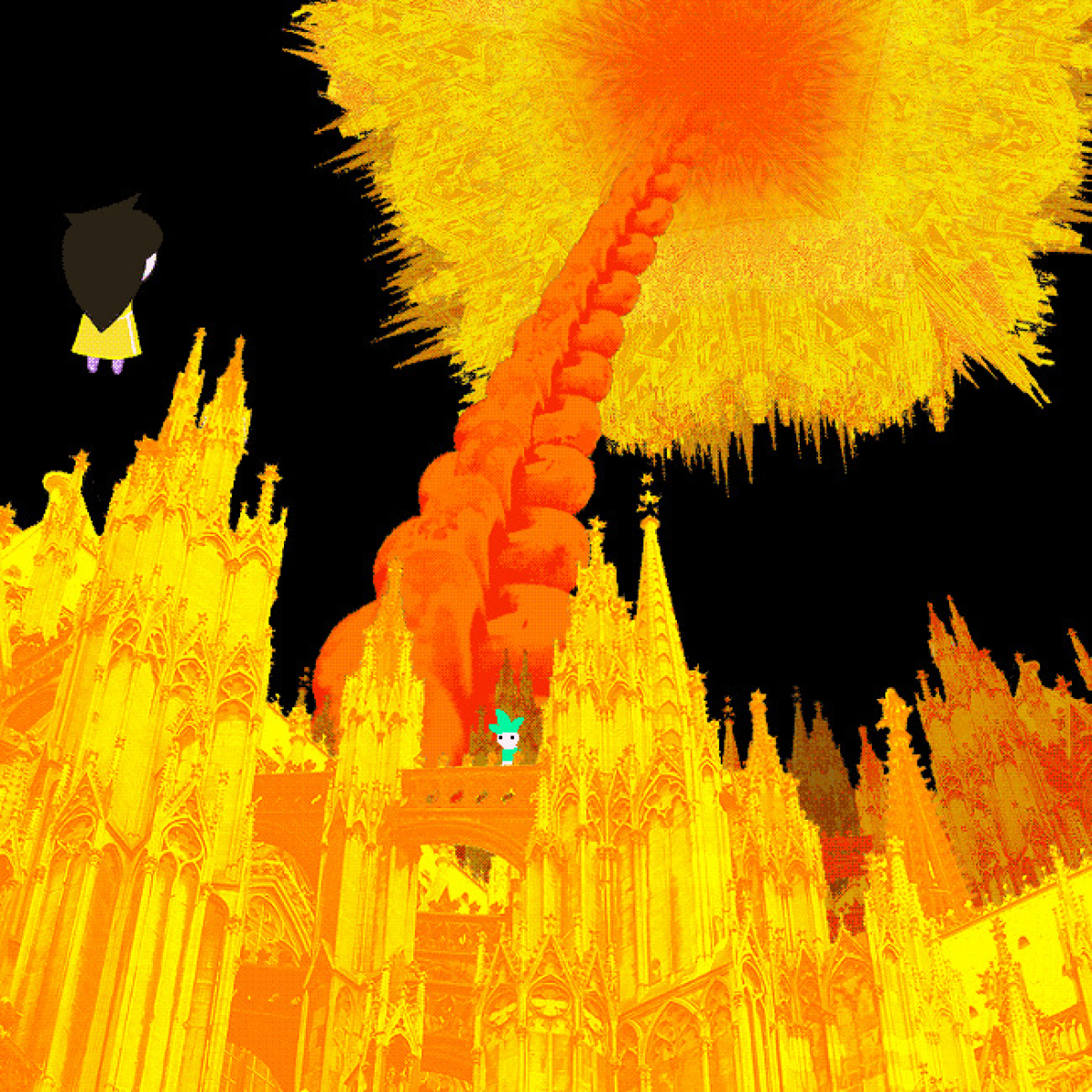
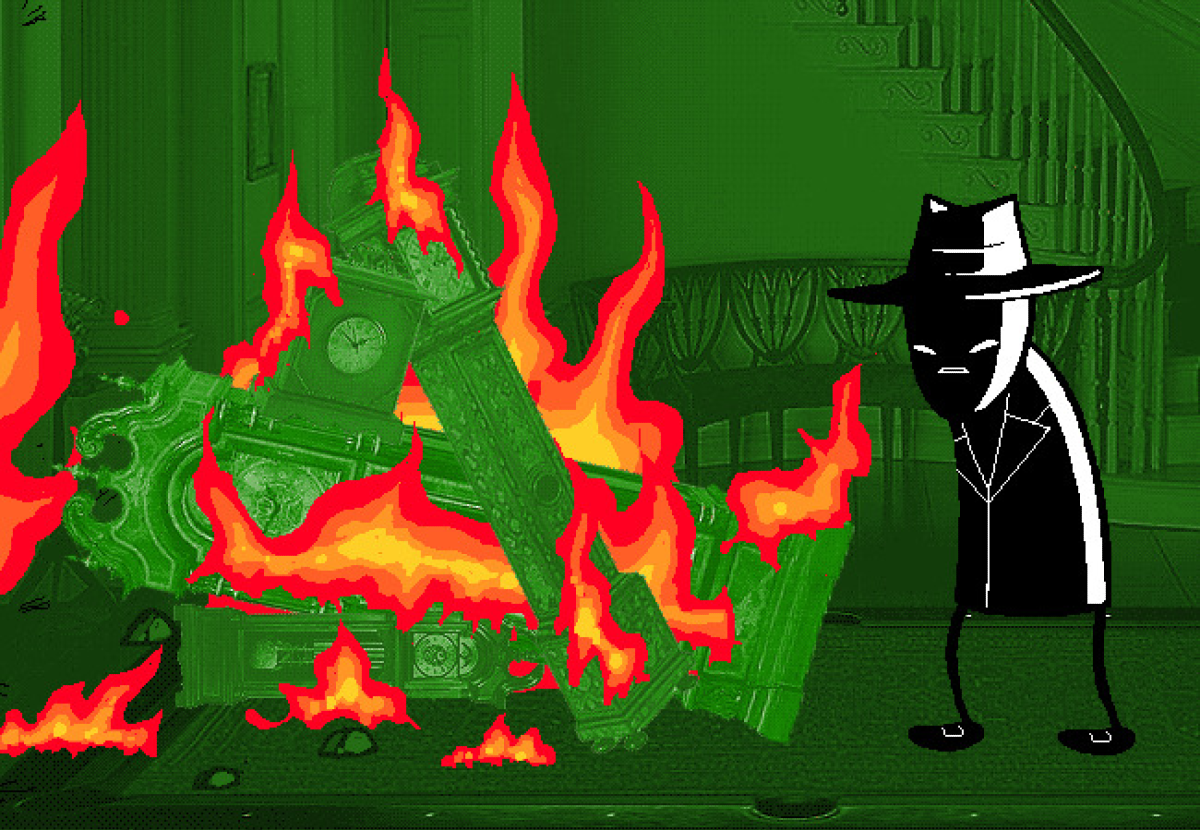
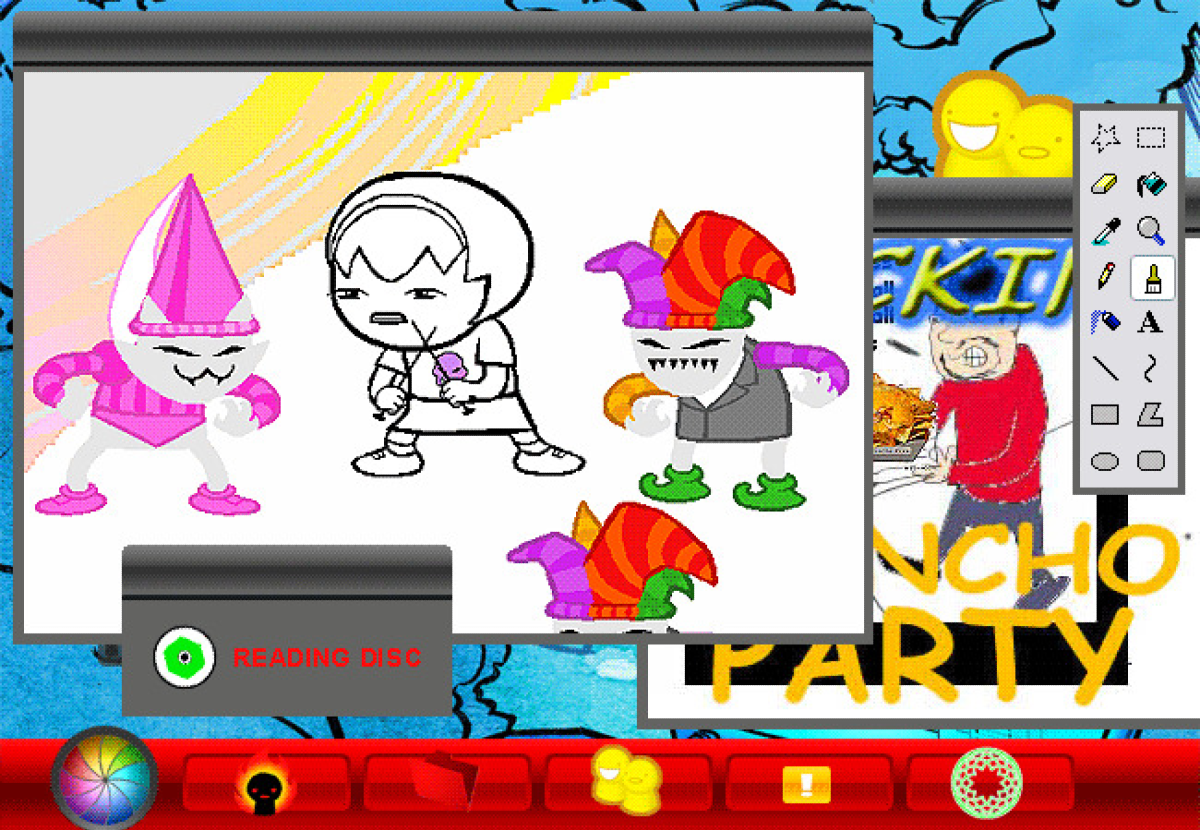
To understand this, we must focus on three central characteristics of the webcomic: the narrative structure, the humor, and the visual identity. Regarding the latter, it can be said that Hussie was ahead of the conception of the internet as a vast dumpster of images, an idea that was later solidified with pieces like the game Getting Over It with Bennett Foddy or the film Grand Theft Hamlet. The illustrations in Homestuck continuously employ a collage technique with royalty free images, sometimes ultra-processed or superimposed. This implies, on one hand, a notion of appropriation of materials available online, and on the other, a focus on low resolution (or, directly, low quality), reinforced by an art style that mimics MSPaint creations (even though Homestuck was drawn in Photoshop, the website was called “MSPaint Adventures”). A third facet relates to the conception of a collaborative artwork, something common in comics, but in this case led to not only having guest artists but also musicians, animators, programmers, and a long list of others.
This visual identity is, therefore, collaborative, appropriative, and deliberately poor in terms of resolution. These pillars form a very specific type of image that maintains visual and symbolic coherence throughout the webcomic, and again, gives the impression of observing a work constructed with recycled materials from the internet's trash. While this generally applies to much of Homestuck's imagery, a specific case is Sweet Bro And Hella Jeff, something like a “webcomic within a webcomic.” It’s the comic published by Dave, one of the protagonists, and is a prophetic example of the shitpost style that would plague the internet by the end of the last decade: drawings in paint that look like they were made by five-year-olds, with absurd texts written in Comic Sans.
This leads us directly to the other two facets that form the “Homestuck aesthetic”: humor and narrative structure, which are actually inseparable. If there’s one thing that defines this webcomic, it’s the way it combines an epic plot, concerned with existential themes like identity construction and friendship in a literally apocalyptic context, with a meta-narrative that is essentially absurd and reactive to traditional storytelling forms. In Homestuck, characters die over and over again, but there’s never any catharsis. Everything seems part of a grand cosmic joke. Many characters appear to have an awareness, from an early moment, of the futility of their actions: they assert that the game is lost from the start. Not out of fatalism, but because of the very broken temporality of the plot, where the future is genuinely known. The solution is to change the objective. It’s no longer about winning but about performing a scratch, literally scratching the hard drive of their existence to generate an ejection that allows them to restart the universe into an alternative one. And so it goes with everything: there’s no narrative piece that isn’t worked meta-narratively.
One could say that this type of narrative is classic internet postmodernism, an aesthetic that plays with an illusion of deep and complex meaning, but at every turn refuses to effectively represent it. In other words, a post-ironic aesthetic: it’s not just a sarcastic rejection of classic narrative structures, as these threaten to emerge all the time, but the boundaries between what should be taken seriously and what shouldn’t are crossed continuously. This results in a reading experience that is very hostile towards the reader, but therein lies the appeal. And, crucially: if this kind of post-irony is so identified with internet culture, it’s partly because Homestuck helped popularize it.
This type of narrative is classic internet postmodernism, an aesthetic that plays with an illusion of deep and complex meaning, but at every turn refuses to effectively represent it. In other words, a post-ironic aesthetic.
Today, there’s a paradox regarding how to read Homestuck. Not only does the website where it was published no longer exist as such, but much of the animations and video games it included depended on Flash software, which was discontinued in 2020. This broke hundreds of animations and games on the site, disabling the possibility of experiencing the original reading. To replicate it, fans developed their own unofficial downloadable collection that emulates the entirety of Homestuck, along with other webcomics by Hussie. In other words, for many years, Homestuck became a literary piece inaccessible through official means, in lost media.
However, starting this year, what is available as part of the official Homestuck canon is the animated pilot by Vivienne “VivziePop” Medrano, creator of Hazbin Hotel and Helluva Boss. Perhaps there’s no better example than this to understand the place Homestuck occupies in the present: it’s an infrastructural piece of our internet culture, both for the way it influenced aesthetics and narrative forms and for the careers it helped build. But it’s nearly impossible to read. For those of us who know it, it’s like knowing a dead language, or like having the membership card of a forgotten lodge that still opens some doors.
✦ Suscribite
Las notas de 421 no tienen paywall
Y a cada colaborador se le paga por su trabajo. Las dos cosas dependen de los suscriptores.
Dante Sabatto es sociólogo. Investiga y escribe sobre pensamiento contemporáneo, con un foco en aceleracionismo, horror cósmico y postcapitalismo. Sus textos exploran la intersección entre estética, técnica y política en la cultura del siglo XXI.