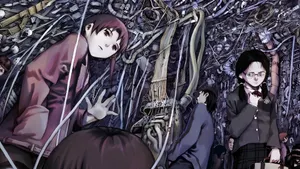
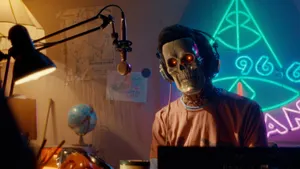
Reflections on the dissolution of the self, cyber art, and the act of self-affirmation that comes from refusing to participate in the rituals of humiliation advocated by the current paradigm of the creative industries.
"Terrible ghost", he called it, as if that wasn’t enough, after having stolen a dragon. A non-binary artist was exhibiting at Malba, without the proper citation to Ciruelo, a well-known illustrator, despite the similarities between their works. Thus began a series of humiliations directed at him. Under the museum's protection, and with the ex post facto rewritings of curatorial texts advocating for copying, the artist took aim at Ciruelo to the point of setting his work to music with Los Viejos Vinagres, from Sumo. He had won. Or at least, that’s what he thought, until angry hordes cornered him and demanded his exile at the top of their lungs.
Instead of taking responsibility for the oversight, Malba sent its guardians to wield urgent buzzwords like ready made and appropriationism. This language is a form of aggression that John L. Austin calls perlocutionary force. Essentially, using language not to communicate, but to hit the other with linguistic clubs. Words that, in theory, speak of art, but instead remind one more of violent bureaucracies. Like an unfaithful boyfriend uttering the word sex-affective.
Emerging artists are pressured to make their trauma histories public. Governments, competitions, friend associations, banks, and other strategic partners reward the sacrificial role,an added value of contemporary work.
But the backlash also left the artist with no moment of peace, who unearthed devastating labels: man, cis, white, heterosexual. However, the canceling anachronism was not only ineffective but added fuel to the fire. The public multiplied its anger in thousands of comments that the artist curated in their Instagram feed: they deleted respectful interventions filled with likes and kept the most problematic comments at the top to strip the illustrator of their victim role.
That the artist violated Ciruelo's intellectual property is beyond doubt in these paragraphs, and it’s something that colleagues, journalists, and lawyers have pointed out. In any serious museum, ignoring the moral and patrimonial rights of artists, collectors, artwork photographers, their heirs, etc., should be grounds for dismissal. A "mistake" can cost the institution millions of dollars and turn into a public relations nightmare. In the publishing sector, publishing a plagiarized book is a legal issue for the publisher. Fortunately for everyone, the illustrator decided not to take legal action.
Despite this, the artist didn’t stop, and the museum seemed to be defending them, but was it really so when they left them to fend for themselves when resolving the issue from the communication department was so easy? Shouldn’t Malba ensure proper references and be trained in handling these cases?
The institutional protection was an illusion. The artist had to explain their own work: an absolute defeat. A ritual of humiliation offered to the dark forces. Not satisfied with that, they laid out their social disadvantages, particularly their non-binary gender and the injustices of their own biography. There is room for optimism: the Internet will forget, the lesson will be learned, and we hope their artistic career doesn’t collapse. But not all artists are so lucky.
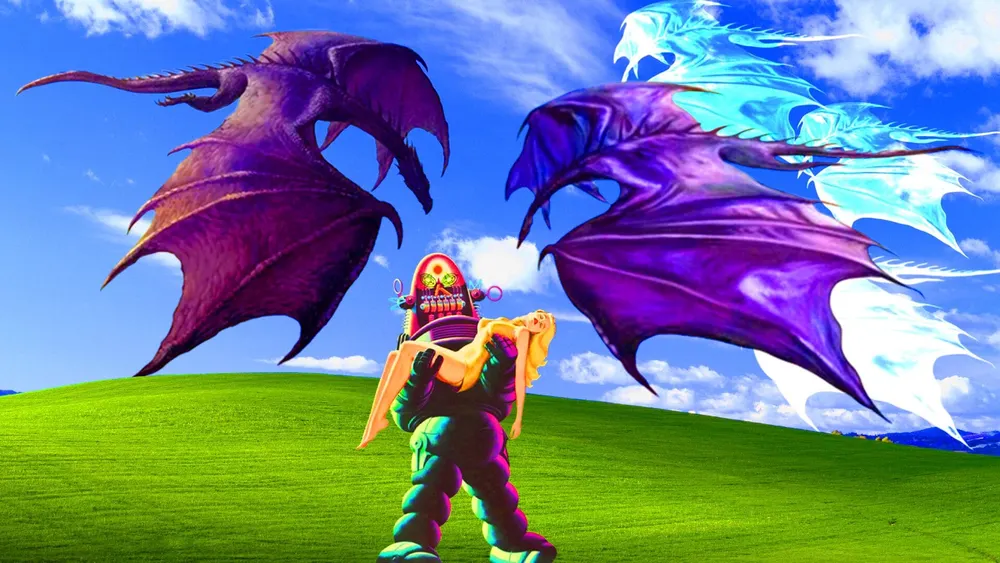
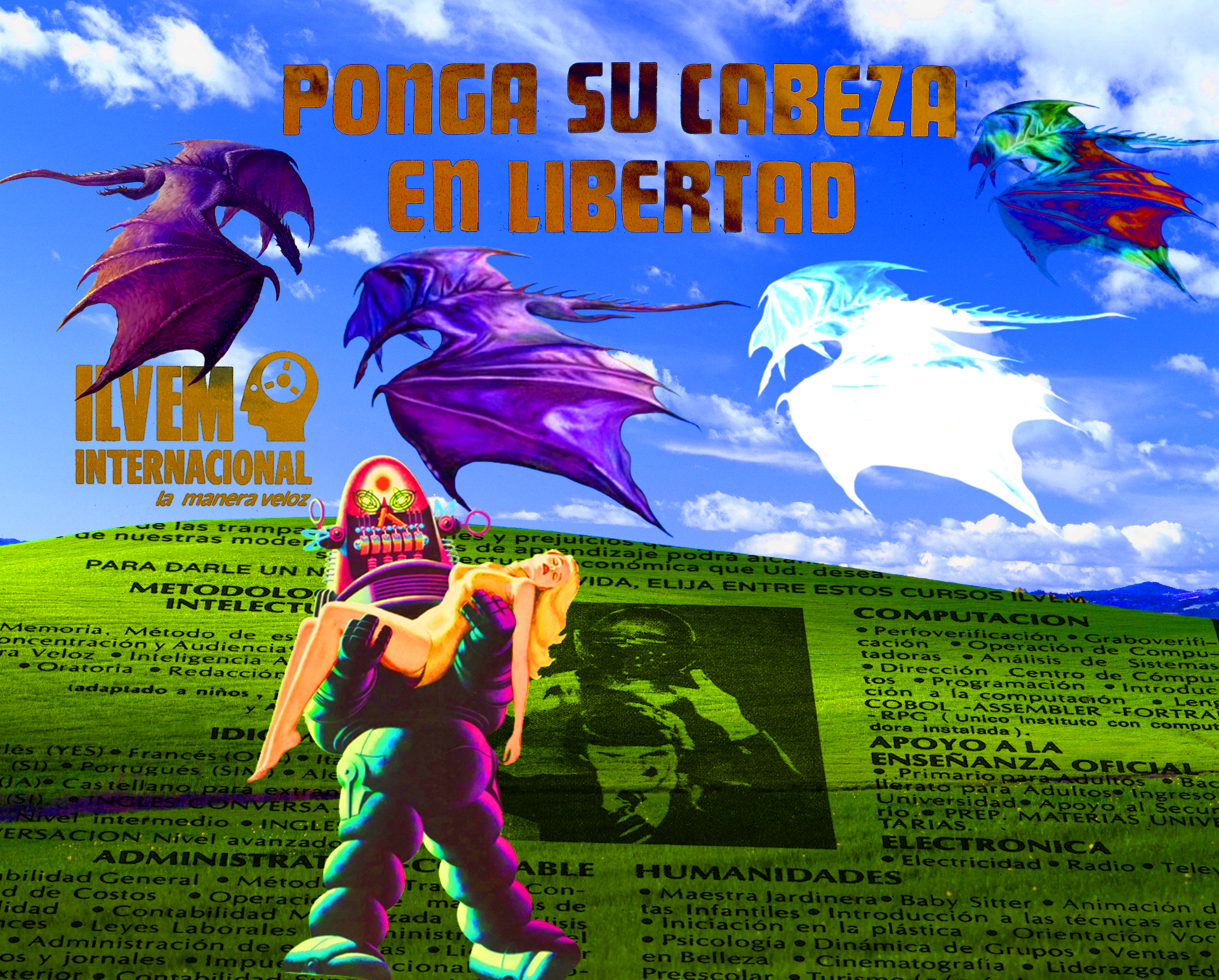
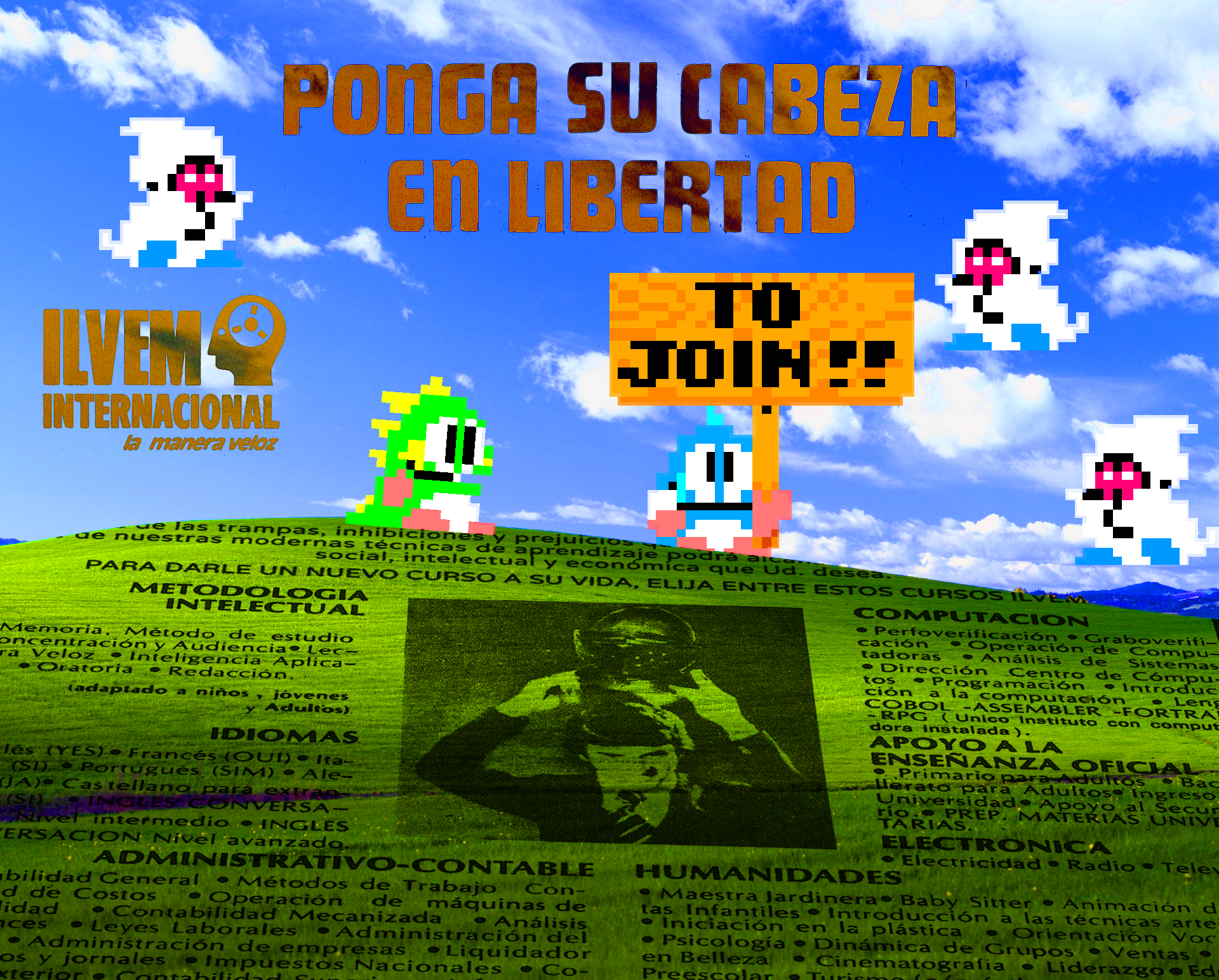
A collage by the artist that transforms and recontextualizes Ciruelo’s dragon and the one exhibited by the Malba in the show "El desentierro del diablo", in dialogue with the ILVEM Institute and "El planeta prohibido" (1956), juxtaposed against the Windows XP “Bliss” background.
Blood sacrifices
The previous paragraphs aim to illustrate how emerging artists are pressured to make their trauma histories public. Governments, competitions, friend associations, banks, and other strategic partners reward the sacrificial role,an added value of contemporary work, a phenomenon not far from the pornography of inspiration that people with disabilities often denounce when they feel compelled to move audiences of non-disabled people.
Once the ritual sacrifice begins, there’s no turning back. When it comes to young artists, the consequences can be catastrophic. Just last decade, that tacit demand for self-flagellation ended up costing young LGBT+ Effy Beth and Ioshua their lives, celebrated only after their deaths. The obsession with surpassing the professional ceiling of clandestine cultural centers activated the most ancestral form of ritual sacrifice: blood.
Ioshua would cut himself on stage reciting poems about homosexual stories, among drawings of revolvers, caps, and ejaculating penises. Meanwhile, Effy would water the city with their own blood in a reaffirming via crucis of their gender identity, where each spillage was transubstantiated into menstruation through the artistic act. It was a response to someone who once told them they would never be a woman for not ovulating: "I am always a woman."
Ioshua, according to his friends, died of "cold and AIDS", while Effy died by their own hand. It’s not that art is immediately responsible, but the structures that push their youth to deliver blood shows in front of an excited audience cannot provide support for the troubling side of their behaviors.
The job searches of artists and students facilitate young people competing among friends to expose themselves more and to immolate themselves in the narratives of their traumas from childhood abuse, discrimination by class, race, or gender, non-hegemonic bodies, disabilities, or neurodivergences that, when made known, exclude candidates from job searches but promise them a slim chance of making it in some scholarship or exhibition organized by wealthy institutions that give voice to minorities obsessed with their self. The brain mechanism behind these illusions is the same as that behind the very contemporary scourge of online casinos: the reward prediction error. The mouse pulls the lever but cannot know when it will receive the treat and enters a dopaminergic loop. Maybe the next competition will send me to Europe.
The job searches of artists and students facilitate young people competing among friends to expose themselves more and to immolate themselves in the narratives of their traumas from childhood abuse, discrimination by class, race, or gender.
The sacrifice of private life is the boundary between some and others. On the other side are the art professionals with paychecks and/or inheritance who don’t need to bare themselves and certainly not bleed before the world and its predators without compensation or support in return. What presents itself as an act of social justice is, in reality, the exercise of the sometimes sociopathic privilege of the few who can afford to protect their intimacy and engage in cultural industries without needing to be an open book as vulnerable as it is exploitable.
Cryptography of the cemetery
In 2022, the novel+techno-esoteric VideoDreams incorporated a real ghost into its plot. Less than twenty years ago, humanity heard an unembodied voice that spoke and sang from a world where sound recording did not exist.
Édouard-Léon Scott de Martinville was interdisciplinary: a printer, shorthand writer, inventor, and 19th-century French linguist. His obsession with translating stimuli from one sensory zone to another categorically different one led him to build the fonoautograph, a machine he patented in 1857, whose essential purpose was the synesthetic endeavor of representing sound visually. The device was inspired by the human ear and could trace sound oscillations on strips of paper. What Scott de Martinville had not intended was to gift humanity its own ghost. In 2008, the traces were scanned, calibrated, and transduced into sound waves. The voice was finally decrypted. At the Lawrence Berkeley National Laboratory, Scott de Martinville manifested singing the first recorded song in history: Au Claire de la Lune, a lullaby.
The dead sing and they also dance. Every weekend, just meters from the Obelisk, no less. The Pantheon (now Réquiem) was the reigning dark club of the last part of the nineties, located in the basement of the building of the Institute of Speed Reading, Study, and Memory (ILVEM) at Avenida de Mayo 950. The establishment remains almost unchanged, except for the decor, the private rooms, and the staircase to nowhere that provided shelter for the secret practices of the creatures of the night. For decades, dark rhythms have accompanied the fluttering of black leathers in an underground cemetery, tied to the impenetrability of the past that encrypts itself in every dance of shadows.
ILVEM, the original building, promised for decades a mental updating agenda through the development of cognitive and cybernetic skills, present both in the transhuman logo where an electromagnetic tape replaces a brain and in the amalgamation between man and machine in its courses: perforation verification, recording verification, programming in assembler. ILVEM was founded by the Krell brothers.
The krell, in turn, are a vanished civilization in Forbidden Planet (1956), a landmark in science fiction. The only trace left of the krell is a planetary machine capable of materializing (or generating?) the objects of imagination, but also the objects lurking beneath it: the Monsters of the Id. The beast, the primitive mindless one. A species eliminated by its own subconscious.
In this age of machines that generate objects from our imagination and herald our own disappearance, we often complain about the theft of intellectual property in training datasets. Artists and writers find their work regurgitated under someone else's name and devoid of soul. But isn't that just a surface conflict? Isn't the machine of plagiarism a reproduction of a deeply human issue, with the difference that we expect the cosmic horror of data centers to absolve the crime, as if we were declaring that there was no murder on the Orient Express when the evidence of authorship melted into one another?
What dark corners must we navigate to find artistic facts that are foreign to the logics of the machine, which ultimately reflect the narcissism of our species?
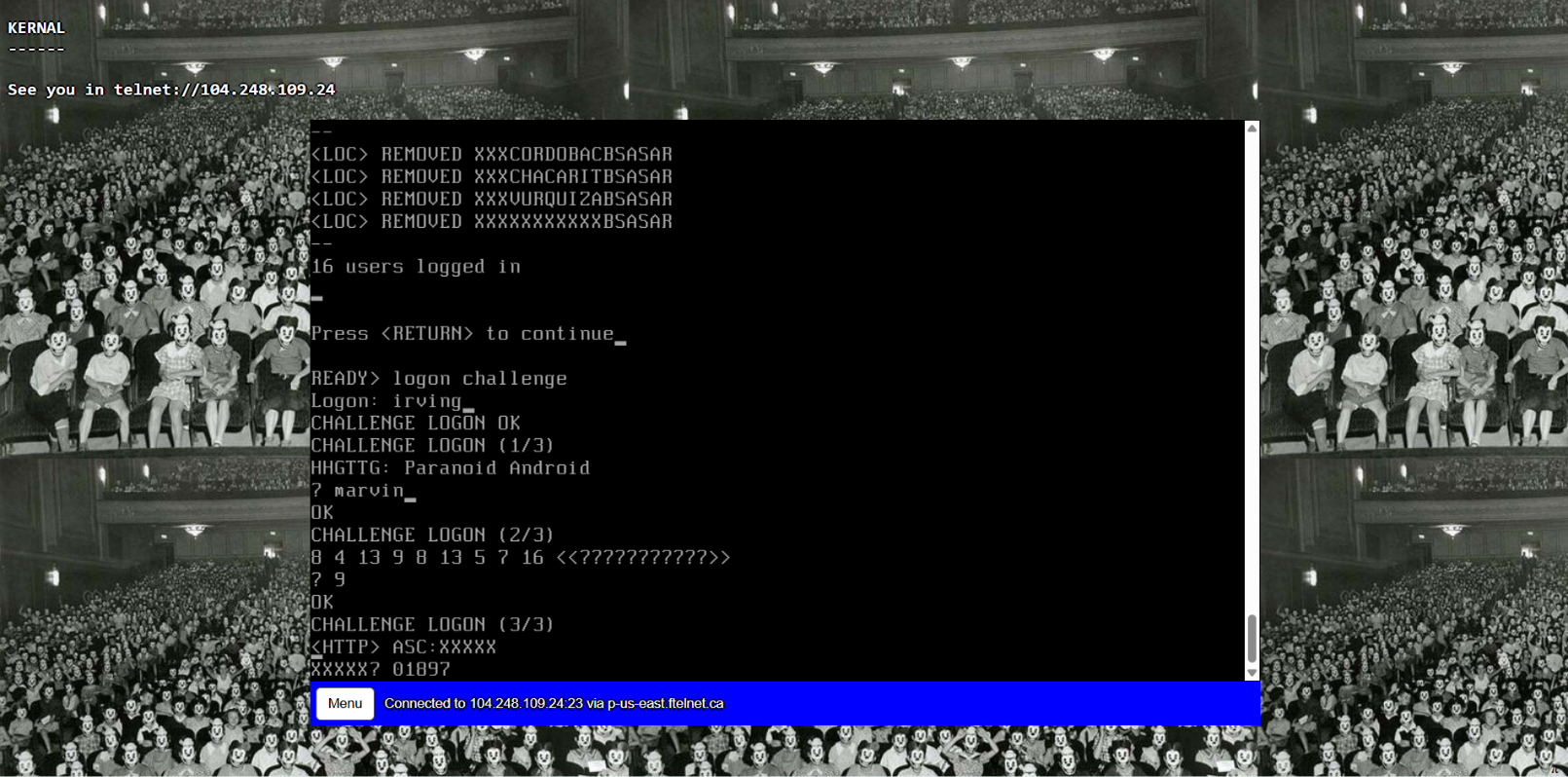
The IP appears randomly around the city on stickers. The project circulates under the nickname Telnet. There is no information about it, no one claims authorship, no one is earning academic points or prominence in any social graph. It doesn't show up on Google, and it's unclear whether it hides illegal content or if it's a cybersecurity competition like Capture The Flag. Nothing. A ghost.
The images displayed by the website that serves as the interface and paratext for the console are, to say the least, disconcerting. An auditorium of children wearing Mickey Mouse masks from the mid-20th century, a capture featuring a pixelated apparition in the middle of the night. The society of the spectacle. As we begin to investigate, it becomes clear that we are facing levels of encryption that reveal explicit and persistent references to Borges' work (The Aleph, in particular) hidden behind various types of codes, from the most ancient to the cybernetic. A psychogeographic challenge sends the user specific coordinates of the Chacarita cemetery in search of a token to access the next level. The physical loss of this token perhaps explains the reappearance of a command that accesses the server's guestbook, where a community of anonymous users leaves greetings, shares clues, and allows some coordinates to be anchored to the project, which seems to have been active since 2018 and captures the attention of cyber-surgeons, Pungas from Villa Martelli, and the Ekoparty cybersecurity conference, much to the relief of users who don't know if they're about to access a snuff video library. Although nothing can be guaranteed.
What can be assured is that all this work, participation, creativity, and coordination of efforts remain foreign to the specialized academy of digital art and literature. Telnet is merely a demonstration that independent projects, born out of passion, which do not place names or categories at the forefront, have little chance of being recognized. But on the other hand, it doesn't seem like Telnet cares, nearly a decade into its existence with minimal efforts to gain visibility. And that is its crucial lesson: to dissociate visibility from survival. To transcend the pressures of the self. To think of unique, technical, and specialized projects outside of cultural capital. Meanwhile, in not-so-secret laboratories, evolutionary barriers are being surpassed.
Dissociate visibility from survival. Transcend the pressures of the self. Think of unique, technical, and specialized projects outside of cultural capital.
Just like the krell from Forbidden Planet and the Krell brothers from ILVEM, we are haunted by obsessions of cerebral upgrades from which we cannot escape. One of the bastions of the transhumanist agenda in the dawn of General Artificial Intelligence is the neurotechnological upgrade of the species, like the recently interrupted Building 8, Meta's telepathic lab, the daily advancements in human-machine implants from Neuralink, or human protocerebra in test tubes playing Doom. Beyond these experiments, this upgrade of the species has already become a reality manifested in thousands of clinical uses of neurotechnology, such as cochlear implants, modulators for tinnitus, Parkinson's, and Tourette syndrome, or, not to stray too far, psychiatric drugs.
The end of Jean-Marie Schaeffer's human exception is precisely about that: there is nothing in the species that excludes it from cultivating its own protocerebral brains, despite the normative insistence of States to affirm more or less directly the existence of the soul. It is not far-fetched to recognize in these conditions the first glimpses of a future technological singularity not only in the form of artificial superintelligence but as a hive mind materialized in updated and modified biology. A neurocolonialist movement that has been putting minds in condition for almost two decades through the hacking of dopaminergic cycles, the redesign of personality, and the conquest of cognitive domains that previously belonged to the intimate realm of brains. Nature already whispers transcendence beyond the boundaries of life, like the uterine tumor of Henrietta Lacks that continues to live and grow 74 years after its owner's death, and in the flow of ideas between brains without mediation, as happens with the craniopagus twins Krista and Tatiana Hogan, who share brain structures and jointly process thoughts and sensory experiences that are unrepresentable in our sadly monadic character.
Perhaps these experiences can serve as footnotes to think about our own artistic practice, especially for those of us who identify with one or more minorities, navigating the atavistic temptations of algorithms, which are nothing more than the amplification of the most bestial instincts that we cannot help but inject into the machine and which will likely herald our disappearance. Not trafficking our suffering. Doing something for the sake of doing it. Learning to code without working in that field. Not stealing dragons. Looking in the mirror and saying out loud: "no one owes me anything." Imagining the integration of our sensitive experiences into an egregore that no longer knows death. Embracing being a ghost. Tropisms that steer us away from the sacrificial stones destined for them to consume our innards and the last drop of our blood.
✦ Suscribite
Las notas de 421 no tienen paywall
Y a cada colaborador se le paga por su trabajo. Las dos cosas dependen de los suscriptores.
Lingüista. Maestrando en Humanidades Digitales.
Publiqué La masacre de Reed College (2013) y desarrollé la novela+ transmedia VideoDreams (2022).
Editor a cargo de proyectos artísticos, científicos y ambientales.