Jonathan Hickman: Obsession, Conspiracy Theories, and Posthumanism
What if comic books were designed like meticulous architectural blueprints? From sports nerd to Marvel revolutionary, Jonathan Hickman uses infographics, political intrigue, and dystopia to rebuild universes. Discover the architect behind the X-Men and the Avengers.
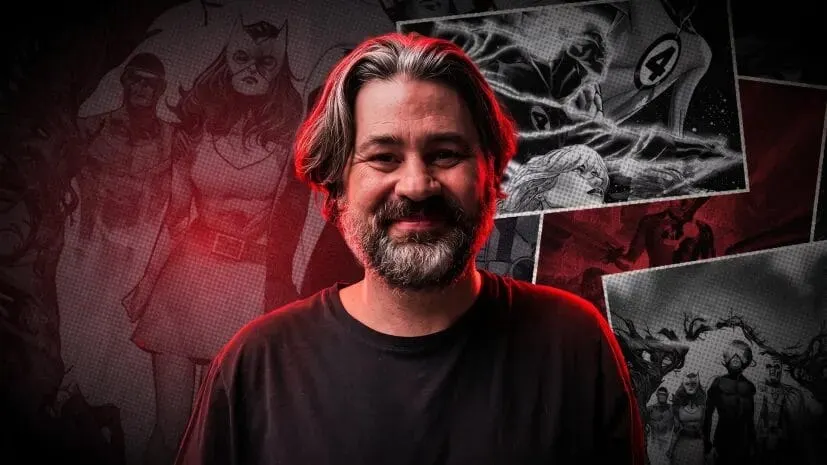
Jonathan Hickman was born on September 3, 1972, in South Carolina. He grew up there, influenced by the "Southern gentleman" ethos. As he mentioned in an interview: "In my family, certain things were highly valued that I now take for granted, like how to behave and good manners. It's simply a certain sense of propriety in behavior that one is supposed to have, something that fascinates me but doesn't resonate with others." This fascination with the cultural forms of the American South would appear in some of his later works, particularly in East of West.
In his youth, he also had a fascination with drawing and sports. He was, at the time, a nerd straddling two worlds. Hickman is one of the very few American comic creators who appreciates soccer, and on more than one occasion, he has expressed how much he enjoys the World Cup. He is also a voracious reader of fantasy and science fiction. His favorite author is Frank Herbert, but he also loves Tolkien and William Gibson. Another influence he often mentions is Cormac McCarthy, and the McCarthy-esque conception of morality and nihilism, as well as the solitude of man in the face of a merciless world, have greatly influenced his work. Fantasy, for its part, impacted his conception of worldbuilding, the attention to detail in creating a fictional universe.
Comics came into his life through a random issue of the Legion of Super-Heroes, and throughout his adolescence, he was a reader of DC Comics. He only had affection for the X-Men from Marvel. This preference of Hickman's is bitterly ironic, as he has yet to work for DC to this day. The only time he was very, very close was around 2016-2017, when it was practically a done deal for him to take over the Legion, and in the end, Dan Didio handed it to Bendis, who produced one of the worst runs in history. What a dream it would have been to pair Hickman's systemic obsession with the expansive and rich world of tomorrow of the Legion. Maybe someday...
Throughout his adolescence, he was a reader of DC Comics. He only had affection for the X-Men from Marvel. This preference of Hickman's is bitterly ironic, as he has yet to work for DC to this day.
After finishing high school, he entered Clemson University in South Carolina and earned his degree as an architect in 1994. At that time, all he wanted was to be a comic book artist, and, influenced by the success of Image, he copied Jim Lee and tried to break into the comic industry, failing in the attempt. This failure led him to work as a designer of CD-ROMs and web pages, and in advertising as an art director. It was there that he began to incubate the perspective that would set him apart as an author: a blend of design, infographics, and storytelling. In his own words, he switched to writing because "I couldn't find anyone who wrote the comics I wanted to draw."
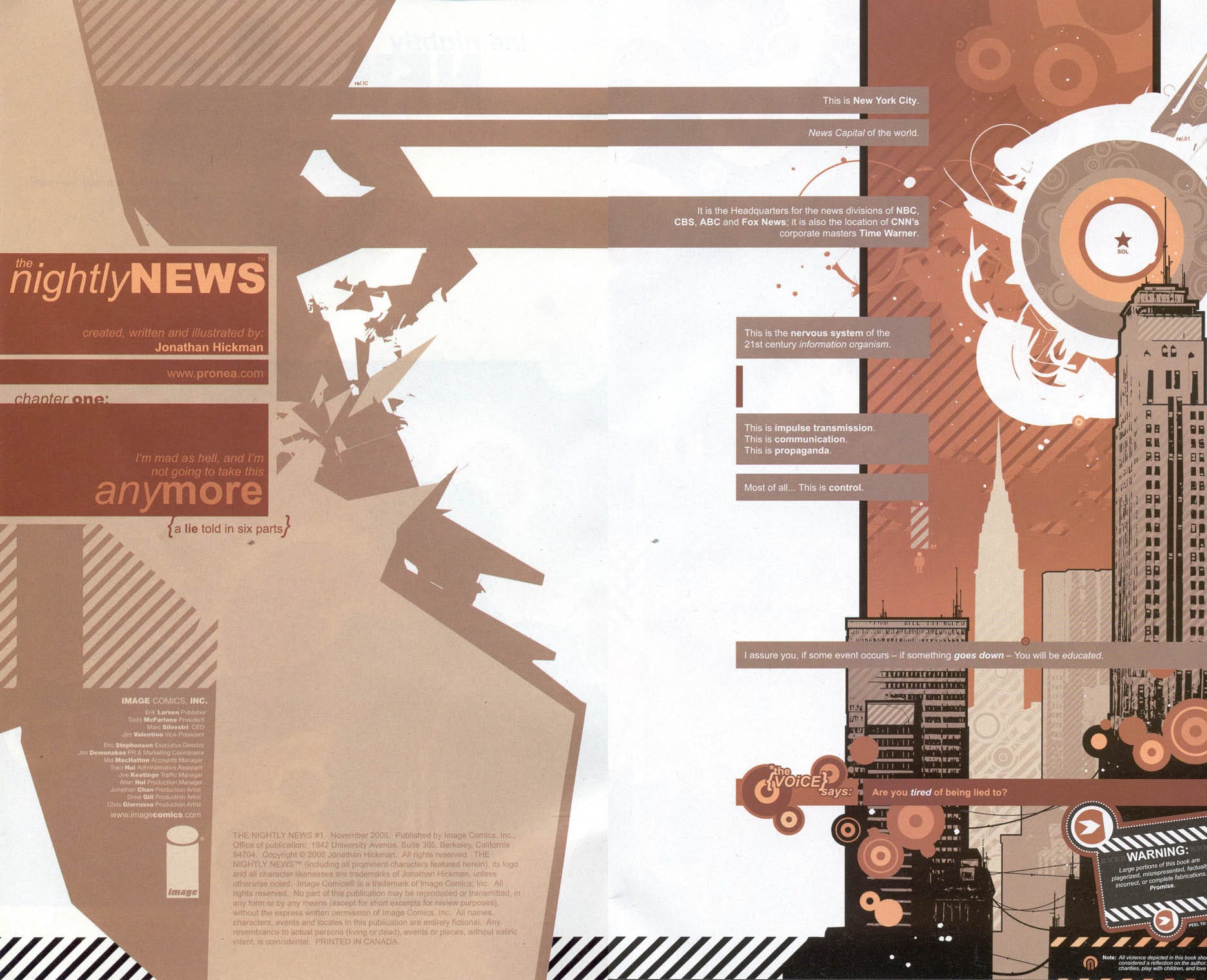
Around 2004, bored and depressed by his corporate job, he sat down and wrote a "five-year plan" to break into comics. He then created a professional pitch for his first miniseries, The Nightly News, which he presented to Image. Using his background in advertising, he proposed a business plan where he would finance the comic's publication, allowing him to sell it without prior contacts. The Nightly News, which Hickman wrote, drew, colored, and lettered, follows a former journalist who forms a cult dedicated to the assassination of journalists and acts of terrorism against the companies that control information. The comic was a strange piece, at times infographic, at times comic, at times political pamphlet, and it garnered significant hype.
Then, Hickman moved on to other miniseries: Pax Romana, about a group of knights sent by the Vatican on a time-traveling mission to prevent the fall of Europe to Islamic forces; Red Mass for Mars, with Ryan Bodenheim, his take on superhero deconstruction, featuring an analogue of Superman who lands on Earth in the Middle Ages; and Transhuman, with J.M. Ringuet, a science fiction story about the rise of three transhumanist corporations, told as if it were a documentary.
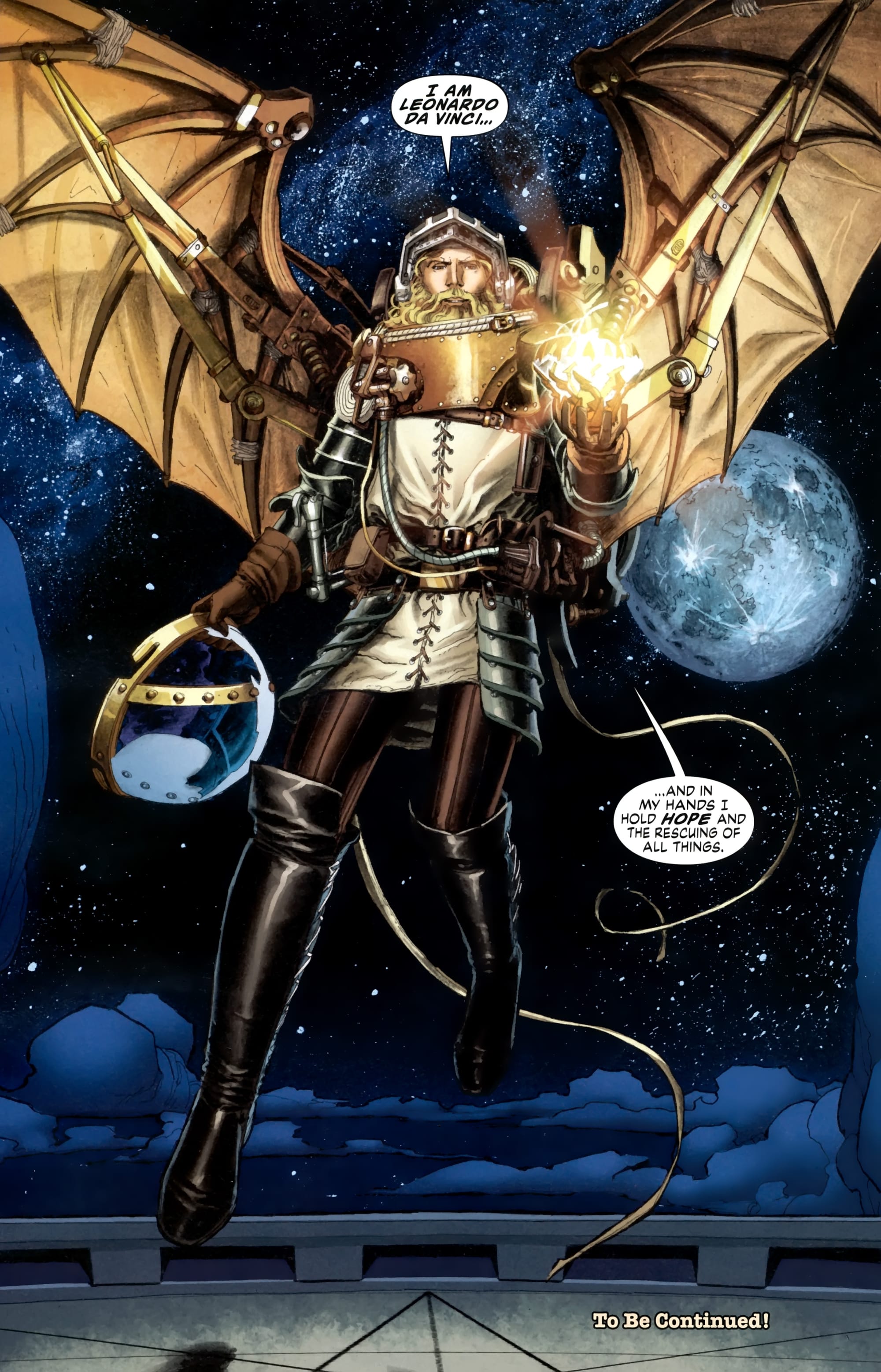
Thanks to these introductions, he received a call from Marvel. Brian Michael Bendis had read his comics and recommended him to take over, along with him, a series called Secret Warriors, a spin-off of the 2008 event Secret Invasion, which followed Nick Fury and a group of young secret agents cleaning up the Earth after the Skrull invasion. From here, he would jump to a more personal project, which actually originated from a concept for a series owned by the author, starring Da Vinci: S.H.I.E.L.D., the secret history of the spy organization, featuring guest appearances from Da Vinci himself, Nikola Tesla, Isaac Newton, Zhang Heng, Galileo Galilei, Michelangelo, and Tony Stark's and Reed Richards' fathers, Howard Stark and Nathaniel Richards. Here, Hickman would already showcase several moves characteristic of his authorial brand: structured stories, conceived from the outset; complex machinery formed by the abilities of a set of characters (synergy in the sense of superpowers); a secret history of the world that reveals the hidden threads that drive it; a mix of historical figures and absurdly pop fictional characters; a concern for power and who wields it. Additionally, it illustrates another characteristic of Hickman: his fervent imagination, always ready to produce new concepts, and his desire not to hold them back for a future project where he could extract more from them.
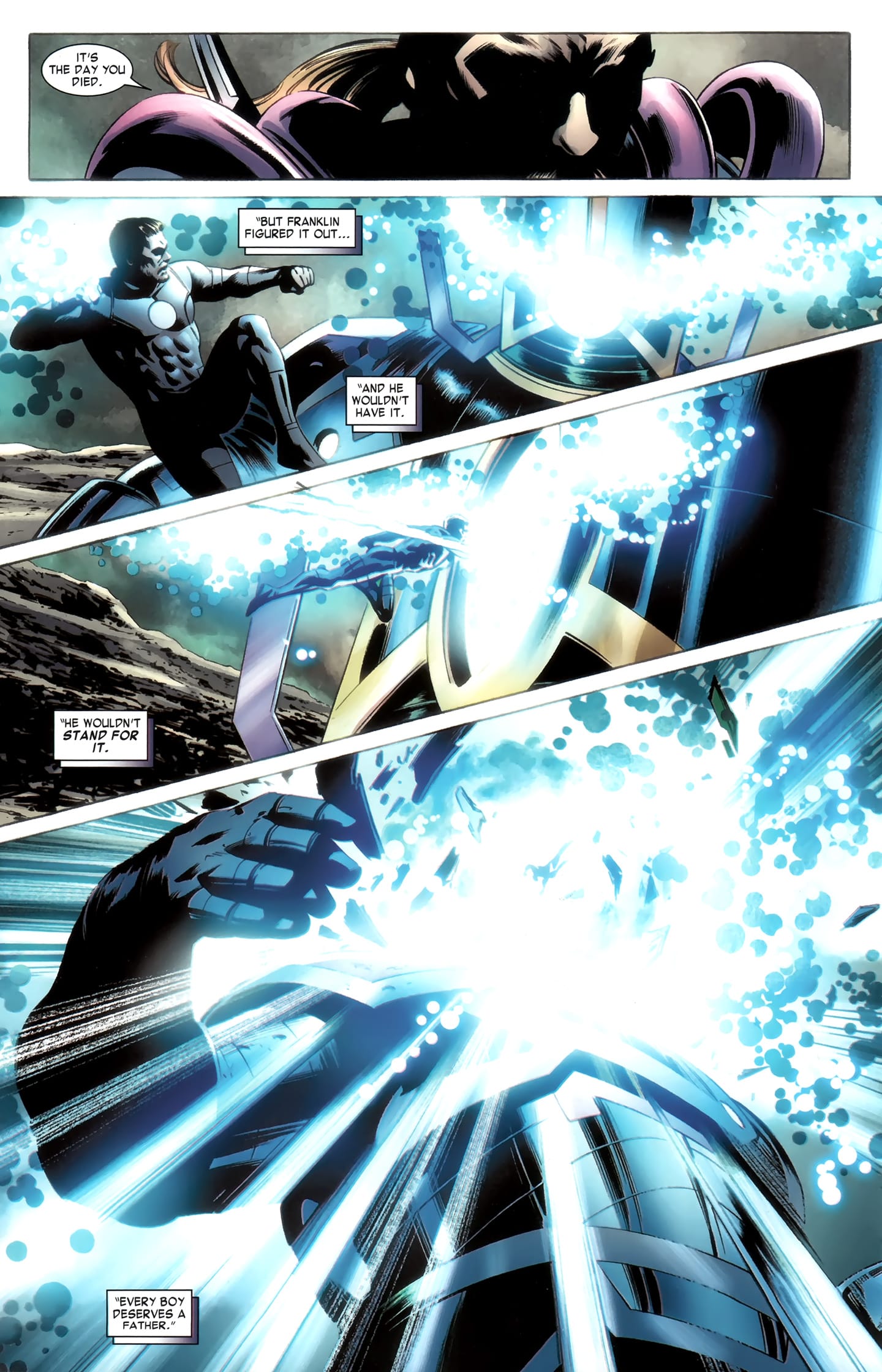
From there, he would produce his first masterpiece at Marvel: the long run on the Fantastic Four that began in 2009, perhaps the best modern run of the First Family. For me, what makes it great is how Hickman employs the variables "family and exploration" to expand the world of connections among Reed, Sue, Ben, and Johnny into an extended family without renouncing science fiction and the monstrous. Moreover, this run already foregrounds something that was present in S.H.I.E.L.D., but got a bit lost in the deconstruction of the secret history of the Marvel universe: the relationship between father and son, and the legacy that can be left behind.
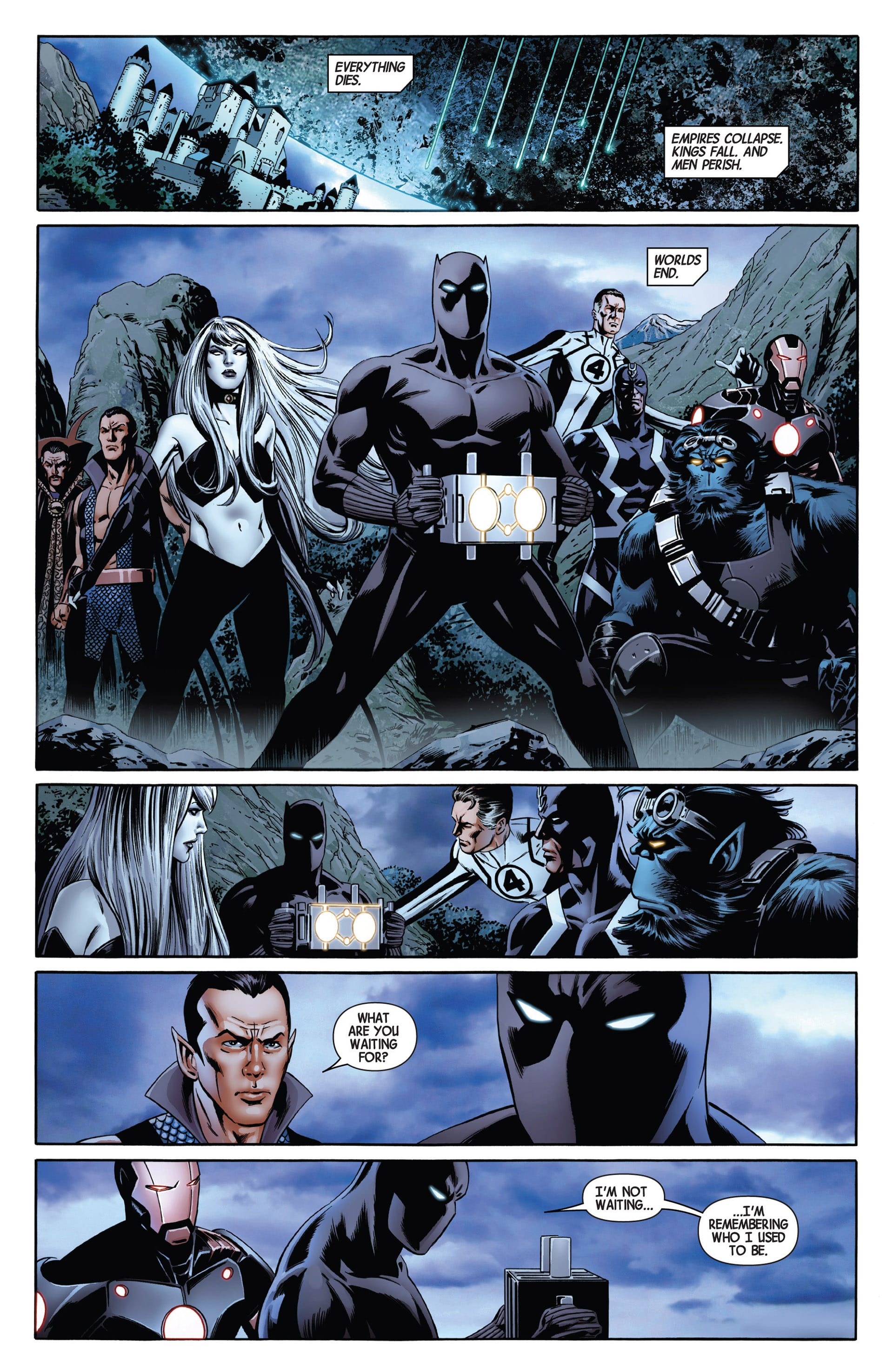
As a result of this strong performance, Hickman was given Avengers, the main series of the Marvel universe, just as Brian Michael Bendis was stepping away after a decade of steering the destinies of the "most powerful heroes on Earth." Hickman immediately diagrammed a plan in two series: on one hand, Avengers would be the series about "the light," the Apollonian, featuring an idealistic team of Avengers seeking to perfect the "Avengers machine" to include more characters, more abilities, and better combat against evil. On the other hand, in New Avengers, the darkness, the Dionysian: the Illuminati, the society of men willing to make the tough decisions of the Marvel universe, which includes Black Panther, Reed Richards, Tony Stark, Doctor Strange, Black Bolt, and Namor. They face the "incursions," overlaps of universes during which there are two options: the destruction of both, or the absolute decision, to annihilate one universe so that Marvel can continue. At one point, Hickman said that his run on the Avengers posed the question of what happens to heroes when they can't win: do they remain heroes? Do they change and become villains? During this run, he also created The Black Order, the "children" of Thanos, who would later appear in Infinity War and Endgame. Over time, the two parts would collapse into one another, and darkness would prevail, leading to Secret Wars, one of the best Marvel crossovers in history, set in Battleworld, a world formed by the islands of all the alternative lands, all the little pieces of history that survived the final incursion, which annihilated the multiverse, ruled by an all-powerful Doctor Doom who stole Reed Richards' family. Yes, as you can imagine, this event also served as a closure for the Fantastic Four and all of Hickman's first phase at The House of Ideas.
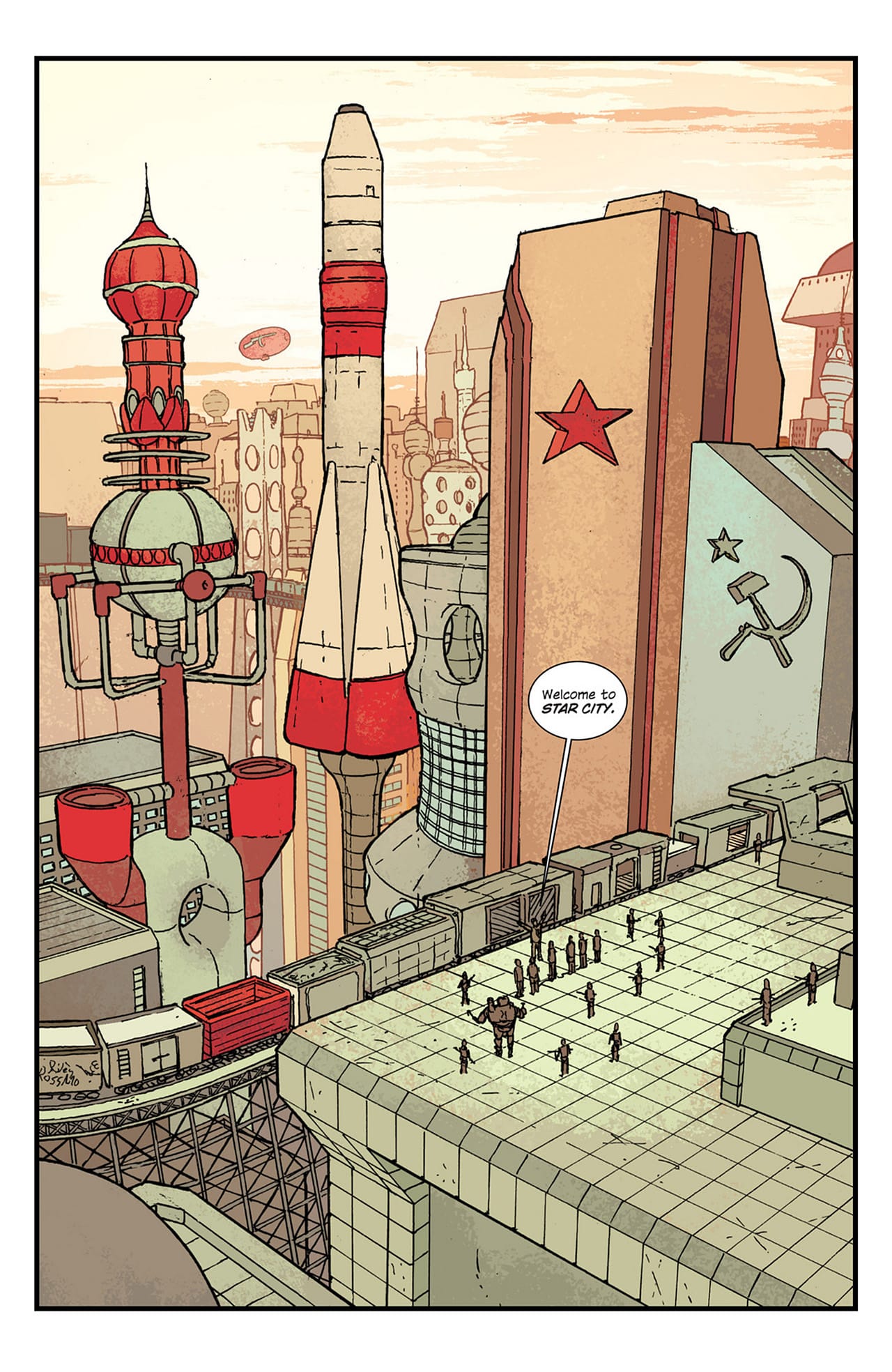
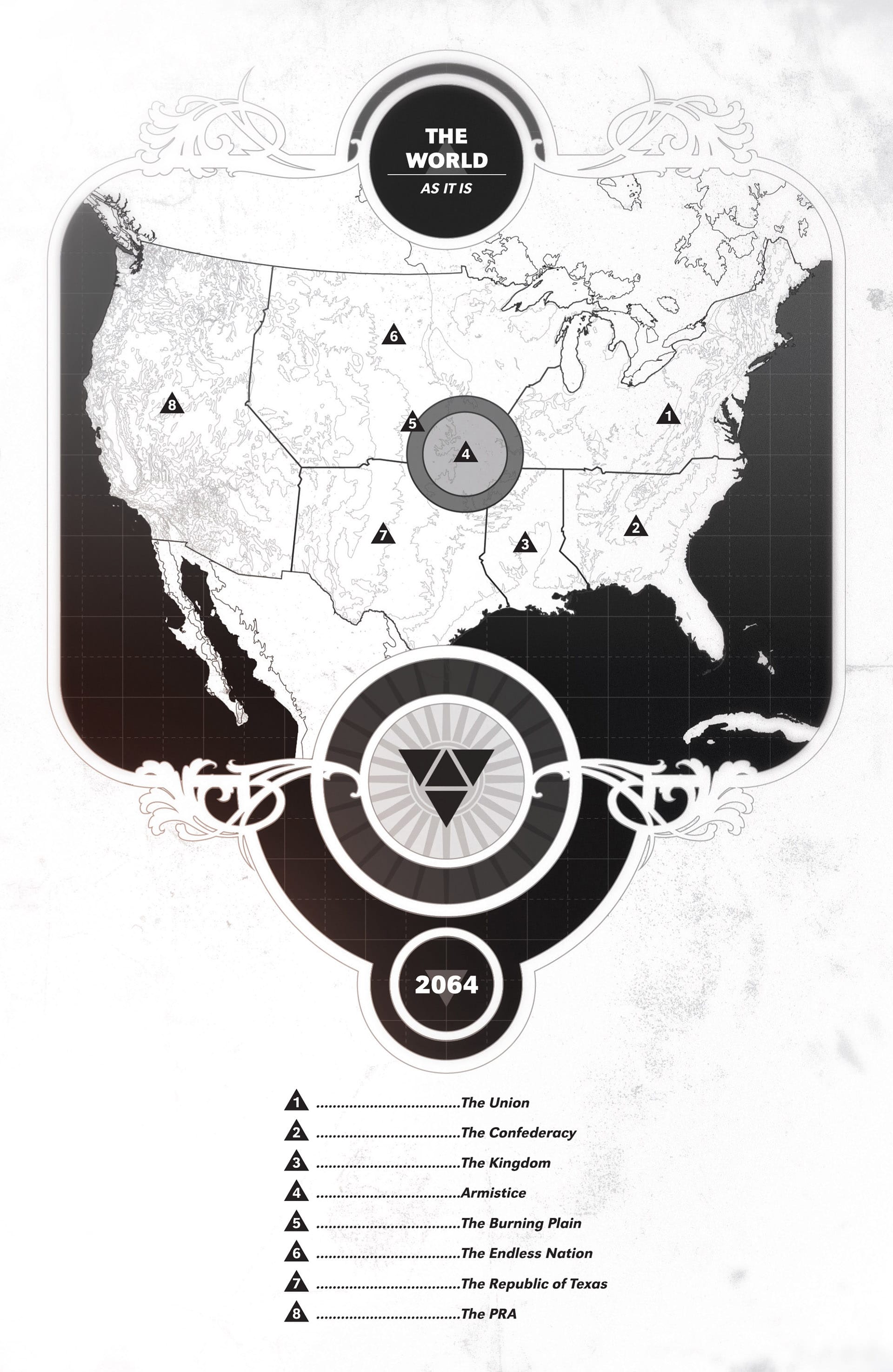
In parallel, the author continued to nurture his garden of personal projects with two excellent series: East of West, with Nick Dragotta, and The Manhattan Projects, with Nick Pitarra. The former is simultaneously a love story, an apocalyptic tale, and a reflection on the fabric that binds the United States. This world, a mix of fantasy, western, and science fiction, sees the U.S. divided into several countries due to the prolongation of the American Civil War until 1908 and the fall of a comet with mystical roots. At that moment, the six factions gather in Armistice, the landing site of the comet, and decide the end of the war and the division of the United States into six countries: The Union, The Confederation, the Kingdom of New Orleans, founded by former slaves, the Infinite Nation of the indigenous tribes, the Republic of Texas, and the PRA, the People's Republic of America, a socialist state founded by an exiled Mao Zedong on the Pacific coast. In 2064, when the series begins, the Four Horsemen of the Apocalypse awaken and set out to bring about the End Times, and there, on that fine base of geopolitics and alternative history, Hickman and Dragotta sprinkle a deluge of eschatology.
In his run on the Avengers, Hickman posed the question of what happens to heroes when they can't win: do they remain heroes? Do they change and become villains?
The latter is a sort of extension of the logic of S.H.I.E.L.D., but instead of going from the Renaissance to the present, and being intertwined with the Marvel universe, it revolves around the Manhattan Project and features mad scientists like Einstein, Oppenheimer, and Fermi, but with a lot of perversity, gore, and science fiction. In 2016, he would also add The Black Monday Murders with Tomm Coker, which told the story of a group of megabillionaire families operating in the market thanks to the black magic of the god Mammon, and which unfortunately remains unfinished to this day.
But life is a pendulum, and after the conclusion of East of West, Hickman felt tempted to return to Marvel to relaunch the X-Men, who had been suffering from poor sales and growing irrelevance in the Marvel universe for many years. He reimagined the mutants in the most radical way in 25 years, flipping the franchise upside down. I have discussed his run in depth here, but suffice it to say that the break from traditional morality he presents, the notion of a nation of their own for mutants, and making them significant political and economic players, pulling them out of their persecuted status, were Copernican turns so radical that the franchise had no choice but to revert to conservatism once the Krakoa Era ended. Unfortunately, Hickman also considers this one of the worst experiences working with the big companies because he didn't get to finish the story he had planned. His concept was for three major arcs, each radically changing the status quo. But partly because the rest of the creative team wanted to stay in Krakoa, partly due to pressure from Marvel, and partly due to the pandemic's timing, Hickman left in 2021, leaving the story at the peak of the second act.
Simultaneously, in 2020, Hickman and his frequent graphic collaborators Mike del Mundo and Mike Huddleston signed a contract with Substack to create new comics on the platform. There, they set out to establish, with assistance from other authors like Tini Howard, Ram V, and Al Ewing, a new science fiction universe called 3 Worlds 3 Moons (or shortened to 3W3M), consisting of three planets and three moons, with an obsessive level of worldbuilding. The calling card, in addition to a series of short stories, was two massive sourcebooks, heavily indebted to the world of role-playing games, in which they outlined the economy, religion, and magic of this universe they were starting. Hickman describes it as a "conceptual universe" in the same sense as a "concept album": a work in which the parts are fragments of a much larger whole, created collectively.
Beyond this, Hickman from 2021 onward seems a bit trapped, and somewhat enjoying, an exclusive contract with Marvel in which his role is to dust off and relaunch abandoned fragments: the magical structure (G.O.D.S.), the Ultimate universe (Ultimate Invasion), the cosmic corner (Imperial). The results have been varied, with successes like Ultimate, notorious failures like Imperial, and projects that have the aroma of the personal but fall short in execution (G.O.D.S.). Simultaneously, he writes silly miniseries of famous characters, like Wolverine: Revenge and Avengers versus Aliens, which serve more as a spotlight for great artists like Greg Capullo and Esad Ribic than for their writing. His creator-owned production, except for 3W/3M, has nearly come to a halt. The feeling is that Marvel is wasting him, that they have a superstar on the bench and aren't letting him fully explode due to their conservative tendencies, but also that some of the ambition that seemed to mark Hickman's career has dimmed. Let's hope that's not the case.
The Graphic Designer
One of the most striking things about Hickman's comics, for better or worse, is the use of graphic design to narrate part of the stories or to present data that might otherwise take too much space or be too boring on comic pages. This takes the form of diagrams and infographics, which interrupt the flow of the story to throw a deluge of information at you, but also of dialogue pages styled like "classified government reports." Hickman's detractors hate this: they say it's the anti-comic, that he doesn't know how to narrate, that what is shown on those pages should take the form of images more than text.
Hickman fans (at least this Hickman fan) are fascinated by it: the feeling is like a sudden shower of concepts and the opening of narrative threads, often intriguing and obscure that propel you forward because they leave you wanting to know more. Hickman's information pages pour out information terribly, but always leave a door open to curiosity, to the desire to know more. It's a mechanism for generating anticipation, as well as for condensing.
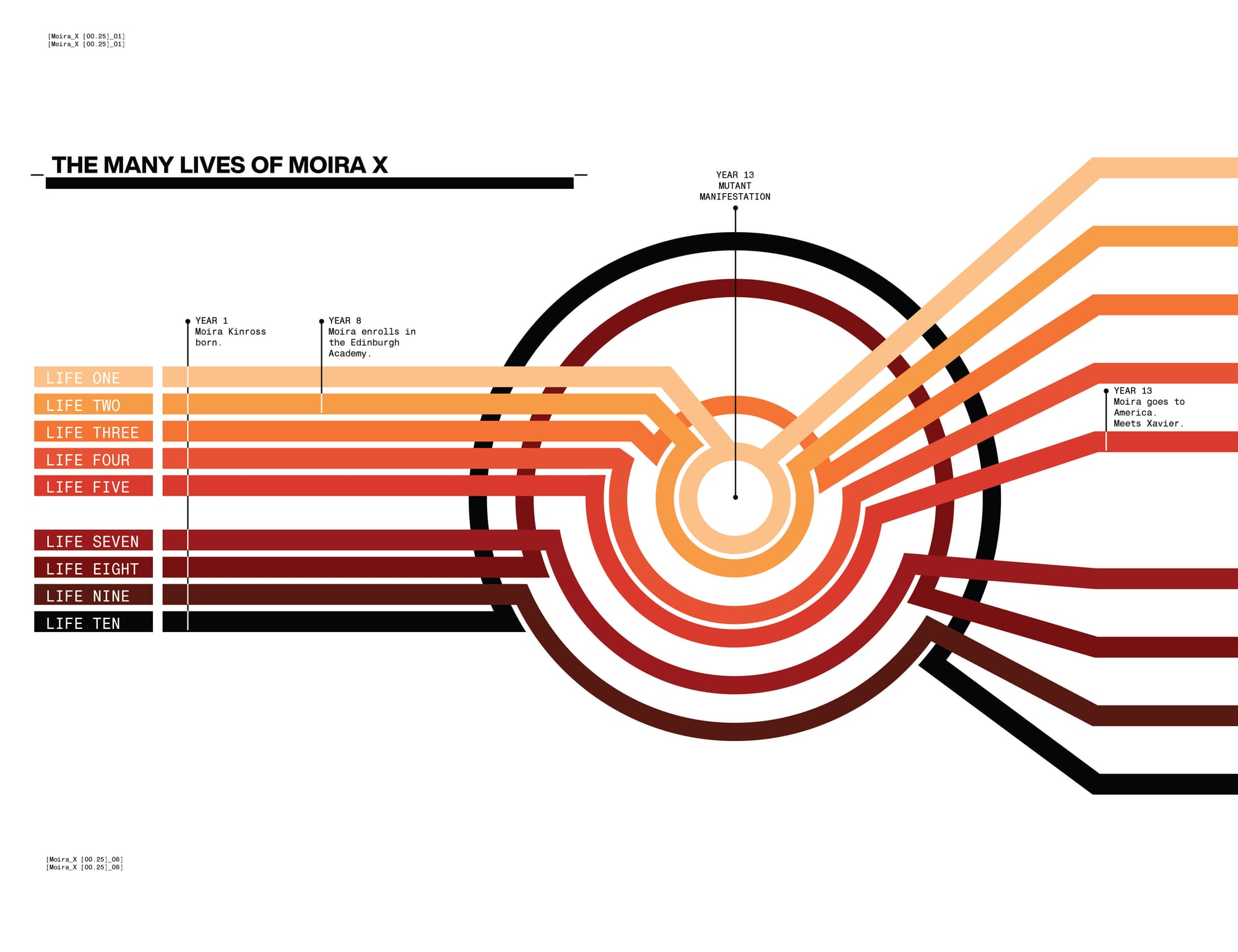
The other strategy is to visually present the main concepts of the comic, like the immense timeline of Moira McTaggert in Powers of X. This resource is located somewhere between graphic design and the sourcebooks of role-playing games. The fascination with the visual aspect, and the salesmanship, also extends to the logos of the series he takes on and, at times, to the overall design of the comic, in a practice reminiscent of the work of Rian Hughes, a frequent collaborator of Grant Morrison. The idea is to create a comic that stands out on the shelves and to present part of the fictional world-building in a more synthetic and enjoyable way than just characters talking to each other with large blocks of text.
The Science Fiction Fan
The division is as old as the genre itself: on one hand, you have hard science fiction, which aims to be scientifically accurate, extrapolating the results of currently existing technology and highlighting the more “scientific” aspect of the genre. Examples include: 2001, Kim Stanley Robinson's Mars trilogy, Adrian Tchaikovsky's tetralogy Children of Time, and Project Hail Mary, along with Andy Weir's novels in general. On the other hand, you have soft science fiction, which focuses more on sociological and psychological extrapolations of the impact of new technologies and the idea of the future. At times, it can even be poetic or conceptual. Examples include the works of Philip K. Dick, Frank Herbert's Dune, China Miéville's Bas-Lag trilogy, and the works of Brian Aldiss. When I started writing this article, I was convinced that Hickman was a hard science fiction writer, particularly due to his interest in grand systems.
But upon reviewing the concepts, I realize how far from the truth that is. Hickman seems that way compared to less structured writers like Grant Morrison and Al Ewing, who often evoke the more metaphorical aspects of superhero comics, their fantasy and symbolic magic. But in reality, he is a soft writer, because what interests him most is how the concepts he introduces, the fictional starting points, modify the actual existing society and the power relations. While he is meticulous in his world-building, it’s hard to think that the notion of the Mutant Resurrection, or Franklin Richards with Galactus as a pet, or a secret cabal of the world’s mega-rich sacrificing market gains to God Mammon in exchange for immortality, have anything realistic or scientific about them. What Hickman brings to comics is a sensitivity to science fiction that is not based on short stories (like, for example, the EC science fiction comics, which even adapted stories by Bradbury, or “For The Man Who Has Everything” and the space saga of Swamp Thing by Moore) but rather on grand epic sagas (and here he also expresses his love for fantasy), novels that attempt to portray social forces by exaggerating and extrapolating what happens in the present. Each of his projects is approached with a conceptual origin that changes the landscape and then the branching impact of those concepts.
The Posthumanist
A topic that is very much in vogue in discussions around science fiction and contemporary scientific imagination is the theme of posthumanism, the possibility for humans to transcend their corporeality and their evolutionary and cognitive limitations through biomedical or cybernetic enhancements. It is generally associated with concepts like the cyborg body, or the possibility of migrating the mind to computer servers, or the idea of cloning as a form of immortality that also incorporates enhancements to make the body more resilient or intelligent. In other cases, posthumanism expresses itself in the breaking down of the human-nature divide, in the notion of hybrid bodies or the possibility of non-human intelligences (think, for example, of Annihilation by Jeff Van Der Meer). Hickman frequently draws from the posthuman notion. It is central to his run on the X-Men, both in the recognition of citizenship and personhood for the island of Krakoa, as well as the latent threat of AI as a replacement for humans and mutants.
Hickman frequently draws from the posthuman notion. It is central to his run on the X-Men, both in the recognition of citizenship and personhood for the island of Krakoa, as well as the latent threat of AI.
But it is also present in East of West, particularly in the relationship that the Endless Nation has with technology, the indigenous nation, the most technologically advanced in the world, which has computers that serve as extensions of the body and replace divination with probability calculations; or in his run on The Avengers, which makes the Beyonders a mega-advanced race that exists outside the Multiverse and aims to protect and care for it like gardeners; or in SHIELD and its concept of the “human machine,” a technological apparatus that can only be activated by a precise set of characters, whose abilities function like gears (he would later recycle this idea in the concept of “mutant circuits,” groups of characters whose abilities amplify each other to achieve something new).
After all, if you think about it a bit, the superhero genre is the quintessential posthumanist genre, and the particular blend of science fiction and fantasy that Hickman works with suits the more ambitious forms of the wonder genre.
The Political/Conspiratorial
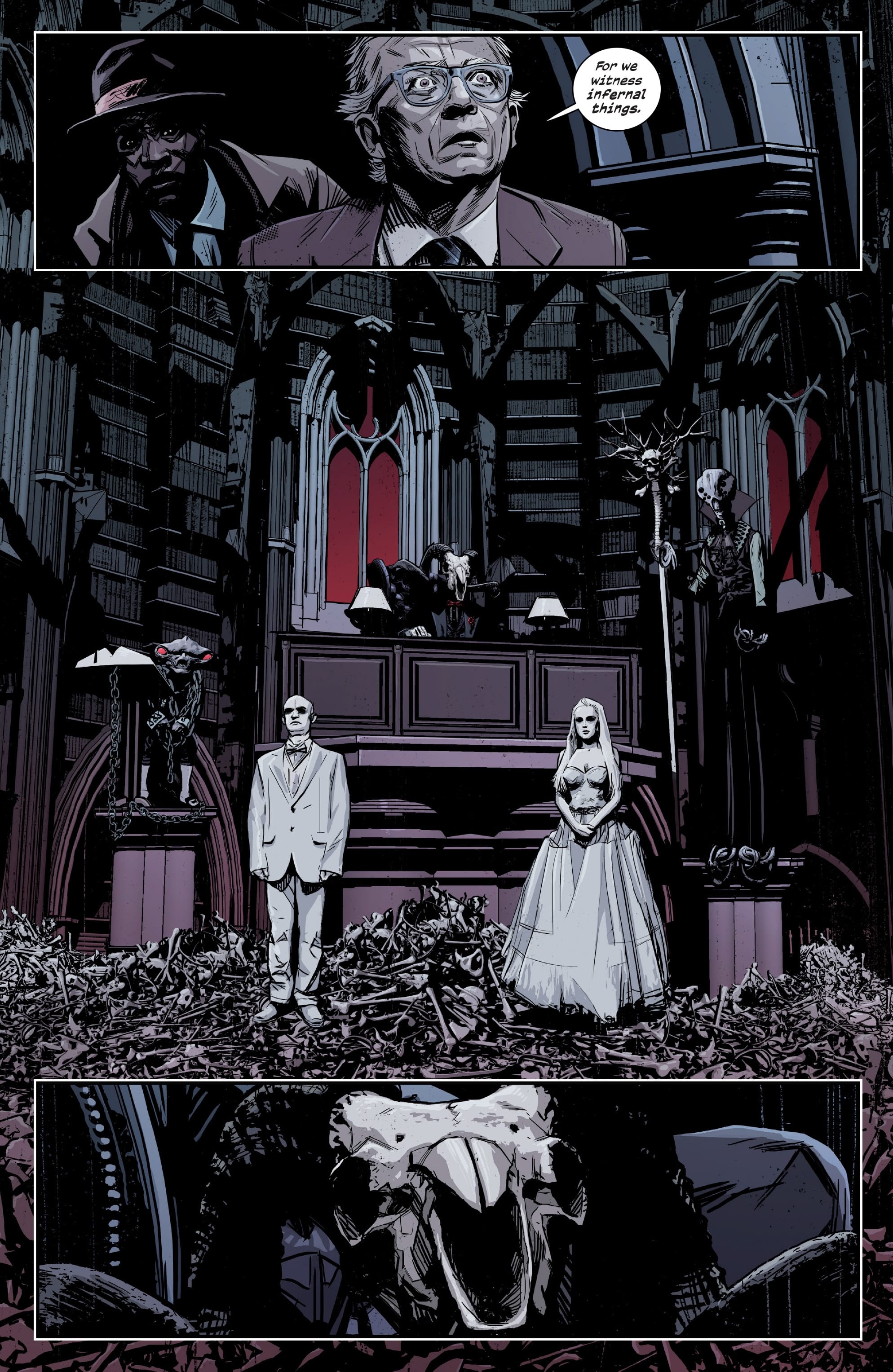
In general, Hickman, in his interviews, denies any kind of political affiliation: he despises bipartisanship and adopts a position that is quite “Center Korea.” This is often a somewhat suspicious stance, which tends to hide political convictions that lean more towards the right than the left. However, these statements powerfully contrast with the distrust of authority figures that permeates all his comics. There is an obsession with powerful men who control and manipulate the world, which allows Hickman to make the world function according to the decisions of a small group of actors, rather than dealing with complex issues like the masses.
But at the same time, he distrusts the small circles of power: generally, they are all evil people, individuals who have betrayed their principles, or good men broken by the exercise of power and what it entails. Here we understand why he cites Herbert as one of his major influences, and how the deconstruction of the messianic figure that this author undertakes in Dune impacted him. However, this political position inherent in his comics, while producing very good drama (one of the great pleasures of reading a Hickman comic is witnessing the verbal and moral duels between elevated characters) also feeds a conspiratorial theory that is distant from political power: it is in the hands of others, who manipulate the world in shadowy ways, and can only be displaced from this position by others equally powerful. In a way, it obstructs direct action from the grassroots. Over the years, this aspect of Hickman's poetics has become increasingly omnipresent, perhaps in tune with a world where it is becoming more evident that the elites care little to nothing for their governed, beyond immediate soma.
The Architect
As I mentioned earlier, Hickman has the title of architect. This role, in superhero comics, however, became fashionable in the new century to qualify those writers who organize the meganarrative of the universe, beyond individual titles. This was somewhat the role that Brian Michael Bendis had during his long run on Avengers, Geoff Johns during Rebirth, or that Joshua Williamson and Scott Snyder now hold in DC. A good architect signals narrative milestones like a roadmap: we are heading here, this event will happen on such date, the idea is to revitalize such characters. And also the tone: with Bendis at the helm, what worked were street-level characters and long dialogues, with a distance from cosmic elements.
The role that Hickman fulfills today in Marvel is somewhat analogous to that of the architect, but not entirely. While in works like X-Men and the Ultimate universe it is the same, in others like Imperial or G.O.D.S. his role is more about dusting off abandoned properties and breathing new life into them. He is not at the center, but on its margins, trying to shift those margins to the heart (or at least gain something). The other aspect in which Hickman is architectural is in narrative structure, his obsession with planning the entire building before starting to write, and his frustration when his plans do not materialize, as in the case of the X-Men. This desire to conceive fiction as a set of pieces erected one on top of the other is one of the most frequent criticisms of Hickman, which leads us to the last point…
The Characterizer
Is Hickman a good character writer or not? Much of the debate and criticism surrounding his figure revolves around this question. The anti-Hickman camp argues that his comics are perfect gears in which the characters are placed in the roles he needs, acting according to what the plot requires, like automatons. The pro-Hickman camp, which I include myself in, argues that certain works are like this (for example, it is impossible not to notice that S.H.I.E.L.D. throws out any attempt at characterization of its main character in favor of its fascination with alternate stories and the “human machine”), but that the best of the writer have very touching human details, like the relationship between Reed Richards, Franklin, and Nathaniel Richards in Fantastic Four, a story of intergenerational love in which Reed chooses his family over the siren calls of “fixing everything” proposed by the Multiversal Council of Reeds, because he knows that a father without love is a monster. Or the fact that East of West is entirely built around a love story. Or the beauty of Ultimate Spider-Man and its slow exploration of the characters over two years, and the evident enjoyment that Hickman gets from playing with the slightly modified archetypes of Peter Parker's world. Or the sense of imminent horror in New Avengers, a comic in which everything depends on the (bad) decisions of its characters, who become increasingly ethically compromised in a dead-end alley.
The answer, as is often the case, lies somewhere in between: it is true that Hickman sometimes conceptualizes his characters like the proverbial circles of a beautiful infographic. But at other times, like with any good writer, they do something unexpected, surprise, or generate affection, and that’s when Hickman works his magic with his craft.
Las notas de 421 no tienen paywall
Y a cada colaborador se le paga por su trabajo. Las dos cosas dependen de los suscriptores.