From mysticism to mathematical calculation? The phenomenon of Yu-Gi-Oh!, where the romance of the cards clashed with relentless competition. How the game evolved, and why retro formats are now the true refuge of the duelist.
For many years, trading card games (TCGs) have been the norm in the Geek community, as we could read in this article from 421. Everyone knows what they are, everyone thinks they know how to play them, and many believe they know how to play them. This beautiful normality didn’t just come about on its own; in fact, many card games didn’t consider it or somehow ignored it because they lacked a means to attract or express the joy of enjoying this type of pastime. In other words, they couldn’t create a rite of passage, as you had to come to it on your own terms and interests (and even then, you could get sidetracked in the process of consecration) to play them.
But at some point, they began to function as a great mechanism, a series of Synchronicities: In Japan, a mangaka decided he wanted to tell a story about ancient Egypt, a world always shrouded in a veil that seems so close to us yet so fantastical at the same time. What did he decide to use as the center of his story? Games and mysticism, things that have an intrinsic relationship with the essence of Egypt.
Yu★Gi★Oh! The Creation of the Myth
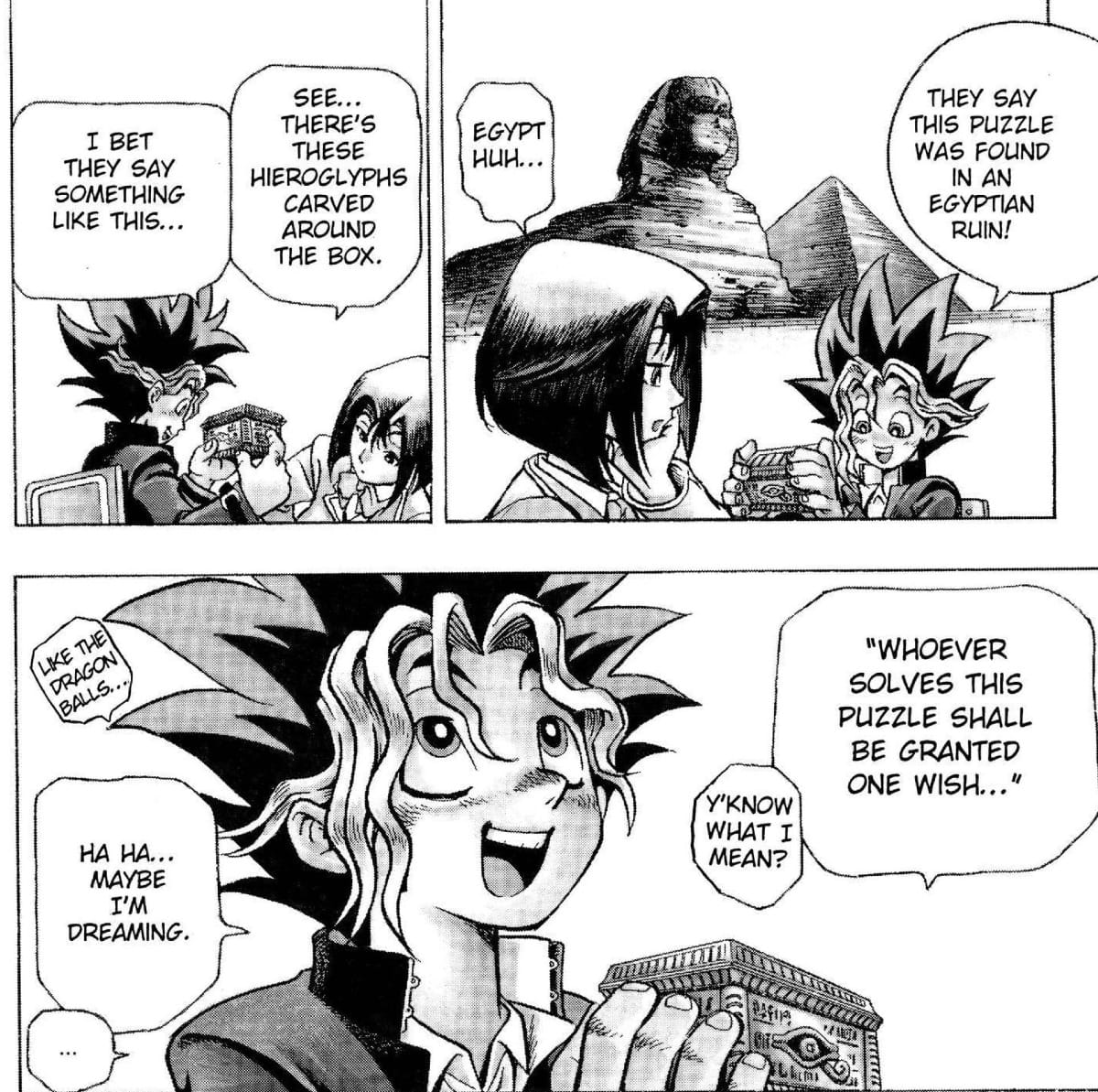
Kazuki Takahashi was the one who created the Yu★Gi★Oh! manga and also designed the card game that came along with the success of his work. The story he wanted to tell was about Yugi Muto, a shy, somewhat gothic kid who was a fan of all kinds of games (from classic board games to tamagotchis/V-pets). The story begins when Yugi assembles an ancient puzzle (Millennium Puzzle) shaped like an inverted pyramid, which no one had been able to solve in 5000 years and which he believed would grant him a wish once completed. Here, the focus is on the most important process of the series: friendship; his wish was to have a true friend.
As the chapters unfold, Yugi discovers that within the puzzle resides a dark, vengeful, and powerful soul (his complementary opposite, his shadow), which uses Yugi's body as a medium. Together, they face some pretty detestable villains through various types of games with a tone of Russian roulette: the loser suffers a hell on earth.
Yu-Gi-Oh! (Viz Comics)
At some point, the antihero is introduced, the antithesis of the protagonist, and above all, the best “Vegeta” that gave us life: Seto Kaiba, along with “Wizards and Magic” (later known as Duel Monsters in the anime). The idea was for that card game to last only two chapters and then move on to other games invented by Takahashi, to advance with his initial idea of a story about games and horror. But it couldn’t be: just like Sir Arthur Conan Doyle with Sherlock Holmes, the public demanded Takahashi to reveal more about this wonderful card game similar to Magic: The Gathering. Its rules were archaic and didn’t make much sense, but it generated an automatic craze among the audience (perhaps the collective unconscious at work), forcing him to change the entire concept he had for his work and focus on this game as the main narrative element. With all this set, the story of Yugi helping Atem transcend to the afterlife and fulfill his destiny began.
In Japan, it took off, leading to a first series in 1998 (with a darker tone, as he always said he had a horror story in mind) and then a new one backed by the big Toei Animation, which clearly landed in the West with a new paradigm for everyone: Yu-Gi-Oh!, the card game. The original series had several sequels: Yu-Gi-Oh! Gx, Yu-Gi-Oh! 5D’s, Yu-Gi-Oh! Zexal, Yu-Gi-Oh! Arc-V, Yu-Gi-Oh! Vrains, Yu-Gi-Oh! Sevens, and finally Yu-Gi-Oh! Go Rush. Discussing each season would require its own article, but it’s a way to understand the longevity of this franchise, which, to some extent, fed back into the game. Although Takahashi initially intended to stop after the second season, he had to accept that success and sales demanded continuations.
The Heart of the Cards and Competitiveness
Each of the coincidences that made this what it is brushes against the mystical. Commercially, it was a resounding success; for many years, it led the sales rankings of card games, winning several awards including a Guinness Record in 2021 for sales and another in 2024 for the largest card tournament.
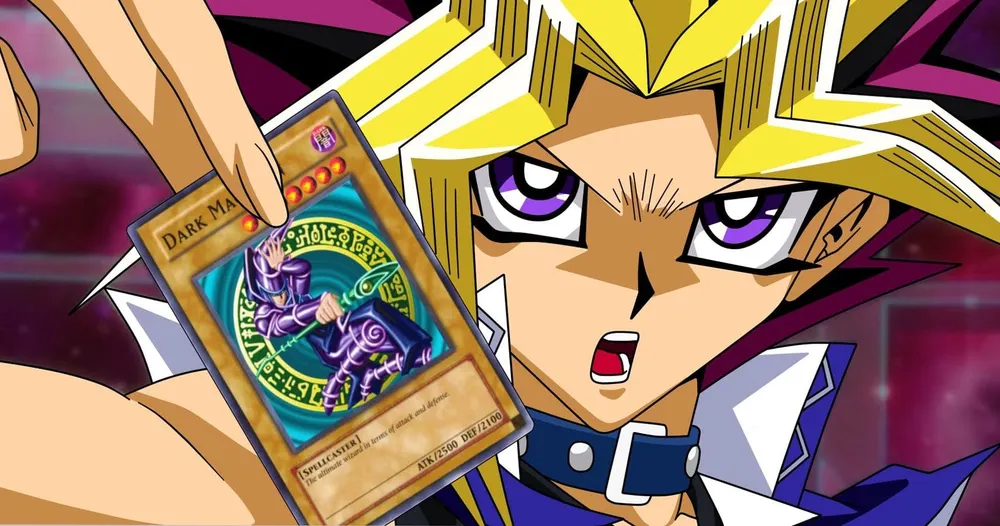
Suddenly, a fresh and interesting anime series managed to combine with a card game that gave us a wonderful feeling: we weren’t “sorcerers summoning creatures” like in Magic, nor were we in a role-playing game where we embodied a character, but we were ourselves with a title: “Duelist.” The difference lies in the fact that Yugi, Kaiba, Joey, and the other characters in the world of Yu-Gi-Oh! are themselves duelists, hence there’s a projection between playing the TCG and bringing the anime into the real world, where we coexist (for many, unfortunately) with a much harsher competitive aspect than the one faced by the characters.
The physical game came out with expansions and Structure Decks that allowed you to build your own strategy of at least 40 cards, introducing a new idea called the “Fusion deck” (back then, now we know it as the Extra Deck), where you placed cards that could be played through a concept called fusion. This was a novelty for everyone: thanks to a card (Polymerization) and the right monsters, you could bring a monster from outside the game. Summons, sacrifices, elements, spells, traps, dragons, warriors… Yu-Gi-Oh! was extremely loaded with mysticism, featuring many different and more agile ideas than the card games that existed at the time. I can assure you that building a deck or playing when it all started was a sensory experience: there was a kind of “moment” where you connected intimately and transcendently with those cards you chose, helping you understand not only “the best” to win in the game” but also what you “truly hoped to achieve.”
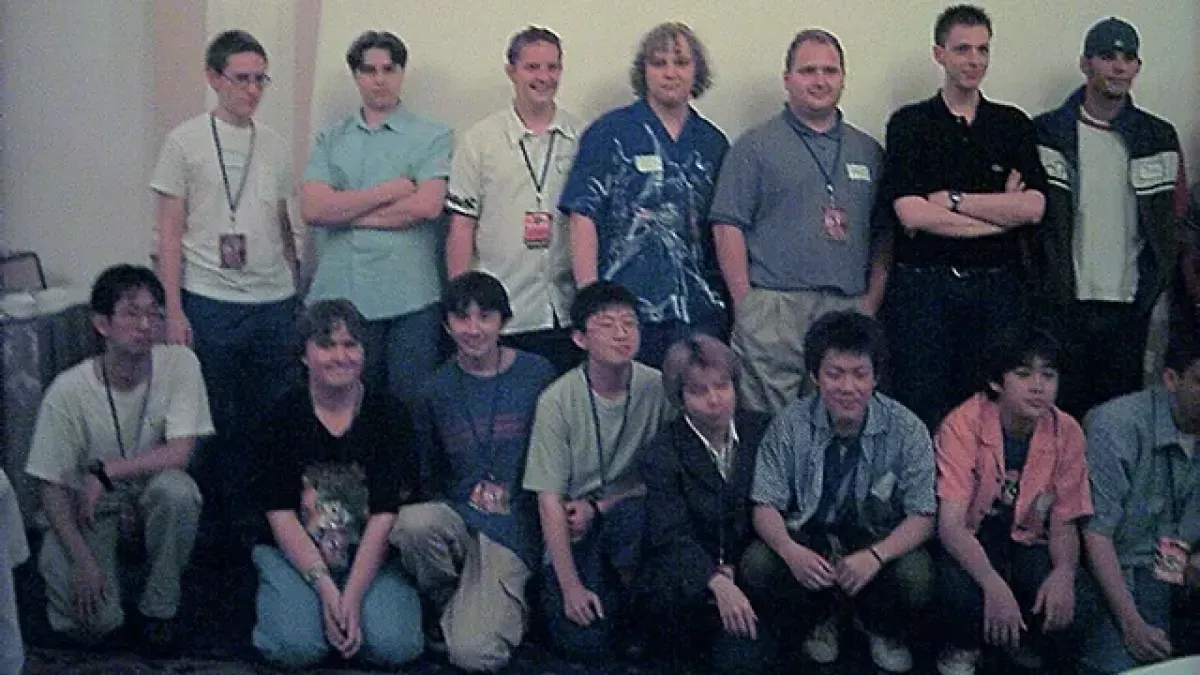
But what we saw in fiction couldn’t be reinterpreted in real life. The Dark Magician and the Blue-Eyes White Dragon that represented the characters so well didn’t do so with the competitive game. By the time the game was imported to the West, strategy had already shifted: there were much more efficient cards like Yata-Garasu, Fiber Jar, The Forceful Sentry, or Delinquent Duo, which could destroy hands and decks through their discard effects. Frustration entered the equation. The 2003 World Championship is a prime example of this: all the decks that were seen were almost replicas of each other.
Players from the 2003 World Championship, all using the “Hand Destruction” strategy (YugiohWikia).
Since I’ve been aware of card games, it has always been the same: the famous metagame. A silent yet relentless logic that dictates what is played, how it is played, and ultimately, who wins. Anyone who feels wronged by this might want to ask themselves if they really want to compete. Because that realm is marked by a particular voracity, a violence that isn’t explicit but is felt in every decision, every mistake, and every defeat. It’s not a space for everyone. And often, all it leaves is frustration.
The paradox is that, of all games, this one was born from a fantasy. From a nearly naive idea: to believe in the heart of the cards, to trust in something beyond probability or efficiency. However, the real game took another path. Where Yugi believed, the player calculates. The game invites you to understand what’s happening constantly and to study not only your own strategy but also that of your opponent. It doesn’t reward romantic intuition, but the right decision at the exact moment. Ultimately: an antithesis to the fantasy that gave it life.
The game doesn’t reward romantic intuition, but the right decision at the exact moment. Ultimately: an antithesis to the fantasy that gave it life.
Everything we play in the West (new cards and thus their decks) usually comes out several months earlier in Japan. Therefore, the metagame is defined earlier, as combos and strategies are already analyzed by the nikkei who have a much broader view of the game. We can only depend on “what happens over there to understand what will happen here.” This concept has always been known as the OCG (Official Card Game - Japan) and the TCG (Trading Card Game - West). The differences don’t stop there: also in the banlist.
Magic, Pokemon, One Piece, Lorcana, and other card games use a way to keep alive what’s most important for companies: sales. Cards rotate with expansions, ensuring:
That the same “broken” decks aren’t always seen;
That the same decks aren’t always played;
It refreshes the way of playing and the strategies;
Help with the entry of new players;
Regulates the price of the secondary market.
We could talk about this for days. But that's not the case with Yu-Gi-Oh! On the contrary, Konami analyzes tournaments to determine which cards might be banned (not allowed), limited to one (only one copy per deck), limited to two, or allowed to be played three times (the maximum allowed per card in a deck). The toughest part of the banlist is that it’s the only way to know how competitive play will change, and it can happen at any moment of the year (although there is an attempt at some periodicity). At the same time, it allows any card to be played, from Legend of The Blue Eyes White Dragon (the first expansion) to the present.
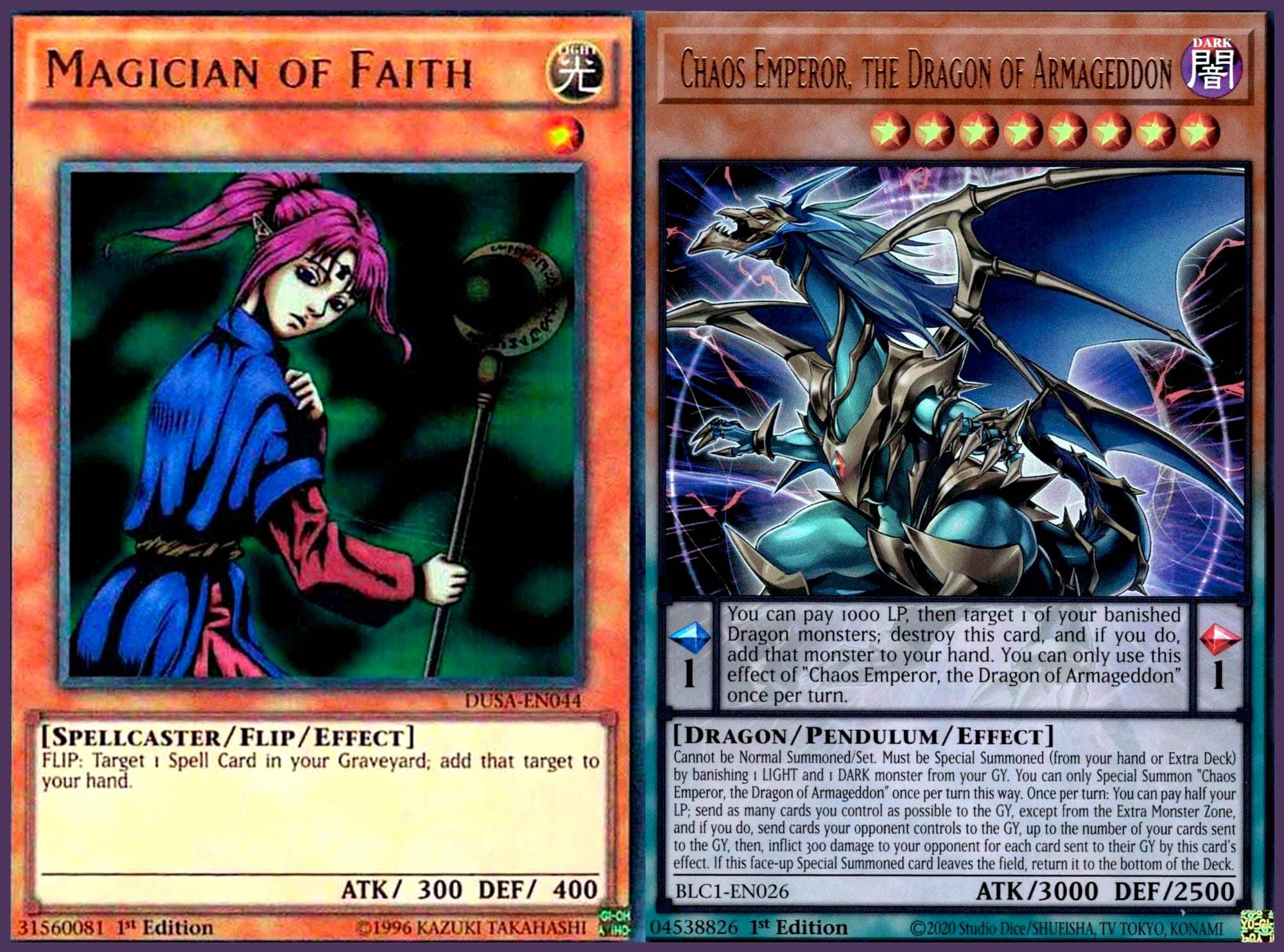
In terms of gameplay, this cumulative situation of cards leads to one inevitable path: power creep keeps growing with each expansion, and it's logical since you need to sell new cards that are definitely better than the previous ones. Each series introduces a new type of card with its own rules and new types: Synchros, Xyz, Pendulums, and Links, along with new archetypes, longer texts on cards, new effects, and concepts.
On the left, we see a classic Monster card with short text that isn't very technical. On the right, we see a Pendulum Monster with extensive text that is extremely technical.
How can this affect the consumer? Over the years, I've seen that while many might find it interesting to see the cards 'growing,' for several players, this can feel oppressive and suffocating. The time and budget that must be invested ends up exhausting many, and perhaps that's why it's common today to find local events, tournaments, and groups for Pokémon or Riftbound (just to name a couple) that focus on those TCGs but not on Yu-Gi-Oh!
Although it is no longer the game that dominates the market, it is one of the few that has managed to survive without changing its essence, even at the cost of becoming more hostile to newcomers.
The King of Games, a dream that demands sacrifices
Back in 2011, I traveled to Brazil to play in the Yu-Gi-Oh! Continental. I hadn't done well in the Argentine National, never had a perfect performance, but I was a relatively good player. I arrived in the country without an invitation to the Continental. I played what was known as a 'last chance,' brutal tournaments where you had to win 6 matches in a row to secure one of the few final invitations to play in the Continental. I did it; I managed to summon a Stardust Dragon that won me the match, and the happiness was immeasurable. Unfortunately, my performance at the Continental wasn't the best; I dropped out of the tournament and participated in all the side events. Honestly, I did really well, winning almost all of them (and when I didn't win, I made it to the finals).
That's when something changed. The game told me, 'this is where you stop.'
The last match I remember from my 'first stage in Yugi' (and the competitive one) ended on a Saturday at Magic Games II like this: my opponent forced me to activate the effect of Stardust Dragon, sending it to the graveyard, but revived it on his turn with Monster Reborn. He passed without doing anything else, I drew for my turn, and the comeback began…
'Mind Control on Stardust.' 'Okay.' 'Activating the effect of Grow-Up Bulb in my graveyard, I summon it and do Foolish Burial to Dandylion to summon two level 1 Tokens.' 'Yes...' 'I Synchro summon Formula Synchron and then Synchro again with Formula and Stardust, summoning Shooting Star Dragon, GG?'
Anything competitive requires a lot of effort. In Yu-Gi-Oh!, you also have to factor in the power creep of the cards we mentioned earlier. New cards came out every month, and I felt like the game itself was pushing me out. I watched many friends drift away and saw the game I loved morph into something else; it was the same but no longer. Something like: 'this can't happen to me, I enjoy the game, that's not going to change.' Until it does change, but life shows me that the wheel turns and keeps moving forward; we grow, and eventually (if we require and want it) we return.
Many people often complain about the game (potential new/old players and those who always wanted to play but never dared): I understand them. And if that's your case, let me tell you that there are options where we can play competitively like we did years ago. The Time Wizard formats: Goat and Edison.
These are fan-made formats that have a lot of activity in the community. Goat is named after the 2005 format where a deck called Goat-Control dominated tournaments. Edison takes its name from a Shonen Jump Championship tournament held in Edison (USA) in 2010. Using both formats' 'banlists,' you can play with the decks that existed back then, following the rules of that time.
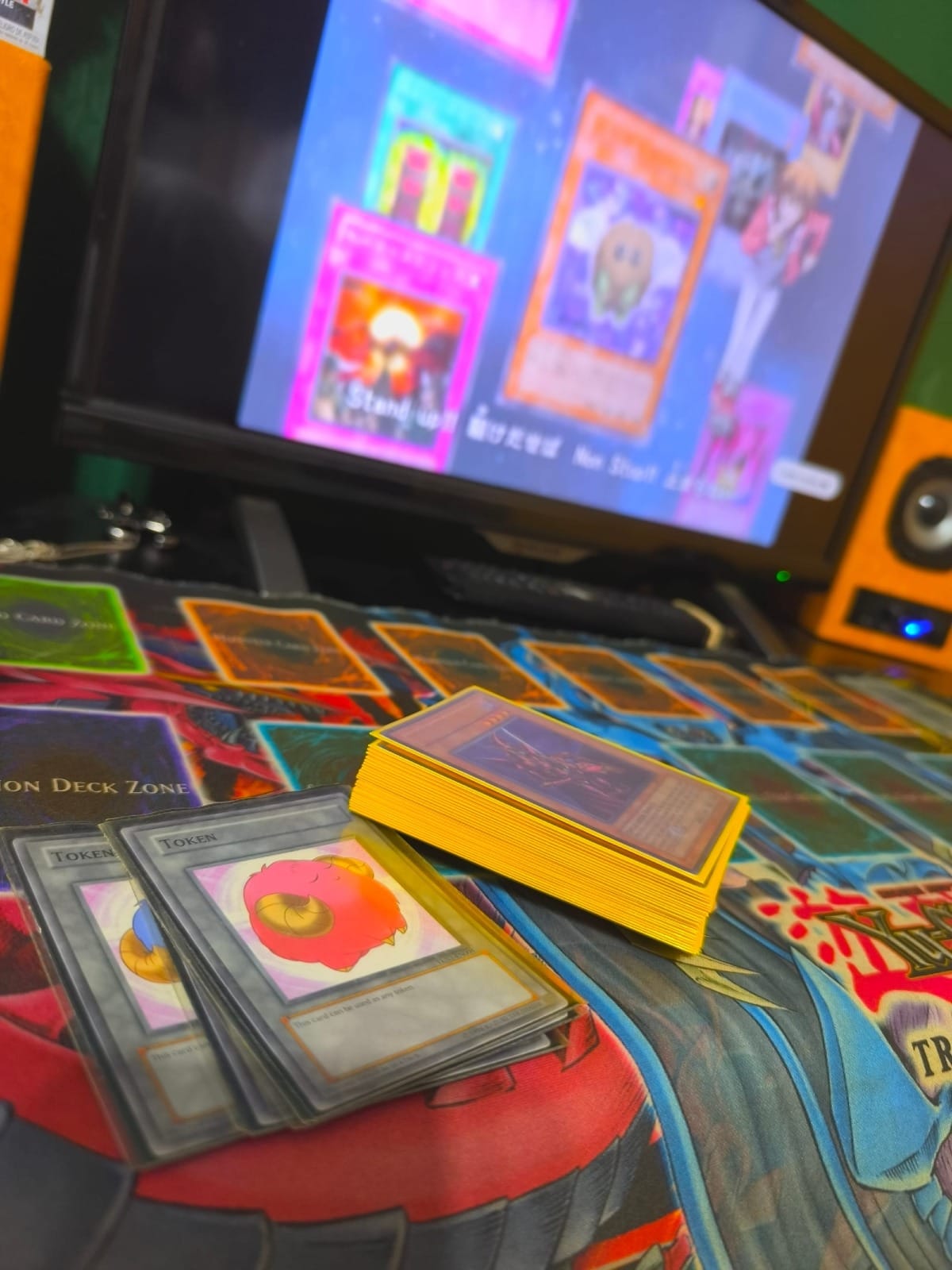
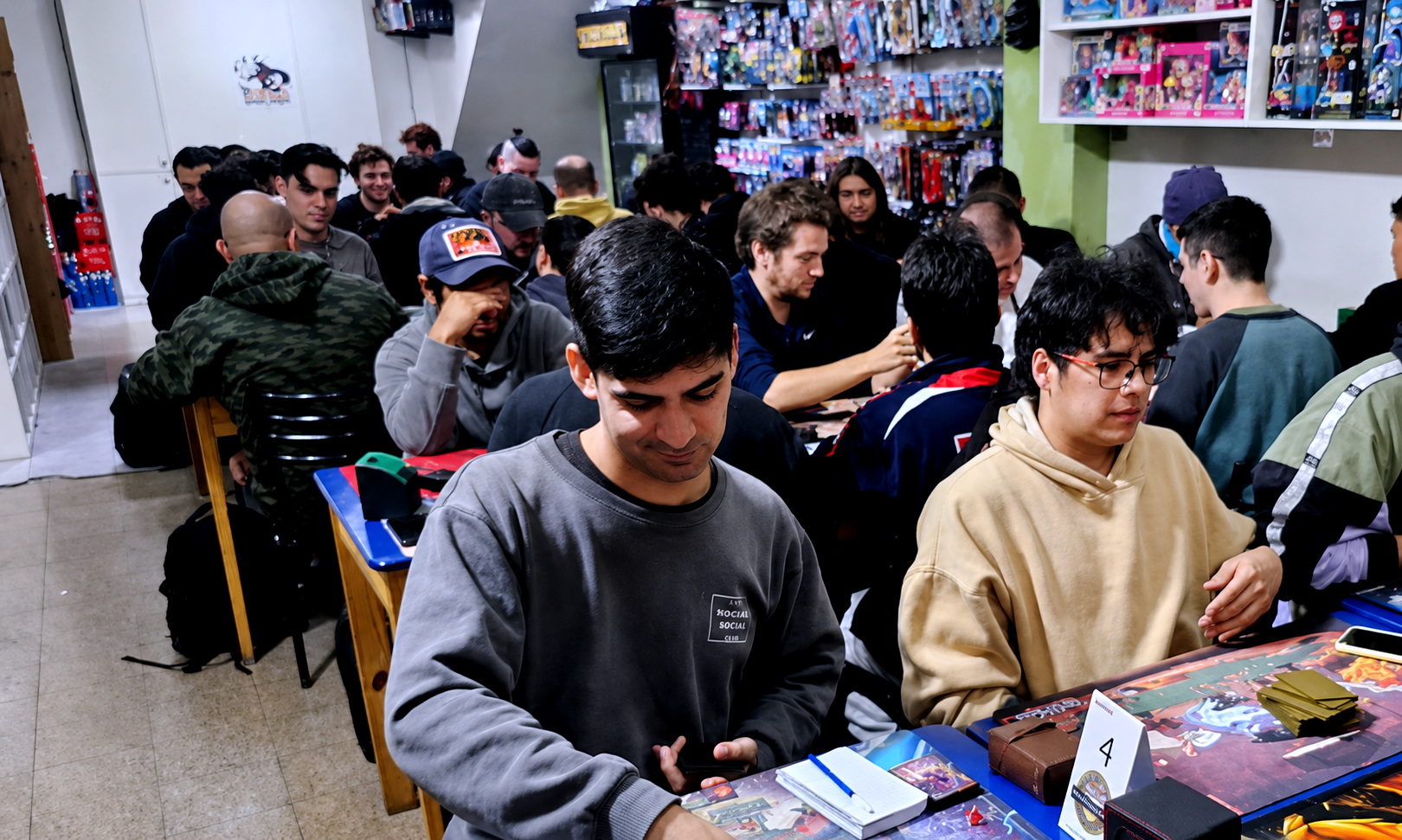
On social media, several groups are active, like Goat Format Argentina and the Waltercup, and it's the players themselves who organize tournaments along with local venues (Dima Games, DuelistCity, etc). If you have old cards, now's the time to dust them off. For those who read the article on "Premodern: Magic for Forty-Somethings", you'll know what I'm talking about.
Última Waltercup (Edison format) - Dimagames May 2026.
Konami (which can't do what corporations usually do) created its own official 'retro' format called Genesys; it has some movement as well.
The story of Yugi and Atem endures in the collective unconscious. The phenomenon never completely disappeared: it remains there, latent, sustained by players still seeking glory in every duel. But for the rest, the connection isn't severed either. Because in the end, one doesn't leave things behind: they drag them along, integrate them. Each experience becomes another piece. And perhaps that's why, at the end of it all, we are nothing more than that: a constantly assembling puzzle. Our own Millennium Puzzle.
✦ Suscribite
Las notas de 421 no tienen paywall
Y a cada colaborador se le paga por su trabajo. Las dos cosas dependen de los suscriptores.