From Prince of Persia to Half Life: PC Gaming’s Narrative Evolution
Hollywood cinema was instrumental in the narrative evolution of PC games: Prince of Persia, Grim Fandango, Dune, and other ’90s classics.

Hollywood cinema was instrumental in the narrative evolution of PC games: Prince of Persia, Grim Fandango, Dune, and other ’90s classics.
Every time a new medium of artistic expression emerges, it goes through a process of searching for identity, defining itself by comparison to what is known. This is what happened with video games. For computer games, born on text terminals in the late seventies, the first mirror was literature. Once the formula of Colossal Cave Adventure was tested, pioneering companies like Infocom began to speak of interactive fiction, labeling their programmers as authors, and inviting figures like Ray Bradbury and Douglas Adams to lend their names to their games. For a few years, bookware was the talk of the town, and it seemed like any publishing house was measuring its chances of diving into digital entertainment.
But that changed when Ken and Roberta Williams of Sierra Online added graphics to the equation: video games were destined to be interactive experiences and also audiovisual. The decade following King’s Quest and Maniac Mansion, from the late eighties to the nineties, saw computer entertainment seeking inspiration from Hollywood's imagery and production techniques. This ambition to imitate cinema took on various forms depending on the capabilities of the current hardware and the ingenuity and exuberance with which designers were able to leverage them.
No one embodied that dialogue between film and video games like Jordan Mechner. A film enthusiast, Jordan dreamed of being a screenwriter or director until the Apple II crossed his path, leading him, unintentionally, into a career in video game design.
During his university years, he spent more time watching movies and programming games than attending classes, and certainly, one activity influenced the other. Reasoning that computer entertainment was comparable to the early days of cinema, he studied the techniques of silent films, which managed to convey so much without text or dialogue. Another major inspiration was classic animation: the stroke of genius that defined his career was recreating the “rotoscope” that Disney had used in films like Snow White and Sleeping Beauty. Instead of composing sequences of drawings, the idea was to film actors and trace their figures to produce fluid and realistic animations. Of course, projecting a video on the Apple II screen was quite a challenge without a scanner or cameras.
The decade following King’s Quest and Maniac Mansion, from the late eighties to the nineties, saw computer entertainment seeking inspiration from Hollywood's imagery and production techniques.
Mechner began by filming his karate instructor and his parents with a super-8 home camera. He then placed the tape in a moviola, an old editing machine, and selected the key frames to trace on paper. To digitize those drawings, he used one of the few peripherals available for the Apple II, a pantograph that plugged into the joystick port and allowed him to trace lines (the same device Ken Williams had used to add graphics to Mystery House). Once the silhouette was projected, it had to be retouched pixel by pixel. Although the resulting animations were basic, just a couple of frames each, the movements and postures of his actors gave an unusual realism to the hero on screen.
According to Mechner, Karateka “was not a fighting game but a narrative game whose mechanics revolved around fighting.” The story was told with just a few visual elements, without text or sound, evoking the original language of cinema: gestures replaced dialogue. He copied the sweeping shots from Kurosawa's films and interspersed sequences of the villain and the “damsel in distress” to build tension. When the game ended, the screen read THE END instead of GAME OVER.
That experiment, which had started as a distraction from college, became a hit for the Apple II and later for the Commodore 64, putting Jordan Mechner at a vocational crossroads. Should he leave college, which he wasn't very interested in, to dedicate himself to video games? Should he keep trying to sell that screenplay he had been working on to seriously kickstart his film career? Or should he dive into the next game, for which he was already being offered advances? He never fully resolved those doubts; in the following years, he would try to do all three at once, which partly explains why it took him so long to finish his next project, a little something called Prince of Persia.
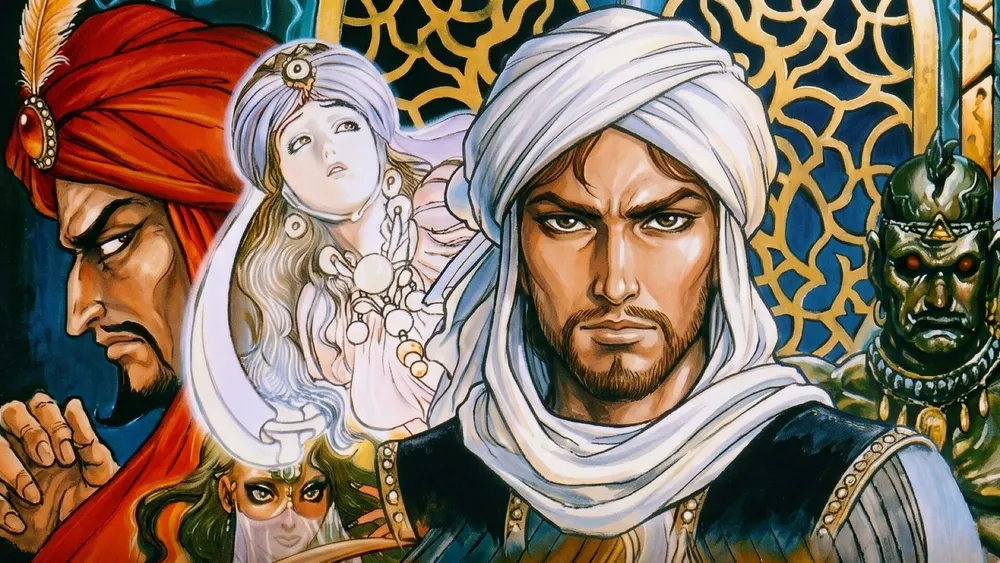
Seeing that the audience responded to his “cinematic” approach, Mechner doubled down. The plot of Prince of Persia was the same, but the setting was new: the hero traverses screens and rescues a princess, this time against a backdrop of One Thousand and One Nights instead of a Japanese dojo. The tone Mechner aimed for was that of adventure and sword-fighting films; in particular, he wanted his game to be an interactive version of those first ten minutes of Raiders of the Lost Ark where Indiana Jones runs, jumps, and dodges deadly traps with a mix of physical skill and ingenuity. To achieve that dynamism, he would once again turn to rotoscopic animation, but this time super-8 and the moviola wouldn't suffice; he needed more fluidity, more frames, and would have to get creative. In this, Mechner distinguished himself from his contemporaries; while others waited for hardware that matched their ambitions, he worked with a craftsman's spirit, embracing the constraints and pushing the limits of the available technology.
Mechner took his brother to a parking lot and filmed him with a VHS camera, capturing the stunts needed for the game. Although there was still no video hardware for the Apple II, he managed to get one to connect the camera and digitize a frame on screen. The problem was that, for it to be usable, he needed a high-contrast image. He solved this with another of his extravagant assembly lines: he played back the footage of his brother on a VCR, frame by frame, taking photos of the television with an analog camera; once the photos were developed, he glued them onto a sheet and traced the outlines with a marker and liquid paper, then made photocopies. And then he filmed that, with the camera connected to the computer. A little pixel retouching and he had his brother moving in black and white, now transformed into a Persian hero. This cumbersome and legendary process took months, but the result was much more vivid than that of Karateka, something never seen before in a video game.
Although the animations were the heart of the project, it would take him a couple of years to turn that material into a finished game. By the time Prince of Persia was released in 1989, the Apple II was practically dead. Mechner had taken too long. We had to wait for a PC/DOS version to come out the following year, with better graphics but the same character animations, for the game to become the success Mechner had envisioned.
That little figure running and jumping fluidly, on a screen that had accustomed me to clumsy pixelated spasms, was like a glitch in the Matrix, a hologram brought from a computer of another generation.
Although I didn't see it in its natural habitat on the Apple II, I did spend many hours playing Prince of Persia on a makeshift 4-color CGA PC (the worst four colors that a twisted mind could combine) and I can attest: that little figure running and jumping fluidly, on a screen that had accustomed me to clumsy pixelated spasms, was like a glitch in the Matrix, a hologram brought from a computer of another generation. The artisanal method of production explains why the game aged much better than its native platform and other later games. Prince of Persia still works, more as an elegant puzzle than as a platformer, now stripped of any cinematic pretensions.
There was a sequel, in which Mechner worked as a remote consultant while trying to revive, now without financial pressures, his filmmaking career. But the true heirs of Prince of Persia were two French games, Another World and Flashback, which took the concept of cinematic platformer to the next level. Although they used similar animation techniques, the production of those games was much less exotic. While Jordan Mechner juggled with his old Apple II, the next generation of computers was already opening new creative territories.
Exaggerating a bit, we can divide late eighties computer users into two groups: those who used an IBM/PC at work and those who had an Apple Macintosh at home. This categorization is somewhat similar to today's iPhone vs Android: the Mac was a sleek (and expensive) closed box, Steve Jobs' “bicycle for the mind”; the IBM PC was a committee-designed device, easily infiltrated, on which Bill Gates would build the Microsoft empire.
But if we look closer, there was a third position, a computer that only a select minority of intense users owned, convinced that the world was mistaken, almost like a religious cult. The Commodore Amiga was built around the same Motorola 68000 processor as the Macintosh, but it added a dedicated chip for memory, another for graphics processing, and another for audio. This combination of processors and the innovative hardware design that integrated them made the Amiga the most sophisticated personal computer on the market (if you could get your hands on one). Everything the Mac could do, the Amiga could do in stereo and color; next to the Amiga, the IBM PC looked like a heavy calculator. This is how the folks at Electronic Arts explained it:
We believe that home computers will be as important as radio, stereo, and television today. The Amiga advances the medium on all fronts. For the first time, a computer offers the audiovisual quality that our eyes and ears deserve. Compared to the Amiga, using other computers is like watching TV in black and white, with the sound off.
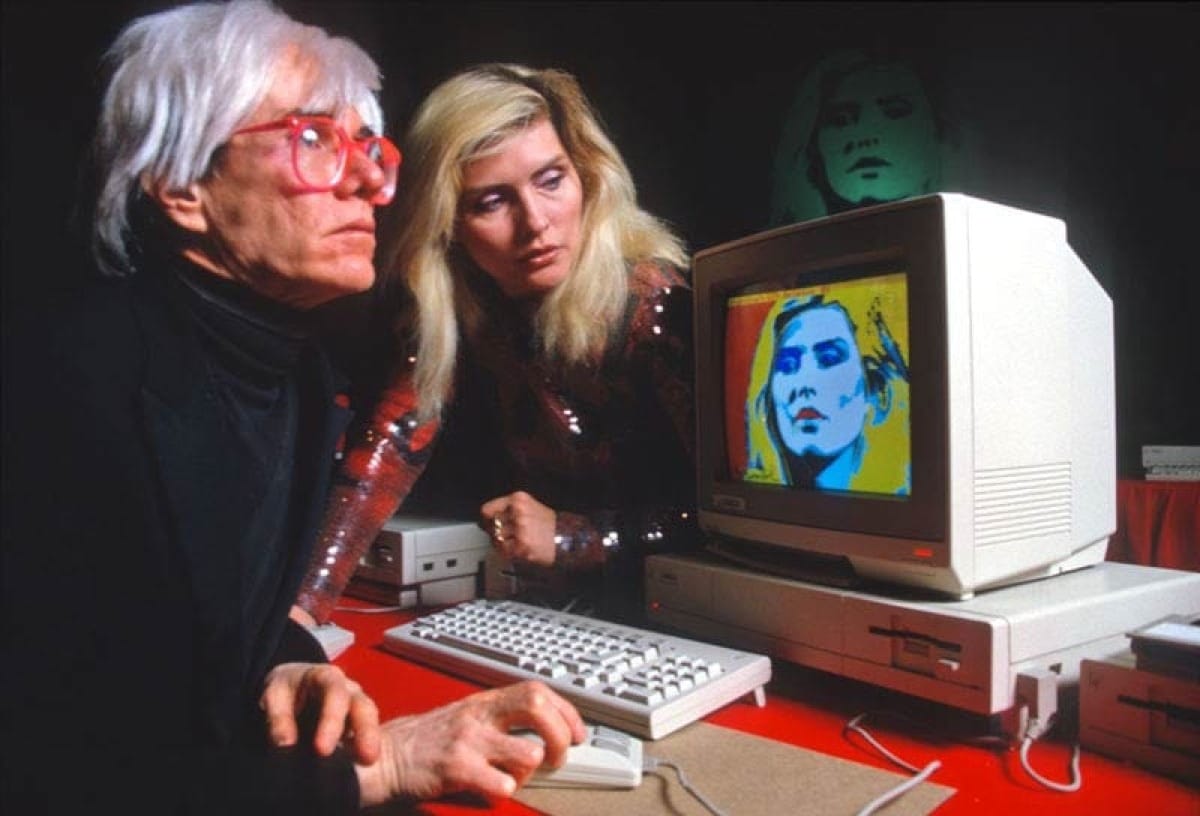
The Amiga was a kind of computer for artists. Andy Warhol used it to portray Debbie Harry, the lead singer of Blondie; the legendary Spinetta, in his eighties technological trance, drew the pixelated cover of Don Lucero with it. Even specialized studios in PC/DOS video games preferred the Amiga's Deluxe Paint for illustrating backgrounds and animating characters.
That same hardware that made it stand out in audiovisual production theoretically turned it into an ideal machine for video games, a segment that the Commodore 64 was starting to vacate and that neither the Mac nor the PC were ready to fill (yet). The problem was the classic chicken-and-egg scenario: without an initial push from Commodore, the user market was small, and few studios were willing to invest in the development of exclusive games, which meant players had no incentives to buy the machine. To resolve the paradox, it took someone willing to bet everything to realize their vision.
Bob Jacob was a film enthusiast living in Los Angeles, where he had invented a job as an 'agent' for software companies: he represented them and negotiated distribution contracts, a task that programmers were not good at. When one of his clients showed him the Commodore Amiga, Jacob was amazed and saw an opportunity to dive into the business himself.
Jacob valued arcades for their ability to completely absorb players' attention, as if transporting them to another planet; computer games, on the other hand, seemed convoluted and repetitive to him: you had to read manuals and type commands on the keyboard, and their fictional repertoire was limited to derivatives of Tolkien and Star Wars. After seeing what the Amiga could do, he reasoned that computer hardware had reached the necessary maturity to attract a broader audience. His idea was to produce experiences that combined the magnetism of arcades with the popcorn entertainment of movies and television:
He wanted games with more rhythm, that conveyed a sense of urgency to the player. Action games, but not just for the sake of action itself. The elements of action, the player's success or failure, had to impact how the story unfolded, driving it forward. He wanted action, but with meaning.
The bar was set so low that it didn’t take much originality: it was enough to bring the most worn-out clichés from Hollywood to the computer for the catalog to seem innovative. The plan he laid out involved visiting a different genre in each game, writing a simple story, and hiring external programmers and artists to implement it. If Jordan Mechner thought like a director, Bob Jacob operated like an executive producer. To leave no doubt about what he had in mind, he named his company Cinemaware.
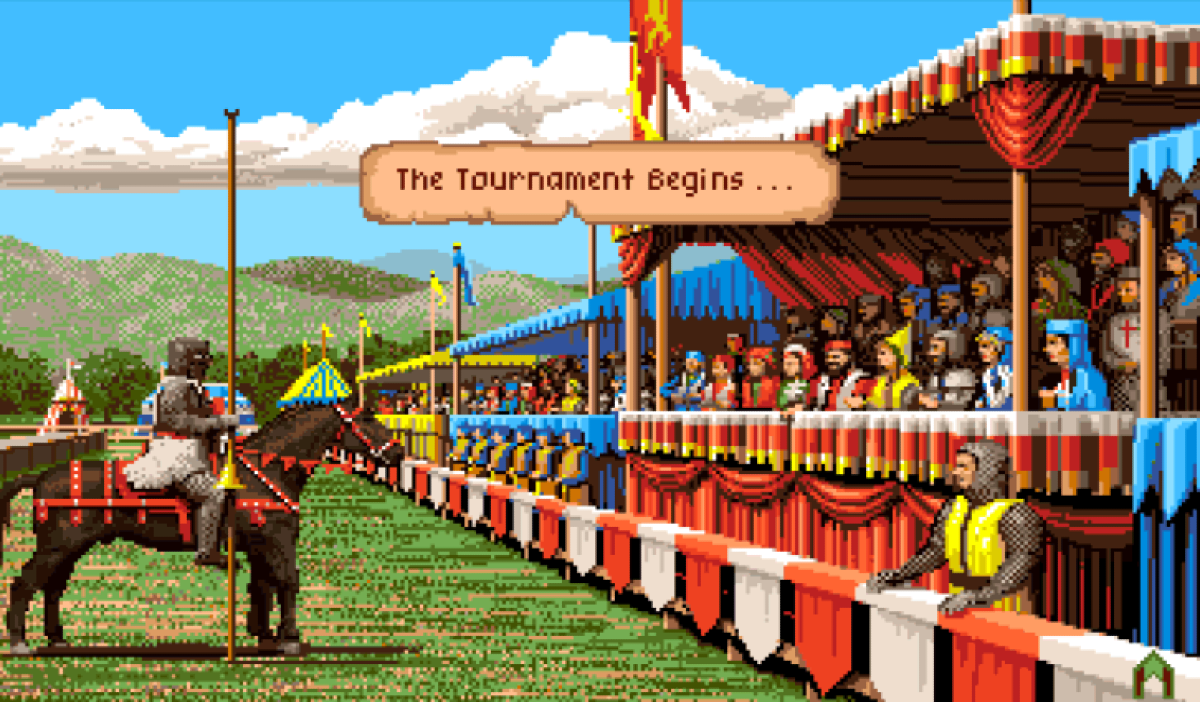
For the first game, Defender of the Crown, Jacob chose a knightly story in the style of Robin Hood. Following his premise of 'action with meaning', the plot of reclaiming England translated into a strategy game reminiscent of Risk, where each confrontation on the board was decided through various mini-action games: lance duels, castle sieges, etc. There was even a mini-game to rescue the princess: the romantic interest was another ingredient in Jacob's recipe and served as an excuse to add a bit of pixelated fan service.
If Jordan Mechner thought like a director, Bob Jacob operated like an executive producer. To leave no doubt about what he had in mind, he named his company Cinemaware.
The truth is that neither the story nor the gameplay were at the center of the experience: what captivated in Defender of the Crown was the graphic quality that illustrated the story and animated the action scenes. As soon as he had the concept for the game, Jacob recruited the best pixel artists in the Amiga scene, gathering piles of illustrations that programmers had to figure out how to insert into the final product. The plan was for the game to grab players' attention visually, and it succeeded beyond expectations: Defender of the Crown was practically a graphic demo, a showcase of everything the Amiga could do, and for that reason, it became a hit in the modest market for the platform. The game mechanics hardly mattered; whether purchased or pirated, every Amiga user ended up loading Defender of the Crown into their disk drive.
After the inaugural success, Jacob continued with his plan, exploring every classic film genre: gangster movies, samurai tales, World War II, even one featuring the Three Stooges. Each installment followed the same formula: a global strategy game with action mini-games, all sprinkled with the best pixel art money could buy. All of them also suffered from the same limitations: superficial gameplay and a balance that swung between too easy and too hard. After a string of negative reviews and a decline in sales, Jacob had to recalibrate, again following the Hollywood model, not just in theme but in method: he appointed a creative director, hired writers, and developed tools to specify the games in the form of storyboards. It was with his tenth title, the B-movie horror game It Came from the Desert, that Cinemaware achieved the perfect balance between gameplay, graphic quality, and story.
The positive reception of It Came from the Desert convinced Jacob that he was on the right track: the market was ready for interactive movies to become the next mass entertainment medium. But there were two major problems preventing him from capitalizing on what seemed to be his big breakthrough: 1. by 1989, it was clear that the Amiga revolution was not going to happen; 2. Neither the Amiga, nor the PC, nor any other available platform could handle the type of game Bob Jacob planned to deepen his project.
It was clear that the next step in turning video games into movies was to replace pixelated animations with film material. It was also clear that to store digital videos, something better than a stack of diskettes was needed; specifically, a computer or console with CD-ROM support needed to become popular. Instead of backing down, Jacob embarked on the production of a 'live action' version of It Came from the Desert, hoping that in the meantime the hardware landscape would clarify. The production of the game turned out to be absurdly costly, dragged on, and the hypothetical savior platform never appeared. Jacob had been right in his prediction, but he arrived too early: the gamble sank his company.
The production of the game turned out to be absurdly costly, dragged on, and the hypothetical savior platform never appeared. Jacob had been right in his prediction, but he arrived too early: the gamble sank his company.
By the way, if the Amiga was so good, why did it die? Commodore, which had bought the design from a startup, never knew how to leverage the technology it had: it failed with advertising and distribution, and never updated the hardware, for example, with CD-ROM support that would have greatly benefited Cinemaware. Except in Europe, it failed to establish itself as a gaming platform or break out of the niche of audiovisual publishing. The Amiga was a multimedia aerolite that landed in the wrong decade. The PC/Windows would need a decade of improvements and reduced hardware costs to bring a similar experience to homes. And, as for Cinemaware, its fate mirrored that of the platform it was born on. Although in the long run video games would become something different from movies, Bob Jacob turned out to be a pioneer: the tour de force of Cinemaware, with its achievements and failures, ended up being a trailer for what would happen to the rest of the industry in the years immediately following its dissolution.
The PC was the most boring computer of the eighties, but it had some things going for it. IBM designed it with an open architecture, meaning other manufacturers, like Compaq or Tandy, could make 'PC-compatible' clones. Bill Gates, in the masterstroke on which he built his monopoly, sold IBM a non-exclusive license for MS-DOS, meaning clones could use the same operating system as the original. Finally, the hardware design, besides being open, was modular, allowing components to be added or upgraded without having to replace the entire machine, maintaining compatibility with software. Because of all this, unlike what happened with Commodore and the Amiga, the fate of the platform did not depend solely on IBM, but rather there was a whole consortium of hardware and software companies competing to expand the market and lower production costs. Thus, while the 1985 PC paled in comparison to an Amiga, the 1990 PC, which was essentially the same, had closed the gap. With a good video card and sound card, the experience wasn't exactly the same but was quite close, and in contrast, the catalog of games for DOS was enormous and kept growing.
With the dominance of the PC established by the early nineties, there was a shift in the dynamics of video game design. Since the platform was configurable, unlike what happened with an Apple II or a Commodore 64, there were no fixed hardware specifications to adhere to: not all users had the same generation of processor or video card. In fact, the demands of games helped drive hardware sales: users were willing to upgrade their machines if it enabled them to play the latest hit. Sierra Online, for example, not content with adding support for Roland synthesizers and Adlib sound cards, directly sold 'multimedia kits' that included the latest King's Quest along with the necessary hardware to experience it in all its glory.
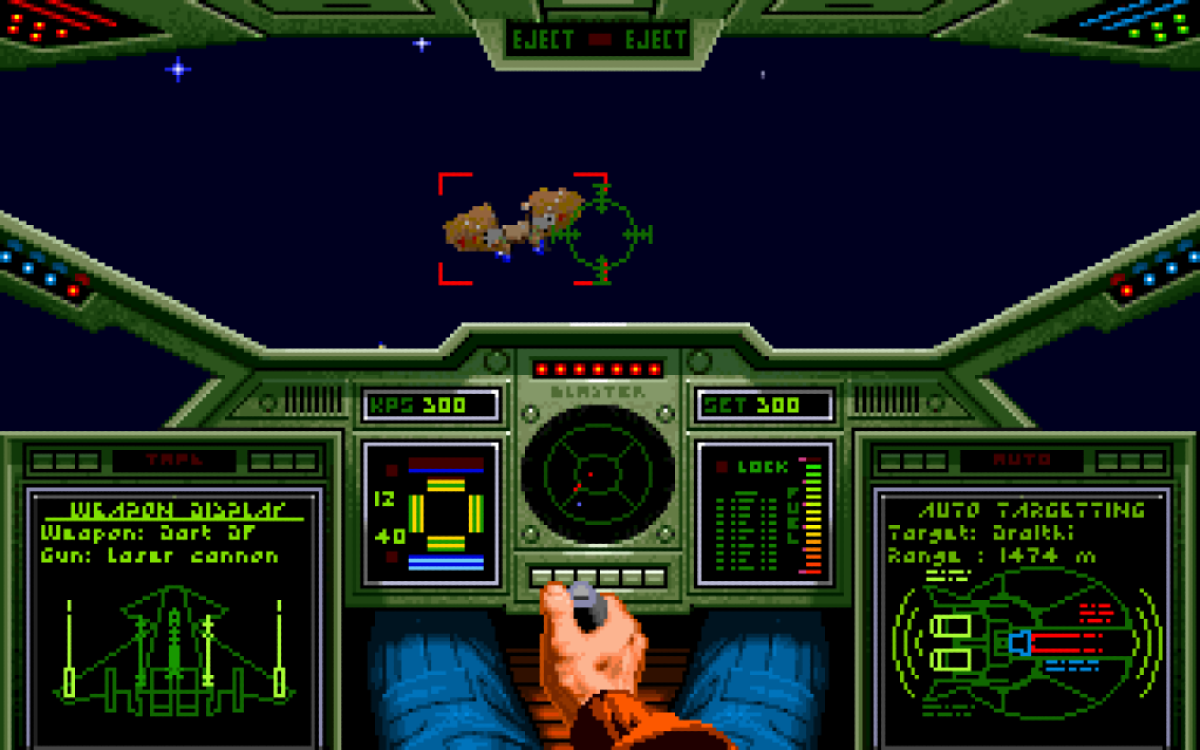
That logic, taken to the extreme, gave the PC its first blockbuster: Wing Commander. Chris Roberts' game was not designed to run on average hardware but on the best computer money could buy in 1990: a 386 processor, VGA graphics, sound card, and expanded memory. Inspired by Cinemaware's games, Roberts surrounded his flight simulator with a story that held it together, a space opera in the style of Star Wars. The outcome of the missions affected the course of a galactic war, and between battles, the player interacted and competed with their peers in a narrative format similar to graphic adventures. As Roberts said:
I love story and narrative, and I think they serve to structure action, giving action meaning and context in the game. That was the guiding idea behind the design.
Something Bob Jacob could have said, but while Cinemaware started with a premise and surrounded it with simplistic mini-games, Roberts began with a solid flight simulator, polished and entertaining gameplay, and put it all in service of his fictional arc. Since he wanted to create an experience above all, he didn't hesitate to simplify details of the plane or sacrifice realism in the simulation if it contributed to his dramatic goals. It didn't matter that the plot itself was basic, a bit confusing, and even ridiculous (the 'enemy' is a race of anthropomorphic cats in space suits); it was enough that there was any story to motivate the player and make them the protagonist.
The resounding and lasting success of Wing Commander indicated that the audience, in addition to good graphics, wanted story. Some interpreted this as confirmation of Bob Jacob's predictions that games were indeed converging towards movies. But, in retrospect, we can take a more nuanced reading: Chris Roberts showed that a game whose main mechanic was combat could benefit from incorporating narrative elements. In this regard, Wing Commander was the first hint of the industry's end-game.
Much of the success of Wing Commander can be attributed to the fact that it filled a space that LucasArts was leaving vacant. No name in the industry was as strongly associated with film as George Lucas, but due to licensing issues, his video game studio was prohibited from making Star Wars games. A couple of years later, with the legal problem resolved, it would be enough to copy the formula of Wing Commander to achieve one success after another, but for the moment, LucasArts in 1991 had to settle for graphic adventures and the occasional Indiana Jones game. Having already released one to accompany the launch of The Last Crusade and with Spielberg's trilogy now complete, Indy’s next computer adventure would have to be an original story. To safeguard the franchise, they brought in a professional to take charge of the project.
Chris Roberts showed that a game whose main mechanic was combat could benefit from incorporating narrative elements. In this regard, Wing Commander was the first hint of the industry's end-game.
Hal Barwood was a Hollywood veteran, a road companion of Lucas and Spielberg in their early years, who failed to sustain his own career as a screenwriter and director. Resigned, he asked his friend for the chance to jump into video games. Barwood was the ideal hire for LucasArts; his understanding of basic notions of rhythm, tension, and dialogue promised to elevate the studio to another league compared to the competition, so he came on board as the writer and director of Indiana Jones and the Fate of Atlantis. But what’s interesting is how Barwood, coming from the film industry, quickly recognized how problematic it was to equate the two disciplines. The topic came up in conversation with Orson Scott Card, a science fiction author who also wrote for LucasArts:
“Video game companies keep talking as if games were like movies,” Barwood said. “But the truth is they’re not that similar. What they actually resemble is plays.” Why? Because, like in a play, there are few locations available, and they’re usually viewed from a single angle. You can’t do close-ups, and the action is so diffuse that it has to be clarified with dialogue. In film, it’s the opposite: you control the pace by cutting and moving the action from one place to another. The camera never stays still for long.
But Barwood’s observation suggested something deeper: designers are betting too heavily on the analogy of games-as-movies. They’re comparing their games to an art form so different that the techniques that work for one will fail for the other. What Barwood discovered—and what every good video game author will have to learn—is that computers are a completely different medium, and we can’t judge them by the standards of other arts. Game authors will do their best work when they focus on what computers do well, rather than wasting time trying to cram movies onto a VGA screen. The art of storytelling with a computer has to be invented, not copied.
That lesson, clear to people like Scott Card, Hal Barwood, and Jordan Mechner, would take a bit longer for the industry as a whole to assimilate.
With the new audiovisual capabilities of PCs, a world of possibilities opened up for video games, but the multimedia equation still needed to clear the variable of storage space. Games like Wing Commander II or King’s Quest VI took up 10 diskettes, driving up production costs and degrading the user experience, as they spent their time swapping disks in and out. The solution was known to all, the same one Bob Jacob had known back in 1989: the CD-ROM. The compact disc had established itself as the new standard for music and had been teasing a leap to computers for years, but the moment never seemed to arrive.
It took not one but two killer apps to break the market in 1993 and put a CD drive in every American computer. The first was Myst, labeled by the press as a graphic adventure but whose creators insisted it was not a game but an “interactive world”: it invited you to explore a lonely island in first person, in pre-rendered 3D environments. Although there were puzzles and some snippets of story, these were more of an excuse to move the player; in that sense, Myst seems more a direct descendant of the simulation of Colossal Cave Adventure than of Monkey Island.
The 7th Guest, the other game that helped sell the CD-ROM, was also a graphic adventure, also in first person, also with 3D environments (in this case, an ominous mansion with some touches of Twin Peaks). But what made it special and what drove everyone to buy it (in a bundle with the CD drive) was that every time you entered a room or solved a puzzle, the game rewarded you with a video sequence featuring real actors. This “live action” technique, later dubbed Full-Motion Video (FMV), opened the floodgates for the most bizarre period in the video game industry.
To understand the Full-Motion Video craze, one must consider the state of the industry and the market at the time. In ’93, arcades were already in decline, and the average gamer had a 16-bit console at home, either the Sega Genesis or the Super Nintendo. Just as with PCs, it was understood that the next step for consoles was to replace cartridges with CDs, but several companies had been timidly trying and failing spectacularly in that regard: the TurboGrafx-CD, the Philips CD-i, the Sega CD, the 3DO, the Atari Jaguar. Sony and Nintendo had a frustrating collaboration to add CD support to the Super Nintendo, which would eventually lead to the PlayStation. But that was still a way off. For a couple of years, the platform with the best capabilities for video games was a well-equipped PC. And thanks to mega-hits like Wing Commander, Myst, and The 7th Guest, it was also on the PC where the money seemed to be.
Ken Williams, who had a vision similar to Bob Jacob’s but was sharper in business, had invested what he earned from Sierra Online’s pixelated adventures into a film studio, waiting for technology to catch up with his ambitions. Once the CD-ROM became popular, he paused Sierra’s other franchises to tackle two mega-productions: Phantasmagoria and The Beast Within. Both released in 1995, followed the formula of The 7th Guest: Full-Motion Video horror graphic adventures. Williams’ hypothesis was that the presence of real actors would finally dismantle the prejudice of video games as entertainment for children and attract the adult audience he had always had in mind. But given the inexperience of the producers, the quality of the script, the choice of actors, and the aesthetics of the set, the result resembled less Hollywood and more Tommy Wiseau or softcore porn on Friday nights on I.Sat. This last association might explain why that first wave of games sold so well despite being so bad.
Given the inexperience of the producers, the quality of the script, the choice of actors, and the aesthetics of the set, the result resembled less Hollywood and more Tommy Wiseau or softcore porn on Friday nights on I.Sat.
By those quirks of the entertainment market, the dominance of the PC and the good sales of interactive movies led some actors to suppose that video games could be a good gig. One that, if it went well, would result in a new source of residual payments, much like VHS had been during the previous decade. So it was no longer just cheap actors like those from Sierra; suddenly, there were second-tier stars taking roles on the PC. Dave Duchovny and Gillian Anderson reprised their usual roles for the interactive movie of X-Files; Christopher Walken played a detective in Ripper; Dennis Hopper was a killer in Black Dahlia; Christopher Lloyd was a cartoonist in a sort of inverted Roger Rabbit called Toonstruck. But the record undoubtedly goes to Wing Commander III, which featured Mark Hamill (Luke Skywalker in Star Wars), Malcolm McDowell (Alex in A Clockwork Orange), Tom Wilson (Biff in Back to the Future), and John Rhys-Davies (Sallah in Indiana Jones and Gimli in The Lord of the Rings). Bingo!
However, after the initial technological novelty wore off, what remained were poorly designed games that were a bit boring and incredibly expensive to produce. They weren’t even nice to look at: bad actors or famous actors with the worst vibes, following instructions from people who didn’t know how to direct, captured in low resolution and cut out over some kitschy renders. Neither Wing Commander III nor IV, for instance, managed to cover their production costs, which didn’t stop Chris Roberts, who was consuming what he sold, from securing funding to direct a film in the saga, with the expected results.
The window of time in which studios, investors, and actors remained convinced that interactive movies could be a good business lasted rather briefly, a couple of years, but it was poetic justice that it was enough time for Jordan Mechner (who a decade earlier had gone bankrupt squeezing art out of an obsolete machine) to have his chance to direct a superproduction. True to his filmmaker's eye and aesthetic sensibility, he wasn’t going to settle for doing the same thing everyone else had been doing:
Filming a long sequence and playing it back on screen is the wrong way to make a cinematic game. The computer is not a VCR. But if you can leverage the knowledge we all have about how cuts work, how shots work, the dramatic effect of a low angle or the camera suddenly pulling back… There’s a whole collective unconscious about cinematic vocabulary, and that’s tremendously valuable to exploit in a game.
Mechner planned to film actors, yes, but not to insert the videos directly into his game; instead, he would use the material, once again, to produce rotoscoped animation, the same technique that had earned him success with Karateka and Prince of Persia. Now, with the hardware and budget in his favor, he was able to hire professional actors and develop dedicated software to digitize the footage. On set, the actors appeared made up and in bright costumes to enhance contrast; the result was animations and art nouveau vignettes ready to be integrated into the action.
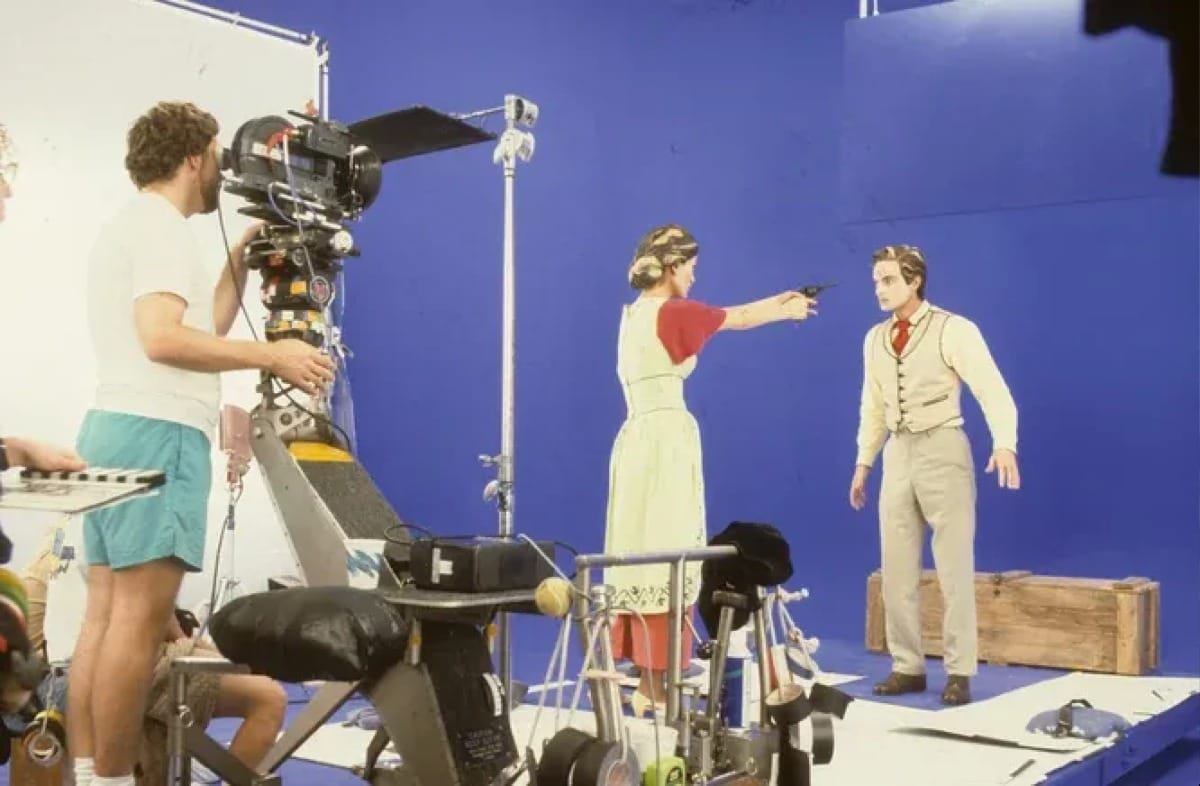
The game would be a cinematic graphic adventure, indebted to Agatha Christie and Alfred Hitchcock: a murder mystery aboard the Orient Express, during its last journey from Paris to Constantinople, just before the outbreak of the Great War. The train can be explored in 3D with the same dynamics as Myst; the cars and cabins are designed based on the originals and are populated with passengers from all over Europe and beyond, each following their daily routines, speaking in their languages, discussing and scheming, reproducing on a smaller scale the same tensions that shook the continent. Time and space play an important role: the journey progresses in real-time, and the player must strategically decide how to move to be in the right place at the right time. If they make a mistake, they have to rewind and try again. Sounds complicated? It is! The game is brilliant but absolutely hardcore.
No one playing The Last Express in 1997 would have compared it to watching a movie. And that was a good thing. This was something else, a computer-native experience, a serious work of fiction that could be inhabited. The attention to detail, the sound of the train on the tracks, the moving landscape outside the window, the voices intertwining as they crossed the cars, the tension of the passing hours and the search for the killer, all contribute to a unique experience, an unprecedented suspension of disbelief on the PC.
No one playing The Last Express in 1997 would have compared it to watching a movie. And that was a good thing. This was something else, a computer-native experience, a serious work of fiction that could be inhabited.
The Last Express took five years and five million dollars to finally become, since 1997, the best game that nobody ever played. Jordan Mechner went bankrupt, had to sell the studio he had just founded, and buried any hopes of becoming a filmmaker for good. But what a game you made, Jordan!
While half the industry was playing Hollywood at a birthday party, a group of rebels was breaking through from below. id Software was led by 'the two Johns', a sort of Lennon/McCartney of video games: John Carmack, a programming genius capable of working wonders with PC hardware, and John Romero, a talented designer with the flair (and hair) of a rock star. Together they released hit after hit: Commander Keen, Wolfenstein 3D, Doom, Quake, each with its sequels and spin-offs, each more popular than the last. With every step, they seemed to open new territory for video games: 3D graphics, first-person shooters, shareware distribution, modding, online gaming, esports. Above all, they fought against an industry stubbornly intent on drowning players in narrative. For Carmack, 'the story in a game is like the story in a porn movie: you expect it to be there, but it’s not that important.' Indeed, id's shooters would drop you into a setting with a weapon and some heavy metal in the background, and you were on your own; no introduction, no context: just kill monsters or Nazis (or Nazi monsters):
One of the industry's problems is overdesign. Programmers don’t know what they want to achieve. I like to give design exactly what it needs to meet its objective and nothing more. That’s why our games hit at a biological level. It’s elegant programming: every element has to be justified. If it doesn’t add to the experience, it goes.

A reclamation of the old arcade adrenaline, packaged in a format that could only exist on a computer. id Software was a bulldozer that split the industry in two; everything left on the other side of the divide had an expiration date.
How is it possible that the audience, who in 1991 bought melodrama from Wing Commander, just two years later demanded the uncompromising violence of Doom? Most likely, the audience didn’t want just one thing, nor was there a single, uniform audience. But we were still decades away from the idea of market segmentation; by the mid-nineties, the only thing that mattered was the mainstream, and the mainstream wanted 3D action.
How is it possible that the audience, who in 1991 bought melodrama from Wing Commander, just two years later demanded the uncompromising violence of Doom?
By that point, the PC was no longer the leading platform as it had been in previous years; now the Nintendo 64 and PlayStation were circulating, two consoles, each with its own style, designed for 3D gaming. To keep up, computer users had to buy an accelerator card like the Voodoo from 3dfx. Even in cinema, which had recently been seen as a model to follow, action blockbusters were increasingly based on CGI effects, and Pixar's 3D animation had dethroned Disney. Companies like Sierra and LucasArts had no choice but to ride the wave: the next generation of graphic adventures would be in three dimensions or not at all. And it would be the last.
Tim Schafer had worked with Ron Gilbert on the two Monkey Island games, co-directed Day of the Tentacle (the sequel to Maniac Mansion that surpassed the original), and had a modest success with Full Throttle, his biker adventure with rock and roll. For his next project, he was given creative and budgetary freedom, with the only condition being that it had to be in 3D. It was that restriction that gave him the key: although they were in vogue, polygonal models at that time were quite crude, far less appealing than the cartoons of the previous generation; Schafer needed a concept that wouldn’t suffer from the limited range of what looked like cardboard puppets; he thought of the papier-mâché figures that Mexicans use on their Day of the Dead; he imagined a game starring skeletons passing through purgatory, en route to the afterlife. Manuel Calavera, Manny, would be his travel agent, a grim reaper selling tickets to newcomers as a way to pay off his own debt and escape the land of the dead.
For once, someone was a little less literal and organically channeled the influence of cinema: Tim Schafer, who at the time had been consuming a lot of film noir, borrowed the plot of Double Indemnity for the first chapter and dressed Manny like Rick in Casablanca for the second; the jazzy soundtrack evoked Miles Davis's Ascenseur pour l'échafaud, The Big Combo, and Sweet Smell of Success, all interwoven with Mexican folklore. Despite the grotesque polygons, the 3D scenes allowed for some play with camera angles, lighting, and close-ups. Added to this, and with a judicious use of music and sound (Manny's shoes on the office carpet and the secretary typing in the background; Manny's shoes on the wet cobblestones of Rubacava and the distant music from the Calavera Café), the result was, without aiming to be a movie, cinematic.
The game was far from perfect: there were convoluted and tedious puzzles, the controls were controversial, and the graphic adventure mechanics didn’t quite mesh with that new three-dimensional world. The second half of the game, rushed due to budget constraints, lost some steam. But in the good moments, the moments we remember, Grim Fandango was an unparalleled aesthetic experience, overflowing with style, evidence of the heights a narrative game with a triple-A budget could reach. The critics understood this, showering it with praise and awards, but the audience… not so much.
Although it didn’t involve filming real actors or require a movie budget, a game like Grim Fandango was still difficult and expensive to produce. And while it didn’t sell poorly, it wasn’t a hit comparable to other games of the time, which could be completed faster and with less uncertainty. Beyond any artistic merit, narrative games like Grim Fandango or The Last Express ceased to be an enticing proposition for studios and investors convinced that most of the audience wanted something else.
Grim Fandango was an unparalleled aesthetic experience, overflowing with style, evidence of the heights a narrative game with a triple-A budget could reach.
The audience, indeed, seemed to be asking for 3D action, but that didn’t necessarily limit itself to the primitive festival of violence of a Doom or a Quake. Just days after Grim Fandango, Valve released Half-Life. Formally a first-person shooter, Half-Life welcomed the player with half an hour of narrative exposition, a long interactive train sequence to the lab, with no weapons in sight. The story was there: you didn’t have to imagine it from the decor or the number of tentacles on the enemies, nor did it have to be told to you like in a book or a movie; the story was revealed to you as you traversed it. Even the action of the game had a narrative side: rather than autonomous enemies on a map, what was there was a kind of choreography synchronized with the player's progress; the action wasn’t emergent but scripted to ensure the spectacularity of the experience.
Half-Life took home the other half of the awards from 1998 and marked a new direction for the industry: a dialectical synthesis between Monkey Island and Doom, proof that cinema's storytelling could be embedded in the native action of the PC. Video games no longer had anything to envy Hollywood; they had graduated to an artistic medium with their own identity, an artistic medium for the 21st century.
Y a cada colaborador se le paga por su trabajo. Las dos cosas dependen de los suscriptores.