Babasónicos: The Poetry of Adrián Dárgelos

Babasónicos: The Poetry of Adrián Dárgelos
In April 2022, the Argentine band Babasónicos released their album Trinchera, and a few months later, the band published an extended edition titled Trinchera Avanzada. Last November, they launched Cuerpos, Vol. 1. In this way, the group has built a committed voice that positions them as representatives of a social subject eager for new music. From the trench to hand-to-hand combat, from hiding to counterattacking. But how did Babasónicos, and specifically Adrián Dárgelos, come to occupy that place? In this article, we will analyze the literary influences and the political dimension of their latest albums.
At some point during the strange nineties, Adrián Dárgelos and Marcelo Cohen became friends. Cohen is a great writer, author of worlds similar to the one we see, hear, and live in, but with slight shifts toward a strangeness and a science fiction that expresses itself both in language and sensory impact: Cohen's poetics attempts to map an era that has stimulated the senses to the point of atrophy. He has published El fin de lo mismo, Los Acuáticos, and Donde yo no estaba (which has now been reissued by Editorial Sigilo), among others. In an effort to name his work, the term “insecure realism” is often used. Something similar happens with Babasónicos, whose extensive body of work challenges the incentives of the spectacle society and responds with an encrypted, murky conviction punk. The world depicted is not a mimetic reflection but a distorted silhouette, serving the image and the language.
How did Babasónicos, and specifically Adrián Dárgelos, come to occupy that place? In this article, we will analyze the literary influences and the political dimension of their latest albums.
In 2007, Cohen published a text titled En la bruma nacarda del origen, which attempts a fictional biography of the group. The text would later be included in the book Capital Babasónico and serves as a good complement to discuss the band's origins. It’s not out of the question that this text dedicates some words to the intersection between the sonic gun and Sai Baba. Despite being repeated to the point of exhaustion, the anecdote continues to propose an intriguing intersection that illuminates the night of misunderstanding.
The text begins:
This story takes place in a past so distant that today it is part of the air we breathe. Or in a future so remote that everything that fantasy and progress can conceive has already happened, has been surpassed, and now returns to what we already know. It was before and it was after. It was in a rogue world and a generous time.
Cohen proposes two parts: “Imagine” and “Listen.”
Let’s move towards that.
Imagine
Dárgelos is a poet of the image, in addition to being a musician.
Here’s a genealogy, possibly incomplete.
One of the main promoters and co-founders of imagism was Ezra Pound. In the foundations of the movement, it was urged to speak of the thing from an objective or subjective place; it was indifferent. What mattered was to eliminate words that did not help present what was being discussed in the poem and to compose following the sequence of the musical phrase. In other words, they were introducing free verse to society.
The idea of breaking away from closed forms had been around for some time, and in Latin America, there were concrete attempts, like the “lean hendecasyllables” of José Martí's Versos Libres. Small shifts that gradually led to the idea that each verse could measure whatever was necessary.
There is a common confusion: thinking that a poet who cultivates free verse doesn’t need to know the metric tradition. This was not the case for Pound, an exhaustive connoisseur of tradition. It also wasn’t the case for his friend T. S. Eliot, who published the essay The Tradition and the Individual Talent in 1919, where he argues that if tradition were merely to repeat what the masters of the past did, literature would stagnate. Instead, he understands that tradition requires effort: the poet must access a “historical sense.” In fact, this is the text where he explores the bidirectionality of the past, which Borges would revisit years later in Kafka and His Precursors: we normally think that the past influences the present, but Eliot argues that the present also modifies the past. It could be paraphrased: our way of reading and understanding Borges or Cortázar inevitably changes after reading some poetry collection (I dare say: one that is good enough) published in 2026. The past and the present adjust to each other.

One more thing about these guys. Pound outlines in his article How to Read, published in 1929, three dimensions, qualities, aspects, etc. of the poem. He later consolidates the theory in his hefty book The ABC of Reading, published in 1934. The “Melopea,” the sound dimension, musical aspect of the poem; the “Fanopea,” the image, related to the visual strength of poetry; and the “Logopea”: the intellectual dimension of the poem. "The dance of intellect among words," says Pound.
From Pasto to Cuerpos, Vol.1, Dárgelos's poetics seems to contemplate the three qualities of the poem.
The possible affiliation of Dárgelos with agism is not arbitrary. Argentina has always been poundian. There have been translations throughout the 20th century. Pound is not an easy author. Not because he is difficult to read, but because he is hard to love. In 1943, he was accused of treason by the U.S. government for his radio broadcasts from Italy in favor of fascist regimes during World War II. In a way, if we adjust his biography to today’s language, he was canceled. But in Argentina, he was carefully recovered and translated.
The possible affiliation of Dárgelos with imagism is not arbitrary. Argentina has always been poundian.
Another author with whom Dárgelos formed affinities is Fabián Casas. We understand that their bond began just over a decade ago, but if we return to T. S. Eliot, there are presents that modify pasts. It seems reasonable to imagine a friendship that, once consummated, allows one to see their own work with different eyes.
In 1990, the year Pasto was released, Fabián Casas founded, along with Daniel Durand, Laura Wittner, Darío Rojo, and others, the magazine 18 Whiskys, named in honor of the number of drinks Dylan Thomas consumed before slipping into alcoholic coma and waking up on the other side of eternity.
These were two publications that circulated a lot of American poetry. The poets featured in those pages perhaps represented the most significant lyrical advance in recent years for our country's literature. And while it’s not easy to draw a homogeneous picture of what happened in the poetry of the nineties, one could say that objectivism, a descendant of imagism, dominated the verses of that time. In response to the neobaroque, it eliminates pomp, any trace of sentimentality, and focuses on the thing, the image, the memory. To achieve this, American objectivism is referenced, and a personal way of expression is invented. The result: trimmed, concise, concentrated forms. Argentine objectivism is that, along with some adherence to the work of authors like Joaquín Giannuzzi, who, from the fifties until his last posthumous book, well into the two thousands, refined his approach to everyday life as the center of the poem. The magazine circulated the voices of Argentine poets who were part of this movement and some others from the Anglo-Saxon world. I believe that this area of Argentine poetry is the one that resonates most with Dárgelos.
By the way, he writes the back cover of the book by Casas's heteronym Los poemas de Boy Fracassa, from 2024. He says:
In the mid-eighties, I was going through the end of my adolescence in the neighborhood of Lanús, a landscape composed of various shades of gray and brown. A group of figures we called Los grandes because they had the knack for obtaining and using drugs decided to venture on vacation to Rio de Janeiro.
The story that Casas constructs about Boy Fracassa is quite amusing. The book The Sertón, in Portuguese, was supposedly found in the library of tennis player Gastón Gaudio, with whom he lived for a few years. “I remember that reading those poems gave me an unforgettable feeling of peace and joy,” Casas says about the discovered text. The book is said to have reached Gaudio through fellow tennis player Guga Kuerten, who had received it as a gift from his sister, the “intrepid traveler” Clarice.

Dárgelos approaches the figure of the heteronym in question in his back cover. Fiction is the channel to reinvent the past. The imaginary stories of Marcel Schwob, in a poetic key (and, of course, many more examples could be cited regarding this type of artifice). He then talks about a certain Carlos Vicio, who allegedly introduced him to the delights of the author:
They didn’t hear anything from him until six months later. He returned changed, speaking very fluent Portuguese.
And he adds that he
gave him a small, well-worn book he had with him. That book was The Sertón by Boy Fracassa.
Dárgelos, for his part, has two poetry collections. Oferta de sombras (2019) and La voz de nadie (2024), presented by Casas.
As we mentioned, imagism and objectivism are two currents present in both songs and poems. But that’s not enough, of course. Dárgelos's influences come from many spheres of culture, and all are found in his extensive and hard-to-categorize discography. If Pasto, Trance Zomba, Dopádromo, and Babasónica are albums that, despite their playful nature, remain serious, Miami (1999) is something else entirely. The writer and translator Eleonora González Capria tells me over coffee that for her, the main operation of Miami is to embody the tacky, and Jessico (2001) is the parody of that construction. I add that it’s possible that Miami achieved that level of saturation of its own seriousness because it condenses a search that can be traced in the outtakes, namely: Vórtice Marxista, Groncho , and Vedette. Three compilations with a satirical tone, whose songs didn’t fit with the imprint of the albums that could have housed them, but which outlined a tone that the band needed to explore. By the way, Luis Paz’s approach to the circulation of these albums is very interesting here.
 Pierre Froidevaux
Once they reached that tone, everything changed. Because after the Miami-Jessico duo, the band understood that there was a path in irony and confession. In Infame, Dárgelos's language assumes its power. Again, the multiplicity of genres becomes the norm. It’s the time of rock and bolero, surf and glam, pop and electro. The horse on the cover by Alejandro Ross (once again), straddling innocence and opulence, along with the typography from the series Fame, provides the key. Irresponsible and stripped down, Babasónicos thus reestablish their foothold in the hit industry. But Dárgelos's roots remain in the saying. The music allows for fine polishing, the song becomes a means to convey ambiguous sensations, flirting with the subversion of mandates and rock mischief. Dárgelos implants words and verses that resonate and become synonymous with him. Even when he quotes, as in the case of the line “where it brushes against the bambula,” a borrowing from La experiencia sensible, (2001) by Fogwill, and one of the group’s most famous lines. Between pastiche and reflective poetry that marries popular culture with a personal, almost secret literary collection, Dárgelos builds a voice of broad impact, peeking into the mass without losing its cryptic and mysterious essence. But perhaps the main reason why it’s so difficult to categorize this poetics into a single lineage is the constant reinvention of its forms. As if each stage were a different band, and the dialogue between language and music changed its dynamics.
After the Miami-Jessico duo, the band understood that there was a path in irony and confession. In Infame, Dárgelos's language assumes its power.
The stage that began with Infame lasts until A propósito (2011), and with Romantisísmico (2013), a transition begins, along with Discutible (2018). Then would come the current stage. In an interview with Paz Busquet for Hablar de poesía, Dárgelos responds regarding the resources he uses when composing songs.
Interline spacing gives me a lot of flight; I can live inside it. I like when I can live inside the reading. I like literature to silence the internal dialogue. For me, literature is the greatest instance of intimate communication that exists between two people.
Dárgelos's syntax is permeated by meter. In that same interview, he says that “the most brilliant lyrics are the ones that break the meter imposed by the music.” If for Badiou “the poem is a form of thought,” Dárgelos's way of thinking about language, like that of other poets, is to push its limits. His phrasing lingers in memory, and humming his music is to witness a tension between written language and sung language. Two ways of measuring meter, that of the song and that of poetry, which coalesce in their difference. A virtuous example of the utility of free verse: shifts from the closed form that imprint a memorable echo in the poem or the song.

Listen
The broadcast cut of Cuerpos, Vol. 1 is an ars poetica titled “Warning.” The ars poetica is a sort of declaration of aesthetic principles made by the authors. There is a very famous one by Vicente Huidobro that starts:
Let the verse be like a key/ that opens a thousand doors.
In “Warning,” Dárgelos sings (or perhaps recites?):
As for me, I prefer to reject what seems/
Totally absurd
In those early albums, a unique mythology emerges, rich in language and rhythmic variations. What a song demanded, the lyrics provided. The universe expanded with the videos, a subplot that complicated a porous world of influences, where psychedelia, clandestinity, youth, and an ironic form of transcendence were expressed in every instrumental that crossed their minds. Now I think of the video for “D-Generación”: swagger, sensuality, fashion, chaos, and suddenly Carca dressed in a seventies style, playing the role of a hustler on a pale, cold corner.
In this unsettling present, having made the journey, it’s time for metapoetry. In Cuerpos, Vol 1, the voice takes center stage against a stripped-down instrumentation, focused on creating a nebulous atmosphere. A sound display produced by engineer Gustavo Iglesias, as always in this discography. Clear, in a close-up that allows you to hear every syllable, the singer's voice warns about the artifice and the lyrical will to graffiti minds with just the right amount of control:
(…) anyone can be
A snail in all of our songs
A sophisticated way to lie, lying to keep going
An aerosol in another’s consciousness
The era of Trinchera and Cuerpos is Babasónicos' most political period. This phase begins with the appropriation of the communist symbol of the hammer and sickle, transformed into a trident and crescent moon, to illustrate La Izquierda de la noche and then the entire album. The left of the night is also a belonging outside of institutionalism. And here’s something interesting. It doesn’t matter who finances, distributes, receives, buys, or celebrates the work and the expectations it produces. What matters is from where it is stated and, above all, towards where: a posterity, outside of the circumstances, that will be able to hear Babasónicos' subaltern anchoring through time. Because art, in all its escapes and possibilities, belongs to the night, not the market. And that should be enough:
I made myself part of the left of the night.
I might not tell you anything more.
Nonetheless, Dárgelos has refrained throughout his career from making explicit political statements. Over time, he has shaped an opaque voice in his worldview and increasingly sophisticated in poetic expression. If Miami represents an aesthetic rebirth, not devoid of the provocative critique that characterized their early albums, Jessico gave them visibility that took their song far. In the ambiguity, in the assumed voice of the freaks, Babasónicos embraced popularity and bet on deepening the hit-making form. Music made them lieutenants of discontent, and social upheaval had its soundtrack.
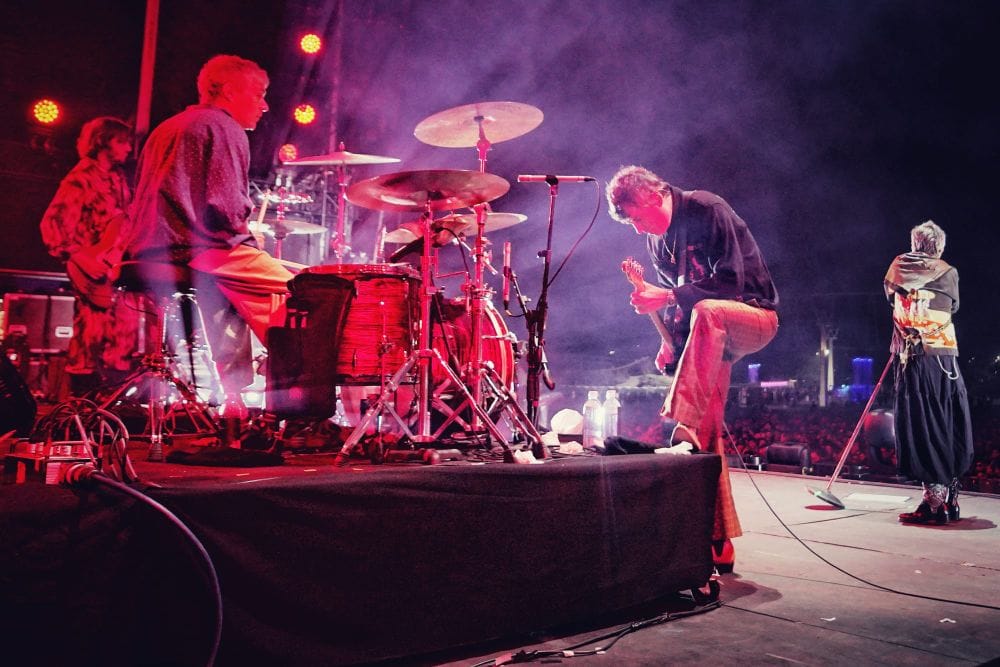
Impuesto de Fe, a live reimagining album with its respective videos, is a reaffirmation of their most listened-to songs. The identity of a big band was built with the allure of an engaging live performance for anyone. The idea seemed to be to amplify the niche as much as possible, without losing sight of the sonic origin, the suburban mystique, the kitsch elegance.
I mentioned at the beginning that the pages of rock biographies, one of our digital ruins, traces of a better internet, reveal that the name of the group comes from the combination of the sonic gun, a 90s toy, and the yogi and fakir Sai Baba. Let’s not kid ourselves: if the name managed to coagulate, it was also because the band was part of the sonic rock movement, an English wave that moved and inspired them. Sonic and a bit mystical, they understood from the beginning the place that cultural syncretism granted to spirituality. Something more than crumbs, impulses of transcendence like advertisements.
A state of deep trance/Has put me on a wandering plan.
Or, in other words:
Tancerollersheebabuggiezombadictosonico
I was born in Lanús; Lanús: city and ghetto
As we clarified in the initial coordinates, Trinchera was released at the end of April 2022. Alberto Fernández was in power and Argentina had not yet won the World Cup in Qatar. The Albertist spring had passed, and some libertarian slogans had already emerged. In that mix of doctrines, the album chooses to use not only symbols but also some words from the Marxist glossary. As an album that engages with the political, it is reckless or impossible to say that it expresses something of what the author of the lyrics thinks, because the semantic field could very well have been worked exclusively as fictional material. But it is also true that the political had never appeared so clearly.
The era of Trinchera and Cuerpos is Babasónicos' most political period. This phase begins with the appropriation of the communist symbol of the hammer and sickle, transformed into a trident and crescent moon.
Cuerpos, Vol. 1 comes out in a different context. In October 2025, already under the government of Javier Milei and with some rooted libertarian ideas. In that sense, the verses of Capital afectivo resonate, a song we’ll return to in a moment:
It's hard to hide / What needs to be said.
The circumlocution becomes arduous when what you want to say touches on the political. But what does the political mean in the work of Dárgelos and Babasónicos?
There is an artistic debate that was born alongside literary criticism. A few years before the Bolsheviks took the Winter Palace and during the early, vibrant days of the USSR, the Russian formalists—a group of theorists and linguists including Víktor Shklovski, Borís Eichenbaum, Román Jakobson, and Yuri Tyniánov—were not only concerned with dissecting every cog in the literary and artistic machine but also with highlighting its autonomy. Opposing them were theorists and officials of the Revolution who understood that formal analysis was important but could not accept the idea of autonomy.
In the song Trinchera, Dárgelos sings:
Each one claims in their own way
Each person, every one
Has their own personal way of seeing things
Things that don’t deserve to be written
Unless one of the two forgets their role.
The album that marks the most political phase of Babasónicos expresses a disbelief in the political and party institution that, given the context of bipartisanship and the pressure on musicians to take a stance on economic model offers, could have been interpreted as an album outside public debates. But far from that, in Trinchera, Dárgelos chooses to dive headfirst into a symbolic territory that, while always present in one way or another, had never been expressed so clearly. Clarity, of course, hidden behind the language itself, which takes advantage of its solidity to commit some periphrasis that doesn’t leave the verse bare in a protest song.
Thus, in Madera ideológica, we hear:
Who do we ask what / Why do we ask for more / If they can only give what they dream they have.
Discontent and nonconformity, unwavering stances of a counterculture that influenced Dárgelos, directly or indirectly, resonate in this kind of Marxist reading that critiques ideology and returns to the material bases with which the world should be contemplated.
And now, in Capital afectivo, he adds:
Squandering affective capital / This way no one believes they own it.

In the fifth chapter of Literature and Revolution, Leon Trotsky states, after clarifying that formalism would do better to heed the tenets of futurism and recognize its importance within the scientific field:
What is the formalist school? As it is now represented by Sklovsky, Jirmunski, Jakobson, and a few others, it is primarily an insolent abortion. After proclaiming that the essence of poetry was form, this school refers its task to an essentially descriptive and semi-statistical analysis of the etymology and syntax of poetic works, to a count of vowels, consonants, syllables, and repeating epithets.
All ball. They support it, but as a rival.
A few years earlier, Lenin, in his 1905 text "The Organization of the Party and the Literature of the Party", claimed that art cannot be individualistic, but collective.
What is this principle of party literature? It is not simply that, for the socialist proletariat, literature cannot be a means to enrich individuals or groups: in fact, it cannot be an individual enterprise, independent of the common cause of the proletariat. Down with nonpartisan writers! Down with literary supermen! Literature must be part of the common cause of the proletariat, be a cog in a single, great social-democratic mechanism set in motion by the politically conscious vanguard of the working class.
The formalists continued their quest to understand and analyze the structure of art and laid the groundwork for an open controversy forever. The well-known synthesis “form is content” does not resolve the complexity of the analyses brought forth by the fathers of literary criticism, but it does convey, at least, a central idea: for a way of conceiving art, how the work is made is sufficient as a political proposal.
Dárgelos's militancy speaks that language. His way of claiming is to twist the tongue to access its edges. From there, he pushes and says things he believes are important, understanding that the context, from an artistic conception, adds nothing to the form.
A few years later, Adorno revisited the debate on the “rigid antithesis between committed or engaged art and pure art” to discuss the work of poet Paul Valéry, in which one could
manifest a knowledge of the transformations that anxiously and deliberately aim at changing the world, which almost lose the very weight of the world that is being transformed.
In Revelations Aside, we witness perhaps the clearest verses of this stage:
There has always been an unjust past / It's just that this present / I wouldn't wish on anyone / Some might be doing fine / but denying it is another matter.
The tone of Disarm Yourself echoes, back in Trance Zomba:
Fear, blood, dry fire / Some son of a bitch must be happy.
In The Artist as Lieutenant, Adorno champions the figure of Arnold Schönberg, a musician and painter who, in his exploration of the twelve-tone scale, liberated music from traditional tonal rules: he, like Paul Valery, listened to his material, the only logic that should matter.
It's not easy to fall in love with the present, and even less so to find in contemporaneity the ideas that might serve some future. It's much easier to latch onto melodies and verses that have already passed through the filter of time and call to us from eras that, although unresolved for anyone, had their works and debates. The present works are diffuse:
I feel like we’re escaping from something / But not from the same thing, is heard elsewhere in the mentioned Warning.
It’s possible that in identifying that escape, there lies a key. If we don’t shy away from the same thing, we might dare to think, at least, about where we’re headed.
Cover photo: Matías González.
Las notas de 421 no tienen paywall
Y a cada colaborador se le paga por su trabajo. Las dos cosas dependen de los suscriptores.