Are memes just a joke? On the internet, irony serves as a shield of identity against “normies.” But watch out: it has escalated so much that it has moved from online mockery to the real political arena. Discover the dangerous evolution of digital humor, from 4chan to post-irony.
In this sense, irony plays a defensive role for the identity codes that bind together the cultural subgroups of the deep web. In other words, in these specific contexts, irony is not merely a stylistic device or humorous tool; it operates in a much more pervasive way in the internet dialect, which could be conceptualized as a code, password, tone, or stance, to borrow one of Limor Shifman's (2014) definitions of memes. Irony thus exists on a level beyond the purely discursive, constituting a fundamental pillar of the ideological and libidinal economic domain that shapes subjects, communities, and their cultural content: memes, but not just them (Wiggins, 2024).
Irony plays a defensive role for the identity codes that bind together the cultural subgroups of the deep web. In other words, in these specific contexts, irony is not merely a stylistic resource.
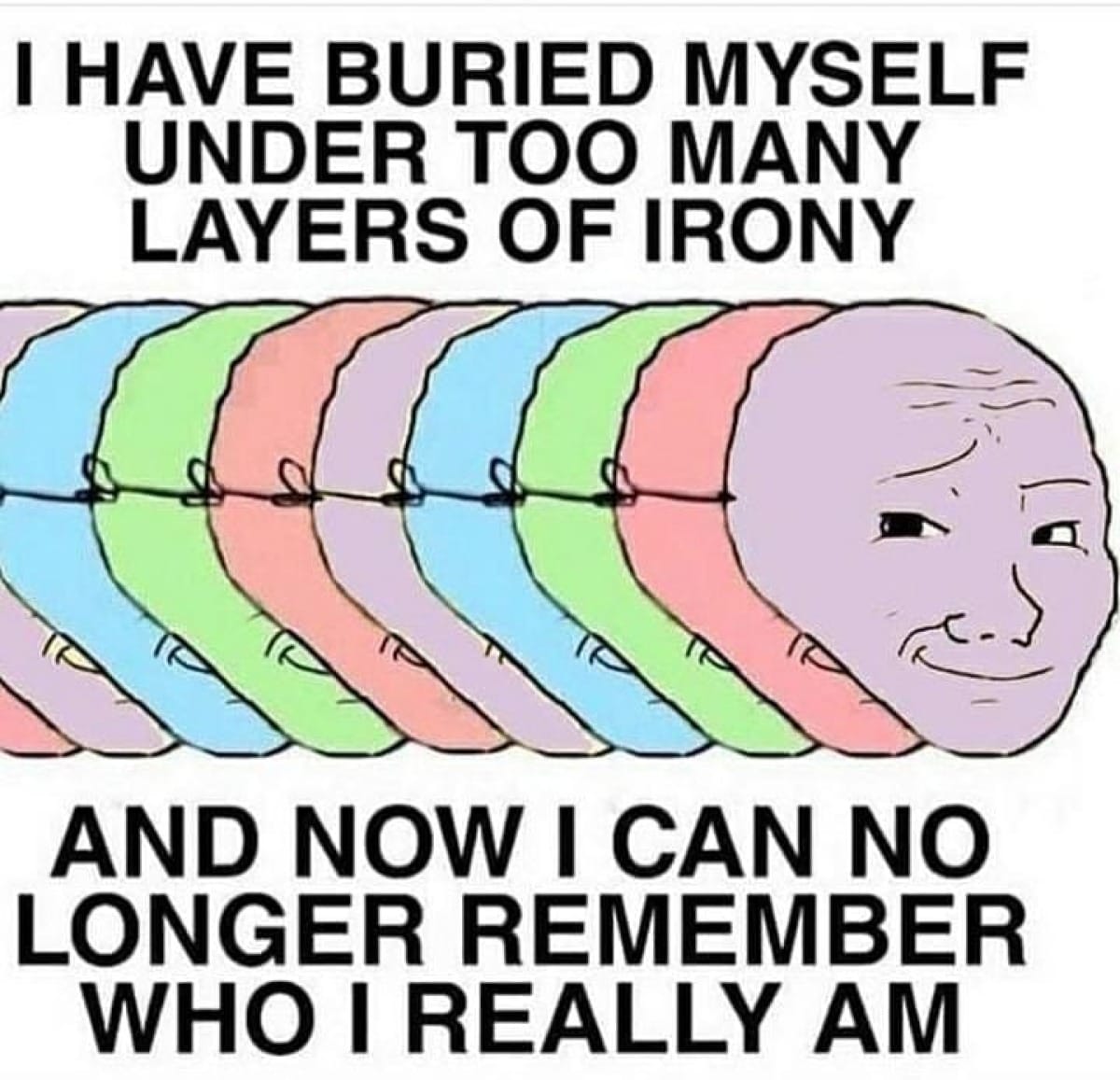
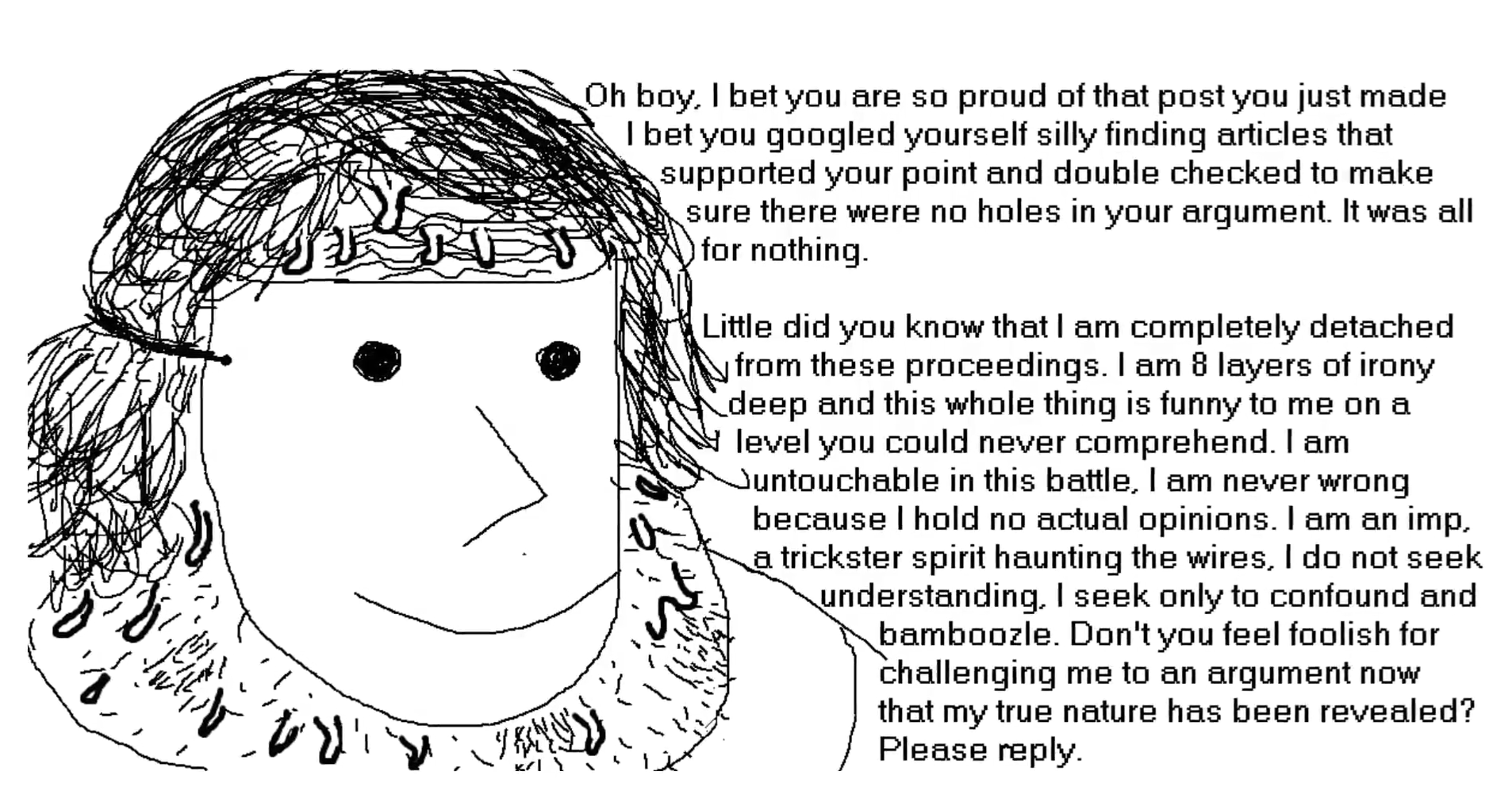
In Is Democracy in Danger?, Juan Ruocco (2023) clearly described one of the possible drifts of this ironic spiral, analyzing the historical-political trajectory from 4chan to the presidential election of Donald Trump. In an effort to differentiate themselves from the new users entering the forum, increasingly radical ironic strategies were developed to prevent cultural emblems from being appropriated by the “illiterate” in the community's language (aka normies) and to defend the underground identity of the forum. This ultimately reached a peak in the search for signifiers that would provoke the greatest possible rejection: “using nazi symbolism to get under a rival's skin in an internet discussion and win it, something that years earlier was a meta-ironic trolling strategy, became literal” (p. 190). In the relentless pursuit of destroying any possible meaning, irony and its evolutionary mutation, meta-irony, ended up confronting the cursed reverse from which they were precisely trying to escape: the appropriation of the code was ultimately instrumentalized to favor a particular political party, with the subsequent sinister return of a hidden meaning beneath the infinite layers of irony. What was for the lulz ended up becoming de facto.
As can be seen, the topic of irony on the internet is no small matter, given the effects it has on the production of subjectivity and its consequences in reality. Therefore, it is important to approach the topic with the dignity it deserves:
Irony deals with contradictions that, even dialectically, are not resolved in a higher totality, and that arise from the inherent tension of keeping incompatible things together, because both are necessary and true. Irony is about humor and serious play. It also consists of a rhetorical strategy and a political method.
In summary, irony is an inseparable element of the ideology and libidinal economy of the discursive practices underlying internet memes and their cultural derivatives. However, irony is inherently a highly unstable and volatile element, difficult to handle in inexperienced hands, which can leave the subject more disoriented than before and thrown into the radical dissolution of the symbolic references that stabilize meaning and communication. In this sense, Hegel's definition of irony as “infinite and absolute negativity” is worth noting, which turns the ironist into a sorcerer's apprentice who invokes dangerous forces they do not understand, in combinations that can yield catastrophic and unexpected results.
Precisely this destructive and corrosive component of irony is what Seong-Young Her attempts to formalize and systematize in his blog The Philosopher’s Meme, in order to locate the structural invariants and the operational logics of the dialectical movement of irony on the edge of its double oscillation: post-irony and meta-irony.
Meta-irony vs. post-irony
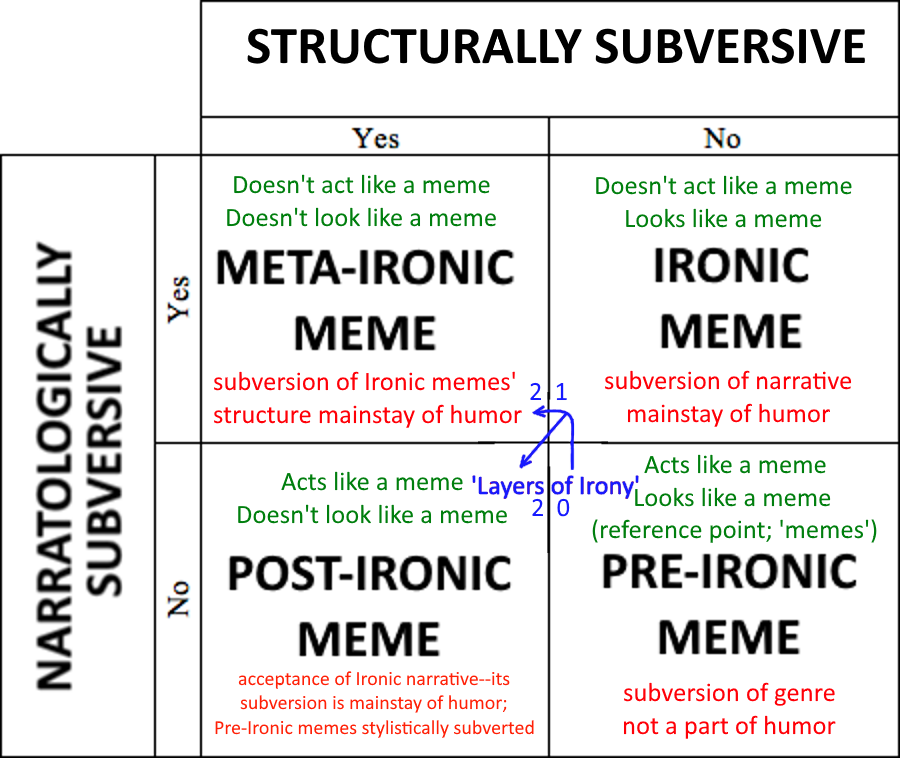
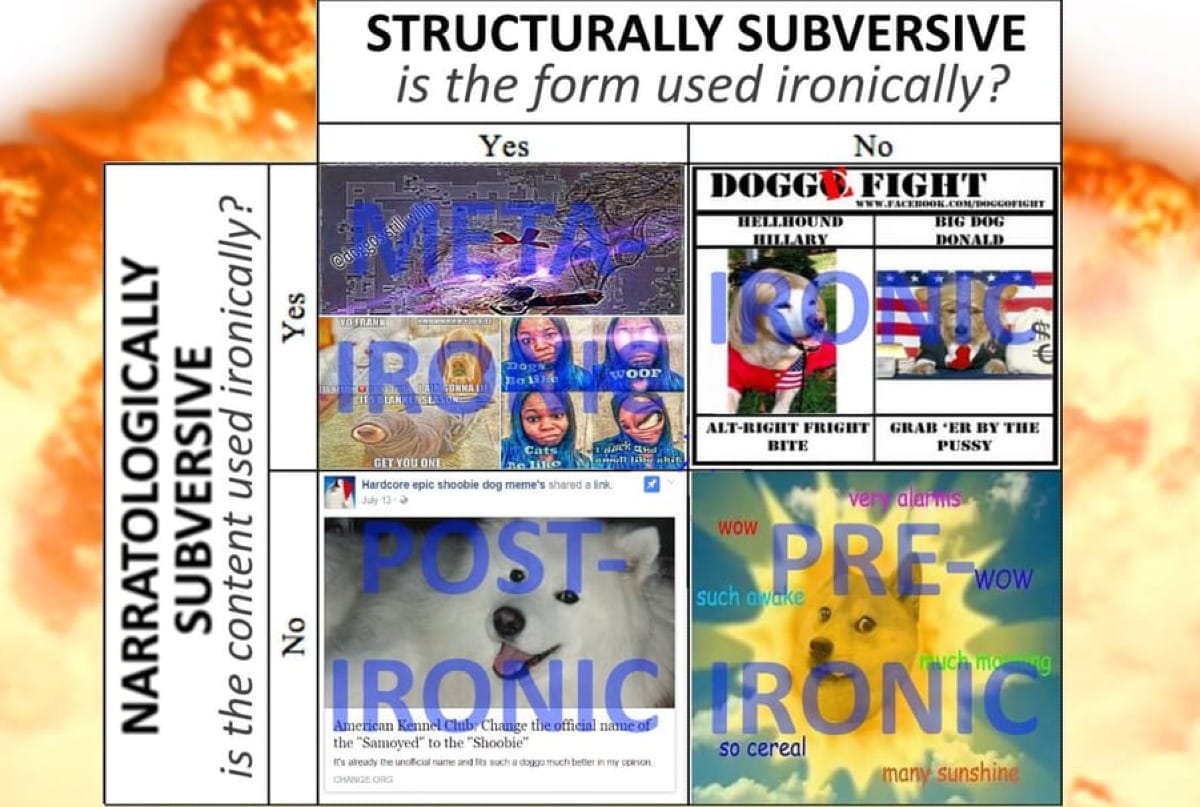
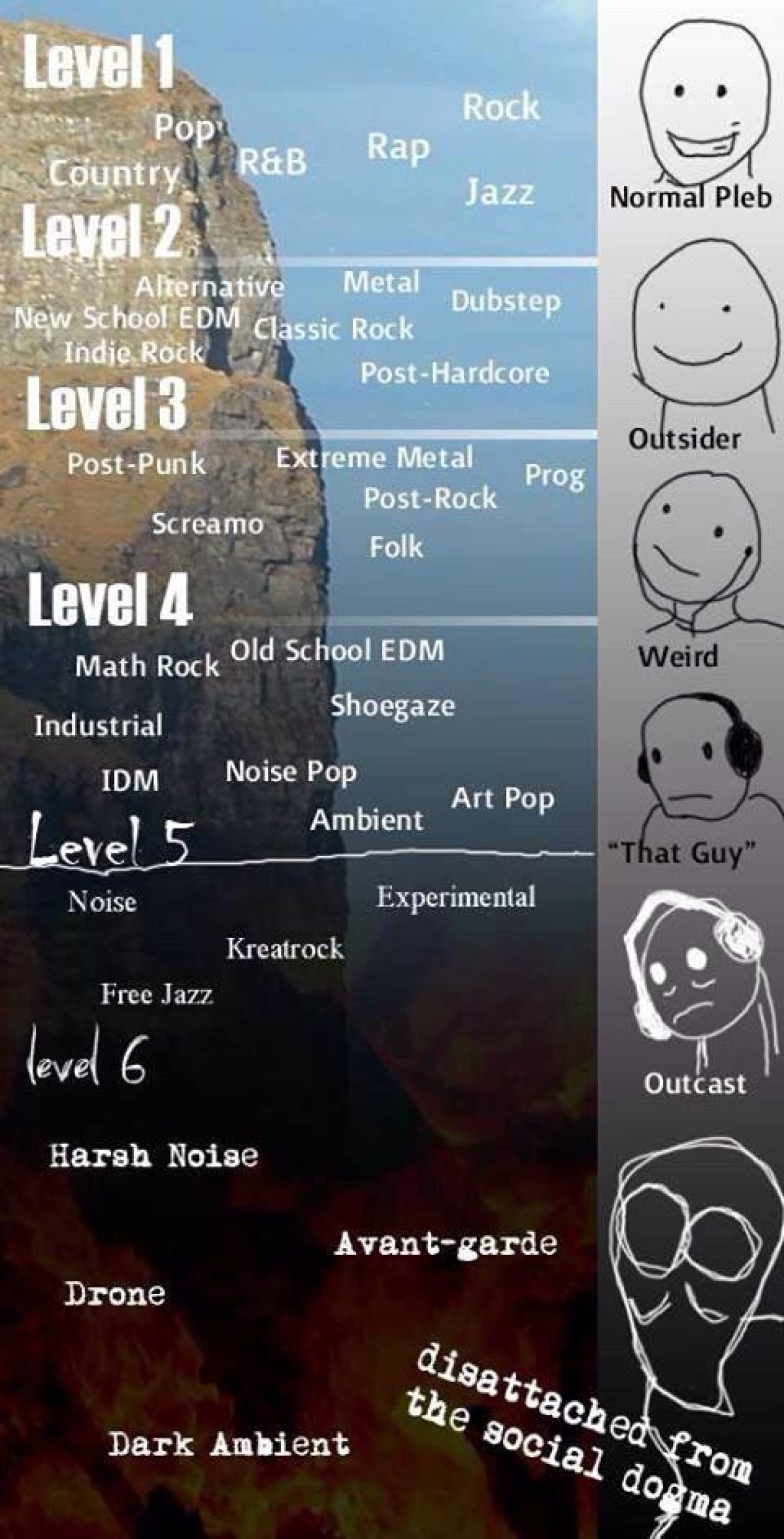
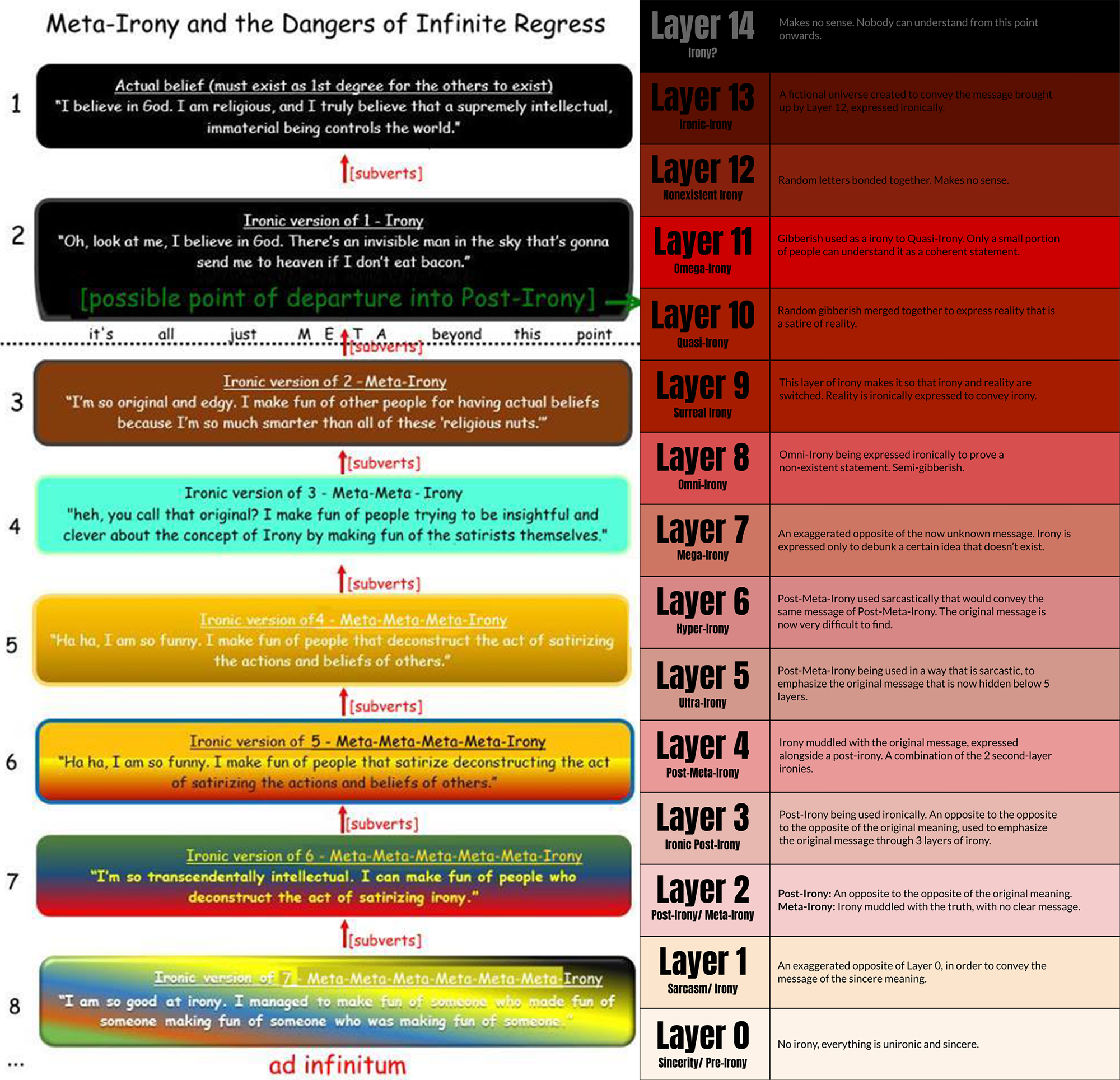
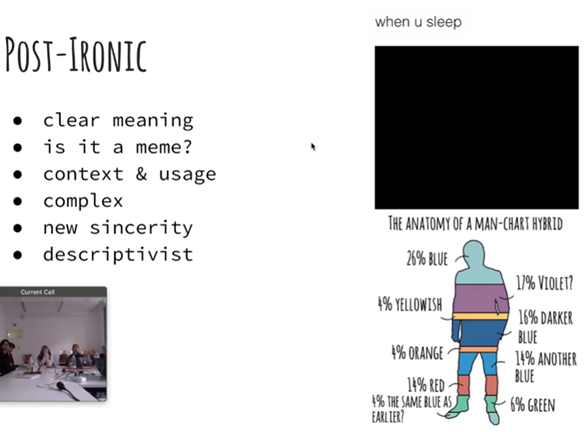
Seong-Young Her is an old-school forum user who studies internet memes from the history of art and has developed his own theory of irony in internet memes, which reaches its culmination in this image. According to this conceptualization, irony in internet memes can be classified into four categories, which we will briefly describe below.
Pre-irony
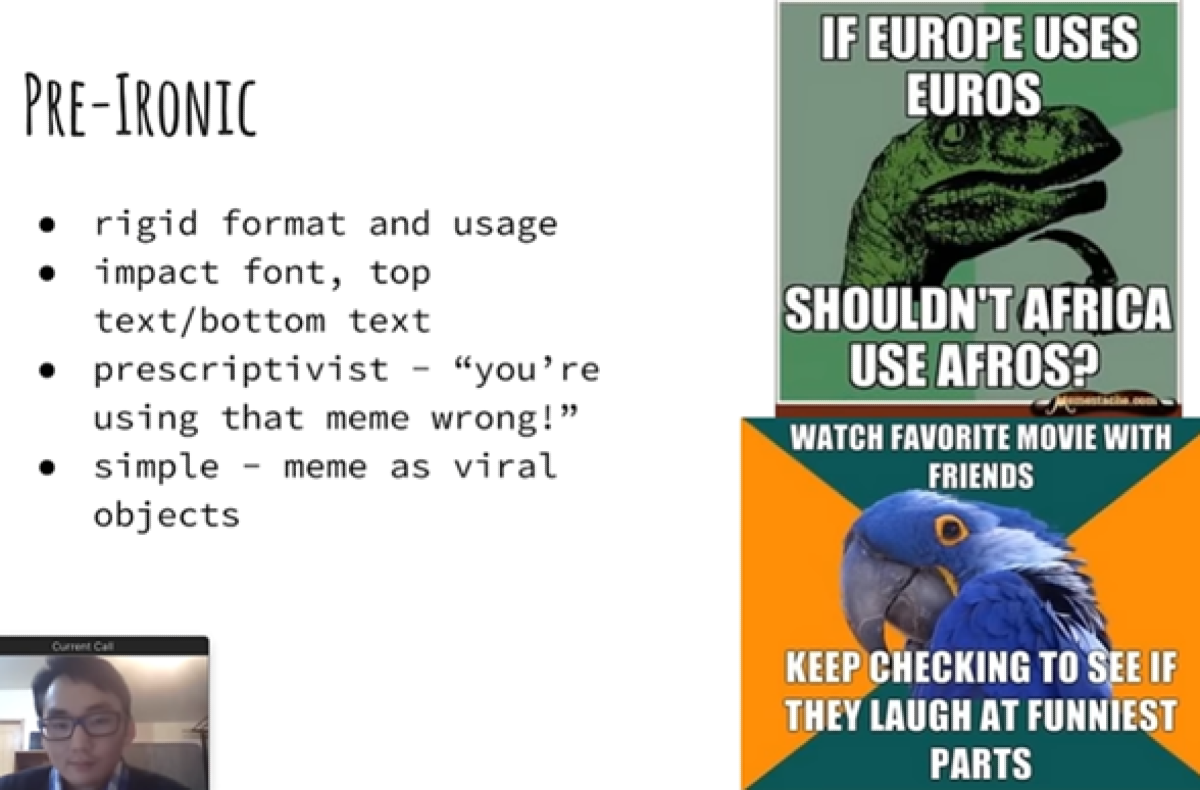
The first level constitutes the zero level of irony, as it implies its absence and refers to the traditional humor of early internet memes. Its resources are all those of humor in general: puns, hyperbole, satire, absurdity, double entendre, parody, etc. It also includes appeals to specific communities that reinforce identification and a sense of belonging, images used to express emotions, ideas, or reactions (example: WhatsApp stickers), and the old and not entirely extinct motivationals, which convey some superficial reflection or motivational message without resorting to humor. For a precise illustration of the examples that comprise this category, see the meme account of the psychology faculty kiosk, Carlos's kiosk.
Memes: A Microcosm of Art History (Part 3 - Pre-Irony). Seong-Young Her, 2016.
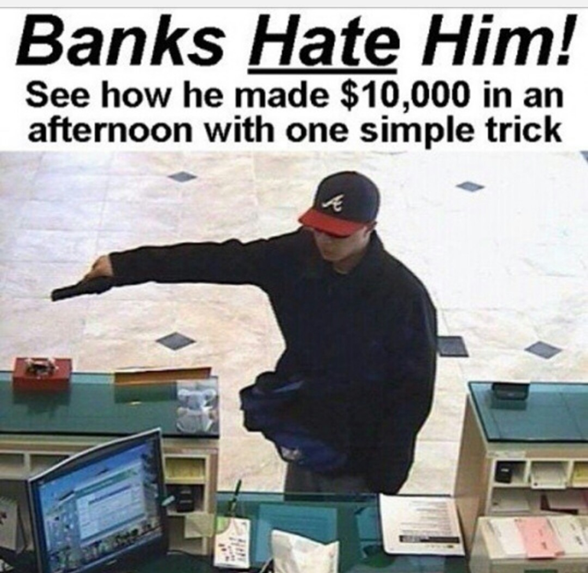
Irony
According to Her's research (2020), irony in memes began to emerge from 2013 onwards. Briefly, this consists of a semantic rise operated on the pre-ironic meme taken as the minimum unit of communication. This means it adds an interpretative level in the enunciation, taking the previous statement as the object of ironic mockery. It requires knowledge of the irony code: implying the opposite of what is said. It also requires recognizing the existence of two distinct levels in the communicative act: to use a somewhat dubious and loose Freudian terminology, the latent and the manifest.
Unknown source.
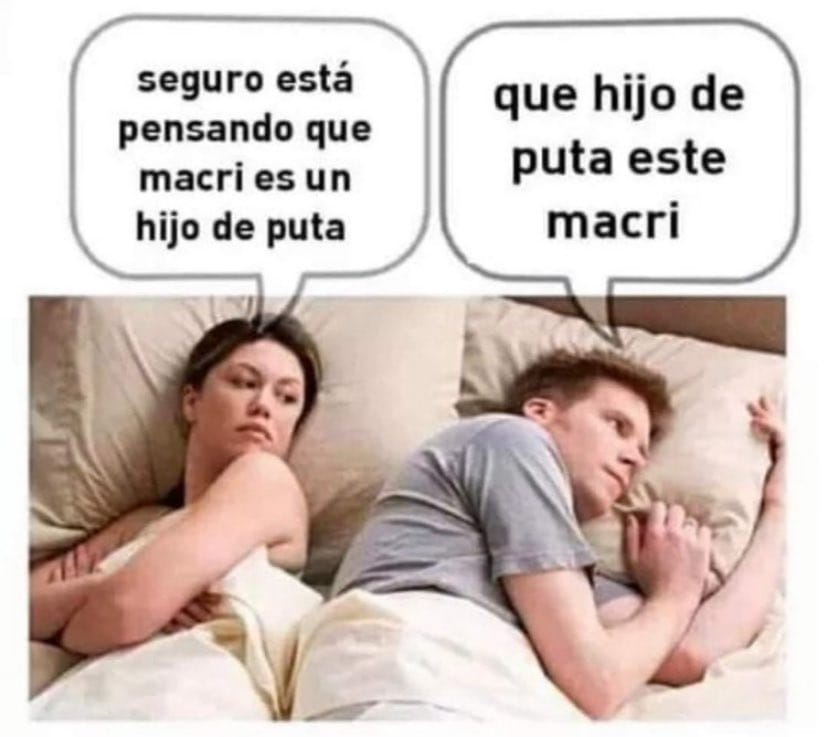
An example. During the pre-ironic era, it had become a common code of gatekeeping to accuse others of "using that meme incorrectly" to point out the ignorance of users who made "bad memes" according to socially established rules. But eventually, this code turned in on itself and began to be used ironically, namely, by consciously misusing meme templates to create an ironic sense or to annoy other users.
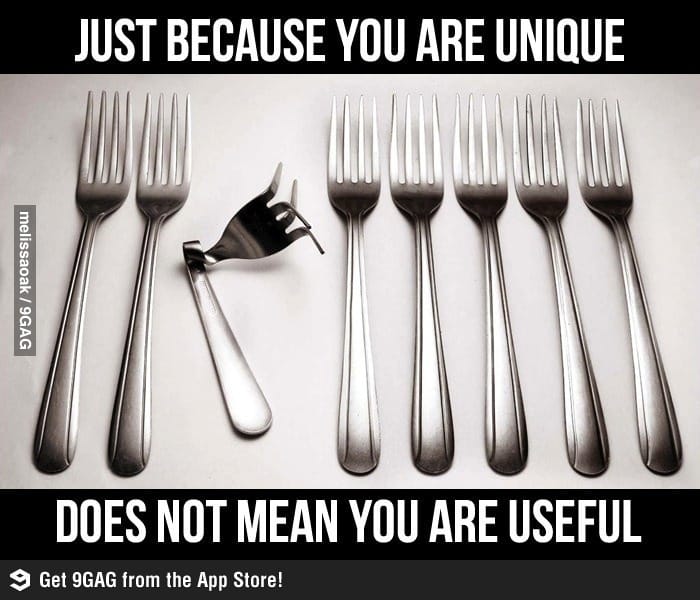
Another example. When motivationals became a normie thing and started to induce cringe, their obscene and ironic counterpart emerged: demotivationals, which mocked the naivety and innocence of their meme predecessors.
Fuente desconocida
Meta-irony
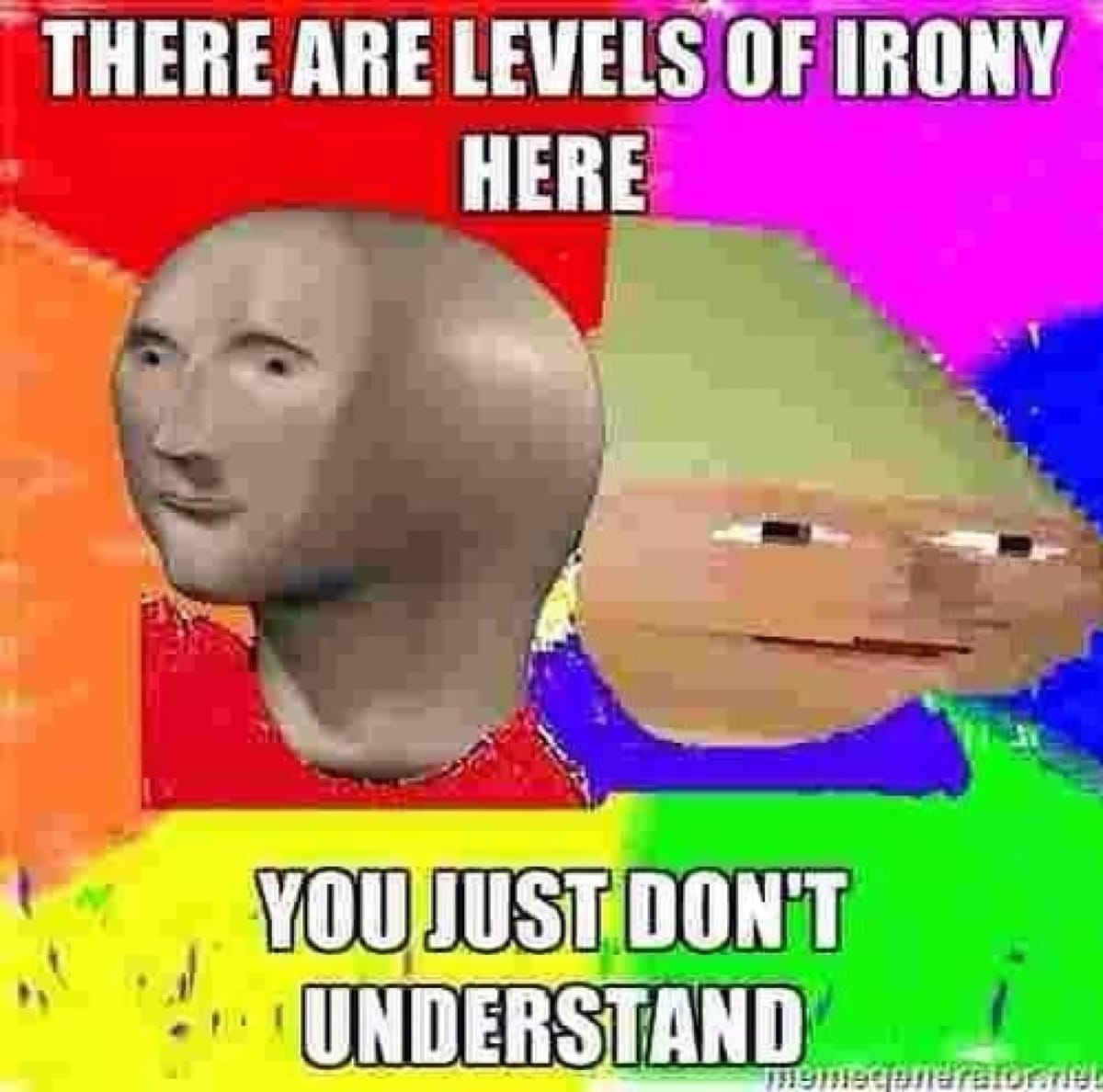
The prefix "meta," according to its Greek etymology, is used to indicate a "beyond" the subject being discussed. It implies the overlay of a level of abstraction over the original concept that is taken as the object of discussion, for example, in "metalanguage," "metaphysics," or even "metagame". In this sense, meta-irony takes irony as its object to subvert it, which introduces a serious complication, since if irony is the denial of literal, authentic, or sincere communication, the irony of irony as a denial of denial should lead us back to the level of literalness, shouldn't it? Well, no.
According to how Her understands meta-irony in the discourse of internet memes, it does not entail a return to level zero as a denial of denial, but rather implies a step forward towards challenging the field of meaning as such. Ultimately, it aims at the total destruction of meaning and communication, wielding the weapons of irony in all their power.
Source unknown.
As we pointed out with the example of 4chan and Donald Trump, the anthropological motivation driving ironic spiraling is the need for differentiationvis a vis against a previous group, in this case, the ironists who had made irony a common part of internet language.
Source unknown.
Meta-irony is identified with the quintessential postmodern gesture: it targets the empty core of all ideological formations of modernity (cultural, political, religious, etc.) and reveals their contingent and, ultimately, arbitrary nature. Just as the Dadaist and Surrealist movements did in their time (Wiggins, 2024), in meta-irony, meaning as such is called into question by exposing the inherent inconsistencies of every sociocultural formation that, based on language practices and performative acts, ultimately reveal themselves as nothing more than a complex game of smoke and mirrors, with no real substrate beneath.
Source unknown.
Meta-irony states along with Wittgenstein that, ultimately, everything is language games. Secondly, it adds a radical analytical function, in the sense that it operates a decomposition of every unit in favor of a multiplicity of exploded and incongruous shards that cannot be rearticulated into a new whole, leaving the user thrown into a nihilistic void with no foothold to make sense of the experience.
Some of the techniques that can be found associated with the meta-ironic movement include:
Meta-memes: memes that reference other memes, or memes within memes. Direct references to the code of the very meme community to which the meme is directed.
Shitposting: mass and chaotic posting of low-quality or incoherent content (spam, meta-offtopic).
Complexity and demonstration of technical virtuosity: deepfried, distortion, saturation, lossy compression (JPG). And its counterpart, voluntary ugliness or simulation of technical ignorance: for example, "Graphic Design Is My Passion".
Pre-ironic memes like found footage: ironic reinterpretation of a traditional meme without editing.
Breaking the fourth wall: direct address to the meme's audience.
The problem that arises with the meta-ironic movement is that the multiplication of levels of irony inevitably leads to a point of incomprehensibility and nonsense (which is itself a message). Consequently, exasperated by this abstract babble, post-irony counterattacks in a dialectical and evolutionary manner: within the desert of simulacra and hyperreality, it seeks to locate some meaning within the irony of memes that, although partial, allows for a relaunch of the cultural communication process and the reconstruction of common ideals. But not by returning to pre-irony or classical irony, but by traversing and sublimating the conclusions of meta-irony. That is, overcoming and simultaneously preserving its internal contradictions in a productive way that generates a transformation of the ethos of ironic memes.
In a gesture of synthesis (as opposed to the analysis of meta-irony), post-irony seeks to rescue the category of truth buried under the infinite layers of nihilistic cynicism. But it will no longer be about the absolute truths of literalness or authenticity, but rather a truth that is “half-said,” or with a “fictional structure,” paraphrasing Lacan.
Memes: A Microcosm of Art History (Part 5 - Meta & Post-Irony). Seong-Young Her, 2016.
"The wound can only be healed by the spear that inflicted it"
The anecdote goes that Carl Jung treated James Joyce's daughter, Lucia Jung, who suffered from a psychotic episode similar to her father's, but with much greater psychic vulnerability as she couldn't “sublimate” her madness through literary production like James did. They say (though it's unlikely) that upon reading Lucia's literary works, Jung told Joyce: “where you swim, she drowns.”
In the current historical context, marked by the proliferation of psyops from memetic warfare coming at us from all directions, our task is to refine the categories with which we think and inhabit the codes of the internet, if we want to avoid drowning and be able to swim through the murky depths of irony and its mental sludge.
Our task is to refine the categories with which we think and inhabit the codes of the internet, if we want to avoid drowning and be able to swim through the swampy depths.
But also, the sharp edge of irony can be a fundamental tool in emancipatory struggles and the disputes over meaning that unfold in digital communities, functioning as a weapon with the power to dissolve crystallized significations that reproduce oppressive power regimes and cognitive slavery. Finding the balance point in the volatile dialectic of irony is no easy task, but it can become a matter of vital importance for navigating the online experience of the memesphere without falling into the bottomless pit of digital nihilism.
Paraphrasing Lacan: better for those who cannot align their horizon with the ironic spiral to which their era drags them to renounce in the ongoing work of Babel!
memes de culto ~
ironia paraontologica y escatologicismo trascendental ~
si ud ha comprendido seguramente este equivocadx ~
adoctrinando normis via offtopic ~