How the Algorithm Feeds Chronic Dissatisfaction
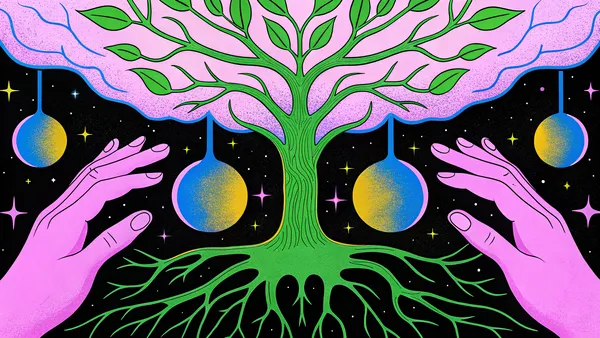
The algorithm never shows us what we already have, only what we're still missing. How to get off the chronic dissatisfaction ride.

I remember how during the pandemic everybody was buying stuff online for the house. It seemed like we were going to need a ton of things for the lockdown. Though there was also buying things as an excuse to go out and do something, like my friend who spent the whole pandemic buying stuff on Marketplace that she'd drive out to pick up, and that was the fun part. Buying things so you could go pick them up. The satisfaction wasn't so much in the consumption itself as in the activity she built around it, when going to get what she'd bought became something to do. Could it be that sometimes we consume not for the object but for the temporal structure the purchase creates? I'm thinking now about Shein and how long things take to arrive, that waiting period. What if consumption can also work as a little adventure, a plan, something to look forward to; a way of giving shape to our days?
Lately I've gotten obsessed with workout sets. I sink into the scroll of the infinite catalog of leggings in all their different colors, cuts and textures that the Instagram algorithm serves up for me every day. Because yes, I'd love to say I only consume content about philosophy and literature, but no, I look at leggings. I let Instagram show me everything it wants to sell me, because if I'm going to take a hit of dopamine I want it to be the good stuff. Sometimes I even go to the actual store to try on leggings just to confirm that they're gorgeous but don't fit me the way I want them to. Clearly the research gives me more pleasure than buying them, though I still don't think I'm winning the battle, because the amount of time I waste scrolling, trying on leggings and playing the little resist-the-urge-to-buy game is a lot. Does the legging obsession give me something to do?
For these occasions, waiting for us just around the corner, there's the self-love discourse that gets along so well with marketing: “Girl, treat yourself, you deserve it, that's why you work your ass off.” Self-love and the moral approval of hard work, combined into a sales pitch. It's not consumption, it's justice: it's only fair that you buy it, like something restorative. These are slogans that can help ease the guilt of a purchase or push you to make it; I've turned to that discourse more than once myself to convince myself an expense was justified. A purchase can work as a release, or as compensation for a bad day, an insecurity, a bout of anxiety. Then it remains to be seen what happens when the effect wears off and the object becomes part of all the other stuff we already had.
The algorithm never shows you your closet, what you already have; it shows you what you're still missing.
Rationally, I can admit that I don't need more leggings. My closet is full; I have so many clothes I barely get to wear them, more clothes than occasions to wear them. And yet at times I feel like I'm missing one: in another color, with another cut, one that's more on trend, one to replace the last one, one that this time will actually fit the way I want. The algorithm never shows you your closet, what you already have; it shows you what you're still missing. How is it that I feel the leggings I have are enough and yet I want others? Is there a number to reach, or was the problem never quantitative? I stop looking at leggings and start watching desire: how it's built while I scroll, how it's manufactured through repetition.
The production of insufficiency
In this search, if I stop focusing on the object and start studying the mechanism, I can see there's a material, technical and cultural infrastructure that explains the feeling that nothing is ever enough. First of all, I think we see too many things all the time, or at least it seems like we're seeing more things than before. Constant exposure to the stream of images on social media, that torrent of lives and events happening in places where we aren't and of objects we don't own, feeds that experience of insufficiency.
I'd rather think of this as a condition of our times than as a problem to fix, to avoid falling into the trap of individual blame, where we're all addicts who can't stop scrolling. The truth is the scroll isn't designed for us to find something; following the logic of the casino slot machine, it's designed to make us believe the next thing might be better. This leads to something that's been diagnosed as opportunity fatigue: when there's a lot to choose from but we always believe the best will be whatever shows up next. Which is what happens to me with leggings. The feeling that the perfect find is possible, but always just a little further ahead. Faced with this, I stop to ask myself whether limitations might work as a kind of containment barrier, or a soothing balm. Could it be that limitations give us freedom? That maybe living in a small town, for example, where there isn't much to do, could free us from the FOMO of not being at three things at once?
Algorithms are very good at understanding our desire and even intensifying or steering it; there's a lot of engineering behind that. For the attention economy, our sensibility is the resource to exploit. Accumulation is that paradigm that never rests and thrives on a sense of permanent incompleteness. That's why satisfaction is inconvenient for the logic of accumulation, because it depends on the cycle never stopping. The capitalist valorization that governs our relationships and exchanges today needs exhausted bodies and overstimulated minds, because discontent is profitable, and because we can keep consuming even when, or especially when, we're exhausted.
Finally, I suspect that “wanting to conquer more” is closely tied to the way we conceive of time. A linear, cumulative time that goes “bulldozing” forward like an arrow, conquering, getting things, and where there's always a "later" that's better than the present.
Aspirational desire
The path of insufficiency runs from the most visible to the deepest: it starts out operating on objects and possession, you never have enough, then shifts toward identities, you're never enough, until it ends up seeping into our attachments. I hear it all the time when we voice wishes like: "I'd love to do yoga," "read more," "save money."
I wonder whether in those cases the desire really points to the activity or to the image of oneself that the activity promises. Would I love to do it, or would I love to be someone who does it? A desire can be completely "borrowed" and still sustain a fantasy that organizes a stretch of life; what's interesting isn't so much its authenticity as the work it does. We never hear "I'd love to learn magic tricks," or "I'd love to watch The Simpsons four hours a day." We don't hear them because they aren't desires that are necessarily socially valued, or that come with a positive payoff, the way working out, saving or learning a language might. Maybe these aspirational desires work so well because they're prefab responses to the world's stimuli or demands. Faced with discomfort or an impulse, the world already has a catalog of available answers, and it's easier to pick from that catalog than to invent something new. There are choreographies, scripts. It's easier to stay in the race than to drop out. Or even easier to keep doing than to stop.
It's also easy to feel we're not enough: not attractive enough, clever enough, successful enough, or that our life isn't interesting enough to be shown or told. For women, this logic operates with particular intensity, and the glow up trend shows it clearly. The glow up promises that if you do a ton of things within a certain stretch of time, you'll get to enjoy a transformation and become unrecognizable. But the reality is nobody would sell a diet if it had a beginning and an end, if it started and finished. Diets and makeovers wouldn't be a business if you did the diet and that was it; they're a business because there's always something missing, always another product to add to your skincare routine, another new glute exercise or another pair of leggings to work out in.
Who's afraid of settling?
Thinking about enough runs into the problem of settling way too fast. Improving and not settling is a human quality; self-improvement is something human beings have pursued in different ways throughout history. But there's a demonization of the idea of settling, a prejudice about comfort, about not giving it your all. In fact there's value placed on always being busy, going full throttle, balls to the wall; even being tired works as a sign you're doing well (God, what a shitty world). It's worth asking here: who benefits from me needing to keep fulfilling myself, training, obtaining, achieving, ad aeternum? Always chasing after something, besides disconnecting us from the present, makes saying "this is far enough" seem suspicious, as if it were a kind of resignation, mediocrity or lack of ambition, with the risk of falling behind. For the moral system of capitalist accumulation, stopping always seems to require a justification.
There's a demonization of the idea of settling, a prejudice about comfort, about not giving it your all.
All of this runs the risk of sounding like an invitation to lower expectations, to settle for less, or like a minimalist manifesto, which would be hypocritical when for a lot of people scarcity is a real material problem. What I'm trying to think through has less to do with having a lot or a little than with the experience of feeling that it's enough, that at some point and in some way we can stop. Even people with resources to spare can have enormous trouble experiencing sufficiency. Nor is this meant to be a lecture about how much one should consume or desire. Those measures, of appetite and satisfaction, are very singular, personal and even circumstantial parameters. What interests me is analyzing an internalized, naturalized way of being. Mechanisms work best when they stay invisible, and maybe observing them isn't enough to dismantle them, but it is enough to stop mistaking them for the natural order of things. Thinking about sufficiency would be, in that sense, a way of unsubscribing, even if only for a moment, from the demand that something always be missing, from the rush or the feeling of running late.
The moving threshold of attachment
The difficulty isn't that sufficiency doesn't exist, but that the point at which we might experience it seems to keep shifting, like a horizon that recedes as we move forward. Consumption needs satisfaction to be fleeting, because a satisfied consumer stops consuming. For that, offering new objects isn't enough: the threshold of enough has to keep moving.
This, per se, wouldn't be a bad thing; it can be a driving force. The problem shows up when that movement starts to rest on a kind of attachment that no longer works in our own favor. Lauren Berlant called it cruel optimism : that relationship in which the very thing we desire ends up getting in the way of our flourishing. The optimistic part would be that enthusiastic, motivating or even euphoric thing of chasing the promise. It's like when we have a crush on someone, and suddenly everything we do makes more sense, or feels more fun or less of a drag. The cruel part isn't the desire itself, but the kind of bond we form with an object, a scene or a fantasy of the good life that keeps organizing our existence even when it no longer brings us closer to what it promised and starts to harm us.
Lack carries forward momentum: there's a direction, a purpose, the purpose of chasing the carrot. There's a marked path, a clear search, the one where we go out and get what we want. Lack produces orientation, a project, even hope. That explains why it's so hard to let go of these kinds of logics that organize time, that organize lives. There's a calm, a comfort in knowing what we're chasing. Because when something is missing, the direction is a given: we head toward the next purchase, the next goal, the next upgrade. But if we suddenly said, "Okay, I'm good with this," a much harder question would show up: "So now what?" And I think that question can be far more unsettling than lack, because it forces us to stop, to observe, to breathe, to inhabit the present. That moment when there's no choice but to invent a way of living once, at least for a while, we stop running after something.
It's not hunger, it's thirst
The software industry popularized the idea of the beta version, introducing the logic of the permanent update. In a beta, something already works well enough to be used, but it isn't fully finished; it still has a way to go before becoming the final version. It can be improved, it's expected to improve. I wonder if this model didn't end up seeping into our lives: How much longer do I have to keep preparing before I start living? Shakespeare is credited with the line "This is not a dress rehearsal, gentlemen, this is life". I have no idea if he actually said it, but just in case I always quote it. Maybe sufficiency is the chance to stop living on delay, or to step off the treadmill of perpetually preparing for a life.
The logic of the permanent update echoes an intuition Grafton Tanner develops in Foreverism when he analyzes our contemporary difficulty in producing endings. According to Tanner, we live in a culture that dodges endings, precisely the thing that lets us recognize that something is over, that something has been completed. There's a certain satisfaction or relief tied to endings, even something that can be painful or sad, a kind of farewell, and when nothing ever ends, those feelings lose the chance to surface; those emotions are left in suspension. Limits and endings grant us the right to a break, to silence, even to forgetting.
When we look at how insufficiency plays out, we find that dissatisfaction stops being a private feeling and starts turning into a political category. Satisfaction is tied to limits, to endings, and without endings there are no breaks, no stages, no celebrations. A celebration is a milestone, and one of its many functions is to pin down a moment, an event, a way of saying "this deserves to be marked and inhabited before we move on to something else." By celebrating, we acknowledge that something was enough. Maybe that's why celebration can suspend, even if only briefly, the logic of permanent value-extraction. Endings make ritual possible: we celebrate a harvest, a graduation, the end of the year. In a culture that sustains and foreverizes, where everything stays indefinitely open, updatable, improvable, the gesture of celebration ratifies that "done," acknowledging that, for now, something is enough.
There's a phrase from the fitness world, a very suspect one, that I'm obsessed with: "It's not hunger, it's thirst." It has a whiff of cheap oversimplification, even of dangerous advice: the idea that hunger can be solved or shut down with a glass of water. I don't know if it holds up physiologically, but it illustrates the possibility that a perception is being misread. I wonder if we often mistake one lack for another. The scarcity of time, the most ubiquitous scarcity of all, also structures insufficiency. Time is what lets us enjoy the things we have, or grow into the things we trained for, or enjoy the things we achieve. Not necessarily free time, but time to inhabit, to just be. Time to enjoy, even time to consume. Accumulation is the easy path, the learned one, the one we know, but giving ourselves time to inhabit things and objects is the hardest part. Stop adding, halt the growth, make room for the things we've already chosen. And choosing some things means not choosing others. For a new piece of furniture to fit in the room, you'll probably have to move, rearrange or even get rid of what's already there. I'm saying it to you, and I'm saying it to myself.
Sufficiency isn't about no longer wanting, but about recovering the ability to call something finished and have that be enough.
Distance is thought of as a tool for objectivity. Having distance from an event, from a person, helps us understand it, see it with more perspective. Whether temporal or spatial, distance gives us a kind of power, a sort of wisdom. In a painting, for an object or a shape to stand out from the background, you need contrast. Without contrast, everything looks the same. Talking about sufficiency would also mean talking about the necessary emptiness around things, the room to breathe. Breathing, satiety and celebration would then be forms of sufficiency with a counterpart in the body. There are experiences that only exist, or can only truly be enjoyed, because something ends: sleeping, feeling, being satisfied. There are specific practices that provide endings, that restore the experience of the limit, where you can say "done for today, that's enough" and enjoy having finished. It's not forever, it's not perfect, it's not absolute. Sufficiency isn't about no longer wanting, but about recovering the ability to call something finished and have that be enough. Stop adding as a way to start inhabiting. Because living means leaving some lives unlived. Maybe it's not hunger, it's thirst. You're not short on clothes; you're short on time to wear the clothes you already have, on closet space to see them, choose them, put them together.
Las notas de 421 no tienen paywall
Y a cada colaborador se le paga por su trabajo. Las dos cosas dependen de los suscriptores.