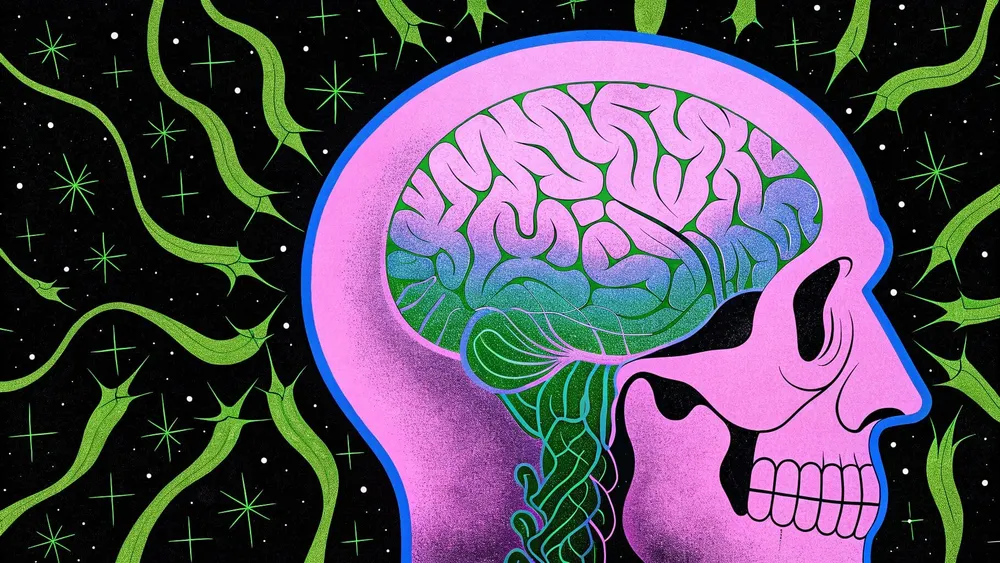
Out of 11 million bits of information, your brain processes only 50. So who decides what you think? The algorithm hacks your biochemistry to control you. That’s why true cognitive sovereignty begins with understanding how your own mind works.
To construct reality, my brain receives 11 million bits of information per second, but it can only process about 50. Who or what decides which 50 those are? Me? An algorithm? My desire, my need, or is it just an automatic response to a stimulus designed to exploit my reward system?
I ask myself these questions every time I remember. It helps me feel a sense of control over my life, a feeling that I’m not living chained in Plato's cave, that I’m not being run over by technofeudalism.
I enjoy that feeling of autonomy, or agency, that I feel I’m losing with cognitive capitalism. Perhaps because it has become customary for us to delegate our personal care, our own self-knowledge, self-deciphering, and cognition in general, to technological and algorithmic devices. Or because our brains are malfunctioning due to being intoxicated. Whether one or the other, they are two sides of the same coin. Both are part of the battle for our minds (as Byung-Chul Han discusses), but above all, for our biology. Because, to exert power over the “psyche,” one must first go through the body and the brain.
To construct reality, my brain receives 11 million bits of information per second, but it can only process about 50. Who or what decides which 50 those are? Me? An algorithm?
In this new phase of capitalism, power has found its ultimate expression by targeting the brain and neuroendocrine processes that directly affect human autonomy. In other words, it didn’t become “immaterial.” In fact, it uses the most material and basic mechanisms that exist to shape subjectivity: our biochemistry. Thus, cognitive autonomy becomes biologically more costly.
I think of autonomy as layered: it cannot be exercised from an intoxicated or dysregulated brain. That’s why biological sovereignty (the ability to care for the material substrates of cognition) is the foundation of any real autonomy. And for that, perceptual agency is the concrete practice of that care: training interoception, attention, and the ability to distinguish between a genuine sensation and an induced one.
For neurosciences, agency means being the author of my own actions and responsible for the consequences. But agency also has a strong biological basis. Human autonomy at this moment is a weapon against a cognitive capitalism that seeks to colonize the nervous system, manipulating our behavior (today's neuromarketing is the emotional market of Bernays from the last century). This goes unnoticed not only because of the sophisticated and discreet algorithmic mechanism but also due to a lack of knowledge about our biology. A biology that is formatted to change, that is flexible and allows us to adapt and co-evolve.
That flexibility makes us connect (consciously or not) with algorithms, apps, AI, and the world in general, incorporating the environment into our own bodies. The organism-world interactions result in evolution.
We know that evolution fundamentally means change in time. It’s not necessarily good in itself. By hybridizing with each new technology of today, the outcome of the change (cognitive, motor, physical, molecular, epigenetic) can be ambiguous, as much an improvement as a failure, depending on the situation. In the words of Jere:
Hermes gives you a prosthesis that expands your technical ability, and in exchange (even without you noticing) you give away the part of you that naturally knew how to occupy that role. Little by little, you offload onto the material, like Theseus's body, where in the end, at the omega point, the terrible singularity awaits you with drooling teeth peeking out from its jaws.
In other words, it can be an “optimization” but also come at a cost. That’s why I think it’s necessary to slow down a bit and choose what to keep and what not to, what to connect with and what not to, what to expose ourselves to and what to protect ourselves from. Because if we start from the premise that we are always transforming into that loop of perception-action (in terms of Pörksen and Maturana) and thus we become who we are, it’s better to choose what we perceive from the world and how we do it.
Building autonomy
If we think about building a house, no matter how complex its architecture, the foundation requires a good structure and quality materials. If those foundations fail, everything that comes after will too. In the same way, any cognitive process depends on a biological foundation. That’s why perceptual agency is the first link in sovereignty. And biological sovereignty (the ability to care for the material substrates of cognition) is the floor of any real autonomy.
Because neuropower not only fights for your attention with algorithms, but it also causes neuroinflammation, dysregulation of neurotransmitters and circadian rhythms, and many other negative things. It attacks the biological conditions that make attention possible.
In other words, the battle for our minds is being fought, to a large extent, in the silence of our cells. That’s why biology can help us see the hidden side, to reinforce our cognitive autonomy.
First, the biology of reality
Evolution didn't make us wise, but it did make us frugal. We need a huge brain to survive in this world, and that comes at a cost. The brain consumes 20% of the body's energy budget while being only 2% of its mass. Yes, it's the most metabolically expensive organ, but it has many mechanisms to optimize energy. For example, it anticipates events, predicts using mental models based on past experiences, and takes more efficient shortcuts. Or it filters out “irrelevant” information for survival, using only those 50 bits I mentioned at the beginning, thus assembling a coherent “image of reality” to face the world.
Neuro-power not only competes for your attention with algorithms, but it also causes neuroinflammation, dysregulation of neurotransmitters and circadian rhythms, and many other negative effects. It attacks the biological conditions that make attention possible.
Receiving signals from the environment and processing ALL of them as information would be costly, slow, and, above all, unnecessary. That's why the brain: 1. Filters almost everything and decides what deserves your attention and what can be ignored; 2. Invents narratives that organize reality. And also: confirms what it already believes, repeats what works, uses shortcuts (biases) built from previous experiences, ideas, words, biography, loves, fears, desires, habits, social influences. Well, your culture.
But let's dive deeper. The process goes more or less like this: first, the brain constructs a hypothesis about what is going to happen (brain predictive mechanism), contrasts it with sensory signals (internal and external, the filter to prevent it from being a hallucination), and there, depending on the margin of error (the distance between prediction and present sensory signals), it adjusts the predictive model (learns) or maintains it (that is, modifies the shortcut or keeps using it). With all that, our image of the world is built.
The more multisensory information the brain receives (what you see, hear, touch, feel), the more complex that reconstruction is. The dynamics of the perceptual process sometimes also bring us closer to hallucination. Because we are all vulnerable to variations in our emotions, perceptions, cognitions, even if we don't have any mental health disorders (for example, schizophrenia), even if we are very “intelligent,” “healthy,” “attentive,” “critical.” Because what distinguishes reality from illusion is not a mechanism, but its functionality: an experience is “real” when the brain's predictions sufficiently correspond with the environment to guide a “successful action” (or, as some biologists would say, adaptive). For example, if I see a chair and sit down without falling, my perception of the chair is “real” in the only sense that matters for survival: it is coherent with the world, successful. But if I see a chair that isn't there, try to sit down, and fall (as Maturana would say, coupling fails), that perception was a hallucination.
In other words, the world we experience is a reconstruction, a selection, an interpretation, and a tendency to feel. So, the question is whether we will control it or be controlled, whether we will be builders or built, whether we will guide our action, perception, and evolution or just be swept away by the tide.
Biological sovereignty
Each of our cells is sensitive to chemical, mechanical, electrical, and electromagnetic signals that modulate its genetic expression (thanks to epigenetic mechanisms that turn some genes on and silence others), changing, in turn, its functioning, shape, and communication.
This sensitivity gives us the ability to respond quickly to the environment, to perceive and act flexibly. This increases the “repertoire” of what we can do. An example of this is the much-discussed neuroplasticity, the nervous system's ability to change its form and function, to create synapses (new connections between neurons) where needed. And this is where we see that habits are transformative: the synapses that are used a lot (through habits, practices, and training) strengthen (myelination), while those that are not used weaken and are “pruned.” This happens with the entire metabolism. The environment changes our electrical and biochemical connectivity.
That same flexibility, which can be very useful at times, can turn against us in a “biologically unfavorable” environment. For example, infinite scrolling trains the brain for an excessively weak prediction, generating attentional fatigue and sensory overload, because it maximizes surprise, novelty, and information saturation. On the other hand, hyper-personalized algorithms reinforce beliefs and eliminate challenges to predictions, resulting in an excessively strong prediction. The nervous system becomes dysregulated, leaving no room for cognitive flexibility or neuroplasticity. We become rigid, polarized, unable to update our beliefs in the face of contradicting evidence.
Infinite scrolling trains the brain for an excessively weak prediction, generating attentional fatigue and sensory overload, because it maximizes surprise, novelty, and information saturation.
Neuroplasticity also suffers from neuroinflammation, toxicity, and hormonal disruption caused by exposure to a physical environment filled with chemicals (present in air, soil, water, food, clothing, etc.) that no human body can process: phthalates, parabens, bisphenols, PFAS, microplastics, heavy metals, food additives. In addition to chronic toxic chemical exposure that directly affects brain function, and algorithms that impoverish cognitive quality, there is also the digitalization of social relationships. The latter reduces opportunities for embodied coupling, increasing loneliness and dysregulating neuroendocrine systems that depend on social contact. We lose the sense, the motivation to act, and this loss further impoverishes the brain's ability to update its predictions through direct experience (active inference).
It's a loop.
The decoupling loop of modernity
Poor nutrition and lack of sleep affect the entire nervous system. Someone poisoned by a hostile environment feels unwell and is more prone to emotional dysregulation, anxiety, and depression. Their brain distinguishes reality from illusion poorly, evaluates poorly, and has more difficulty exercising critical thinking.
In that loop, it is almost impossible to identify the hallucination, and an organism that does not perceive its environment well perishes.
A species that does not see the problem does not solve it.
And we are collapsing both outside and inside: ecological, economic, social crisis + depression, anxiety, loneliness, polarization. McGilchrist, a psychiatrist and philosopher, describes this scenario as metacrisis, a crisis of perception of shared meaning. If perception is an interface that filters signals to assemble an image of reality, I return to the question from the beginning: who decides what stays and what doesn’t? How is it filtered?
Perhaps we should adjust the filters, shift our focus, decide what gets included and what doesn't, what signals are useful and why.
Because the story of humanity has never been just about surviving and reproducing, but also about understanding, creating, loving. Therefore, the selection of what is useful, what is relevant, necessarily involves a negotiation between biology and culture, but it should never be entirely delegated to a blind algorithm.
The solution is not to see everything, but to see better. Not just to see with our eyes, but with our whole body. That's why the body is the first territory of contention. First, we must be able to feel our own body as a reliable source of information (fatigue, hunger, stress, inflammation), and understand what affects our perception and cognition. This involves paying attention to the hidden side of cognitive sovereignty, the biochemistry that strengthens (or erodes) mental clarity, the ability to choose, the possibility of not being swept away by noise or the interests of others. We need to reclaim our agency, because we are likely facing a radical shift in our ability to couple with the world through AI.
Chaos is not a thermodynamic issue, nor is entropy, and collapse is not inevitable. Because, as living beings, what defines us is not the flow of energy, but the configuration of relationships that allows that network of production to sustain itself in flow. Biologically, autonomy is defined by a system's ability to maintain itself through a history of interactions (a very autopoietic view). And that ability, although it occurs in an entropic universe, cannot be reduced to thermodynamics or information; autonomy lies in the way we come together in language, emotion, and the coupling of social and individual life.
And while collapse is multifactorial (involving chemical, biological, attentional, social, and symbolic factors), it is also unitary, because all of them converge in the rupture of the structural coupling between us and our environment.
Collapse can be avoided, because we are flexible. And science tells us that autonomy can be regained by training it with practices that re-synchronize body, community, and meaning. Here are some ideas:
Regulate your nervous system (synchronize your biological rhythms, reduce stress, promote neuroplasticity, breathe deeply).
Take care of your body (move, prioritize rest, reduce exposure to ultra-processed foods and plastics), as much as you can. Every little bit makes a difference.
Cultivate presence (contemplation, reading, nature, study, meditation, less scrolling), even if just for a few minutes each day.
Develop metacognition (question yourself, observe your own prediction and error processes, develop body awareness).
Seek social interaction (meaningful relationships, teamwork, idea exchange, community, mutual support), because we are social and emotional beings.
Your day can start with a breathing exercise before you get out of bed, as it synchronizes your biological rhythm and avoids alert mode. Drinking water, being aware of your posture, not exposing yourself to blue light right away, all these are ways to care for your biochemistry. Looking out the window, even for a minute, is a form of contemplation and attention training. Noticing your thoughts, your strongest ideas, and questioning them is a metacognitive exercise. Seek social contact after regulating your nervous system a bit, calming your mind, and reducing noise.
What matters is to sow micro-interruptions in the inertia we carry.
Choose what to share
Our imagination and creativity have run dry from disconnecting from the world. A world that is still here, waiting for us to learn to look at it again so we can tell it anew, in a different way, more complete, more complex.
Because we cannot tell a world we do not feel, nor narrate stories we do not remember, nor create myths without understanding our experience or our mind.
Perceptual agency serves as the seed for those new narratives to actively choose at least some of the 50 bits that remain and, perhaps, give more meaning to the world.
✦ Suscribite
Las notas de 421 no tienen paywall
Y a cada colaborador se le paga por su trabajo. Las dos cosas dependen de los suscriptores.
Soy bióloga, investigadora y artista. Investigo en las intersecciones de la neurociencia, la estética y la cultura. Creo que la biología es una herramienta para pensar la realidad y el arte para transformarla asique las combino.