Chronicle of a Disconnection: How I Survived a Year Without Social Media
Living without social media is a luxury reserved for the few and a lost cause for most of us. A reflection on why it’s easier today to imagine the end of the world than to shut down Twitter. But don’t despair: it is possible to live a little outside the digital spotlight.
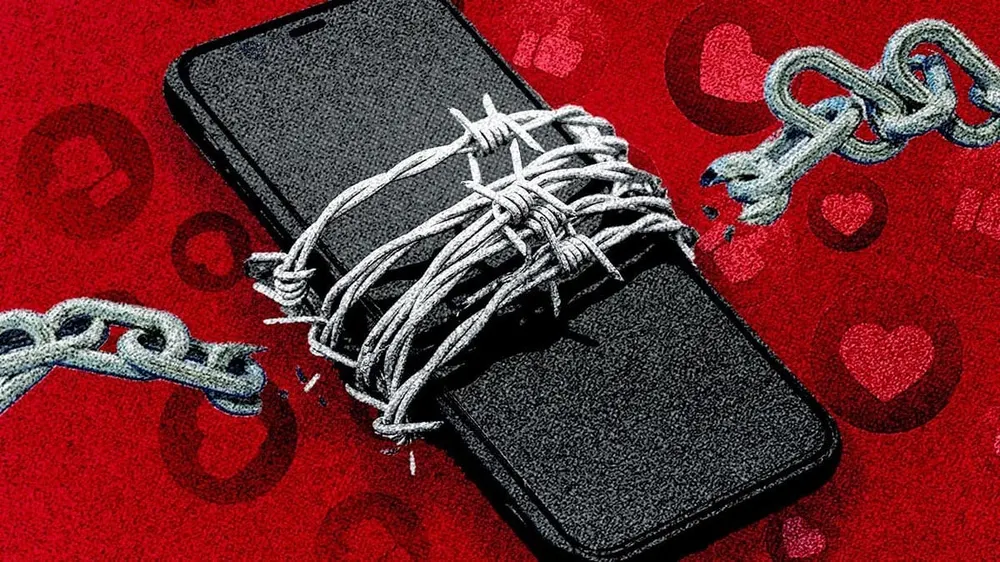
Less than a year ago, I uninstalled social media from my phone. That day, the app I use to track my active usage of my phone reported 9 hours and 35 minutes (a milestone that was practically Milei-esque). A workday spent scrolling through memes, casually voyeuristic about others' lives, and posting political stories to my microscopic audience. I decided, caught in a tentacular crisis of anxiety, that dropping out was the only answer. Instagram, Facebook, LinkedIn, Snapchat, TikTok: they all went. I kept WhatsApp, YouTube, and Twitter, the toxic sewer of the Internet that we will never call X (and yes: my problematic consumption).
The hyperventilating anxiety attack was the starting point of a path that was anything but linear towards recovering my time and attention; rehabilitating my mental and physical health; and following a strict cognitive diet. In just under a year, I set a strict 60-minute daily timer for Twitter exposure, bought a flip phone (a resounding failure), and a Kindle (a resounding success), started using my MP3 player again, lifted weights, knitted, sewed, embroidered, and baked. Above all, I read. I read a lot. I got bored. I loved it. I also deactivated friendships, disconnected from digital everyday life, and faded from public conversation. I got depressed.
Less than a year ago, I uninstalled social media from my phone. That day, the app I use to track my active phone usage reported 9 hours and 35 minutes. A workday spent looking at memes, casually voyeuristic about others' lives, and posting stories.
This microliterature of the self makes me uncomfortable: the first person is always debatable, the anecdotal is not confirmatory, and exposure gives me anxiety. But my exodus from social media revealed something that, I hope, will help build a possible starting point to problematize the naturalized ubiquity of social media and, above all, how to escape from it.
Social media: Is there no alternative?
I want to get a tattoo. But I don’t have Instagram. I also don’t have my tattoo artist's phone number: I used to connect with her via DM. So, I have a problem, one that will repeat itself. Namely: what is sold, is sold on Instagram; fame is achieved through TikTok; jobs are found on LinkedIn; Facebook Marketplace is my favorite haunt for buying used items. Access to the largest showcase on the planet has been democratized and horizontalized via initially free platforms.
Not having social media is a form of self-exclusion from an economic, political, and social configuration that most users and consumers cannot afford. If you are an entrepreneur, self-employed, a freelancer, or all of the above, lacking an Instagram account is unfeasible for financial survival. As a sign of a global economic crisis, the line between hobby and potential second income blurs, and every passion is likely to be monetized on social media. Whether you’re a butcher, accountant, or content creator, having community management and brand identity is essential. The possibility of going viral is an open door for everyone to gain new clients, exchanges, and commissions. It’s kind of like an initial drug.
Social media is not just a business, corporate, or entrepreneurial realm: public and political institutions publish everything from official statements to campaign platforms on social media. It’s a direct, fast, and massive reach to the taxpayer's or potential voter's pocket without intermediaries, brokers, or assemblies. The rise of the Argentinian right, which replicates Steve Bannon's hyperstition manual, was triggered by the highly effective affective communication of the conservative, libertarian, and individualist pipeline. In the era of low-intensity activism and the digital street, adhering to an ideology has never been cheaper, and it has never been easier to polarize in a country addicted to division.
This acceleration of late capitalism is dubbed platform capitalism and reconfigures the political, economic, and social constellation. Its hard core is data mining, monetizing attention, and dataveillance captured through social media. It uses the currency of attention, desire, and indignation: these are the substrates on which moods form, mutate, and dramatize. To stir them up, the mechanism is simple: create high-impact content in easily digestible short formats. The more views, the more engagement, more traction, more money flowing into the platform: baiting becomes the norm, and content saturates the channel. Cognitive sovereignty is impossible.
Social media is an extension of technological progress and, therefore, carries the sheen of inevitability. Paraphrasing Mark Fisher, today it might be easier to imagine the end of the world than the disappearance of social media. Fisher unsubscribed from the service of life in 2017, when social media was still a decentralized organization of real political action. The depressive hedonism he foresaw was prophetic: in the decade since his death, stimulus overload, instant gratification, constant connection, and the perpetuation of apathy have accelerated, intensified, and transformed into pillars of the capitalist attention economy.
Disconnection is a luxury that not everyone can afford: the exodus becomes a class marker, and the gap with those who need that connectivity widens.
In fact, today it’s so unthinkable not to be on social media that when I confess I don’t have any, there’s a delayed reaction that swings between disbelief and direct questioning. At the pharmacy, they suggested that route to find out about the latest deals; the vet assured me I’d find the hours of operation there; my activist space sends out calls via social media; the Ministry of Human Capital publishes its latest news on its Twitter channel; the Official Response Office (ha) posts disinformation threads.
It’s a functional dependency: those without a profile don’t exist on the radar of basic services, whether from the state or commerce. The interface with the citizen is outsourced to opaque algorithms in Silicon Valley. I chose to desert them (thanks, dear Bifo) as a radical “no” to the social game, the economic order, the imperative of connectivity. But I know that my act of resistance is very shabby and a bourgeois privilege: the moment I participate in a project that requires visibility, social media will return. Disconnection is a luxury that not everyone can afford: the exodus becomes a class marker, and the gap with those who need that connectivity widens. Not being on social media is (still) an elective isolation. But (still) I haven’t been able to get my tattoo.
The first impact of disconnection: FOMO no more
Your friend's band, your cousin's birthday, your buddy's project, the weekend shenanigans, your activist call, the clothes you like, the latest rights violation, the status of Line B: everything happens in the digital playground. And if you’re not even in the game, accepting that you’re going to miss events, thoughts, and updates is essential. Finding joy in missing them, what is called in millennial circles Joy of Missing Out, is optional.
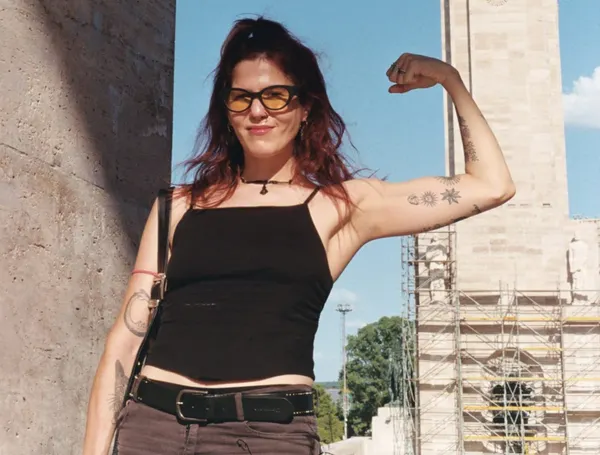
 Julieta Rosell
The accelerationism that intensified technological development has also spilled over into the social sphere: we live in a frantic whirlwind of events and sensations that unfold at an unprecedented speed. Optimistically speaking, it’s a bit like an effect Sonder: the wonder that every human life is as complex, filled with thoughts, emotions, and routines as our own. On a less optimistic note, it’s the constant infiltration of an informational whirlwind that demands constant attention and exceeds the capacity of the mind's processing. The brain's RAM collapses into a series of emotions with programmed obsolescence: what was viral yesterday is irrelevant today.
I feel overwhelmed. I have constant access to the escapades of the President, the network installer for my cat, my husband, my best friend, the plumber, and Churros El Topo (the best social media manager in town). To all of humanity. There’s no emotional and cognitive bandwidth that can keep up. I uninstall social media, but it also feels like unsubscribing from the newsletter of my loved ones' lives.
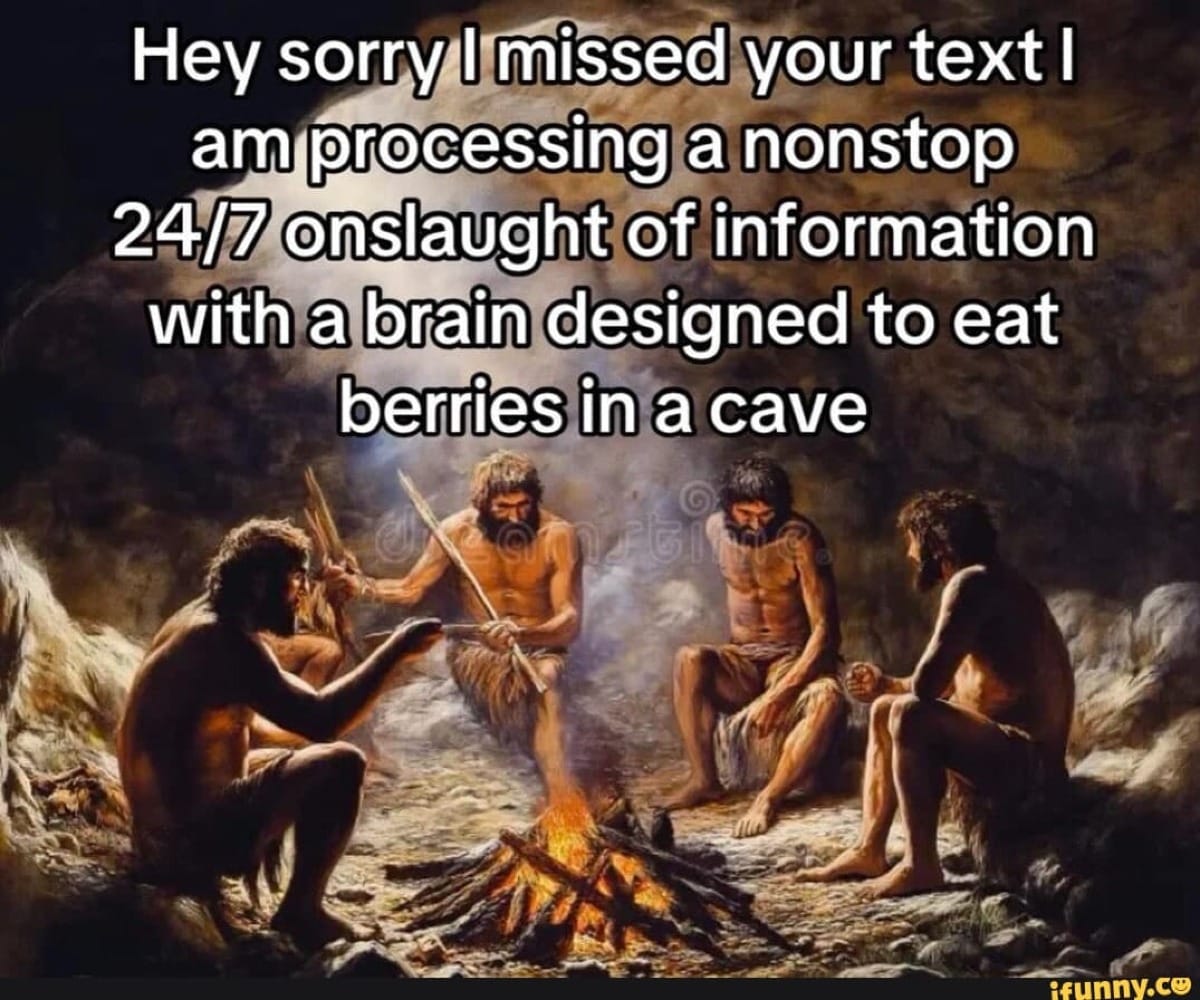
I made a sticker for WhatsApp quoting an excellent tweet: “Hi, sorry I didn’t see your message, but I’m processing an unending attack of information 24/7, with a brain designed to eat berries in a cave.” I don’t keep up with what’s happening, and that’s okay. I stop going out, and that’s fine too. I start to embrace the slow, initiate more deliberate processes, even if they’re infrequent, even if they’re digital, shifting from image-commodity to manual-thing. I knit a lot. I’m learning to sew with a machine. I’m getting back into pottery. Maybe it’s the itch of turning 36. Maybe it’s that it was unsustainable.
My failed attempts: dumbphones, doomscrolling, and dysphoria
I scroll through my feed of stories on Instagram. Overstimulation: a live genocide, baby kittens, drones with artificial intelligence in a war, my friend’s trip to Mar del Plata, a loop of retirees being repressed and statements from Milei; all equal in relevance and turned into consumable objects. Scrolling is an endless parade of images that inhibits depth, an automatic saturation that numbs all reaction, an addictive mechanism requiring minimal effort.
I research: the neurological effect is already studied. Scrolling activates the reward circuit in the prefrontal cortex, releasing dopamine and entering a flow state that distorts time. Shifting focus in milliseconds affects information processing and storage, concentration, and memory. In childhood, it can produce attention deficits, sleep disturbances, language problems, and socialization difficulties. My friends can’t get through a meeting without checking their phones every 18 minutes. It’s not generational: it seems my parents can’t either.
I myself can spend hours watching stories and I blame the physical device. It’s designed for infinite vertical scrolling, constant accessibility, absolute portability, and immediate gratification. It’s a reward-generating machine, a pocket-sized dopamine bomb. This didn’t happen to me when I had my trusty BlackBerry, the pinnacle of phone design that I held onto until 2016, when it stopped supporting WhatsApp. Since then, smartphone design hasn’t changed in terms of hardware: every device today is a lightweight rectangle, with a shiny touchscreen, physical buttons only on the sides, and front and rear cameras. Meanwhile, I long for the crazy designs of the early 2000s, I mentally build an altar to my Nokia 1208, and I subscribe to radical notions of independence.
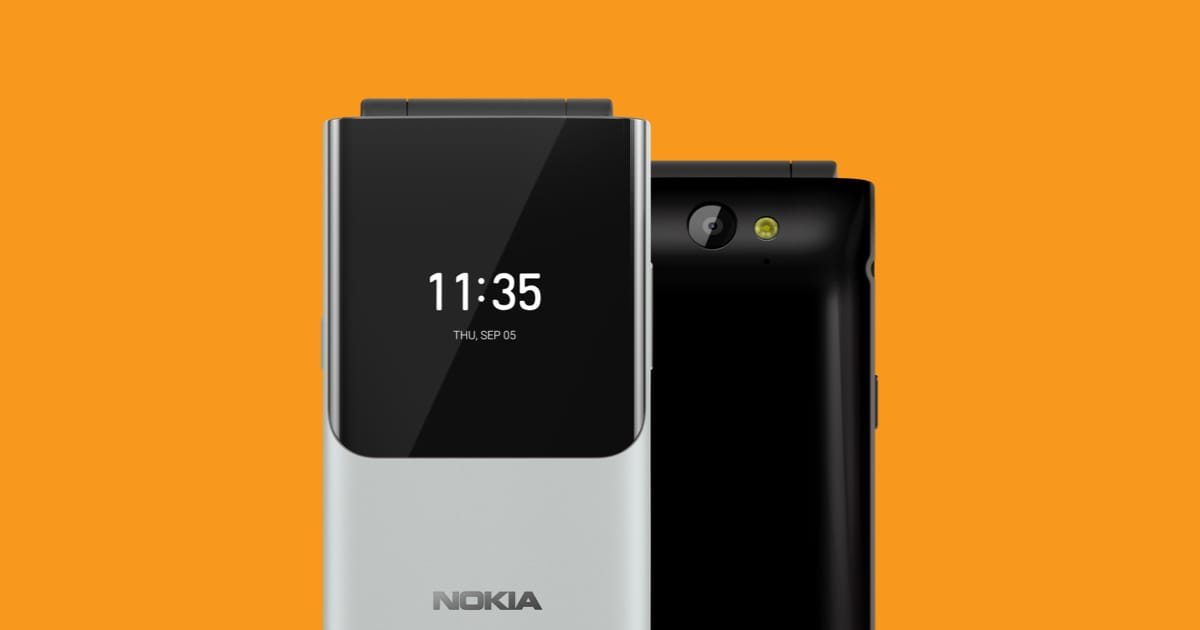
I come to a determination: I’m buying a flip Nokia, with physical keys and even Snake, a dumbphone that deliberately creates friction in navigation and is trending in the United States. I research threads on Reddit, articles online, YouTube videos to find the right device for me. Various devices designed for disconnection have emerged: Mudita Kompakt with its e-ink, the Punkt built for paranoid people, the Jitterbug created specifically for seniors, and many more. Their price hovers around USD 500.
My digital minimalism experiment goes wrong. The phone fails when I try to connect it to WhatsApp (my main communication channel) or even to the Internet. It’s clear that scanning a QR code for my health insurance will be impossible: the operating system doesn’t tolerate MiArgentina or banks. In short, I got scammed: the ad on Mercado Libre promised that the phone had hybrid features. I try other phones rescued from 2010 and fail. My infrastructure of existence, as it is today, does not allow for the disconnection that the Nokia invites.
Shifting focus in milliseconds affects information processing and storage, concentration, and memory. My friends can’t get through a meeting without checking their phones every 18 minutes. It’s not generational: it seems my parents can’t either.
Being analog is consumerism with a different label: the Nokia cost me 90 bucks. I can’t financially recover from my decision and I repurpose the brick into a nice paperweight. I continue using my Samsung with its usage-tracking app. Both are monuments to a freedom that no longer belongs to me.
“Everything that happens, happens to be made into a reel”
I see in stories the trips to Japan, the selfies in public spaces, the GRWM of kids, the plates of the joke, the photos of dishes in trendy restaurants. I get allergic to ostentation in general and performativity in particular.
Susan Sontag already prophesied: every human experience has become an object of consumption, ready to be recorded, packaged, and shared; every moment has the potential to become digital content; events occur because the camera captures them. Today, participating in an event is consuming it in the form of an reel. Doubling down on On Photography, we not only inhabit an aesthetic consumerism to which we are addicted and are junkies of images: today we limit the world to a vending machine of moving images that we consume in a daze on social media.
More than ever, in social media, capital is image. To appear is to be, it’s using the technology of the self to create one’s own digital narrative. A parade of signs unfolds that adds value for and to the gaze of others. The cognitive dissonance between social media and real life is ridiculous: just look at the President of the Nation posting edited photos of himself on his official accounts. He wants to be seen as a heartthrob, like a lion, like Ulysses on his ship, like an action hero: traditionally masculine. The snapshots published by the press show another face, another height, another body, another hair. He mediates his relationship with his own face through digital editing tools; his face becomes a communication project. What a crazy thing to say.
Exposure to standardized faces and the homogenization of features via filters, particularly targeting the faces and bodies of women, also affects me. Social media imposes impossible beauty standards: plump lips, smooth foreheads, slim bodies; a farm of dysmorphias. I reject enhanced lips, but I go to the dermatologist to find out how much a Botox injection for my millennial reader forehead costs. I oppose it more out of fear of side effects (and because I’m broke) than from genuine repulsion to the practice.
I recognize how relieved I am not to be seen on social media. Intimacy is not just a right; in my case, it’s part of a particular symptomatic aspect of my anxiety. I’m terrified of being seen; exposure feels unbearable to me today. This anonymity is also a liberation from the yoke of others' expectations. I turn off the camera and my face is mine again, the only space where it cannot be monetized.
Am I being paranoid?
Every time I search on Google, a module with AI Intelligence pops up that I can’t figure out how to eliminate. All AIs offend me equally. If the digital world was already parasitic and invasive, the inclusion of artificial intelligence tools in social media, apps, and popular search engines reinforces a model of extractive business built on private data. They jeopardize planetary survival, sustain unstable political regimes to obtain cheap energy, and exploit displaced or impoverished micro-workers around the world.
ChatGPT seems to me a hallucinatory monstrosity that induces an uncritical import of cheap concepts; NanoBanana violates every precept of the artwork; I know people who use Claude as a therapist. I can’t help but find a moral quagmire, a tainted playground, a monstrous collective psychosis, a community wank, a nefarious servility, an intellectual deforestation, an ethical and aesthetic aberration, and a climatic condemnation.
 Javier Pallero
Two weeks ago, as a preparatory exercise for this text, I shared a first draft of this note with Google AI Mode. Its verdict horrified me. Beyond the crude flattery and unfounded praise, Google claimed that, due to my background as a designer and photographer, my personal story resonated in the text.
That information, while only incidentally true, is not available in any of my public or professional profiles. When I asked where it had dug up that data, it apologized, saying that "its wires had crossed" and that we could "wipe the slate clean and start over." I couldn't help but wonder: what exactly does it know about me and where did it get that information? How do they track what we leave behind without us realizing it?
Social media is one of the vital substrates on which artificial intelligence is built, a perfect symbiosis that combines freely provided information with opaque handling of data and privacy by tech companies. Since Cambridge Analytica, it's clear that social networks are a sinkhole of invaluable personal information. They allow insight into what content you consume and interact with; who you talk to and form your circle with, where you move, what events you attend, your search history, how you see yourself. Above all, it confirms that those data points are capitalizable.
Software like Gotham from Palantir (which literally connects the nefarious seeing stones of The Lord of the Rings with Lucius Fox's spy software in Batman: The Dark Knight) collects, connects, and massively analyzes profiles, interactions, geolocation, and social media content. It merges this with state databases and public, medical, and financial records. The result is a monster of technovigilance and digital control that enables everything from automated military incursions to immigrant raids.
The arrival of Peter Thiel (the technocrat father of Palantir who claimed that "freedom is incompatible with democracy") in Argentina and his meeting with Javier Milei seems to cement an alliance between the torrents of information managed by the State, the private software analyzing big data, and its potential use as an institutionalized tool. In a country where a social media post can land you jail time, where Meta owns WhatsApp and every action seems to leave a digital footprint, not sharing information seems like the only rational response. I've stopped using Google as my search engine. I search for digital self-defense tactics on DuckDuckGo.
A path made of trial and error
I realize that this is something that can't be done in a day. Not in two. Not in a year. As I approach the anniversary of uninstalling social media, I wonder what the next step is on the path to disconnection. And, as I carry a permanent guilt, I question how to improve and chastise myself for the vices I still hold onto, for the absurdity of writing this note. I defend, perhaps mistakenly, some of them.
I determine that instant messaging platforms like WhatsApp pose a constant availability that I dislike on principle, but I can't find better alternatives. I hate that it's tied to Meta and I'm concerned about the security of my data. I think using it on the computer, like the old ICQ, could be useful: I can stand up and walk away from the laptop; not so much from my phone.
I realize that this is something that can't be done in a day. Not in two. Not in a year. As I approach the anniversary of uninstalling social media, I wonder what the next step is on the path to disconnection.
I think about my YouTube account. I'm fascinated: there's not a day that goes by without listening to the editorials of Tenembaum, Bercovich, Lijalad, and Lantos. I follow streaming channels like Posdata, Café Kyoto (Juan Felipe Salguero is one of the sharpest minds of our generation), Noticias de Ayer, Pablo Borda, Pupina Plomer, Mate, and Delireo, with trained professionals I deeply admire who invite us to think about the world from different perspectives. I actively reject Gelatina, Olga, Blender, and Carajo.
I have hours of documentaries and unique niche podcasts at my fingertips, from the embalming process of comrade Lenin to the trans-Andean campaign of San Martín, along with sewing tutorials and super light content. They are videos, yes, but long ones that I mainly listen to while lifting weights, going for walks, or commuting to work.
Here's the problem: Twitter. The political circle is my hard drug. I locked my account several months ago and limited my usage to an exorbitant 60 minutes a day. It's a network where I don't post, but it aggregates information directly from its sources, vital for political construction. I justify it by saying that since it's a text-based network versus one anchored in video, the mechanism is less toxic. I recognize it will have to go eventually.
As a device, the Kindle changed my life. I'm an avid reader who devours about two or three books a week. I'm also quite thrifty, so pirating books is my passion. I also download movies and music (and you can read why it's important here). I aim to listen to entire albums again: to break the daily suggestions of Spotify and enjoy the work as it was conceived. I use my old iPod Shuffle with a screen: a gem that allows me to keep decentralizing devices.
Is there anything else I can do? I ask you, the reader. Here, some other answers.
Less screen, more life: some tips
Like smoking (and so many other -isms), I believe that once you're addicted, you're addicted for life. Recovery is never a straight line. But here are some flawed considerations that might help on the path to disconnection.
- There’s no right way to quit social media. Anything you do for your physical or mental health is always going to be ideal. Don’t set standards for yourself that you know you won’t be able to meet.
- Paradoxically, use an app. Keep your smartphone connected but limit your access to social media. I have a free app called AppBlock, but there are plenty of others you can customize to your liking. Pro tip: putting your phone in grayscale really helps tone down the intensity of the device.
- Disconnect. Literally. Make plans outside the house, go for a walk in the park or by the river, take up pottery, meet up with friends or family—these are all great alternatives. Above all, READ. Learn to do things with your hands. Claim your physical independence.
- Lift weights. Play any sport you enjoy. Having a body and using it is the antithesis of the digital universe.
- Learn to be bored again. Our brains aren’t built to process constant stimuli. They don’t need it.
- Nighttime hygiene is essential. Stopping screen use two hours before bed and keeping your phone out of the bedroom can help avoid doomscrolling.
- Challenge yourself not to take out your phone during a gathering. Dare to experience physicality without your attachment device. Look at those around you: how much time do they spend without checking social media or their phones?
- If you can, reclaim the analog. You don’t need to buy a newspaper, but going back to writing on paper, using physical cash, or using a printed map—forcing your brain to interact with physical matter is a reminder that the world is what’s outside the screens.
Final thoughts
Quitting social media didn’t make me a holier, better, more productive, or wiser person. I still need my dose of political chatter to understand where I stand. I still have anxiety. But it did return the human scale to my days, the privilege of my boredom, the luxury of anonymity, a little less headache, and a bit less anxiety in a world that challenges itself to be increasingly exclusionary, cruel, and intense. I use and recommend having fewer social media accounts and perhaps reconnecting with what’s happening outside.
Las notas de 421 no tienen paywall
Y a cada colaborador se le paga por su trabajo. Las dos cosas dependen de los suscriptores.