The Yellow Fever of 1871: When Buenos Aires Ran Out of Coffins
The epidemic that reshaped Buenos Aires, forcing the city to build a cemetery, a railroad and new hospitals.
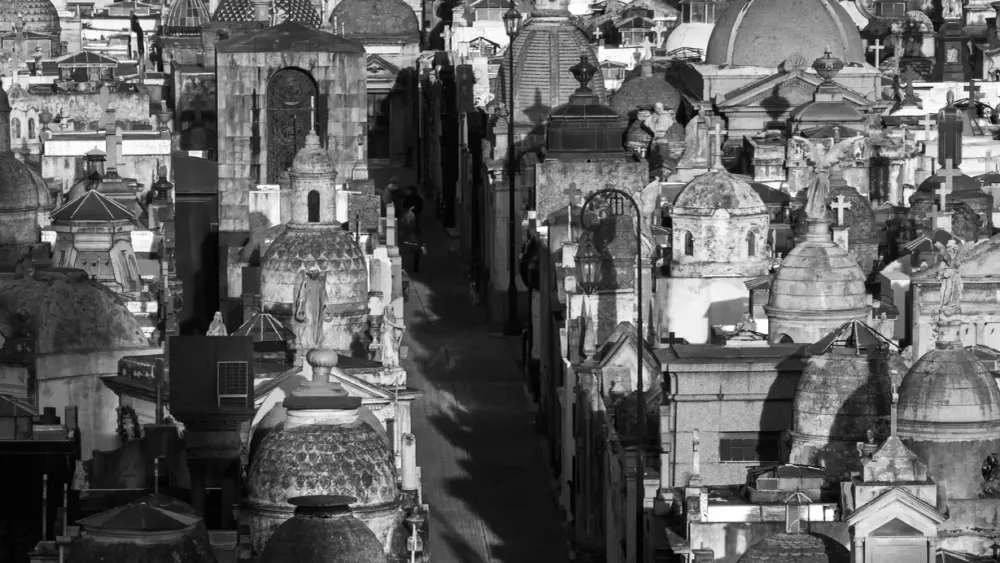
I arrived at the Francisco J. Muñiz hospital in October 2020, in the thick of the pandemic, to train in Infectious Diseases. Before that, as part of my residency, I had spent a year and five months at the Bernardino Rivadavia General Acute Care Hospital.
As a Rosario girl fresh off the bus in the big city, I spent my first months collecting little culture shocks: the savory or sweet medialuna became the medialuna de grasa or de manteca, and the carlito, noble fruit of the afternoon snack, was replaced by its ketchup-less cousin, the tostado. But while I was learning to get around the city, what struck me most was that in Rosario we talked about zones (north, south, west, downtown), while in Buenos Aires people talked about neighborhoods.
Walking around, it was easy to see why. The differences between the neighborhoods of the two hospitals were too stark to miss: French-style buildings, ladies with little dogs, chain pharmacies and coffee shops along Pueyrredón and Las Heras, on the way to the Rivadavia, in Recoleta. On the other hand, heading down Jujuy and turning onto Caseros, in Parque Patricios I saw low houses, Huracán fans, working folks, corner kiosks and, next to the Muñiz, Florentino Ameghino Park.
I learned that both neighborhoods had suffered, each in its own way, through several epidemics, and that the one I started this story with (the one with face masks and hand sanitizer) had several predecessors in the 19th century: cholera, smallpox and, above all, the yellow fever epidemic of 1871.
I learned that both neighborhoods had suffered through several epidemics, and that the one I started this story with had several predecessors in the 19th century: cholera, smallpox and, above all, the yellow fever epidemic of 1871.
Although the disease was no stranger to the city, that year it left a deep mark, particularly on the southern neighborhoods. For someone taking her first steps in Infectious Diseases, this story was hard to ignore. It was written, literally, on the streets I walked every day. It's worth telling.
A half-built city
In 1871, the city of Buenos Aires was living a contradiction. It had some features of a modern city: since 1856 it had gas lighting, horse-drawn trams running through downtown, and a telegraph line to Montevideo. But sanitary conditions didn't keep pace with progress: there was no running water network, no sewer system, no drains.
The city was riddled with cesspits that contaminated the shallow groundwater, garbage collection was poor, and it was common practice to use trash as a base to level the streets before paving them with stones. The Riachuelo took in the waste from the slaughterhouses and meat-salting plants on its banks, and it was common to find animal carcasses floating in its waters. Given this picture, it's not hard to imagine, as Felipe Pigna puts it, that the air people breathed back then was anything but "buenos aires."
The city was growing faster than it could handle. Until the mid-19th century it had about 70,000 inhabitants. After the fall of Rosas, with immigration seen as the engine of progress, waves of European immigrants arrived, mostly Spanish and Italian. The first census, in 1869, recorded 177,787 inhabitants, half of them immigrants.
The south side, which until then had been the genteel neighborhood of Buenos Aires' old-money families, began to change its demographics, since from 1860 on those families started moving north, leaving their old colonial mansions behind. Many owners saw a business opportunity in this, subdividing the properties into tiny rooms they rented out to immigrants. That transformation gave rise to the conventillos, tenements where each family lived crammed into a rented room with their few belongings.
Nobody suspected the mosquito
Today we know that poor sanitation and chaotic urban growth, combined with summer and rain, are the perfect breeding ground for Aedes aegypti. This little white-spotted mosquito is the star of a huge chapter of infectious diseases called, not very originally, "mosquito-borne diseases". It's the same vector that today transmits the dengue, Zika and chikungunya viruses, and the one that can also transmit yellow fever in its urban cycle. But it was 1871, and it would be years before anyone understood how these mechanisms work.
At the time, the paradigm that explained collective ailments was miasma theory, which attributed disease to the "foul air" given off by garbage, overcrowding, stagnant water and rotting bodies.
Bad science and class prejudice fed off each other. If "foul air" came from garbage and overcrowding, it was easy for residents and the press to link disease with poverty. When the epidemic came, that argument would end up justifying segregation, discrimination and xenophobia. The conventillos and their residents would come to be seen as the natural source of the outbreak rather than its first victims.
It would still be another decade, with Robert Koch and the dawn of the bacteriological era, before science began to accept a microorganism as the causal agent of disease.
Unknowingly, that's how the city awaited yellow fever. A disease that had probably begun its journey down the Paraná River before spreading through its streets, coming from a land still convalescing from war.
War as a prelude
Yellow fever was no stranger to the region. It had been endemic in Rio de Janeiro and other Brazilian ports for decades, and it periodically reached the Río de la Plata through trade between the two coasts. In fact, Buenos Aires and Montevideo had seen minor outbreaks in 1852 and 1858.
On top of that sea route came the river route through the Litoral. The War of the Triple Alliance had just ended with the death of Paraguayan president Francisco Solano López at the Battle of Cerro Corá. Paraguay had been left devastated, with no health infrastructure and a large share of its male population dead in combat or from disease. Ships, troops and prisoners began moving from a ruined Asunción toward the Argentine Litoral, in traffic without any sanitary controls that would soon have consequences far beyond the battlefield.
The first confirmed case on the Argentine side was on December 14, 1870, in Corrientes. It was a merchant who died 48 hours after falling ill. The chain of transmission spread first to his own family and then to his community. The Corrientes authorities reacted quickly, but nothing was enough. The epidemic kept advancing at such a pace that 2,000 deaths were counted between December and June in a city of 11,000 people. From there the disease moved south and finally hit Buenos Aires.
San Telmo, January 1871
Although there are signs of earlier cases, on January 27 three people died in the San Telmo neighborhood. The cases were concentrated in a block bounded by Bolívar, Perú, San Juan and Cochabamba. Dr. Luis Tamini, who had examined the patients, informed the Municipal Commission that it was yellow fever. His colleagues then sent the diagnosis up to the Public Health Council for official confirmation. But while the ruling dragged on, the authorities chose silence and sat on the news for several days, hoping to contain the outbreak before panic spread.
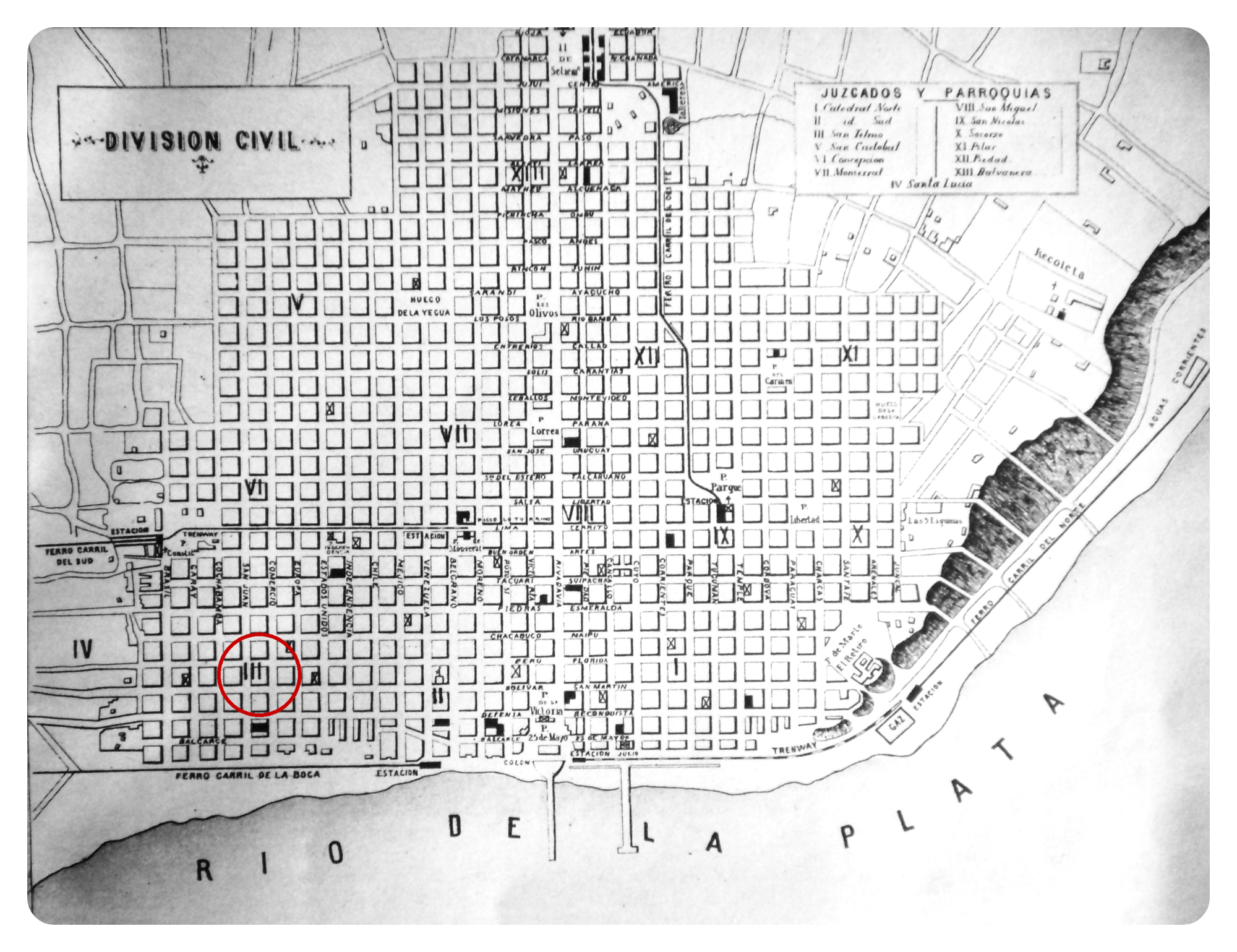
It didn't do much good. The news got out anyway and the press started picking it up. But knowing about the problem wasn't the same as taking it seriously. During the first days of February, while between one and seven deaths were being counted daily, the newspaper La República went so far as to claim it wasn't yellow fever. Its editor, Manuel Bilbao, said he had seen the disease firsthand years earlier, in Lima and Guayaquil, and insisted the Buenos Aires cases looked nothing like what he knew. Meanwhile, much of the city had its mind elsewhere: Carnival was coming.
The epidemic kept advancing at such a pace that 2,000 deaths were counted between December and June in a city of 11,000 people. From there the disease moved south and finally hit Buenos Aires.
A sanitary cordon was set up to isolate San Telmo, where most of the cases were concentrated. For a moment it seemed the measure might contain the outbreak, but yellow fever had already started showing up outside that perimeter. In late February a new hotspot emerged in a conventillo on Paraguay street, between Artes (now Carlos Pellegrini) and Cerrito, far from San Telmo. The house had been built for about fifty people, but more than three hundred lived there.
From then on, the epidemic spread to different parts of the city. The mosquito came in through any window, whether that of a packed tenement or a mansion with a garden. It was known as "the black vomit disease," because of the gastrointestinal bleeding that appeared in severe cases. The name we know it by today, "yellow fever," comes from another of its symptoms, jaundice, that yellowish tint of the skin and mucous membranes that appears when the liver fails.
Those who stayed, those who left
By March, mortality had skyrocketed to between 150 and 200 deaths a day. The terrified city needed to see someone take the helm. Against that backdrop, the People's Public Health Commission was formed, made up of residents who divided among themselves the work of caring for the sick, raising funds and organizing sanitation. Many of them ended up paying for that commitment with their lives.
Francisco Javier Muñiz, a physician and naturalist, died treating the sick. Roque Pérez, a lawyer and president of the Commission, caught the disease while coordinating relief efforts and died on March 26. Manuel Argerich, also a physician, stood by him to the end. Both were immortalized by Juan Manuel Blanes in one of the best-known images of the epidemic, entering a conventillo on Balcarce street to help a dying woman lying beside her baby.
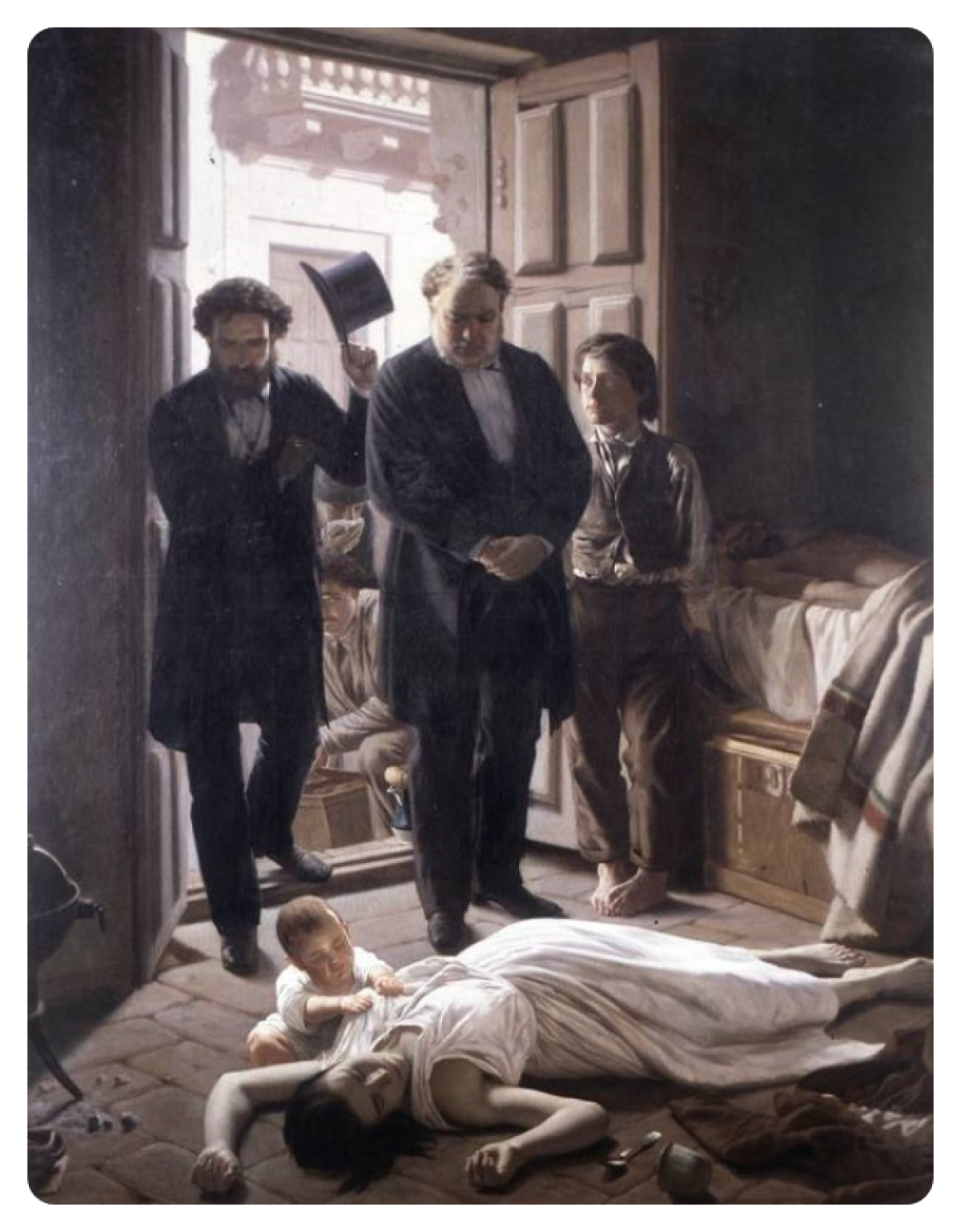
But while some organized and stepped up, others ran. The exodus north, led by those who could afford it, snowballed. By mid-April, between half and two-thirds of the city's population had fled.
But the most controversial escape was that of President Domingo Faustino Sarmiento himself. And he didn't exactly slip away quietly: he arranged a special train, surrounded himself with an entourage and left for Mercedes.
The backlash was swift. An editorial in the newspaper La Prensa at the time called it an act of cowardice:
There are certain displays of cowardice that reveal the measure of a magistrate and what he may be capable of henceforth, in the high office the people have entrusted to him.
When Buenos Aires ran out of coffins
April 10 was the deadliest day of the epidemic, with 563 deaths in 24 hours. A twenty-day holiday was immediately decreed, which brought the city to a complete standstill, to the point that neither the Legislature nor the Superior Court could muster a quorum to convene. A chronicler of the time summed up the drama of those days in three words:
terror, shutdown, flight.
Funeral transport collapsed. Since there weren't enough coffins, bodies were carried wrapped in nothing but sheets. To move them, a railway branch line was built to a new cemetery. It was pulled by an old locomotive, "La Porteña," which could make two trips a day, not nearly enough for the number of bodies piling up at the terminal's depot.
Most ended up in the Recoleta Cemetery and the Southern Cemetery. The latter had opened just five years earlier, on a plot already known by then to be too small. With the epidemic it collapsed for good. That's when the municipal government bought seven hectares in the Chacarita de los Colegiales (today's Parque Los Andes) and created the new Western Cemetery there, which 15 years later was moved a few yards away, to what is now the Chacarita Cemetery.
Sixty years later, Jorge Luis Borges would dedicate a poem to it, in which he writes that "Buenos Aires could not look upon that death."
After the April peak, cases began to decline steadily. With the arrival of winter, the last isolated cases were recorded on June 22, and the epidemic was declared over. The official death toll was 13,614, 8% of the city's population, half of them children. These numbers take on their true dimension when set against the mortality figures for the previous year: 5,886.
150 years later
More than a century later, memories of the epidemic remain hidden in plain sight across the landscape of the city's south side. Muñiz and Argerich now give their names to two of its hospitals. José Penna, the epidemiologist and public health doctor who studied and reconstructed the history of the epidemic, lends his name to another.
Penna was the driving force behind the creation of the Casa de Aislamiento, an isolation house devoted to treating infectious diseases and the direct predecessor of today's Hospital Muñiz. He also conceived its design, with pavilions separated from one another by a grove of trees, so that the natural surroundings themselves would help keep patients isolated.
A few yards away, Florentino Ameghino Park holds several layers of history. Before it was a cemetery, it was the country estate of the Escalada family, where Remedios de Escalada, wife of José de San Martín, died of tuberculosis in 1823 at the age of 25. Decades later, the same land would become the Cementerio del Sur, where nearly 14,000 yellow fever victims were buried. In 1882, a good part of those remains were moved to Chacarita. In 1940, during a renovation, coffins and bones turned up underground. No one can say for sure there aren't more still down there.
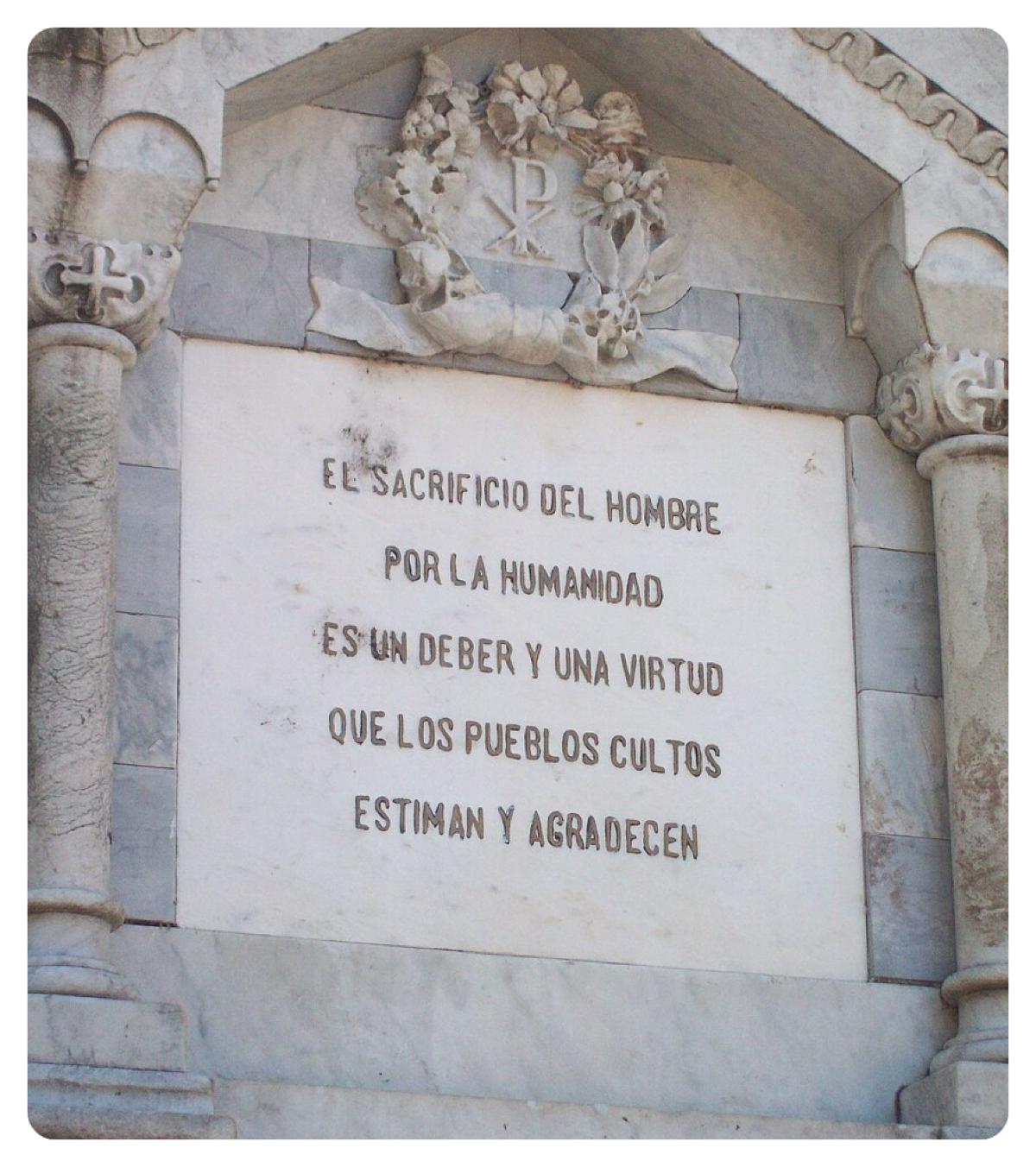
Today the park is one of the loveliest green spaces on the city's south side. On weekdays it's crossed by healthcare workers, patients, street vendors and neighbors. On weekends come the batucada drums, circles of people sharing mate, and kids playing soccer or learning to ride a bike. At its center, a monument erected in 1873 honors the victims of that epidemic and those who died trying to save them.
More than a century later, memories of the epidemic remain hidden in plain sight across the landscape of the city's south side. Muñiz and Argerich now give their names to two of its hospitals.
A few yards away, Hospital Muñiz remains one of the bastions of Argentine public health, responding to the same old epidemics and gearing up for the ones still to come. In between, it keeps training generations of infectious disease specialists.
There is, however, a debt the city has yet to fully pay off. The neighborhoods that bore the brunt of 1871, today's Comuna 4, still show up on the losing side of the Buenos Aires map in many of today's health indicators. The district has worse housing and socioeconomic conditions than the city average. Tuberculosis, the same disease that filled the wards of Hospital Muñiz a century ago, is still hitting the south side hard.
Las notas de 421 no tienen paywall
Y a cada colaborador se le paga por su trabajo. Las dos cosas dependen de los suscriptores.