A Language Without a People: The Strange World of Esperanto
The Buenos Aires Esperanto Association is an organization dedicated to teaching a language that has neither a people nor a state.

The Buenos Aires Esperanto Association is an organization dedicated to teaching a language that has neither a people nor a state.
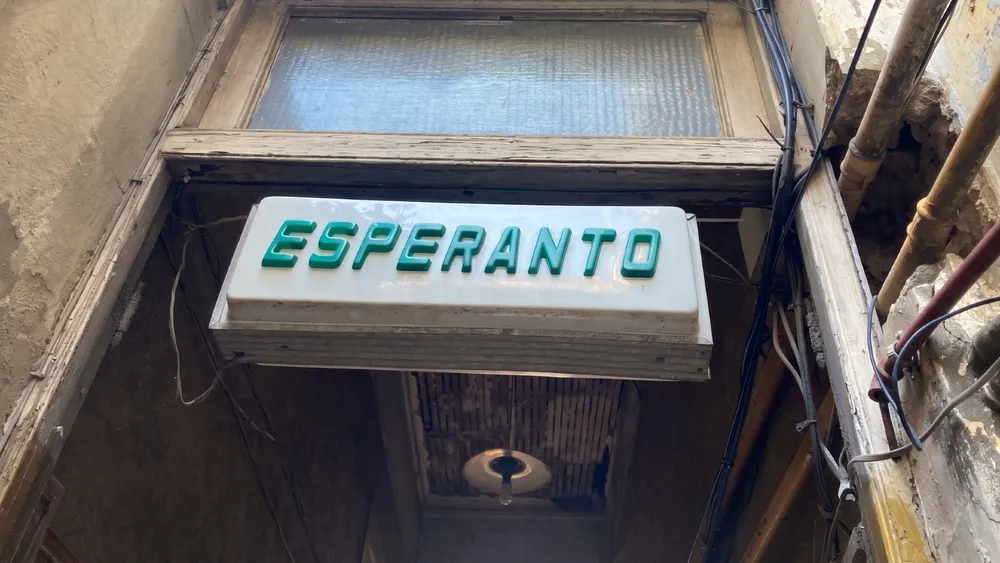
At the door of an old PH on Paraguay 2357, a green flag with a white star flutters. It's not the flag of any country; it's the flag of a language, of a movement. Welcome to Esperanto, the language designed to communicate with all of humanity.
One of its speakers greets me, and we walk down the long hallway from the street door to the door of the Buenos Aires Esperanto Association. Along the way, he welcomes me in his language, then translates it into Spanish and invites me in. In the main room, I find Silvia Rottenberg, the president of the association. "In the eighties, I had a bit of free time after failing with English and French," Silvia explains, who has been studying and teaching the language for nearly fifty years and currently works to continue spreading it. She is one of its main advocates.
Welcome to Esperanto, the language designed to communicate with all of humanity.
Among libraries and shelves filled with books, bunting, and photos of its founder, Lázaro Zamenhoff, I find myself surrounded by the core members of the association, some of whom are not yet thirty years old. The interview turns into a conversation, and at times their enthusiasm is so great that my questions seem to spark discussions among them:
—Listen, I was saying that when we were kids, classes were held in the sixties at what is now Normal 1. Then, when we were older, they had classes at the... what’s the name of the school next to the Colón?
—The Ilse or the Pellegrini. No, no.
—The one next to the Colón. The Roca school. We continued there, that’s where I specialized. After that, there were no more classes in public places.
—I think it's an advantage that it's free, that the language isn't imposed, because resentment can also arise when one is forced to study a language they don't want to.
—I believe that’s true; it’s not that I was forced. We had a lot of fun; we were kids and we enjoyed it a lot.
One of the people conversing is Elena Morteo, who has been studying it since the sixties, making her the longest-standing Esperanto speaker in the world. Her mother sent her and her sisters to learn it as children, not just for the language itself but for what was created around it, the community, the social aspect, the brotherhood among speakers, as if entering a kind of secret society, an exclusive international club.
During the chat, ideas brew and a thousand different tabs open, all interesting: talking with this school, with that institution. I suggest the language lab at UBA, where I mention that if they teach sign language and other quite universal languages, Esperanto should get a chance too. I quickly feel like part of it; I want to contribute, I want Esperanto to grow and be spoken by everyone. Although opinions vary: “It’s a free, voluntary teaching. For now, our focus is more on spreading the course from the association itself, as it’s more affordable for those who want to take it. Sometimes it’s even free,” explains Lisandro Chocobar, a polyglot who speaks Esperanto, English, German, Russian, and Turkish, among others.
The enthusiasm of the association members is evident in every response to my questions. The first and foremost is: What exactly is Esperanto? It’s a language invented by Polish ophthalmologist Lázaro Zamenhoff in 1887. Originally from Bialistok, he saw how the difficulty of understanding among the different ethnic groups living in Poland at that time (Lithuanians, Germans, Poles, and Russians) led to disputes and conflicts. His idea was to create a neutral language that didn’t belong to any country or culture, with no native speakers, that would allow everyone to be on equal footing and be easy to learn. It’s a logical language with clear rules and norms; there are no grammatical exceptions. It consists of sixteen rules, and understanding them is enough to start incorporating vocabulary and speaking and reading it without too much difficulty.
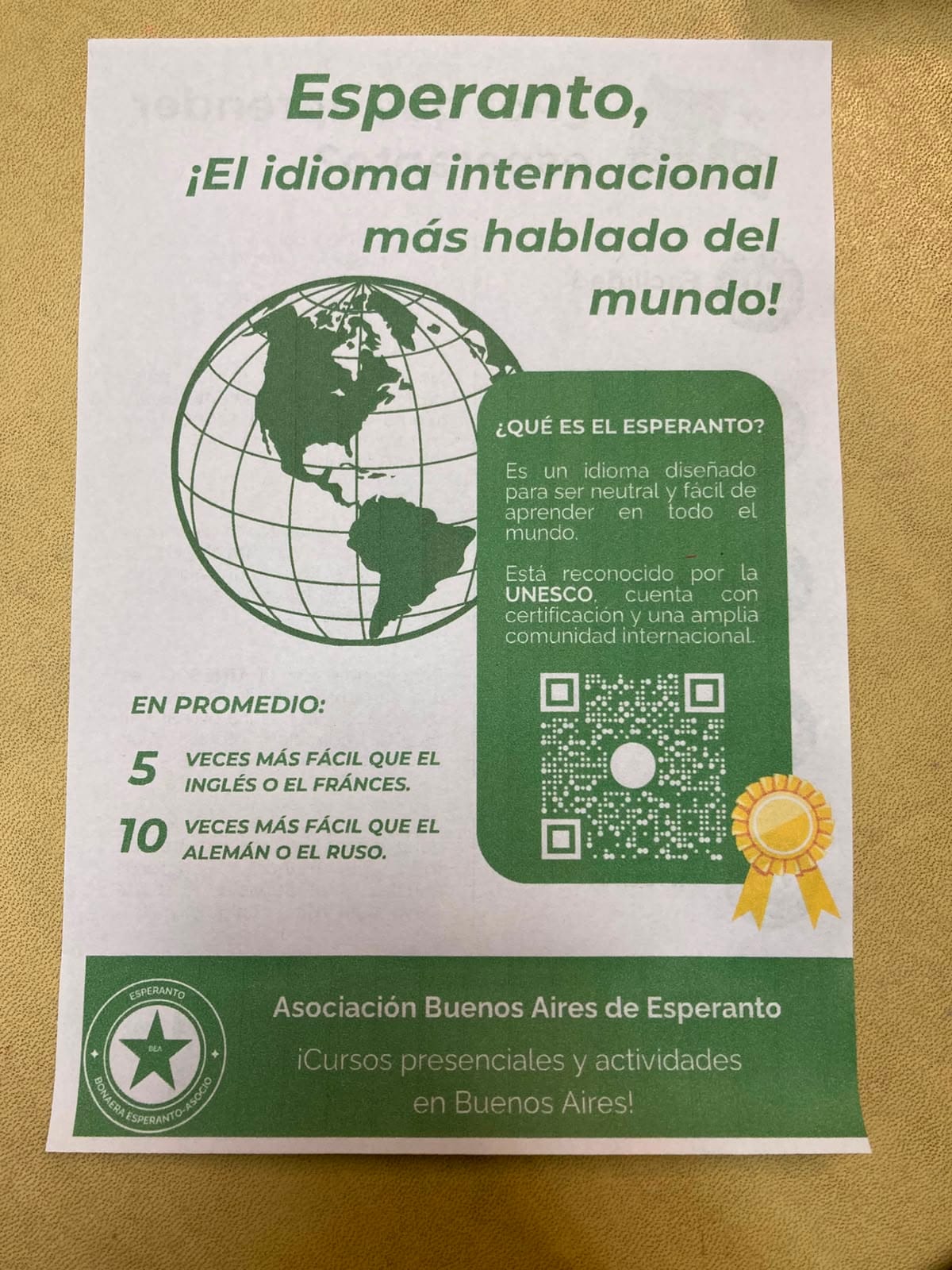
Although it’s not the language of any nation, it’s estimated that several million people speak it worldwide, in countries as diverse as Japan, South Africa, and Mexico. It’s estimated that there are about eight thousand speakers in Argentina, and classes are held in various provinces like Entre Ríos, Rosario, and Neuquén. While the association is the best place to learn it and also build community, many people currently learn it online, even with apps like Duolingo. The association’s promotional posters claim it’s five times easier to learn than English or French and ten times easier than German or Russian. They boast it as the most spoken international language in the world. It has also been recognized by UNESCO; Google has added it to its translator, and Wikipedia has nearly four hundred thousand entries, making it the thirty-seventh language with the most articles.
Although it’s not the language of any nation, it’s estimated that several million people speak it worldwide, in countries as diverse as Japan, South Africa, and Mexico. It’s estimated that there are about eight thousand speakers in Argentina.
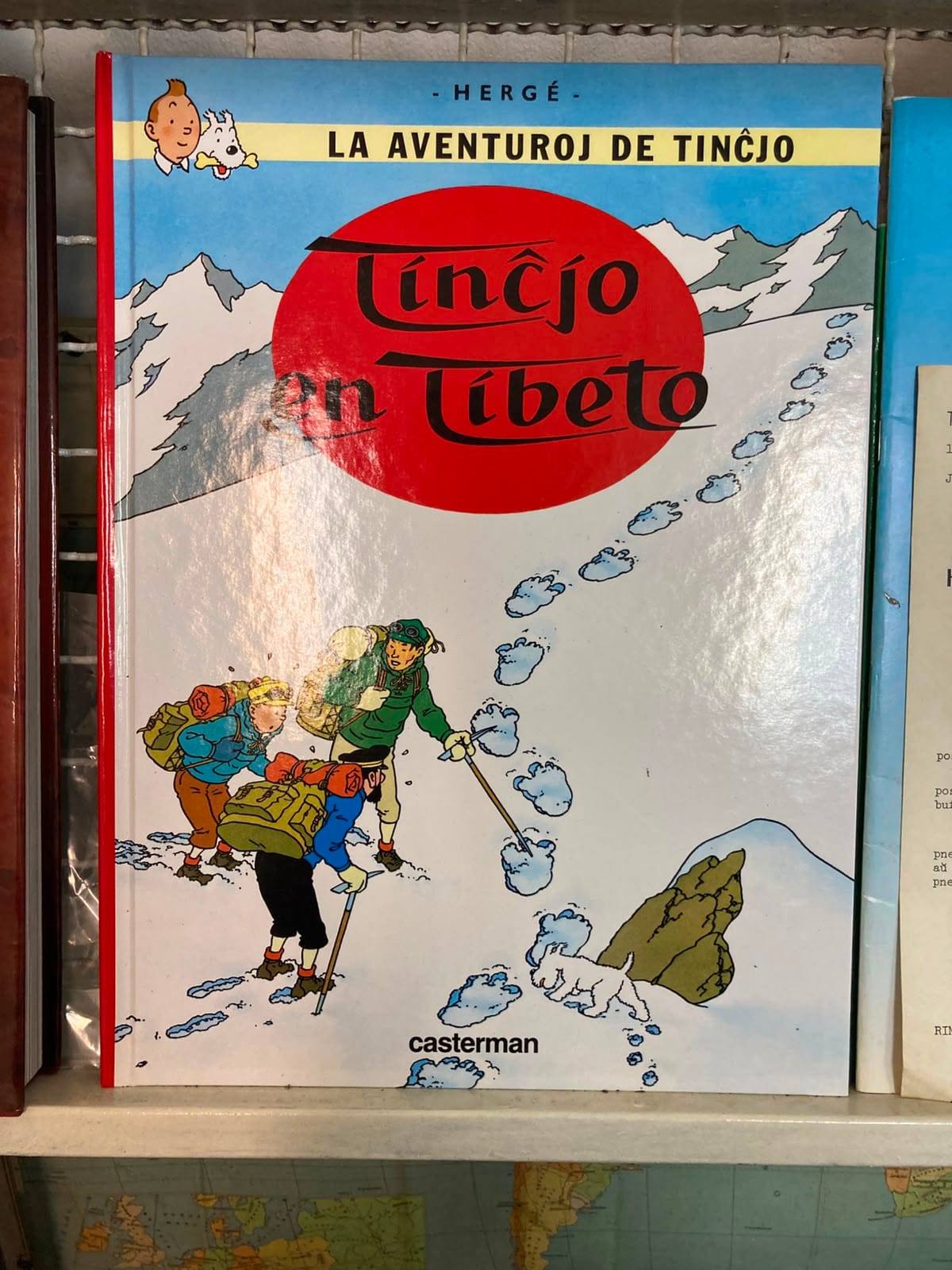
Amidst the cups of tea and pastries on the large table rest some of the most notable titles translated into Esperanto; there’s everything: comics of Tintin, Martín Fierro, The Metamorphosis by Franz Kafka, the trilogy of The Lord of the Rings, along with the New Testament and the Quran. They also show me the book by Argentine Carlos Wappers, titled La paperoj de Wappers, an anthology of reflections, adventures, and oddities written directly in Esperanto, often used as one of the introductory readings for those new to the language. “Since they are short stories, it’s used so beginners can get accustomed,” explains Juan Fertino, the association's secretary.
Esperanto is not just a language without a nation; it’s an international community, a movement. In 1966, Argentine Rubén Feldman González conceived the Programo Pasaporto, a network to connect Esperanto speakers from different parts of the world. In 1974, the Pasaporto Servo was published for the first time in print, a geographically organized guide with the details of Esperanto speakers worldwide. The idea was for them to be able to contact each other and stay with one another, creating a true community, decades ahead of the Couchsurfing project. The rule is that you cannot charge for lodging and that you must speak in Esperanto. There are Esperanto musicians who have organized tours around the world this way, staying in homes, sleeping on couches, traveling the planet the old punk way punk. The last printed edition was in 2017; currently, the Pasaporto Servo operates online.
Fertino reflects, “I believe it has evolved so much and there’s so much history behind it that it has become a movement, at least for the vast majority of us. It’s not just a language; there’s a common goal among the members.” They admit it hasn’t been difficult to confuse them with a sect, because Esperanto speakers have a strong sense of community: if you speak Esperanto, you are part of it, you are a friend. This almost unbreakable bond has allowed people from different parts of the world to have at least one thing in common, a language to communicate and get to know each other. But nothing could be further from a sect; there’s no leader to whom to pay a tithe; on the contrary, everyone makes an effort to keep the language and the community afloat, taking care of the PH, printing flyers, maintaining social media, organizing international congresses and visits from Esperanto speakers from different parts of the world, and holding free events to welcome people. Although they mention an intriguing fact: there are spiritualist communities in Brazil that use Esperanto to communicate with their deities. The use of the language can take off in any direction, whether to talk to spirits, communicate with people from other countries, or serve as a neutral language for an anarcho-punk squat in Eastern Europe.
The first congress in 1905 defined what an Esperantist is: one who speaks and knows the language. Zamenhoff wanted to detach it from any ulterior motive beyond the simple use of the language, whether a speaker or an organization of the left or the right. The ideology belongs to the people, not the language. That’s why many speakers refuse to have it institutionalized, for example, used as a neutral language in the United Nations, to avoid it being an imposition or top-down approach, ensuring it’s an organic use driven by the desire to learn and use it. However, there was an intention from the Buenos Aires Esperanto Association to bring Esperanto closer to the foreign ministry for it to be taught to ambassadors and consuls.
The Buenos Aires Esperanto Association was founded in 1916, originally named the Argentine Esperanto Association, and at the same time, the magazine Argentina Esperantisto was established. Over the decades, the headquarters have changed locations: the current one was purchased with its own funds in 1966, but other properties have been donated by members. The headquarters on Paraguay Street consists of a space where classes are held and meetings take place, along with other rooms that serve as a library and newspaper archive, where members can access all the material. One can find playful rarities like a version of Scrabble with the necessary characters to form words in Esperanto, as well as musical records entirely recorded in the language.
In 2014, Argentina hosted the 99th Annual Congress of the World Esperanto Association, which began on July 27 and welcomed over eight hundred people from a vast number of countries. In that context, the initial team for the Esperanto national football team was also formed, with players from Argentina, Brazil, Cuba, Colombia, Nicaragua, Uruguay, Germany, Congo, and Russia. The idea is to continue with the initiative and face teams that are not part of FIFA, like members of the South American Council of New Federations, even though they cannot train regularly due to the diverse origins of the team members.
One can find playful oddities like a version of Scrabble with the necessary characters to form words in Esperanto.
Despite being a language that is not officially spoken by any nation, there are a few cases of native speakers, such as Judit Polgár, a retired chess master whose father taught her Esperanto before the language of her country, Hungarian. Within the Esperanto community, she is something of a rockstar, an admired and recognized figure. Another (supposedly) has been the businessman George Soros. His father, Tivadar, wrote several books in Esperanto: Modernaj Robinzonoj (Modern Robinsons), from 1923, depicts his escape from a Russian prison camp; while Maskerado ĉirkaŭ la morto (Masquerade Around Death) from 1965, is an autobiographical novel about the Nazi occupation of Budapest. It was translated into English, French, Spanish, Hungarian, Italian, Polish, Czech, Russian, German, and Turkish. Additionally, in 1922 he founded the literary magazine in Esperanto Literatura Mondo. However, Silvia doesn't hold him in high regard; it seems he may have betrayed Esperantists during the Nazi occupation.
More than a century after its invention, Esperanto continues to be spoken and has adapted to new technologies and needs. Far from achieving its ultimate goal of being a language spoken by all humanity, it continues to modestly gain ground among people who do not want to be dominated by the prevailing languages. Although it has perhaps achieved something even more important: a solid and united community, where strangers from different parts of the world can meet and understand each other. In other words, a world that is a little closer together.
Y a cada colaborador se le paga por su trabajo. Las dos cosas dependen de los suscriptores.