A Big Comeback: Inside Magic's Buenos Aires Regional
407 players, a hall that couldn't hold them all and a controversial semifinal: a report from the Regional that brought competitive Magic back to Argentina.

From October 23 to 25, the Magic: The Gathering Buenos Aires Regional took place, organized by DEVIR Brasil. The event drew 407 players, an absolute milestone for competitive Magic since the pandemic.
In the new competitive circuit, these tournaments (the Regionals) are the gateway to the Pro Tour (the professional tournament), the ultimate goal of every player looking to make a name for themselves in the world of “painted cardboard.” To get in, you first have to qualify through RCQs (Regional Championship Qualifiers), which are held at game stores across the region.
The Pro Tour is the biggest event for any player: it brings together the top 300 or so players in the world and pays out $50,000 to the winner. It also has a perk: if you finish with a positive record (winning ten or more matches over the event), you lock in a direct invite to the next one. On the street, a player's level is measured with the classic question: “How many Pro Tours have you played, kid?”
On the street, a player's level is measured with the classic question: “How many Pro Tours have you played, kid?”
But let's get back to the main event: the Buenos Aires Regional. The tournament brought together a huge number of participants (407) in Modern, one of the most beloved formats, but also one of the toughest when it comes to playing Magic.
Tournament details
Here are the key facts about the tournament:
- Event link: Melee.gg
- Format: Modern
- Day 1: 9 rounds of Swiss.
- Day 2: the top 8 from the previous day played a single-elimination playoff (win and you advance; lose and you're out) to crown the regional champion.
- Prizes:
- 10 Pro Tour invitations for the top finishers after the Swiss rounds.
- 2 invitations to the Magic: The Gathering World Championship for the finalists.
- A total of US$34,000 in prizes was paid out as follows:
- 1st: US$8,000
- 2nd: US$6,000
- 3rd and 4th: US$4,000
- 5th to 8th: US$1,500
- 9th to 10th: US$1,000
- 11th to 12th: US$1,000
- 13th to 16th: US$400
- 17th to 32nd: US$150
The players and the metagame
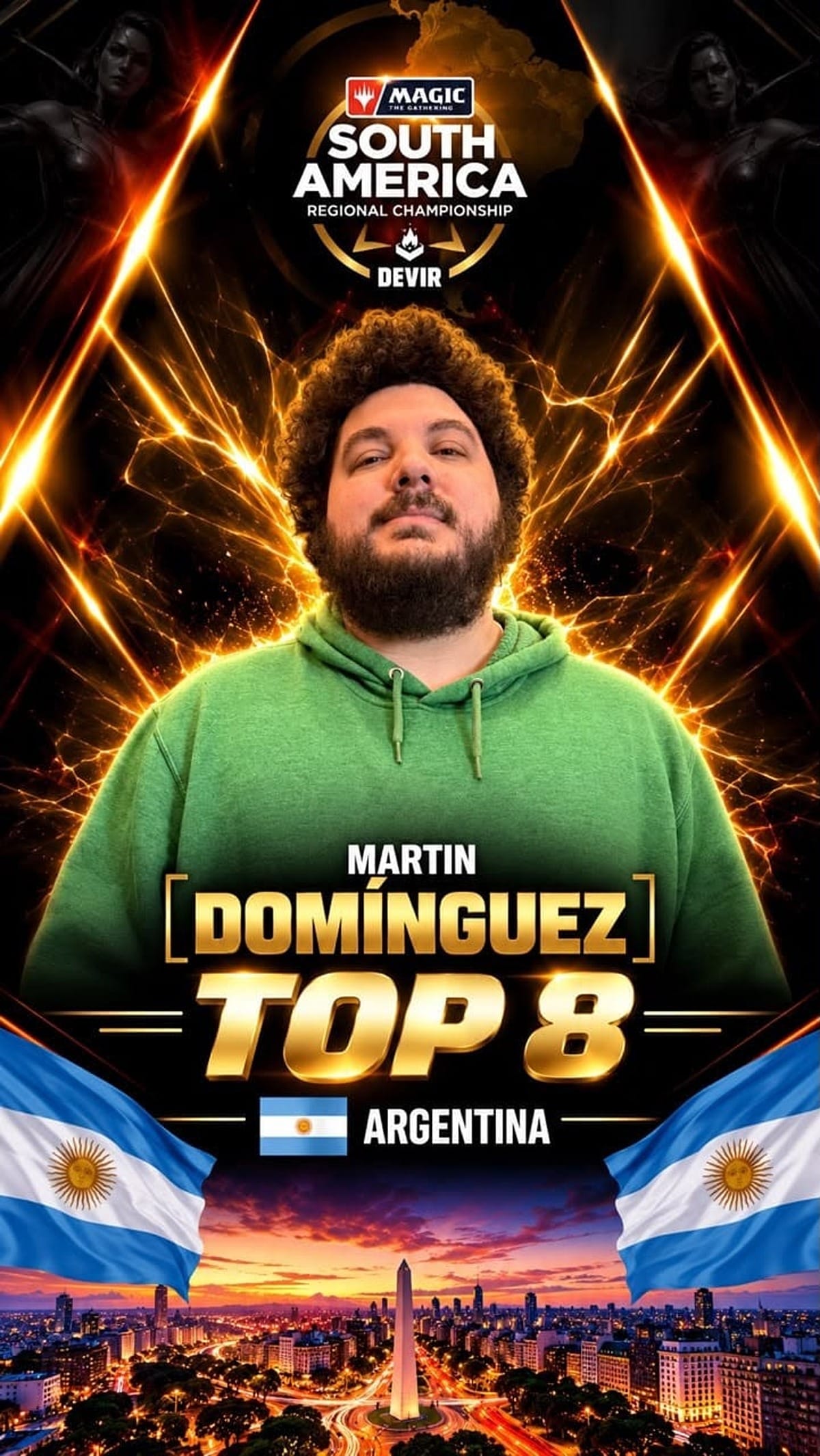
The tournament was ultimately won by Luis Esteban Venegas (Chile), who reached the final alongside Martín Domínguez (Argentina). Both will represent Latin America at Worlds. Luis Esteban capped off a brilliant tournament with an 11-1 record, while our countryman Martín Domínguez finished at 9 wins, 1 loss (the final) and 2 draws.
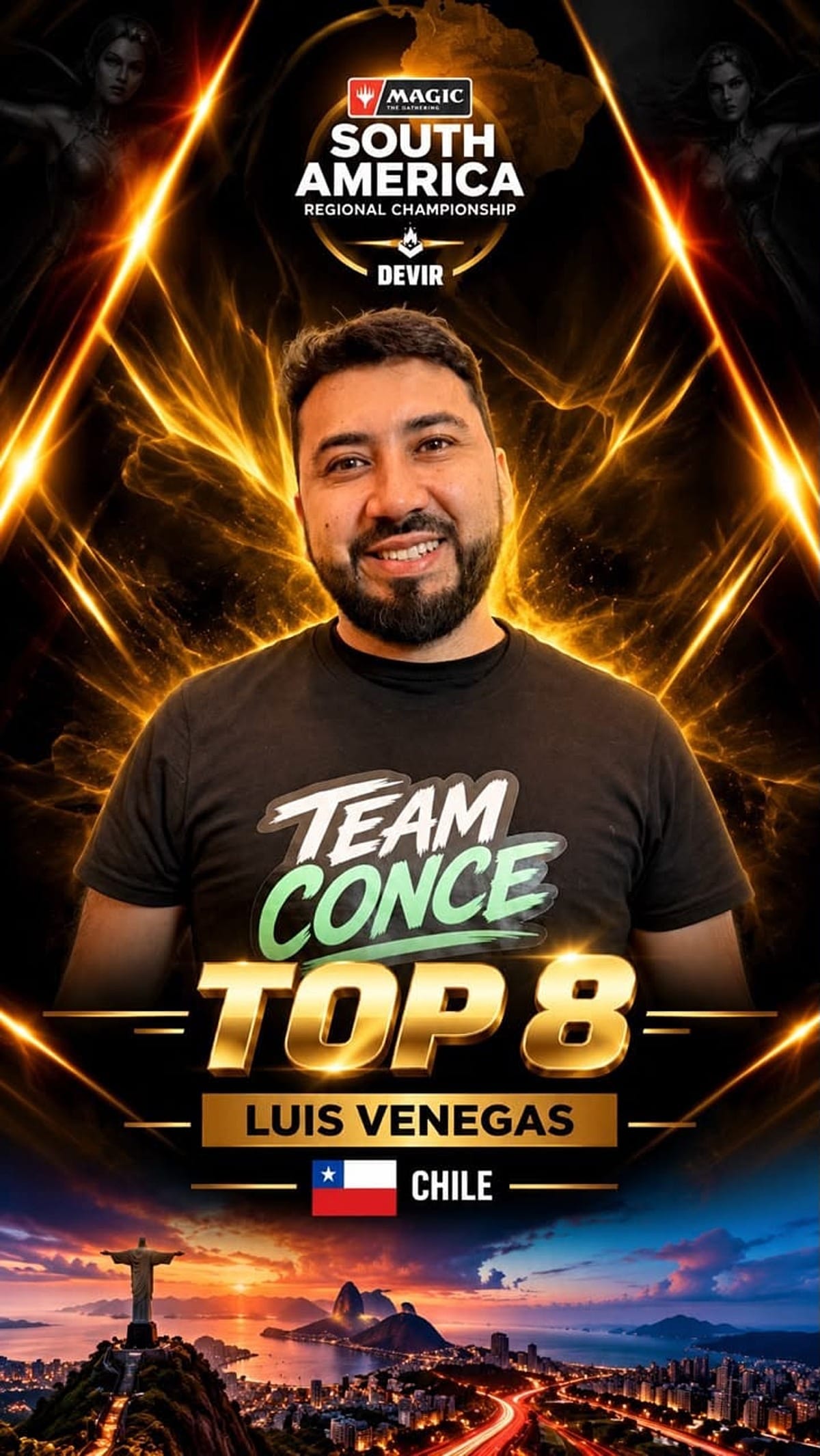
As for the metagame (that “rock, paper, scissors” analysis that determines which deck to pick, what it beats and what it loses to), Modern is a very particular format because the card pool is enormous and the possibilities are nearly endless. So much so that Luis played a Boros Energy deck that had all but disappeared and managed to catch everyone off guard. It goes to show that Modern always has surprises in store, since it boasts the biggest repository of cards, synergies and key pieces in the history of the game.
While the event link shows the final standings, decklists and stats for every player, what you won't find there is what the event felt like on a human level.
The coverage and behind the scenes
For starters, the event had full digital coverage, which I took part in as a caster (commentator and play-by-play). You can relive it here:
South America RC Day 1
South America RC Day 2
On top of the main event, on Friday there were single-elimination qualifiers (last chance) for the final invitations. And throughout Saturday and Sunday there were all kinds of side events: from drafts at very affordable prices, to tournaments in various formats, and qualifiers for the next Regional and for the first-ever draft Pro Tour in history (more on that later).
There was an incredible party vibe in the air. It had been many, many years (since 2015) since the country had seen anything like it, and that's why everybody showed up.
Why did the event go wrong?… Or rather, why did it go so right?
Let's be real: the venue couldn't handle it. On Friday, the last chance qualifiers had to be held at nearby stores because the main hall wasn't available, and it was a madhouse. On Saturday, the side events couldn't start until space opened up in the main tournament as players got mathematically eliminated.
As for the broadcast, we didn't have a decent area to set everything up, we ran into technical hiccups beyond our control (the internet went down at one point!) and the venue's lighting drove us crazy trying to manage the glare on the cards on camera.
For side event prizes, they used a ticket system (like arcade tickets at the boardwalk) to redeem at the prize wall. But there wasn't much variety: just a couple of options (Commander decks, collector boosters) at a really low price, which had people going nuts competing to rack up tickets and standing in a mile-long line for “whatever was left.”
If you only read these details, you might think: “Wow, that event was a total mess, huh?” But no, that's not how it went. Sure, they badly underestimated the turnout, partly because no post-pandemic Regional in Latin America had topped 300 people, and it had been over eleven years since a tournament of this size set foot on Argentine soil. The world has changed: Commander now dominates with overwhelming force, and we went through a pandemic that rewired our heads.
It was hard to foresee more than 400 people playing the main event, especially considering the format was Modern. Why? Because Modern was once dubbed “the people's format,” but it stumbled when Wizards of the Coast (the company behind the game) decided to give it massive support by creating sets made exclusively for it. That changed its makeup, sent the prices of new cards through the roof while old ones lost value, often turning it into an “either you buy the new cards or you can't play” format.
It was also hard because competitive play was dying in Argentina: events that couldn't draw a decent turnout, formats people no longer wanted to play because the cards are impossible to find (Modern) or because keeping up with set releases makes it hard to stay current (Standard). I had done a stream earlier analyzing the state of the competitive circuit after an important tournament that had drawn just eleven players.
Why was the event a resounding success?
Despite the hiccups, the turnout was historic. Not only did more than 400 people attend, but there was real Latin American representation, with players from Brazil, Chile, Uruguay, Colombia, Ecuador and Peru, on top of a huge, fully present Argentine community. Events work when people show up for them, when they come, play and have a blast.
It's true there wasn't enough space, but once the venue got sorted out and the drafts kicked off, they never stopped! At one point I heard through my earpiece (I was commentating live): “Draft 1, registration open!”, and before you knew it they were already putting together draft number 6. The stores Magic Dealers and Tolaria sold singles, sealed product and accessories to an impressive stream of buyers.
The venue was easy for everyone to get to, with good tables, chairs and all the comfort you need to play for hours. Plus, we had official Magic artists on site, so you could get large prints of your favorite illustrations or have cards signed by the people who made them (something we'd missed since the old Grand Prix days).
More than 400 people said, “We like to compete here,” pulling off a historic milestone not just for the country, but for the whole region.
Magic came back to Argentina at a key moment, when many of us felt the looming danger that competitive play would disappear and make way for nothing but Commander, driven by Wizards of the Coast's commercial goals. But more than 400 people said, “We like to compete here,” pulling off a historic milestone not just for the country, but for the whole region.
With numbers like these, let's hope Wizards understands that in Argentina and Latin America competition is essential; we all love preparing for tournaments and spending hours playing just so that one person can walk away with the glory.
A finale with a side of controversy
As you'd expect at a tournament this size, there was one last controversy. In the semifinal, the matchup between Martín Domínguez (Argentina) and Jonathan Restrepo (Colombia) (a match that effectively decided a direct invite to Worlds, since that prize went to both finalists) ended with Martín winning due to Jonathan's disqualification, which removed him from the tournament with no prizes and no right to appeal.
If you want more details on this episode, here's an interview with Martín where he tells his side of the story, with analysis and every last detail.
Final thoughts
This event is very personal for me. For the past couple of years I've been the voice of the regionals in Latin America, and the question always comes up: “Don't you feel like competing again?” Of course, watching a tournament like this, with that hunger for glory and tickets to the Pro Tour and Worlds (events I was lucky enough to play in the past), stirs something inside. But it's also beautiful to be the voice and face of these broadcasts, to show those who haven't taken the plunge yet every detail of every game, every player and every big name we have in the country and the region.
The Buenos Aires Regional was hugely anticipated. There were those with high or low expectations, those wondering what's going on with the game in Argentina, and those who had maybe drifted away in search of other horizons. It proved, loud and clear, that competitive Magic is more alive than ever. What matters is showing up and joining in. Who knows, maybe at the next tournament you'll find me calling your match and celebrating the win of a new generation or of old friends making a comeback.

2026 is on its way out, leaving us with big expectations for 2027. On the competitive front, the São Paulo 2027 Regional is coming up at the end of January, awarding slots for the Pro Tour in Tokyo, Japan (a big, long-awaited return!), in a season centered on Standard. But if 60-card decks are your thing, there are plenty of active formats (Pauper, Premodern, Pioneer), plus digital platforms like Magic Arena or Magic Online.
If you need help or have questions, you can find me streaming on my Twitch channel, on my YouTube with special content, or at the next tournament, whether playing elbow to elbow or in front of the camera calling your next big win. The world of TCGs is more popular than ever.
Las notas de 421 no tienen paywall
Y a cada colaborador se le paga por su trabajo. Las dos cosas dependen de los suscriptores.