Solarpunk Tactics: Cards, Apocalypse, and Art
Solarpunk Tactics: Cards, Apocalypse, and Art
Jorge Luis Borges once said that "there's no classification of the universe that isn't arbitrary and conjectural," and this phrase applies equally to the world of games. Nothing kills fun faster than trying to classify it. Nothing is more futile than attempting to capture the magic of a design with labels. And yet, as soon as a title shakes up the market with a new proposal, a thousand imitators follow, and you know they've learned the wrong lessons because they come armed with cold, derivative pronouns, more inclined to win over the Steam algorithm than the hearts of gamers. This happened with Slay the Spire and deckbuilders in 2018, it happened with Magic The Gathering and TCGs in '93, and it will probably never stop happening.
But in the indie scene, there's still a desire to be different and, above all, authentic. That's why I'm already tipping my hat to a title worth playing, if only for its oxymoronic premise: Solarpunk Tactics is a card duel video game where there's no luck involved.
How do you play?
At first glance, the formula of Solarpunk Tactics is simple and familiar. Your goal is to reduce your opponent's life to 0. To do this, you'll play creatures and tactics. The creatures persist on your side of the battlefield and, at the end of each turn, attack the creature opposite them or, if there’s nothing there, the opponent directly. The tactics serve to enhance your creatures or weaken your opponent's, featuring various classic keywords from this genre (like trample or poison) and some more idiosyncratic ones from a positioning game, such as tanking the damage that their neighboring creatures would receive or having their attacks damage the entire opposing area of the battlefield.
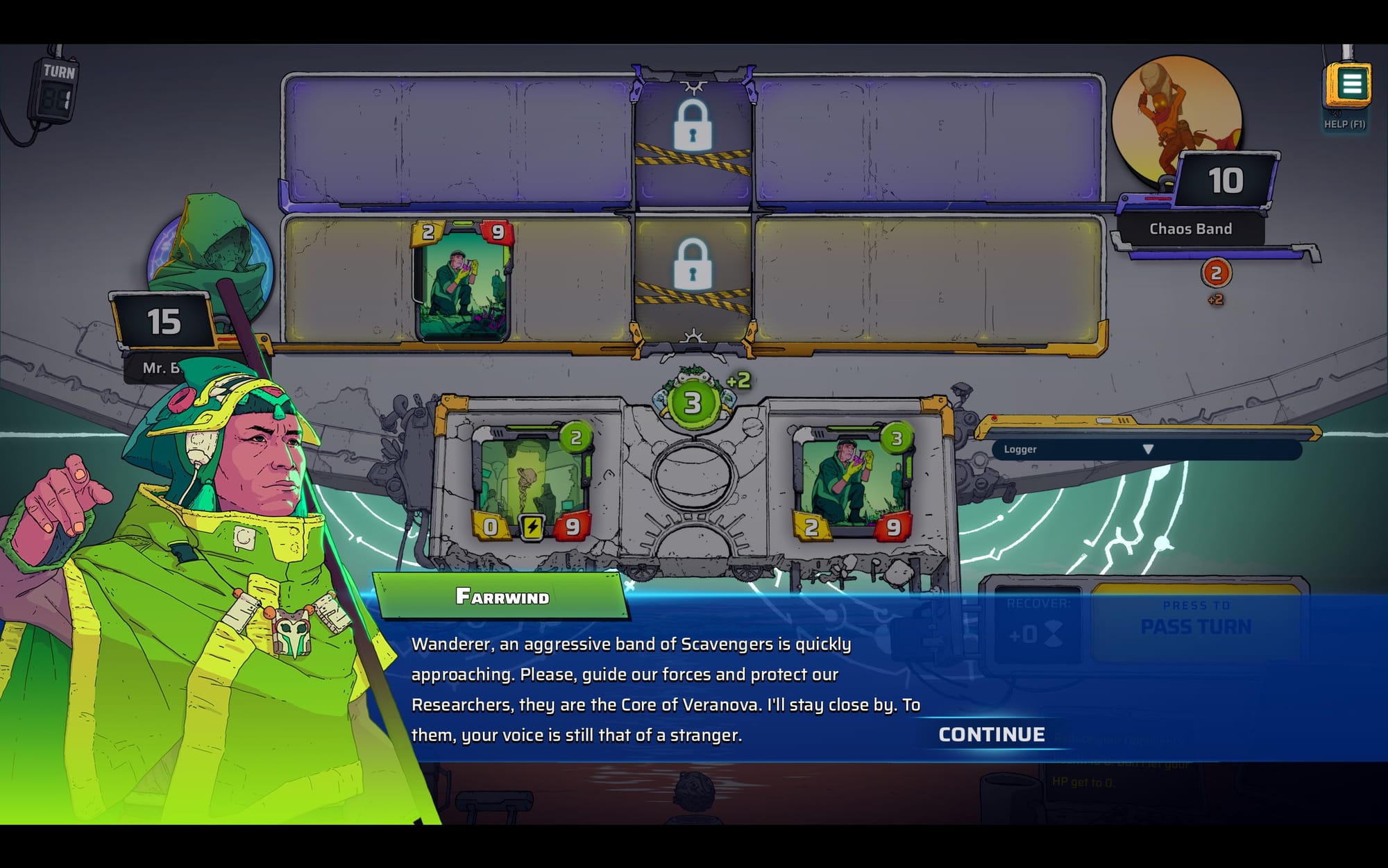
Of course, your cards have costs, and to play your best creatures, you’ll need to save up or play creatures with ramp, increasing your base energy generation, which starts at 2. This economic tension is complicated by the fact that you’ll be playing with up to four factions, each using a different type of energy. But unlike Magic, where the problem lies in the randomness of drawing the right lands to play your color combination, here you will always (eventually) gather the necessary energy: the question is when to spend, when to save, and how to allocate the mere 7 slots for creatures you have. Solarpunk Tactics is a generous yet restrictive game. It has clear guardrails to ensure you don’t have dead turns, but it wants you to feel a constant sense of urgency. Unlike the scientists of Jurassic Park, it doesn't want you to ask if you can play something, but rather if you should.
Solarpunk Tactics is a generous yet restrictive game. It has clear guardrails to ensure you don’t have dead turns, but it wants you to feel a constant sense of urgency.
The cornerstone of this philosophy lies in the most bombastic twist of the title, which almost complicates defining it as a card game: you can always play any of your sixteen creatures/tactics. You don’t need to worry about drawing a good hand or how many copies you have left of your bomb. Everything is available from the get-go until the bell rings. Solarpunk Tactics has perfect information and zero luck. “No top-decking, no bad draws, no excuses.”, reads its Steam page, and it’s spot on. You have all your toys at your disposal and all the responsibility to win each match.
I know what you’re thinking, you dirty combo players: how is this game not broken? If with all the luck in Magic there are decks that can win on turn one, how do you avoid that when you have access to all your cards? The second pillar, perhaps less flashy but equally transformative, is that you can only play one “card” per turn. Games are built on restrictions, and this one changes everything. Suddenly, each turn carries a heavy weight: do I play a creature that generates energy for something big later, or do I start causing trouble early on? Do I respond to my opponent's creature with something that absorbs their assault, or do I attack on the opposite flank to open a damage race? As I mentioned before, the omnipresent emotion is urgency. In few games is the concept of tempo as palpable as in Solarpunk Tactics.
I know what you’re thinking, eager combo players: one card per turn… sounds boring. Where’s the excitement, the texture, the glucose spike that only a chain of plays can give you? Don’t worry, Solarpunk Tactics has plenty of that chimichurri. The central mechanic I haven’t explained yet is time warp X, which is basically an exception to the restriction I mentioned earlier. Certain cards allow you to play again only if you have at least X time energy, which is a special type of energy. The catch is that, of course, these cards consume that time energy, so threading a combo will require a very precise order in how you play them. And how do you get time energy? There are two ways, which round out the experience of this title. The first is to have an Avatar, which can be any of your creatures, played in the space between both halves of the battlefield. Your Avatar will give you 1 time energy per turn, in addition to receiving certain bonuses and potentially applying its buffs to your creatures in both zones.
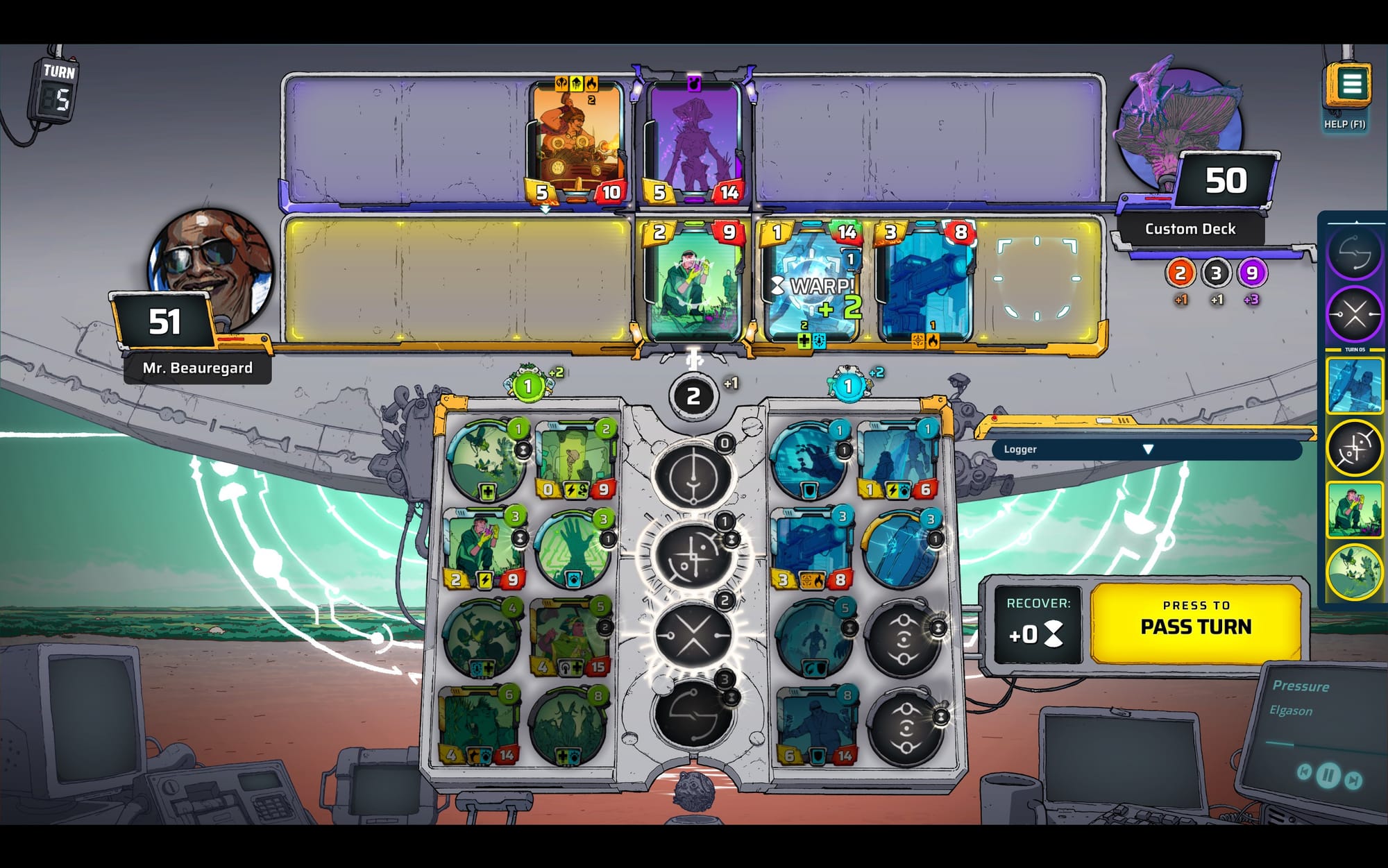
The second way is very simple but has delicious implications. Every time you perform a time warp, meaning you play an additional card, your opponent receives one time energy. This means that the crazier your combo, the more rope you give the other player to return the favor, which in turn gives you more energy. It’s a flash of positive interaction that, in a 100% confrontational game, is there to make you think twice before getting lost in an eternal combo. Again, Solarpunk Tactics lets you do it, but the question is, should you?
The apocalypse has never looked so beautiful.
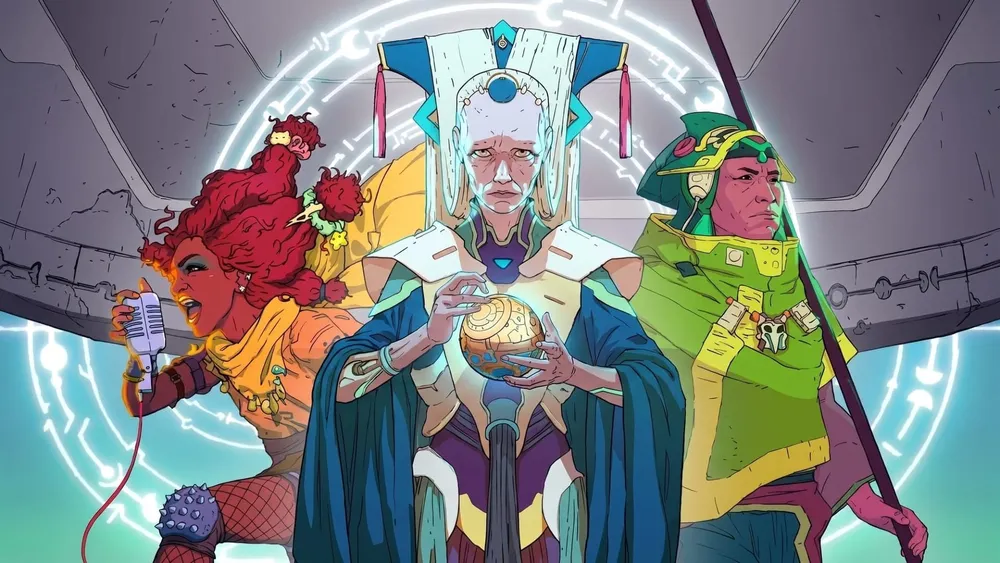
For such a cerebral, chess-like, and mechanically rich experience, it’s a pleasant surprise that Solarpunk Tactics is so visually striking. In fact, the way I discovered it was because, amidst the wave of titles at EVA 2025, I couldn’t overlook its aesthetic and had to approach to see what it was about. There aren’t enough compliments for the art of this game, created by Jorge Matar, which masterfully combines handcrafted pencil strokes with an explosive and vibrant color palette, even in the most sinister or repulsive pieces.
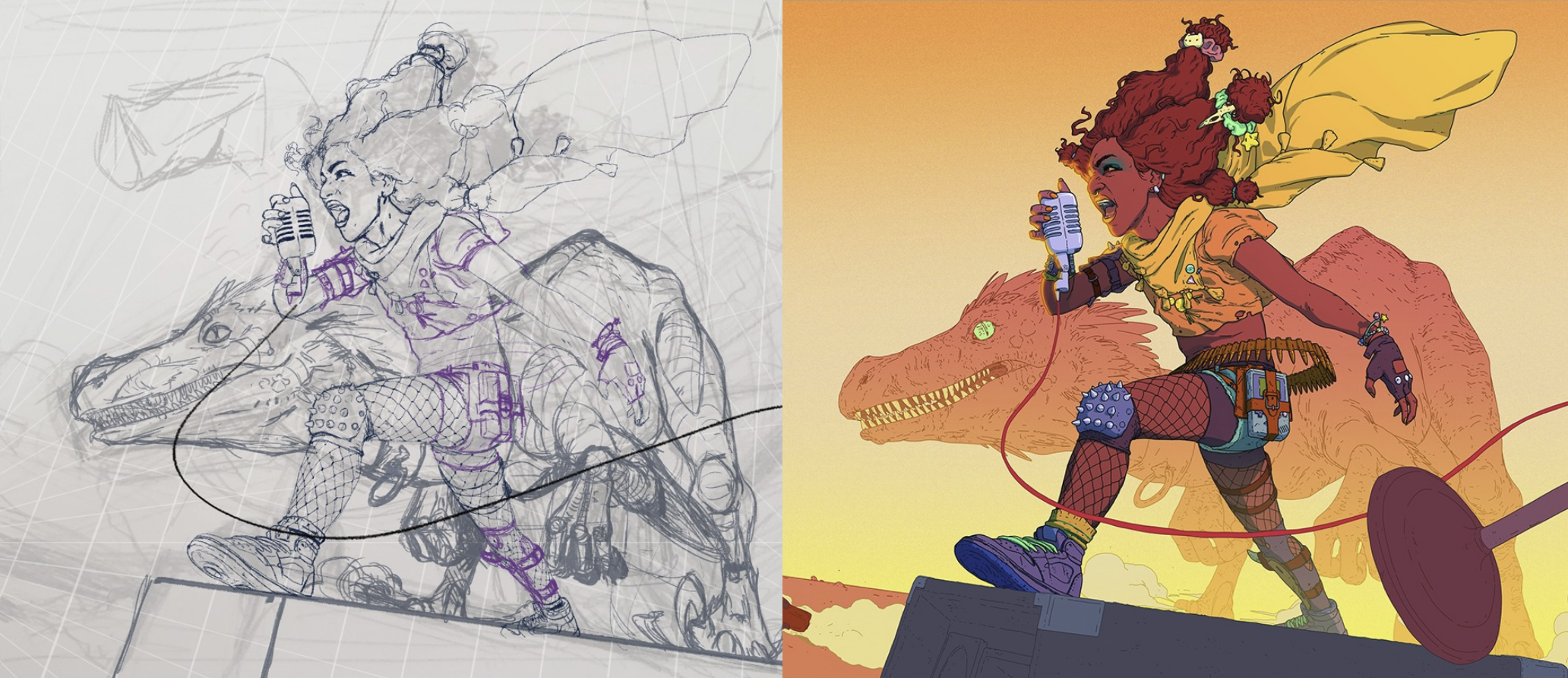
The setting of this game is a post-apocalyptic world ravaged by biochemical warfare, resulting in the annihilation of most of Lumnia and the fracturing of time itself into different timelines. Consequently, only four factions survive. Each embodies a grandiose concept under which to rebuild civilization - Life, Death, Order, and Chaos - and is led by a Time Weaver, someone capable of manipulating time and eventually reuniting it under their timeline. It’s a well-trodden yet still very foundational worldbuilding, enhanced by its charismatic characters, whom the eight-level tutorial introduces in the style of Advanced Wars, with sparkling dialogues that hint at their personalities and differences in how to face this dystopia and its first antagonist, Meleborus and the Nexus, the fungal faction that feeds on death.
There aren’t enough compliments for the art of this game, created by Jorge Matar, which masterfully combines handcrafted pencil strokes with an explosive and vibrant color palette.
“Meleborus is not a villain but a force of change, of transformation,” explains Nicolás “Tenchu” Altomonte, lead programmer of Solarpunk Tactics and CTO of Obnoxious Games, the Rosario-based studio behind it. My question had been why, in a solarpunk themed game, the enemy of the prologue was a force of nature. He tells me that it’s inspired by the Scorpion Clan from Legend of the Five Rings (an excellent and very particular Living Card Game from the golden days of Fantasy Flight, which is still alive in Argentina in the hands of a group of fans), a faction whose reputation for being ‘the bad guys’ is actually a role they choose to play since they promise their emperor “I will be your villain”. “Meleborus, then, comes to play that role, opposing to set things in motion, destabilizing the other factions. They also wanted them to have an aura of mystery, alluding to psychedelia, to mind control. And their true intentions will deepen later with the deep lore.” The prologue of Solarpunk Tactics is just the tip of the iceberg of Lumnia. There’s much more to reveal and even to develop alongside the community. “The results of the tournaments (which we’ve already held in alpha and will soon open to everyone) will influence the development of the characters. And the decks and cards used by the champions will appear as single-player enemies. Solarpunk Tactics is not designed exclusively for PvP or solo play. It’s both, and we want them to be connected.”
A bit of hope and freshness in a dystopian market.
Nicolás acknowledges that these plans are “very ambitious for an indie studio,” but he shows no doubts regarding the roadmap. He also has no qualms about telling me that Obnoxious Games started out trying to make another game with too much scope, which led them through many "first times" and left them well-prepared to tackle this project. While the team (which also includes Nahuel Gómez Aprile and Gustavo del Gerbo) has experience with many card games (from Leyenda, Pokémon, and Magic to more recent titles like Runeterra, Artifact, and Midgard), the original inspiration is Spectromancer, a 2008 title I had never heard of but was not surprised to find associated with the one and only Richard Garfield. Spectromancer proposed a dueling card game without a hand, deck, or discard, but with RNG in card availability. The folks at Obnoxious wondered what would happen if that idea was combined with perfect information and the warp mechanic, and thus the seed of Solarpunk Tactics was born.
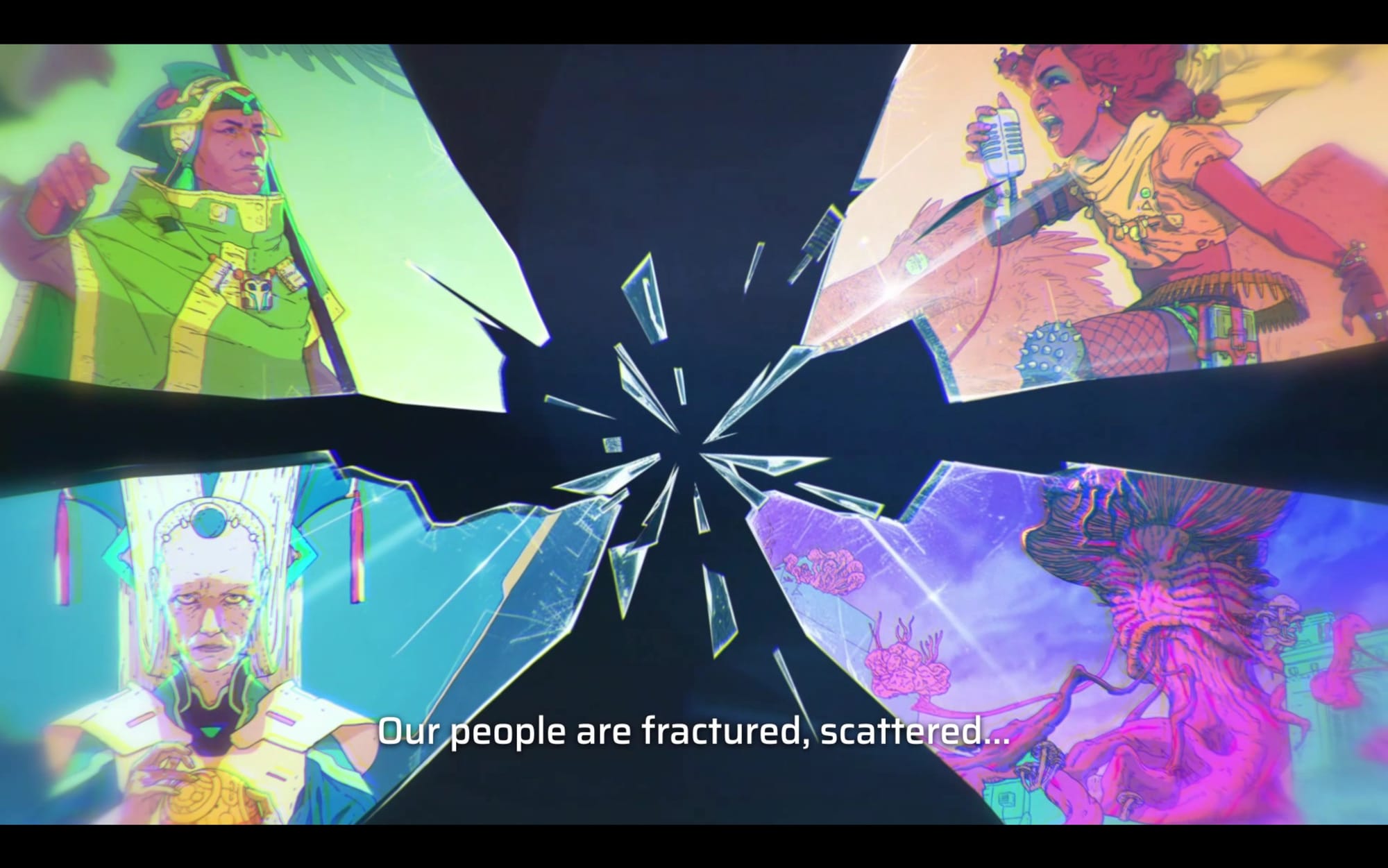
That was several years ago. In between, there’s been a tremendous amount of work: more than ten collaborators simultaneously, a very strong community on Discord, support at the municipal, provincial, and national levels, from the Rosario Game Devs group and Crack Bang Boom to EVA and winning a ticket to GDC. Oh, and developing in Godot, with all that we already know that entails.
“It’s all grassroots, but that’s how we like to develop, with a solarpunk vein,” declares Tenchu, making it clear that they’re not using the term as a sci-fi dogwhistle but as a declaration of principles that encompasses a political thought, a way of working, a type of story to tell, and a playful experience to share. “This is a game without microtransactions and without pay-to-win mechanics. I love the philosophy of DOTA, although I think giving all the content to the public at once is a disservice to the experience. Players like to unlock things, have personal progress, and along the way experiment with the cards they obtain. But we definitely don’t want you to have to grind endlessly.
They’re not using the term as a sci-fi dogwhistle but as a declaration of principles that encompasses a political thought, a way of working, a type of story to tell, and a playful experience to share.
As for what horizon to pursue now, the strategy is threefold. On one hand, Obnoxious Games is looking for a publisher to finance the complete development of the game. They're also considering launching a Kickstarter to crowdfund the long journey to version 1.0. But the main avenue is to transition to an open beta, which will allow them to gather wishlists, rebalance the cards based on massive stats, nurture the competitive scene, and of course, spread the word about the game.
So whether you enjoy environmental sci-fi, or you thought the card game genre had nothing new to offer, I invite you to check out the store page for Solarpunk Tactics, add it to your wishlist, request access to the Steam playtest, and manipulate time to save what’s left of Lumia.
Las notas de 421 no tienen paywall
Y a cada colaborador se le paga por su trabajo. Las dos cosas dependen de los suscriptores.