Borges, the Precursor to the Backrooms
Amid endless labyrinths, VHS nostalgia, and chaotic geometry, the film Backrooms (A24, 2026) revives the horror of the infinite and proves that Borges continues to shape the weird fiction genre.

Amid endless labyrinths, VHS nostalgia, and chaotic geometry, the film Backrooms (A24, 2026) revives the horror of the infinite and proves that Borges continues to shape the weird fiction genre.
Borges, the Argentine writer, remains a ghost that haunts weird Western narrative. Recently, Backrooms, the new A24 film directed by the very young Kane Parsons and written by Will Soodick, came out, and it’s hard not to think of him.
Did I like the movie? Yes, and no.
Is the movie deficient in any way? Many things could be said: that it exhausts itself (as Peter Griffin said in Family Guy regarding The Godfather: It insists upon itself, Lois), that it seems little more than an endless parade of spooky settings in the most diminished version of a Wes Anderson film, that it allows for a psychological reading that’s been visited to the point of exhaustion when the backrooms tend to appear as the protagonists’ “unconscious,” escaping “above” the labyrinth that the film itself creates when introducing the “scientists” without leaving anything unresolved, etc.
We’re going to keep talking about Borges until the year 5000, or until a meteorite destroys the Earth, whatever comes first.
But his flaws don’t matter. What matters is the overall effect of the device. And its effect is, I believe, broad, and by broad, joyful. First, because it picks up, at least in the larger contexts, a glove that no one dared to take after David Lynch, that of surrealism; second, because it half-confirms a thesis I like to play with; namely: that we’re going to keep talking about Borges until the year 5000, or until a meteorite destroys the Earth, whatever comes first.

I doubt that the audience of 421 is unaware of where backrooms come from. I would like, in any case and for the confused, to briefly recount the history of the phenomenon.
Creepypasta can be read as contemporary urban legends. They are fictional stories close to the genres of horror and fantasy that mutate in the material they work with (either through texts written in forums or blogs, or through images or videos), and which have been shared since the early days of the Internet. Just like oral tales, creepypasta function in their “openness”: they are never definitively closed, always managing relatively open endings, and are always structurally arranged for people to redefine them and take them to new ports, expanding them until they create a consistent and difficult-to-systematize or historicize lore.
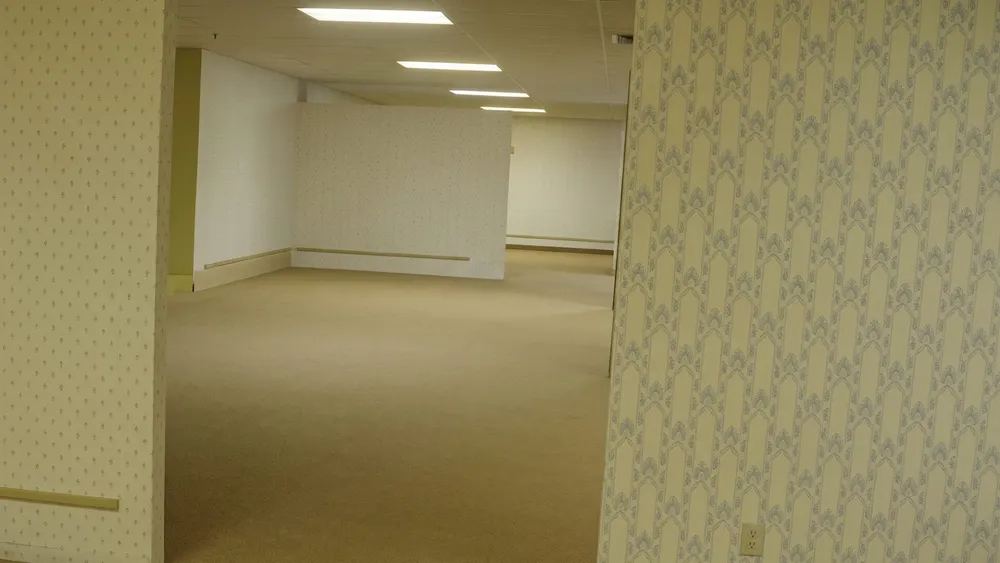
The Backrooms are, duh, a creepypasta. They describe a kind of infinite labyrinth made up mostly of office environments that are generated and rendered automatically as the viewer moves forward. The backrooms would be a no-place, or a dislocated place, out of joint, outside of any possible topology, outside of any human mapping known so far by science.
Its birth is curious. It was on May 12, 2019, when a user on 4chan, in a board reserved for discussions about the paranormal, asked about those places or zones that generate some kind of unease. One specific image became particularly popular. You’ve probably seen it at some point in your life.
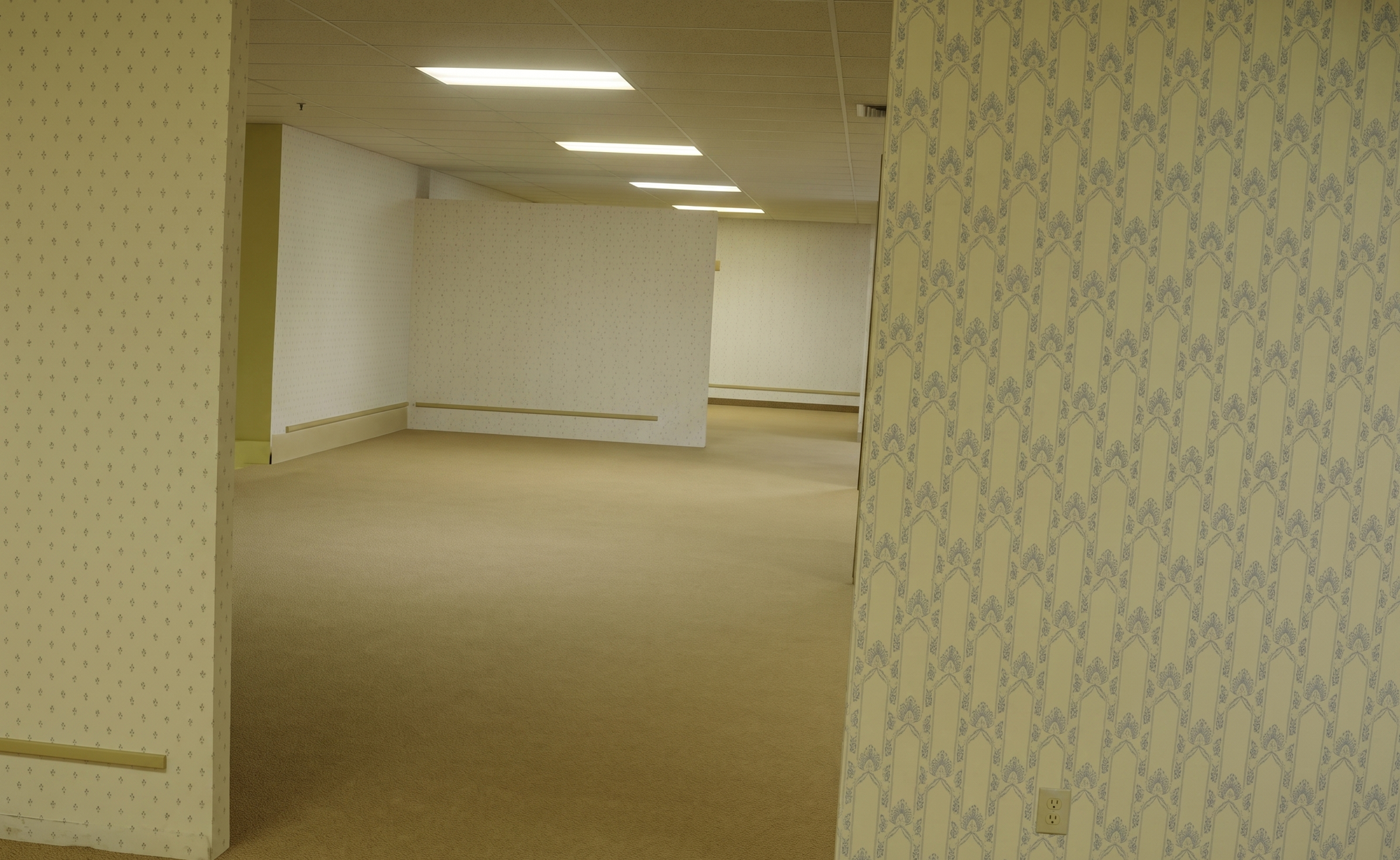
After the image and, by extension, the debate about “liminal spaces” became popular, the 4chan community began writing stories about places that seem barely displaced from reality and sharing photos of “no-clip” spaces, that is, spaces where reality seems to fracture (like strange alleys, abandoned gas stations, long hallways with dim lights, etc.).
At the center of the creative fever, an anonymous user described what is probably the most well-known definition of the backrooms to date:
If you’re not careful and you step out of reality in the wrong areas, you’ll end up in the Backrooms, where there’s nothing but the smell of damp carpet, the madness of monochromatic yellow, the endless buzzing of fluorescent lights, and approximately six hundred million square miles randomly segmented, where you can get trapped. God help you if you hear something wandering around, because you can be sure it already heard you.
The phenomenon achieved enormous success in digital culture, and the fandom became gigantic. So much so that in January 2022, a 16-year-old boy decided to upload a video to his YouTube channel that ended up revolutionizing the history of the genre. The video, set in 1996 (presented as found footage and crafted with a VHS aesthetic), shows a young cameraman who accidentally enters a backroom and gets lost, trying to escape from certain entities that are stalking him.
The young man who produced the video, named Kane Parsons, would take less than four years for A24 to give him the responsibility of taking charge, at only twenty years old, of one of the most anticipated horror film projects of 2026.
The Backrooms respond to an aesthetic of “the liminal” that developed underground throughout the 2010s and is now in good health. It would be interesting to eventually dedicate an entire note to this phenomenon. Not only for its reach, its own weight, and what it has to offer to the renewal of the general aesthetic of horror. But also, and above all, because at least for Valentina Tanni in her latest book published by Caja Negra called Liminal Aesthetics, the digital culture of vaporwave, the backrooms, and weirdcore are today “rarefying” reality and redesigning the aesthetic of horror in contemporary cultural industry.
One of the most relevant precedents, at least in cyber culture, of these alternate ways of understanding both time and space appears in the famous novel Neuromancer (1984) by William Gibson. It is in that novel, although also in the same author’s story “Johnny Mnemonic” (1981), where the concept of “cyberspace” first appears.
What is cyberspace? In literary and philosophical terms, although also in the concrete terms of institutionalized physics, cyberspace seems to function as the very negation of space. It is a no-place, removed from standardized topological diagrams and virtually from end to end, where, however and despite everything, there are “things” that are “located.” At the same time, cyberspace functions as a radical re-founding of time as we understand it. In cyberspace, there are neither national routes nor areas, there are no navigation charts nor fleur-de-lis, there is no North or East; what exists, on the contrary, is a dialogue, a “point of contact,” and a transfer of information at proto-luminal speed. Time, in cyberspace, ceases to be measured by the distance between point A and point B, it ceases to be land and hills and mountains and seas to become nothing more than energy, electricity, and light.
Metaphorically speaking, we can never “see” cyberspace but only perceive its “effects” in the real and concrete world we inhabit. And there’s something in this discrepancy (between the real and the virtual, and in the coefficient of their effects) that is fundamental to address the specific problem I wanted to bring up. Because what I would like to talk about, as I already mentioned, is the fundamental precedent of the aesthetics of the backrooms: Jorge Luis Borges.
As a game, it's always fun to approach Borges through philosophy. Let's dive in, then.
There is a classic problem in Ancient Philosophy. It is known as the “third man problem” or “third man argument.” This is a critique that Aristotle makes of Plato's theory of ideas. Plato believed that the world we inhabit (the world where we are born, breathe, and love) is nothing but a form of derivation, multiplication, an aberrant and impure copy of the one true world that exists, which is the “realm of ideas.” In this framework, the dog we see in the street is not the “real” dog but merely the material and concrete form of the “idea” of a dog, which is what truly exists, or also a material form that participates in the “idea” of beauty, an attribute or characteristic that a dog might possess.
Now, Aristotle says, if we concede that the dog we see and pet is nothing more than an unnecessary duplication of the real, of the world of ideas, then we would need 1) an “idea,” another, that explains the necessary relationship between the concrete dog we see and the “idea of a dog,” 2) or an idea that explains how a real dog and a very cute boy are connected, among other things, by their beauty, and at the same time, 3) an idea that explains how these two entities (the dog and the cute boy) are linked to the “idea of beauty.”
And this is where the problems begin.
According to Aristotle, if we follow the Platonic line, it is necessary to maintain that if there exists a set of entities that share some “common property,” it is because they belong, as a set, to a special “Ideal Form.” Thus, if a set of entities shares a property, they should necessarily be grouped under a specific Ideal Form (let's say, Form 1), but at the same time, there would need to be an Ideal Form (Form 2) that explains the necessary relationship between all the entities that share a common property and Form 1, and at the same time, a third form (Form 3) that explains the necessary relationship between the grouped entities and Form 2, and so on, ad infinitum.
In that context, following Aristotle, this theory would lead us to an infinite duplication of the world, reducing it to complete absurdity and making any philosophical task impossible: there would be no starting point to think about the infinite.
Is it possible to systematize, to make computable an infinite system of infinities? What mathematical secret could be hidden there? Or in other terms, what philosophical truth? Or rather, should we abandon all hope, since an infinite system of infinities is, by itself, ungraspable by any philosophical or computational system?
Perhaps the Abrahamic religions, in a very irresponsible reading of the entire tradition of theology, resolved the problem in a forward flight when they said, and still say, “to all this mess you see, Simba, that you don’t understand and never will, we call it God.” Hence, perhaps, the so-called God of the Gaps: something like the last resort of certain theologians where huge gaps in scientific thought function as arguments, evidence, or ultimate proof of the true existence of God.
If the real can be taken as something ungraspable, infinite, how is it possible then to “represent it”? Is it within our capabilities to draw a map of the real that represents each thing as it truly exists?
But if neither science nor philosophy can account for an experience, an entity, a composition of the world that is incalculable, non-mathematizable, non-conceptualizable, perhaps we should turn to a thought that is much more elastic, freed from methodological sequences, analytical rigor, and categorical apparatuses.
This "other thought" is what we culturally call literature.
And Borges is the writer of the 20th century who attempted to tackle these problems.

In On Rigor in Science, and with his characteristic sense of humor, Borges dives deep into the impossibility or impracticality that Aristotle already highlighted. If the real can be taken as something ungraspable, infinite, how is it possible then to “represent it”? Is it within our capabilities to draw a map of the real that represents each thing as it truly exists? If in Platonic thought the world is always a “duplication,” since the only real thing would be the “world of ideas,” what purpose would there be to “duplicate” the “duplication”? Could the frenzied desire to duplicate the duplication, to represent the world and the real point by point, lead us to madness? Borges writes:
In that Empire, the Art of Cartography achieved such Perfection that the map of a single Province occupied the entirety of a City, and the map of the Empire, the entirety of a Province. Over time, these Unwieldy Maps did not satisfy, and the Colleges of Cartographers raised a Map of the Empire, which was the size of the Empire and coincided exactly with it. Less Addicted to the Study of Cartography, the Subsequent Generations understood that this sprawling Map was Useless and, not without Impiety, surrendered it to the Inclemencies of the Sun and the Winters. In the deserts of the West, shattered Ruins of the Map endure, inhabited by Animals and Beggars; throughout the Country, there is no other relic of the Geographical Disciplines.
Backrooms explores this problem with three rather peculiar gestures.
The first. Lovecraft, the father of the so-called cosmic horror, would work in his literature with the idea that what ultimately drives men insane is the revelation of the true composition of the universe: the inhuman beyond time, the beyond of the limits of space, the ancient biological formations that have no mercy towards us, the secret that distant stars hold, the null value of the human species in the universal mathematics, among other things.
Now, if in Lovecraft the danger to the human race is found most of the time “out there” (or at least “coming from beyond,” like Cthulhu, who sleeps in the Pacific), then Backrooms takes the opposite path: it internalizes and territorializes the horror that the infinite provokes; it does not place the infinite out there, in the vastness of the cosmos, but rather here, on our own Earth.
From the fantastic, and from a narrator who is much more amazed than terrified, Borges also places himself in front of this manifestation. In one of his most famous stories, he writes:
The diameter of the Aleph would be two or three centimeters, but the cosmic space was there, unchanged in size. Each thing (the mirror moon, for instance) was infinite things, because I could clearly see it from every point in the universe.
This gesture in Backrooms (the infinite on Earth) is leveraged by a second, even more radical one: the infinite relocated on Earth is, besides being infinite, always changing and mutating, and by extension, impossible to predict. To the infinite, already a phenomenon at the edge of our anthropic understanding, is added a final attribute, that of a chaotic infinite, which breaks every possible system of causality and, therefore, any human attempt at comprehension.
Backrooms incorporates as elements of its weirdness what in mathematics are called chaotic systems, stochastic systems, and out-of-equilibrium systems.
To the infinite, already a phenomenon at the edge of our anthropic understanding, is added a final attribute, that of a chaotic infinite, which breaks every possible system of causality and, therefore, any human attempt at comprehension.
Borges also wanted to tackle these problems, sometimes even before they were anticipated by the exact sciences. He does, of course, play certain tricks. Each of them has a little trick. In The Lottery in Babylon, chance, which at first surprises, ends up becoming an institutionalized law. The Library of Babel presents itself as chaos, but it is still an obscenely gigantic system, even more infinite than infinity, since it creates infinities from the “set of parts” and from the conjunction of two already infinite sets. In The Garden of Forking Paths, all possible stories occur simultaneously (everything, everywhere, all at once), at least for an unsuspecting observer. The multiverse operating in simultaneity, however, does not represent any disorder for the demiurge who creates the garden, who, with a superhuman capacity, can perceive the perfect architecture.
But there is one last gesture in Backrooms.
The backroom of Parsons and Sodick is not a closed and unperturbed system of centripetal revolutions but rather a non-system always open to the desires, fears, and pleasures of those who enter it. This backroom seems to be an infinite that is not identical to itself, that is, an infinite that does not reproduce solely from its own non-rules, but also incorporates the pathemic, volitional, and desirous infinities (conscious or unconscious) of the humans who dare to enter it.
Hence, each memory, each pleasure, every dysphoric ideation, and every pain, each perverse illusion returns, multiplied and aberrant, different, to be incorporated into the infinite; each pain (always human, too human), in an endless loop , taking form and materializing, but always revisited, terrifyingly transformed in its particularity and specific character.
Tlön, Uqbar, Orbis Tertius, as expected, also addresses this. In another world, perhaps inverted, where consciousness does determine social being, desire, hope, produces, by its own force of egregor, the real. In one of the most polished paragraphs of his entire literature, Borges writes:
Centuries and centuries of idealism have continued to influence reality. It is not uncommon, in the oldest regions of Tlön, for lost objects to duplicate. Two people search for a pencil; the first finds it and says nothing; the second finds a second pencil no less real, but more suited to their expectation. These secondary objects are called hrönir and are, although somewhat disregarded, a bit longer. Until recently, hrönir were casual offspring of distraction and forgetfulness. It seems unbelievable that their methodical production has only been around for a hundred years, but this is what the Eleventh Volume states. The first attempts were sterile. The modus operandi, however, deserves to be remembered. The director of one of the state prisons informed the inmates that there were certain tombs in the ancient bed of a river and promised freedom to those who brought back an important find. During the months leading up to the excavation, they were shown photographic plates of what they were going to find. That first attempt proved that hope and greed can inhibit; a week of work with shovel and pickaxe did not unearth another hrön than a rusty wheel, dating after the experiment. This was kept secret and was later repeated in four schools. In three, the failure was almost total; in the fourth (whose director coincidentally died during the first excavations), the students unearthed—or produced—a golden mask, an archaic sword, two or three clay amphorae, and the greenish and mutilated torso of a king with an inscription on the chest that has yet to be deciphered. Thus, the impropriety of witnesses who knew the experimental nature of the search was discovered... Mass investigations produce contradictory objects; now individual and almost improvised works are preferred. The methodical elaboration of hrönir (says the Eleventh Volume) has provided prodigious services to archaeologists. It has allowed for questioning and even modifying the past, which is now no less plastic and less docile than the future. A curious fact: the hrönir of second and third degree—the hrönir derived from another hrön, the hrönir derived from the hrön of a hrön—exaggerate the aberrations of the initial; the fifth are almost uniform; the ninth confuse with the second; in the eleventh, there is a purity of lines that the originals do not have. The process is periodic: the hrön of twelfth degree already begins to decay. Stranger and purer than any hrön is sometimes the ur: the thing produced by suggestion, the object induced by hope. The great golden mask I mentioned is a notable example. Things duplicate in Tlön; they also tend to erase and lose details when forgotten by people. The classic example is of a threshold that endured while visited by a beggar and that was lost from sight upon his death. Sometimes birds, a horse, have saved the ruins of an amphitheater.
Art is always, at the same time, continuity and rupture. It is continuity of content, of actantial structures, of techniques and tropes; but it is also rupture: of renewal of forms of montage, of treatment of themes, etc. The explosive relationship (always both centrifugal and centripetal) between continuity and rupture, between the institutionalization of an aesthetic form and its threat by new methods and mechanisms of composition, is what makes art move and revolutionize itself.
Art is always, at the same time, continuity and rupture. It is continuity of content, of actantial structures, of techniques and tropes; but it is also rupture: of renewal of forms of montage, of treatment of themes, etc.
The ghostly presence of Borges over Backrooms does not take away a single merit from the film. On the contrary, it allows us to begin thinking about new traditions, new "histories of literature and art". It enables us to create new corpus, new sets of works that besiege contents of forms and manners very particular, and in clear rupture with previous aesthetic productions.
Today, the dialogue between Borges, Backrooms, liminal spaces, and the wave tradition seems to be paving the way for a genre still in its embryonic state, which we could call, if permitted, "mathematical horror," "geometric horror," "ambient horror," or "architectural horror" (or, with a more stylized name, anarchitecture).
It will be a matter of building new traditions from these gestures, of connecting distant terminals, and of putting works that, at first glance, seem disconnected into dialogue. Only something new can come from that.
So, we wait.
Y a cada colaborador se le paga por su trabajo. Las dos cosas dependen de los suscriptores.