Did you know that “Edgar's Fall” and the “Star Wars Kid” marked the beginning of a new era? Twenty years after the first viral internet kids, we explore how one meme turned into a living hell for one person and joyful fame for another.
While young people (and not so young) born in the nineties in the Northern Hemisphere recognize the fall of the Twin Towers as a pivotal moment in their preadolescence, for Spanish speakers in Latin America, another fall, much more joyful, marked our generation: The Fall of Edgar. He himself recounts, surprised, how he was invited to the MTV MIAW awards for millennial content creators, where all the Mexican YouTubers acknowledged him as the original spark of Hispanic American YouTube production.
But those of us who were once geeks, nerds, or simply curious enough remember that the Mexican boy, despite being our favorite, was not the first of his age to become a meme. As we celebrate the twentieth anniversary of The Fall, it’s time for a nostalgic millennial exercise in reclaiming our past and dive into the full story of the video and its Anglo counterpart: the Star Wars Kid.
Playing Jedi
Canada, November 3, 2002. Ghyslain Raza, a shy 15-year-old boy from Trois-Rivières, Quebec, decides to help out with a project at his school. The private Séminaire St-Joseph has a sort of television studio with post-editing software. The project in question is a series of videos promoting 2002 by imitating mainstream fantasy films. When it comes time to do the segment with Star Wars, the software glitches, and they can't achieve the lightsaber effect. Ghyslain, the youngest son of a nuclear engineer and a systems analyst, becomes obsessed with fixing it and, after his classmates leave, he stays behind trying different camera settings, with no positive results. After a grueling day, he decides to be a kid for a while and makes one last take, playing with a golf club as a lightsaber. The software continues to fail, so he decides to head home. But he makes a fatal mistake: he forgets to take the tape with him.
Ghyslain, now dubbed “Star Wars Guy,” becomes the star of the first viral video in history and the first major meme.
On April 19, 2003, a group of students who got their hands on the tape decide to upload it to the Internet on P2P services (which a couple of years later would become Ares or eMule) and circulate it with titles ranging from “idiot-starwars-funny” to simply his name “ghyslainraza.mov”. By April 24, it was already on many websites, and there were numerous edited versions with lightsabers or random backgrounds. On the 28th, Andi Baio, a blogger with considerable reach in the nascent Internet, uploads it to his site Waxy.org along with one of the best remixes, and the video reaches 1.1 million downloads. Let’s remember that, to grasp the magnitude, this is 2003. Ghyslain, now known as “Star Wars Guy,” becomes the star of the first viral video in history and the first major meme. On May 1, he appears in the New York Times, and all television channels in the Anglosphere are airing his video in the news. He even gets parodied in many of his favorite shows, like South Park or American Dad, and in the most successful video games of the time, like Tony Hawk 2 (but, as pop semiologist Jean Michel Berthiaume points out, the parody is actually a tribute from creators who see the boy as a reflection of their own nerdiness).
Far from the fate of Mark Hamill or Ewan McGregor, this marks the beginning of an unbearable hell for the little Canadian Jedi. The bullying at school is intolerable. Every time he approaches a common area, kids stand on tables to imitate his moves and insult him. This extends to the classroom, where teachers and administrators blame the boy. The main comments online range from wordplay on his obesity and clumsiness to direct invitations for him to commit suicide. Ghyslain finishes school with private tutors, outside of the regular school, and is treated in psychiatric wards. Journalists publish his name and address, invade neighbors’ yards, and even pull back the curtains of his home to take pictures, forcing him and his family to move.
Digital privacy laws are nonexistent in the early days of the Internet, and lawyers are juggling impossible situations. In 2006 (when the video, now uploaded to YouTube, resurfaces in fame), they attempt to sue those who uploaded it for damages, demanding compensation for expenses on psychologists, psychiatrists, private tutors, and moving costs. The media picks up on the trial and spreads sums far exceeding the actual costs, accusing the parents of being exploitative and manipulating their son for profit. The star of the video, now a law student, decides to withdraw from the lawsuit two days before to protect his family and retreats back into anonymity until 2022.
Where were you when Edgar fell?
Let’s move to Hispanic America, May 9, 2006. At twelve years old, I rushed out of school in the afternoon to grab some hot chocolate and head to the cyber café around the corner from my house for half an hour. I always had a flash drive handy, which every afternoon quickly filled up (given its memory size) with mp3s downloaded from Ares, funny videos from ElRellano or Malgusto.com, and some mischievous malware that always found a way to sneak in. YouTube was a revolution, as it offered the first two things without needing to download and in abundance. That afternoon, two other kids began their journey to become transcendent figures in the collective memory of our generation (three, of course, counting the cameraman).
A few days earlier (because uploads weren’t instantaneous), eleven-year-old Edgardo Martínez Esparza (to his fans, Edgar) had gone to lunch with his family at his uncle's ranch in Vallecillo, a small town of 549 inhabitants, 120 km from his home in Monterrey, Mexico. Present at the meal were, among others, his older cousin Raúl, who had gotten a digital camera, and a friend of his, Fernando. The latter, Edgar remembers, was a kid known among the cousins for being mischievous. And, true to his essence, he devised the perfect plan. In the year of the release of the second installment of Jack Sparrow's saga, they made Edgar believe they would film a little version of Pirates of the Caribbean, where he would star. Edgar, with a stick serving as a sword, attempted to cross a makeshift bridge over a stream filled with algae and horse and cow manure. It goes without saying what the outcome was.
Days later, Raúl succumbed to temptation and uploaded the video to the Internet. In the first two days following, Edgar endured the expected teasing from his classmates. By the third day, everything changed for the better: an official fan club had been founded, and strangers were inviting him to parties. Whenever he went out, people asked for autographs, photos, and for him to say his signature “¡Ya, wey!”. Like with the Star Wars kid, views skyrocketed at record speed (for that time), and the Internet was flooded with remixes. The Mexican recalls with joy that he became a celebrity at his school, and that media from Mexico City began calling him, allowing him to skip school and be seen as a star by his classmates. A year later, a marketing genius from the cookie company El Emperador decided to film “The Revenge of Edgar” with the three original kids, which led to Edgardo being invited to “Otro Rollo,” the leading Mexican television show of the moment, and a year later he was able to film his personal triumph crossing the bridge for another show.
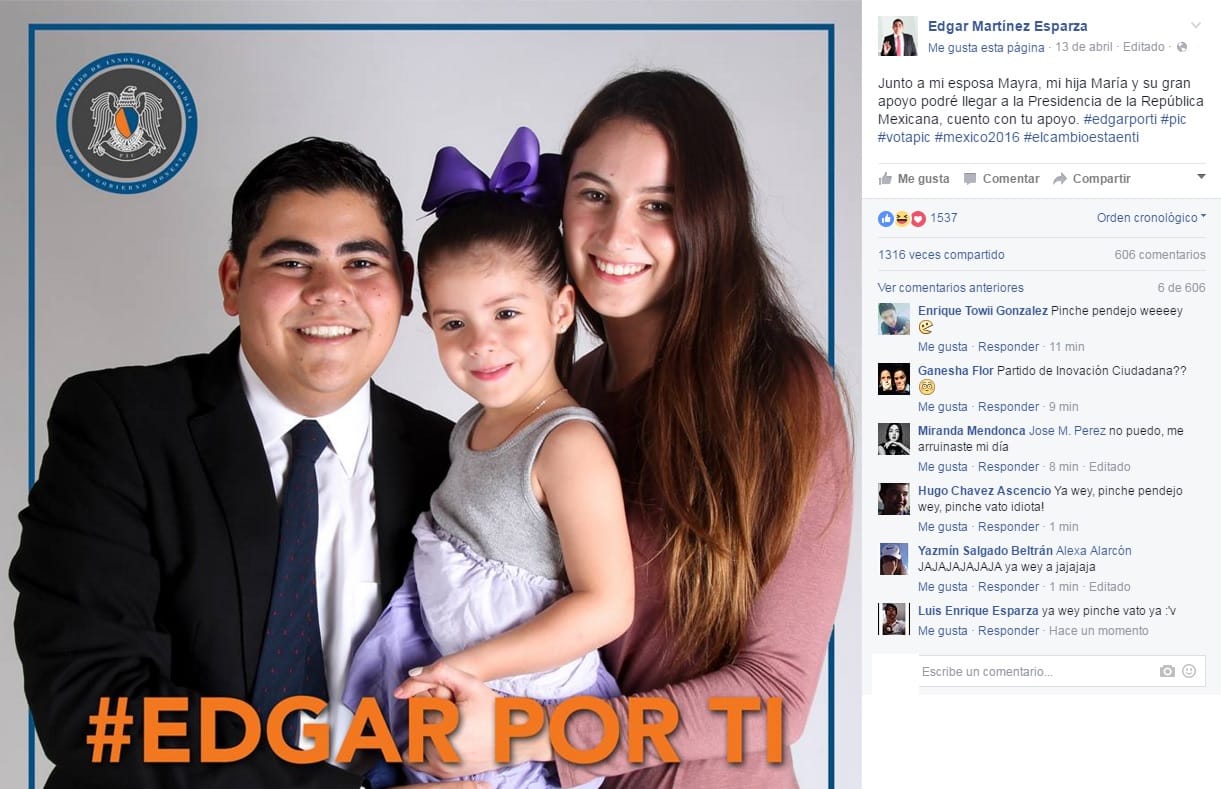
This was not the end of our friend's viral adventures. In 2016, Edgar was studying Communication Sciences at the University of Monterrey, a logical choice considering his experience with mass media. The professor of Political Communication proposed a practical assignment to simulate a presidential campaign in groups. The classmates saw the obvious: Edgar had to be the candidate. They took photos faking a wife and daughter, filmed a spot, and uploaded it, out of context, to his Facebook page. The campaign went viral in minutes. The news spread all over the world, and even CNN Mexico published the proposal from the “Citizen Renewal Party.” Days later, they went to a local media outlet to reveal the truth. For the public, it made no difference. The online street continues to demand Edgar for president in every subsequent election.
Edgar, the 2016 presidential “candidate” for the Citizen Innovation Party in Mexico, alongside a fake daughter and wife.
Contrasting Models
Let’s move to the present. The first viral kids (now in their thirties) have made the same decision to tell their complete stories for the anniversaries of their original publications. The media they chose to do this differ quite a bit. In 2022, Ghyslain starred in a Canadian INCAA documentary called "Star Wars Kid: The Rise of the Digital Shadows", lasting an hour and twenty minutes. His first public appearance in twenty years. Edgar, on the other hand, published an eight-minute video a decade after his success.
Before addressing the obvious difference in emotional consequences for both, it’s interesting to observe the contexts of both videos. Canada and Mexico share the fact of being neighbors to the American hegemon, but with totally dissimilar sociocultural scenarios. The first confrontation is between a context centered on machinery and abundance (the studio in Canada), and another in nature and humility (the wooden bridge). The Francophone's weapon is a golf club, while the Monterrey boy's is a branch from a tree. One video is filmed in a semi-professional recording set, while the other is shot outside a ranch. The Canadian documentary, which I could only access using a VPN based in Canada, is a mega-production that gathers opinions from major experts in digital communications (they could have called Edgar), while Ghyslain travels through three cities to analyze various facets of his story. The Mexican's production, on the other hand, accessible to everyone on his YouTube channel, features him laughing in front of a wall adorned with the iconic red shirt from his childhood.
Moreover, there are more hints of the social democratic technocracy in “Star Wars Kid,” which particularly contrasts with the humanist resistance of “The Fall.” In Quebec, the video is filmed in absolute solitude. An isolated child, alone with machines. In silence, without context. Did he upload it, believing it was great? Was it for a contest? A casting? Each truth is equally valid. In the documentary, Ghyslain states that the interpretation of the video reflects the inner world of each person. Some will tend to insult and mock him, like the youth of 2003. Others, however, would wish he were their friend, as many of us Hispanic nerds felt at the time. Because for those of us who didn’t have a filming set with post-editing software in our schools (and likely didn’t even have computers with Internet access at home), seeing the edited versions with lightsabers was absolutely amazing and enviable.
Canada and Mexico share the fact of being neighbors to the American hegemon, but with totally dissimilar sociocultural scenarios. The first confrontation is between a context centered on machinery and abundance (the studio in Canada), and another in nature and humility (the wooden bridge).
In contrast, in Mexico, the video is cooked within an extended family. There’s no machine or confinement. The setting, props, and even the bridge evoke nature. A spontaneous proto-cottagecore. In front of the Canadian silence, the main source of laughter isn’t in the fall, but in the dialogue between the characters, in their display of childhood mischief. I confess that twenty years later, the “ah, you took a bath,” with Raúl’s silly preadolescent voice still makes me laugh just as much as when I was thirteen. Against the mortuary silence of Canada, shouts, laughter, apologies, and cries fill the air of the northern part of the Great Homeland. Despite the aftermath of the fall ending with vomiting (let’s remember the stream’s contents), everyone, including Edgar, understood it was a joke. Fernando was quickly punished by the victim's older brother: he received a just blow that reminded him that such jokes shouldn’t be made about someone younger. Once that was resolved among peers, the kids agreed not to rat each other out to their parents, claiming it was an accident. It goes without saying that this didn’t prevent the video from quickly reaching the boy's parents.
Edgar and his now-fiancée Valeria, in 2024. They will get married on October 10.
It’s worth highlighting another colorful note that connects Edgar's family with ours. His father found all this fame and public photo requests quite amusing. His mother, however, a devout Catholic, broke down in tears when her coworkers showed her the video. What upset her wasn’t the fall. She found out everything on Mother’s Day, and when Edgar brought her gifts, she made it known: she was utterly embarrassed and furious that her little boy had said so many bad words in public (pendejo, pinche, vato…). But he redeemed himself: when he finally crosses the bridge, some time later, we can see that he wears the typical wooden bracelet with images of virgins and saints on his wrist.
Finally, aesthetics also have something to say in the comparison. The video of the Star Wars Kid features muted colors, with a black background, a gray shirt, and beige pants and floor. There's no life, let alone joy. The only element that stands out is a yellow cloth thrown on the floor, leftover from some previous filming. Nothing excites, nothing grabs attention. The space is tiny and enclosed. If there's humor there, it can only stem from cruelty. In contrast, the setting of the iconic fall is bursting with life. The spontaneous art direction of the scene would make many audiovisual production and marketing professionals envious. Each character wears a t-shirt in a vivid solid color that catches the eye: Fernando in yellow; Edgar in red. Warning and Coca-Cola. Both contrast with the intense green of the background vegetation, and the white pants complement the old trunks that serve as a bridge. Everything is open and spacious. Fernando looks at the camera, grinning mischievously, and so do we.
Until seventy times seven
When I decided to research and compare these iconic falls, I knew a bit about Ghyslain's journey, but I was unaware of how different it was from Edgar's. My undeniable pro-Hispanic bias (let's remember that Latinidad is a concept that includes France, and Quebec is a territory of French language and heritage) led me to prejudge that sociocultural factors could be the most significant differentiation between the two videos. Despite all the differences I previously outlined, after watching the Canadian documentary, I understood something more, which in turn made me notice a fundamental detail about "The Fall."
The moment Edgar sheds his first tear, Fernando apologizes. He does so more than once. The subsequent pact of silence to spare him punishment from adults and the laughter with which Edgar himself recalls Fernando and the fall speaks volumes about the sincerity of that reconciliation. Ghyslain, on the other hand, confesses in his film the pain that lingers to this day: the classmates who stole his video and shared it to promote bullying never apologized. François Vigeant, his lawyer, goes further and recalls that not only did the perpetrators lack any empathy: their parents did too. The lawsuit only brought him more pain.
But not everything is individualistic disdain in the Anglo-French world. The documentary portrays a scene of beautiful humanity. The "Star Wars Kid (now an adult)" travels to Portland, Oregon, to meet Andy Baio, who, let's remember, uploaded the video that had arrived on his website without context and went viral with millions of downloads.
Let's go back to 2003. Andy, 25 years old, learns about Ghyslain's horrific situation through the media. Guilt overwhelms him, as he had only seen a simple joke of someone who forgot to take a cassette out of a camera and uploaded it without thinking too much or inciting any violence. He goes to his website and begins the task of deleting most of the violent comments. These do not cease, and he clarifies:
“Yes, he is overweight and clumsy. We know that. But since 90% of the traffic on this website comes from gamers, tech enthusiasts, and Star Wars fans, I doubt that those commenting were much cooler in school than this poor kid. All of you, nerds, geeks, and oddballs, should think twice before attacking one of our own like this.
He starts a fundraising campaign, alongside another famous blogger. In an interview, he says: "Overall, he seems like a damn cool kid. I don’t care what anyone else thinks; Ghyslain is my new hero". They manage to send him $4,000 and an iPod (a revolutionary gadget of the time). Ghyslain does not respond.
Fast forward to 2022, they meet face to face. Andy confesses that he waited twenty years for this moment and that he can do nothing but apologize. As a freak of the early Internet, he admits to being a relentless seeker, and that he knew details about the life of the video’s protagonist. That he graduated, that he was president of the historical preservation society, that he completed a master's degree. Every piece of news about Ghyslain brought him peace and joy because he lived with guilt and fear that it would end badly. Now Ghyslain is a father, and he ensures that his son does not make the same mistakes. It’s true, no one could have taught him Internet ethics. But the bet is on redemption through transcendence.
When Andy apologizes, something in Ghyslain's face relaxes, changes. He himself acknowledges this in a later conversation with one of his best friends, back in his hometown of Trois-Rivières. “I could have been him. Nothing tells me that I wouldn’t have done the same in his place. And yet, I found a man of deep humanity and empathy.”
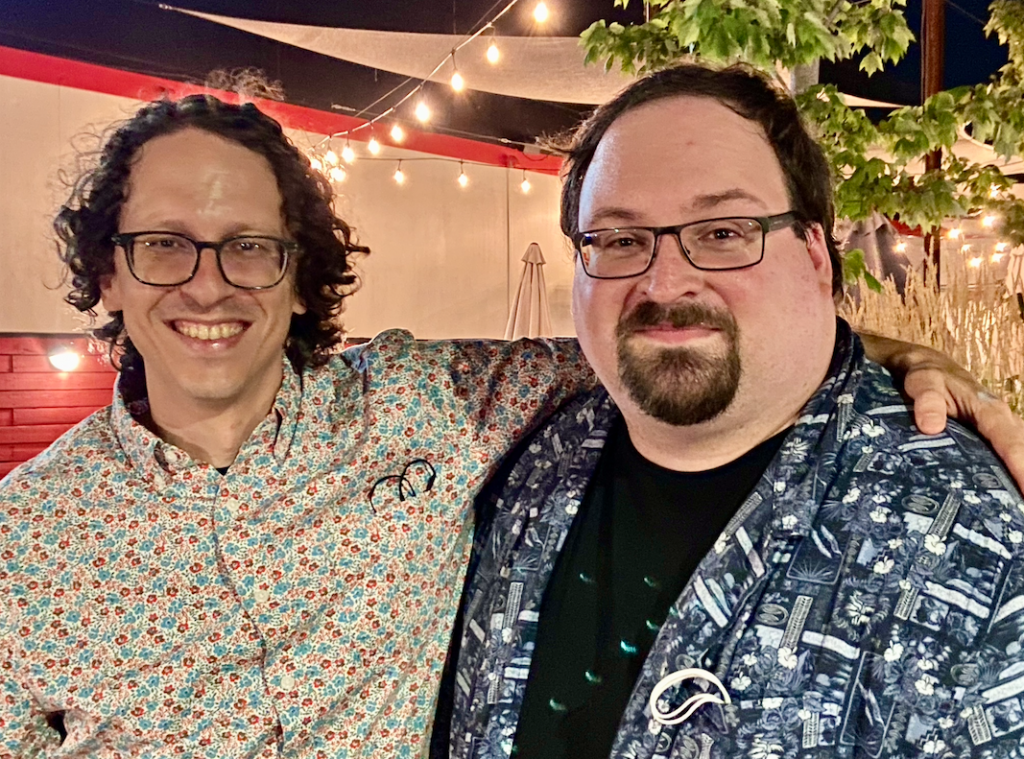
Andy and Ghyslaine, after the forgiveness ritual.
Forgiveness heals invisible wounds and restores humanity. It heals the one who forgives, but it also heals the one who asks for forgiveness. Francisco asserts in the Angelus of September 2017: "Outside of forgiveness, indeed, there is no hope; outside of forgiveness, there is no peace. Forgiveness is the oxygen that purifies the air contaminated by hatred, it is the antidote that cures the poisons of resentment, it is the way to deactivate anger and heal so many heart diseases that contaminate society." In another audience in 2018, he goes even further: “If killing means destroying, suppressing, or eliminating someone, then not killing is, on the contrary, caring for, valuing, including, and forgiving others.”
Ghyslain's friend, with the airs of a café philosopher, theorized: since the pain arose from the product of a camera, perhaps the product of another camera would help heal Ghyslain. He cited some dubious reference from the ancient Greeks. Nothing could be further from the truth, as we confirmed from following our first viral stars. Fernando prevented a childish joke from becoming a cruel humiliation thanks to his sincere instant apology, and Andy returned a bit of life to Ghyslain when he could express his deep remorse while looking him in the eyes.
The triumph of humanism over technocracy.
✦ Suscribite
Las notas de 421 no tienen paywall
Y a cada colaborador se le paga por su trabajo. Las dos cosas dependen de los suscriptores.
Músico, peronista y millennial neurótico. Lic. en Composición UNA pero de hobby trabajo como administrativo en un hospital. Hago canciones con mi proyecto Cancillería de Venecia. La mas conocida se llama Pistones Rotos. A veces escribo.