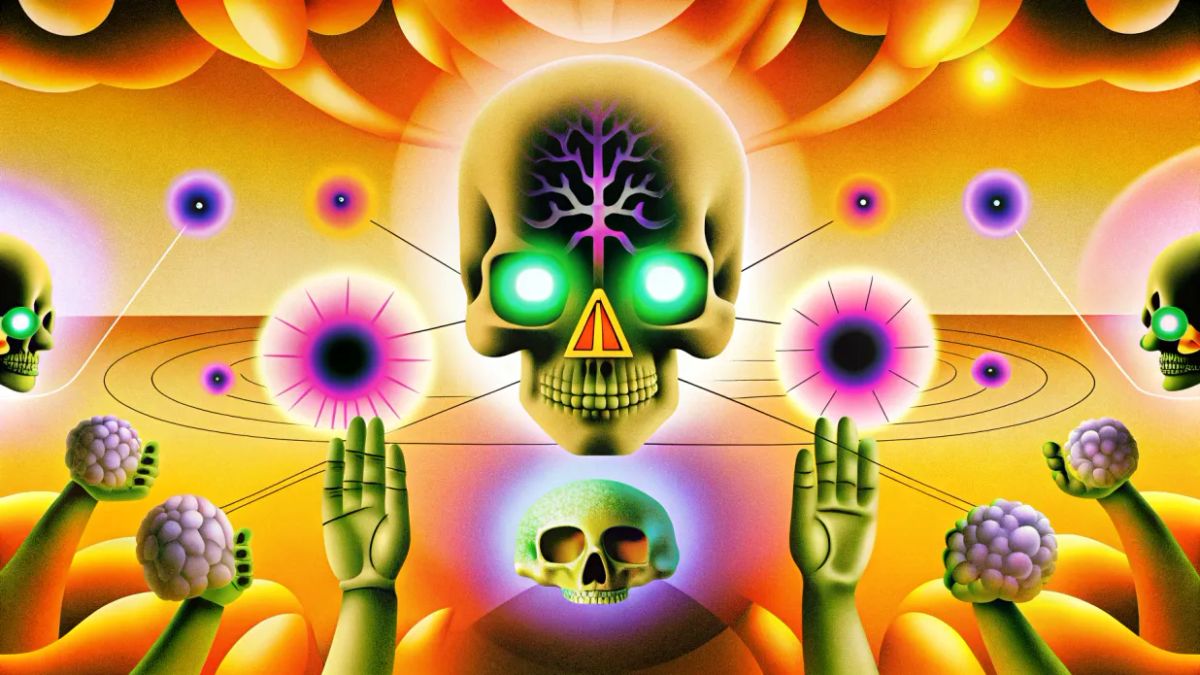
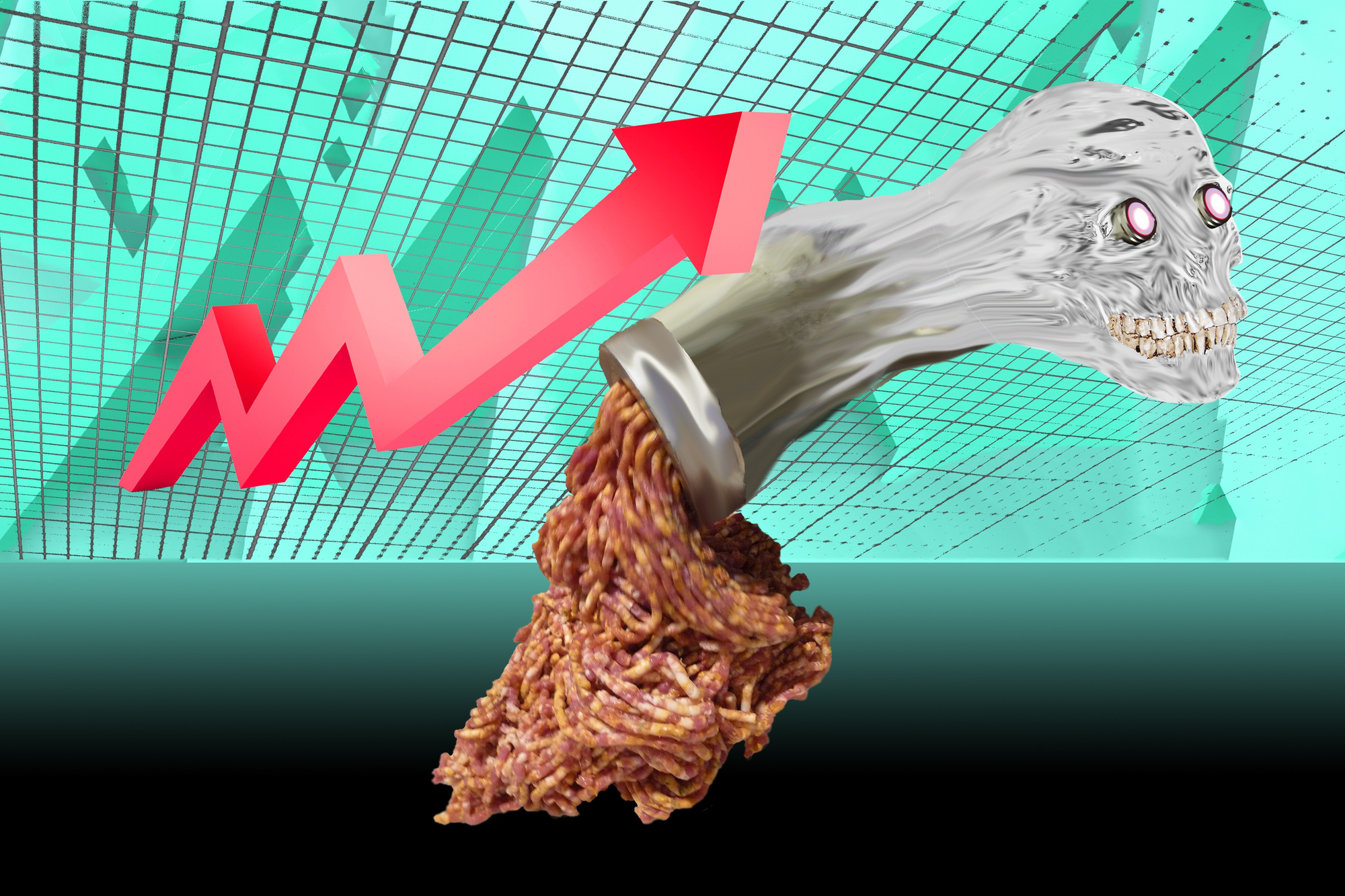
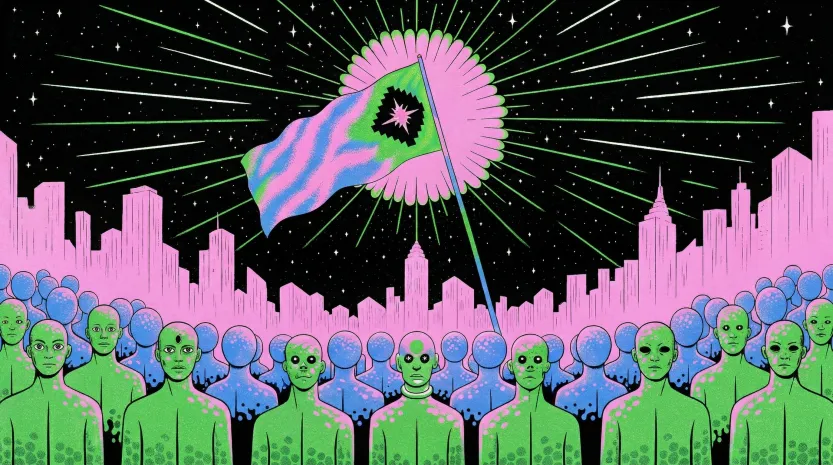
A philosophy, an ideology, a meme. Accelerationism posits that capitalism and technology are unstoppable forces that transform reality faster than we can keep up with them. It’s not about “accelerating”; it’s about learning to navigate a future that has already overtaken us.
Twelve years ago, when I first heard the term, "accelerationism" was a secret name, a forbidden word. Five years ago, it was already being criticized by pop philosophers like Zizek or Byung Chul-han, and Grabois was advocating for it. Last year, Tenembaum used it disparagingly in an interview. Next Sunday, your uncle is going to ask you what it means at the family asado. Are you going to know how to answer him?
Accelerationism is a philosophical current, a political ideology, and a meme. All three at once.
As a philosophical current, it is a synthesis of a series of ideas developed from the work of Nick Land. In very simple terms, we could say that it is a very unorthodox Marxism heavily influenced by ideas from theorists like Gilles Deleuze and Jean Baudrillard. Land, and those who followed him in the Cybernetic Culture Research Unit (CCRU), took Marx's idea that capitalism is a force with immense capacity to implode the old hierarchical structures that have united people for millennia very seriously. The technical advancement of industrial life produces a positive feedback loop whereby social transformations occur increasingly rapidly, crossing national borders, separating families, and profaning beliefs. This process, a true deterritorialization, is read positively: who would want to return to pre-capitalist life, a rigid, stagnant culture where scarcity and hunger reigned?
Land, and those who followed him in the Cybernetic Culture Research Unit, took Marx's idea that capitalism is a force with immense capacity to implode the old structures very seriously.
I won't describe in more detail the general conceptual outlines of accelerationism: Juan Ruocco has already done so in this medium, Alejandro Galliano here, and I myself here. It happens that, besides being a philosophical movement, it is also something like a political ideology. At this point, things start to get weird (yes, weirder than mixing Kabbalism, Blade Runner, and unpublished fragments of Capital). Are there accelerationist politicians? Are they left-wing, right-wing, centrist, or third-position? And what would a politics look like that is up to a philosophy that believes the only true subject intervening in reality is Capital, a kind of techno-Lovecraftian deity capable of time travel?
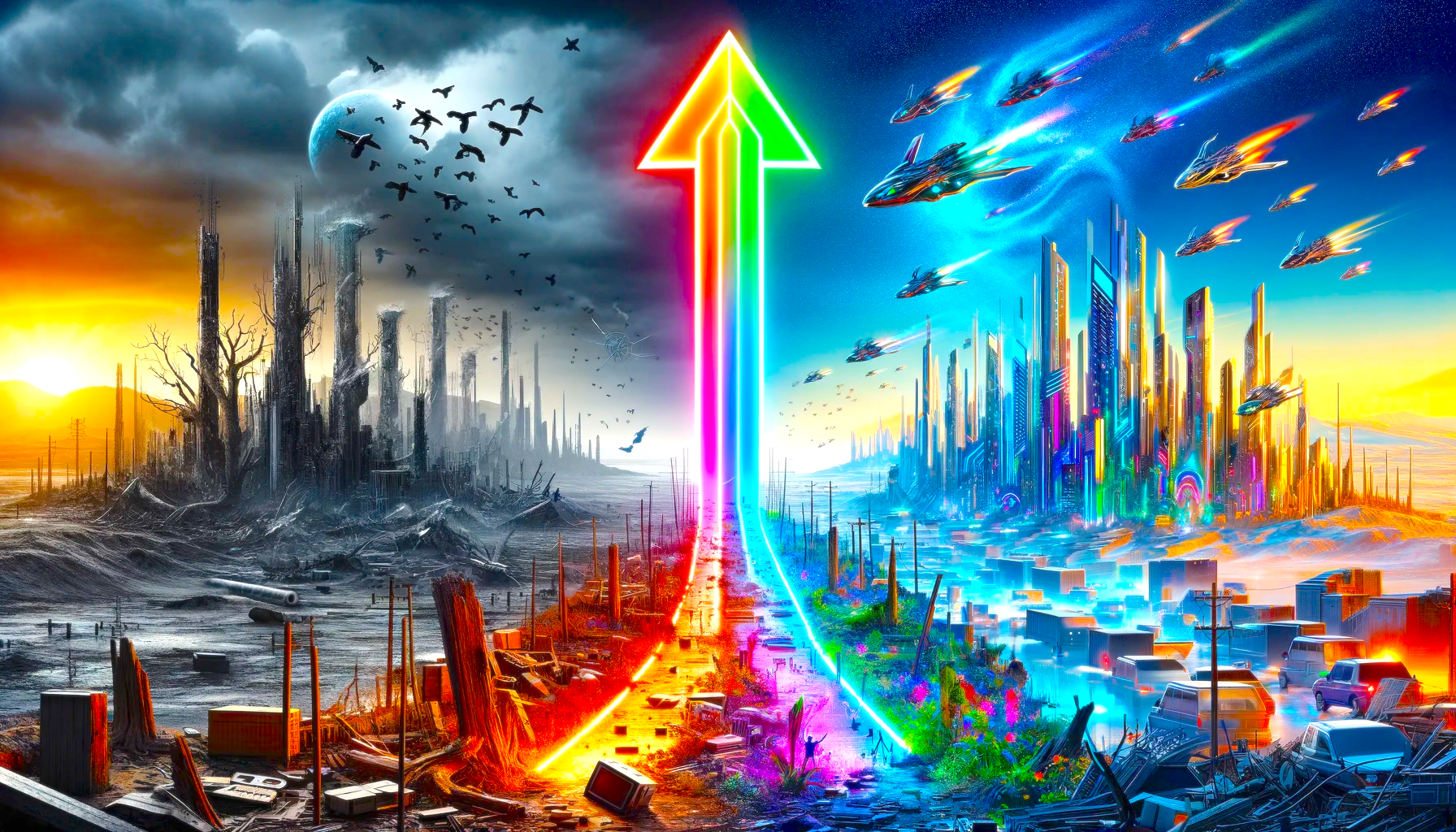
At this point, it is worth dismissing a common interpretation: accelerationism as a philosophy does not say that anything needs to be accelerated. It does not say that we must "deepen the contradictions," nor that we must "go through capitalism to get to the other side," nor that "the worse, the better." Acceleration is a condition of the present, and the only true assertion that can be made is that it is not possible to go back. And consequently, we must identify the processes that lead us forward and learn to navigate them. If there is any action that can be taken, it is only by accepting that one is part of a temporal current that far exceeds the human scale: under this framework, it is indeed possible to seek tools that allow us to intervene in reality.
This is why accelerationism makes a cult of cybernetics: because it believes that through it, it is possible to produce the future, as technological singularity, as soon as possible. In a way, the idea is that the only possible political action is to infect culture with viruses that materially reprogram the established parameters. In other words, a memetic politics: this is how accelerationists think about some political phenomena like the alt-right that gave rise to Trumpism, the spread of memecoins, and, of course, Javier Milei.
Thus, ultimately, accelerationism is itself a meme. I go back to 2014, the first time I heard the term. One should not underestimate the appeal it actually had. It was a code that allowed entry into mysterious conversations about hyperstitions, cyber-gothic materialism, or the interpretation of the Numogram. Knowing it allowed you to enter a hidden underworld that discussed capitalism in very different terms than Trotskyism or liberalism: it did so in terms of occultism, cosmic horror, and cyberpunk, in the language that inhabited the internet. It allowed you to say things that were not permitted by the common sense of late Kirchnerism or the emerging Macrism; it surely did the same in England, Pakistan, or Eswatini, with the corresponding ideologies.
Accelerationism as a philosophy does not say that anything needs to be accelerated. (...) Acceleration is a condition of the present, and the only true assertion that can be made is that it is not possible to go back.
All of this led to a thriving online culture that combined the three interests: philosophical speculation (more or less academic, more or less vulgar), political intervention (militant, intellectual, organic, or inorganic), and the playful practice of meme and shitpost generation. This subculture, a true urban tribe of the online street, unfolded mainly in three fields: 4chan (and specifically the /pol forum), Twitter, and the sites of the territory once known as the “Blogosphere.” In turn, this digital movement was connected with an offline ecosystem: publishers, conferences, research groups, and other areas that produced and edited material about and on accelerationism. Starting in 2013, this subculture became fertile ground where a thousand accelerationisms flourished.
But to reach them, we must take a brief detour. If it’s not about accelerating anything, where does the term come from? Very briefly, the word "accelerationism" emerged as a pejorative term: it was coined by the theorist Benjamin Noys in his thesis on contemporary philosophy and negativity, and he developed it in his book Malignant Velocities, where he first coherently analyzes the work of Nick Land and his followers in the CCRU. But the word only gained relevance in 2013, when Nick Srnicek and Alex Williams reclaimed it and appropriated it with a positive meaning in their oft-cited “Manifesto for an Accelerationist Politics” (MAP). In other words, the term begins as a (leftist) reappropriation of a concept used to denigrate a philosophical movement (of the right?).
The online aesthetics of the early 2010s, during the times of Obamaism and the waning cultural hegemony of millennials, demanded clear ways to name things. The first two factions of online accelerationism defined the form: they called themselves r/acc and l/acc, the right (r, right) and left (l, left), and both claimed parenthood over the movement. And both were, in their own way, right. Land, never reluctant to engage in Twitter debates, quickly accepted the label and recognized himself as the originator of the movement. The followers of the MAP and many readers of authors like Mark Fisher, on the other hand, argued that Land's reactionary turn was recent and that, at least in its beginnings, the CCRU was a research group proposing a heretical, alien left, but a left nonetheless.
So we have:
r/acc: describes Capital as a hypothetical subject that produces itself in the form of an Artificial Intelligence. The meltdown of all the conditions that structured pre-capitalist life cannot be stopped: nothing human will remain, the only possible future is the machinic fusion of transhumanism.
l/acc: emphasizes the “idiotic” nature of Capital, which has operated as an accelerator of disruption but, as it concretizes as a capitalist system, becomes an obstacle to overcome. It postulates the need to unleash latent forces that take society beyond its present limits: technology should not be destroyed but appropriated and redirected towards post-capitalist ends.
But that division is too traditional. We have a 21st-century political movement, forged in the fertile ground of the protomemetic culture of the nineties; are we really going to split along the traditional schisms of Trotskyist parties? Many disagreed with the reduction that the left wing imposed on the more original trends of accelerationism (turning it into little more than a classic communism, just more technophile), nor with the increasingly evident tendencies of Land and his followers to turn the movement into a cult. Sure enough, a few years later l/acc would become indistinguishable from Podemos and r/acc would give way to the Neoreactionary movement.
But in the meantime, other names had emerged. As is the case with any ideology, there were those who encouraged a return to the roots. This is the case of Em Colquhoun's “unconditional accelerationism,” u/acc in English, and also James Ellis's “zero accelerationism,” or z/acc. And, as in all cases, both were presented as the only true and faithful interpretation of the original project's content.
u/acc: acceleration knows no conditions; it is the end of conditions. The acceleration opened by modernity is a process that exceeds any human agency or political project. There is no possible praxis; the process cannot be directed left or right. Because, moreover, the subjectivity that could direct it is not external: it is a product of the very acceleration, not an observer.
z/acc: a “blackpilled” version of u/acc. Not only does it make no sense to propose any kind of human action, but acceleration can only be understood as a cosmic ruin. In the end, there is no creative destruction, only destruction: “Zero” is the entropic death of the universe. If u/acc still holds a place for the human subject, z/acc directly thinks that consciousness is a reflection of nothingness, an illusion.
Both Ellis and Colquhoun raised the same criticism of r/acc and l/acc: that both place too much importance on human beings. But other accelerationisms did not think the same. Ironically, accelerationism has its own “centrism,” its supporters of a moderate acceleration directed towards rational and sensible ends:
e/acc: originating from the libertarian thought of Silicon Valley, “effective accelerationism” focuses on the technical progress of human civilization. Through long-term thinking, they propose to steer technical acceleration to conquer other planets (extropianism), overcome the biological limits of the human body (transhumanism), and, of course, create a General Artificial Intelligence.
d/acc: in response to the techno-optimism of e/acc, Vitalik Buterin proposed a “defensive, decentralized, democratic” accelerationism. In this case, it involves selecting the technologies that will be accelerated through collective deliberation processes deployed via blockchain. It seeks to prioritize developments that strengthen society's defensive capacity.
This is getting ridiculous. It’s clear that the very essence of “acceleration,” as conceived by the CCRU, is that it is a process that escapes human definitions. If we can program objectives or even select certain technologies and discard others, we are not talking about accelerationism. In fact, we stop talking about Capital, which was the main analytical term for the movement. Yet, for some reason, these names existed, not only in lost manifestos in the blogosphere but as discourses of certain significance that managed to captivate figures like Elon Musk and his circle. It’s true, the price to pay was distorting accelerationism to the point of absurdity, but that always happens with political traditions; especially those that, in addition to ideology, are a meme.
To close this mapping, which is by no means exhaustive, some trends have refocused on subjectivity, but trying to avoid overly recentering the role of human praxis. After all, it has always been about this: finding precisely what our place is in a context defined by colossal external forces that surpass us in temporal and spatial scale (the original theorization made extensive use of Lovecraft and his cosmic horror). Some of these accelerationisms focused on specific identities, such as Bl/acc (black accelerationism, pronounced “black”) or g/acc (gender accelerationism). But I want to highlight “Cute Accelerationism,” a text crafted by Amy Ireland and Maya B. Kronik that, despite its absurd name and aesthetics (or precisely because of that), has its particular interest:
Cute/acc: using the vocabulary of the otaku subculture, it poses that the real accelerationist question is precisely what happens to subjectivity under conditions of acceleration. It thinks of the malleability of the body and desire as processes of radical subjective destabilization: it’s not about recovering a humanist practice, but about accepting that deterritorialization does not lead to a single destination of collapse but opens up a plurality of strange futures towards which it is possible to navigate.
More than anything, what I find interesting about 'cute accelerationism' is that it acknowledges its nature as an ideological shitpost, while remaining completely true to a series of core notions of accelerationism: the cult of an Exterior that penetrates the present, the rejection of any return to previous societal forms, and the consideration of inhuman sources of subjective agency that shape reality according to parameters beyond our rationality (even as they utilize it). Thus, it rejects both the anti-subjective tendencies of u/acc and z/acc, as well as the programmatic dirigisme of e/acc and d/acc. Can accelerationism be not only a way to read late capitalism but also a language to think about what happens to us when we live within it?
In one way or another, all forms of accelerationism are inscribed in a common tradition: that of cyber culture, techno-gnosticism, and the heretical Marxism of the late 20th century. What is this strange political movement that sometimes seems indistinguishable from a joke? If I can venture a serious answer to an absurd question, I would say it is the condensation of a series of debates that took place in a very specific context: the peak of political and economic hegemony of capitalism as a global system driven by the West, in the years following the fall of the Wall. In that context, the need arose to rethink the ways in which the global system was conceived and, above all, what happens to the human subject under conditions of total market.
In one way or another, all forms of accelerationism are inscribed in a common tradition: that of cyber culture, techno-gnosticism, and the heretical Marxism of the late 20th century.
Accelerationism, if it is anything, is an experiment aimed at satisfying that need in the most radical way possible: with the extreme premise that people are nothing more than accidents in the true history, which is led by Capital as the subject of the future. And theaccelerationisms, in plural, these ideological memes that this text has mapped, are nothing more than later updates of this dilemma, adapted to the changing context of the 21st century. Perhaps the most interesting aspect is the form they take: halfway between an influential subculture and a joke, they function more like a game.
Today, the total algorithmic mediation of online life seems to block the possibilities of play, of subculture. It is now impossible to imagine that for someone a term like 'accelerationism' could function as a secret code to enter a forbidden world. The life cycle of the meme has been fulfilled. But, as always, the influence persists, perhaps in places we cannot yet anticipate.
Dante Sabatto es sociólogo. Investiga y escribe sobre pensamiento contemporáneo, con un foco en aceleracionismo, horror cósmico y postcapitalismo. Sus textos exploran la intersección entre estética, técnica y política en la cultura del siglo XXI.