Marcos Aramburu's "Las ceremonias": Chronicles of the Drowned and the Saved
"Las ceremonias: crónicas de personas que usan drogas" (The Ceremonies: Chronicles of People Who Use Drugs): a portrait of social class and drug use in recent Argentina.

I'm going to start this review by being self-referential: I've never done drugs in my life. I could say it's because of my Catholic upbringing, but the truth is I just never was interested. I don't know, I don't have a conservative position on it either. I don't think weed is always "a gateway to other drugs"; I know people who smoke and are doing fine in life, better than me, even (low bar). The music I listen to constantly references recreational drug use, and at the same time I understand the whole complex web that is substance abuse and that these are issues that need to be taken completely seriously. I could say I'm straight edge, but unfortunately I really like drinking. For Marcos Aramburu, author of Las ceremonias: crónicas de personas que usan drogas (El Gato y la Caja, 2023), it's the opposite. He says he comes from a "progressive" family and links his drug use to "impulses, spontaneous decisions, actions that start happening before you can rationalize them."
In this book of chronicles, Aramburu asks: What happens to people who use drugs? Why? What circumstances led them there? The author is mostly known as co-host of Industria Nacional on Gelatina, the streaming show hosted by Pedro Rosemblat. His role was always that of the playmaker, the guy who breaks the "seriousness" a show about politics can sometimes have. If something funny happens, you can bet you'll hear him let out a belly laugh or crack a joke. He was also the mind behind the segment "Fábrica de jingles," which reworks songs for laughs, something that's been done since the nineties with the "Top Forry" on Videomatch and the "Ranking Musical" on Todo x 2 Pesos, but this time applied to the national political moment.
In this book of chronicles, Aramburu asks: What happens to people who use drugs? Why? What circumstances led them there?
Personally, I find Aramburu a fascinating media figure. Just as there's the Argentine macho, cultural Kirchnerism gave birth to its updated version: the Argentine dude. With a look of retro jerseys and denim jackets, worship of Maradona and Indio, a cheeky attitude, a joker but a good guy, and "Nac & Pop" ideals, lots of young Argentines try to embody the archetype of the Argentine dude and fail miserably. But not Marcos Aramburu, and that's what makes him the right guy to write a book like Las ceremonias.
There are four chronicles. In Un lugar mucho más bello, Aramburu interviews Carola, Trachyn and Sonya, three travestis who did sex work for years and now work at the Archivo de la Memoria Trans. Countless anecdotes of erotic games, run-ins with the law and drug trafficking, where drugs and sex were constantly intertwined. In Perseguir al dragón, Aramburu meets up at a pizza place with an old friend of his father's who, in the seventies, was an activist in the Montoneros, smoked weed and was gay, a heretical combination for the time. When his brother, a union leader of the Rucci line, is murdered and suspicion falls on his own comrades, Miguel starts depending even more on marijuana and for years falls into a spiral of addiction, unbridled sex and nonstop spending. Todos estamos acá tells the story of Alejandro Pasquale, a visual artist who "advocates" painting under the influence of psychedelic drugs. In the last chronicle, Un yaguareté azul y rosado, Aramburu recounts his personal experience with marijuana, cocaine, LSD, DMT, mushrooms and ayahuasca. The author gets intimate and focuses on that last drug because of his mother, who, before dying of breast cancer, sought a cure in ayahuasca. He interviews relatives and family friends to piece together the hazy image of his mother.
The book was published in April 2023, under the Frente de Todos government, a government Aramburu most likely voted for in 2019 (like I did, I'm not judging). One could take the laziest route and say "well of course a lefty would write a book about lefty stuff like queers and drugs during a lefty government," but Las ceremonias proves to be much, much more than that. There are points where these four chronicles converge (beyond drugs, obviously): politics, activism, the last military dictatorship, grief, sexuality and, most decisive of all, social class.
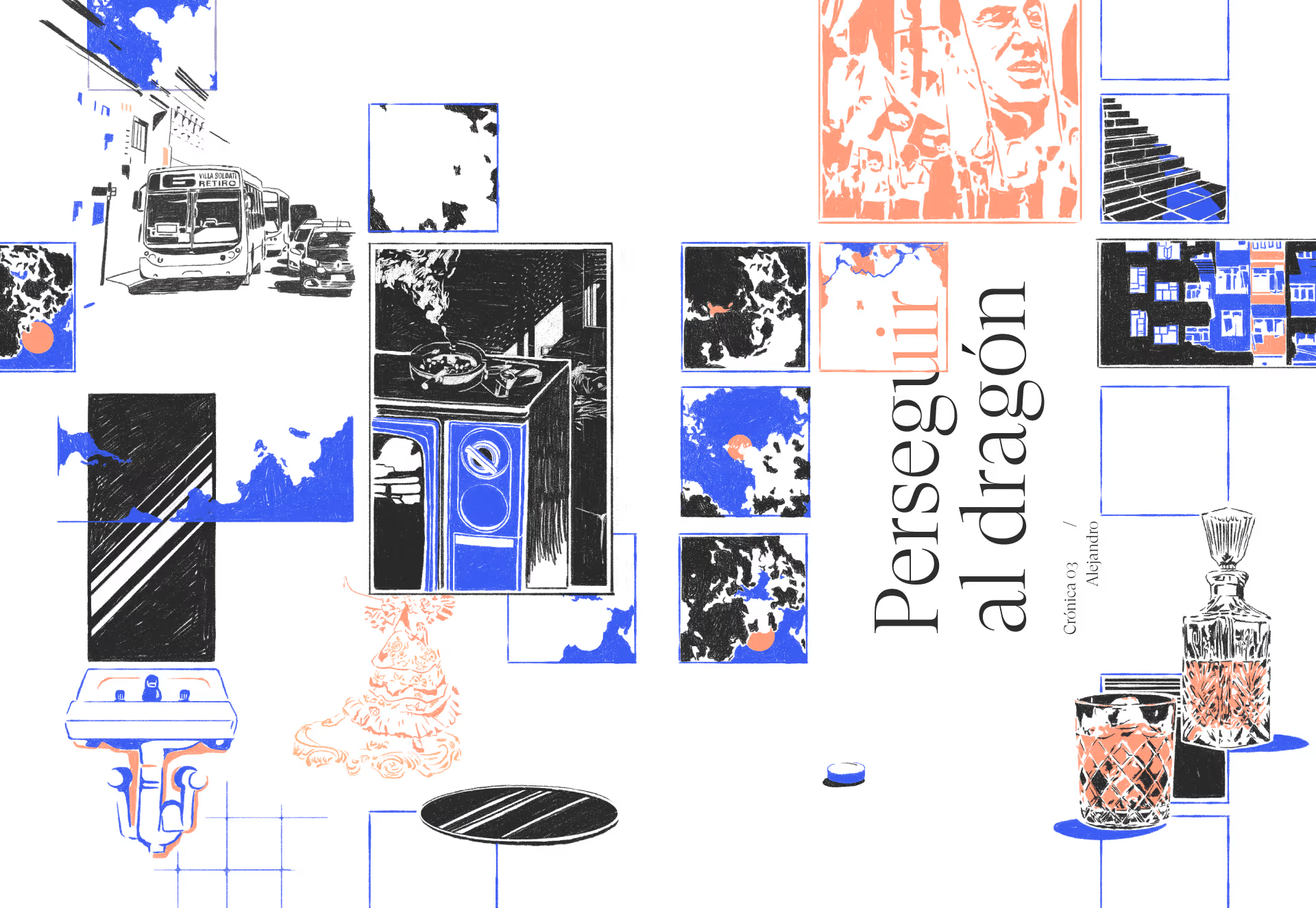
The first two chronicles share the experience of being sexually dissident during and after the last military dictatorship, but they also show big differences. During the dictatorship, Carola, Trachyn and Sonya took their first steps into sex work as a result of the social exclusion they faced for being travestis. Miguel discovered cocaine in '78. Carola, Trachyn and Sonya barely came into contact with "blow" in the nineties. Miguel moved from cocaine to trying hash in Europe and even studied there for a while. The conurbano and prison are recurring settings in Carola, Trachyn and Sonia's anecdotes. Miguel came out of his addiction in good health. Carola, Sonya and Trachyn are still dragging around the aftereffects of years of use. For Miguel, drug use was about "chasing the dragon." For Carola, Sonya and Trachyn, drugs were part of the job. It's clear that the difference between these two stories lies in the social integration/exclusion divide. A divide that, even with the post-dictatorship "destape," was still alive and well.
During the Alfonsín years, Fogwill talked about a "cultural legacy of the Proceso," about how, even after December '83, there were certain continuities from those seven years in national politics and in Argentines' collective unconscious. "Years of dictatorship have led to confusing the concept of democracy (government by the people) with the concepts of liberties and guarantees, which so much effort has gone into granting the population. Nothing is easier, for the government that took office in December 1983, than establishing liberties and guarantees: all it has to do is act by omission," he wrote. This "acting by omission" becomes evident in the first chronicle. Even after the Proceso ended, women like Carola, Trachyn and Sonya were still shut out of the job market, brutalized by the police, sexually abused, and ended up in prison almost routinely. Miguel, even with everything that came with being queer and Peronist in the seventies, and without downplaying his personal tragedy, had access to social, economic and symbolic capital that Carola, Trachyn and Sonia couldn't reach. The same can be said of Pasquale and even of Aramburu, for whom it's a matter of personal discovery. Pasquale does it out of "activism" for psychedelia (he argues they were banned in the sixties because they "opened the minds" of young people and "made them not want to go to war"), while Marcos does it out of "impulse," just for the sake of doing it.
I'm sure Aramburu is aware of all this. Las ceremonias isn't a book that dodges class dynamics; I'd even say it does a good job of exposing them. When he interviews, he doesn't judge or describe with condescension; his curiosity about these characters is pretty genuine and, although he writes every chronicle in the first person and drops a few personal reflections, he doesn't go full gonzo either, and he knows when to step offstage when the story calls for it. That's where the greatest strengths of Las ceremonias lie: not only is it a breeze to read, but it doesn't look at its subjects in a condescending or moralizing way. On the contrary, Aramburu's gaze is empathetic and curious, even at its weakest moments.
Las ceremonias isn't a book that dodges class dynamics; I'd even say it does a good job of exposing them.
The problems with Las ceremonias lie more in the order of the chronicles. What does it say about the book that the first chronicle is the one that most exposes the effects of drugs and systemic injustice on marginalized communities, while the last is about drugs as personal discovery? What does it say about the times? Or, better put, what does it say about the context in which it was published? What you could see in April 2023 was an institutional, economic and cultural crisis of the last Peronist/Kirchnerist government, right before La Libertad Avanza came out on top in the August PASO primaries and the Peronist/progressive/Nac & Pop cultural bubble drifted into a desperate haze trying to win back the Argentine people. In part, Las ceremonias can be read as a requiem for the culture of late Kirchnerism, just before Milei-era culture turned everything upside down and forced political and cultural sectors to rethink themselves.
One specific part of the first chronicle sticks with me, where the evangelical church comes up. Desperate to find spiritual help to end her addiction, Carola turns to her neighbor Yanina (also trans), who introduces her to evangelicalism. "It's no coincidence that in Buenos Aires province most rehab centers for addicts are run by evangelicals," Aramburu reveals. When he asks whether the evangelicals have any kind of rehab program, Carola tells him they don't have "any program," but they did get her work "cleaning at a bunch of places" and that let her "change her life." With the benefit of hindsight, it's striking how little emphasis is placed on the evangelical church's presence in the most vulnerable sectors of society, knowing that the next government would have so much affinity with the institution. Aramburu, instead, rationalizes it like this: "Almost all of us need to feel part of something bigger. The universe, for those who take psychedelics; the kingdom of God, for the evangelicals and for Carola." It's in passages like this that class is erased or ignored as a decisive factor, exposing a certain nearsightedness in the progressivism of that era (a nearsightedness I had too; again, I'm not judging).
As I pointed out before, one of Aramburu's strengths as a chronicler is that he doesn't judge or moralize about his characters, and I doubt his goal with this book was to ask who are you voting for this year, but it's in these details and omissions, in the structure (his choice of stories and their order), that you can glimpse where the country was headed. Las ceremonias is, then, a collection of pretty solid chronicles, written in a simple, empathetic style, about drug users, digging all the way down to find out where that lifestyle comes from. At the same time, it's a cultural artifact of a time that, even though only three years have passed, already feels distant.
Las notas de 421 no tienen paywall
Y a cada colaborador se le paga por su trabajo. Las dos cosas dependen de los suscriptores.