Anomaly 17: Cosmic Horror, Biohackers and the Cyberstate
Corponations, Lovecraftian deities and techno-capitalism. This is the novel by Uruguayan writer Ramiro Sánchiz.
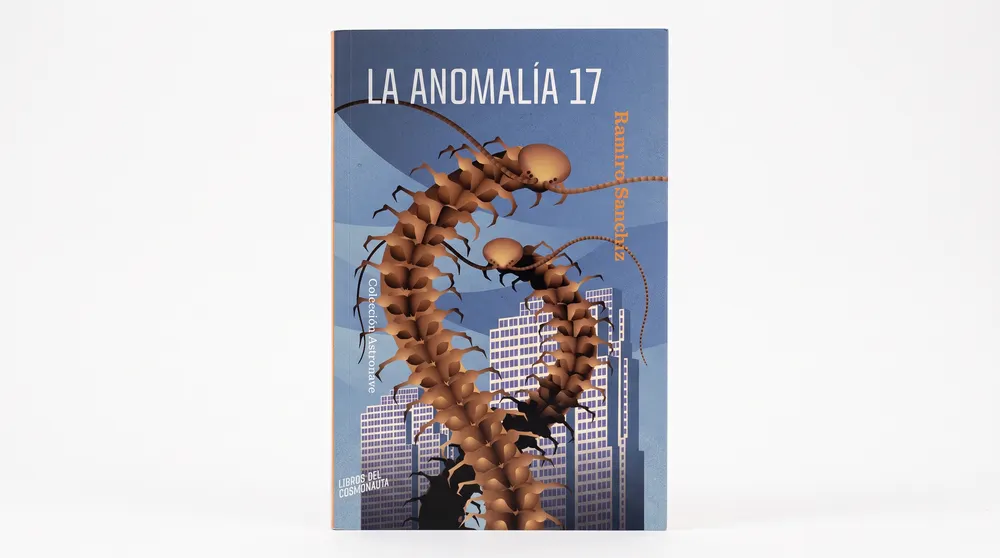
This time around, Federico Stahl is an agent of Antropol, a megacorporation that controls and administers a good chunk of the planet using a dense network of AIs, simulations, synthetic drugs, terraforming systems and other cybernetic devices. It isn't always like this. In Verde, for instance, he's a writer who remembers seeing an alien on Uruguay's Costa de Oro as a kid. In El orden del mundo, he's an expert on Soviet aircraft. In Las imitaciones, he's a cult musician who has vanished. But he's always Federico Stahl, the protagonist of every single book by Uruguayan writer, critic and essayist Ramiro Sánchiz.
You might assume this is just a game. That these are, at the end of the day, different characters who happen to share a name. That they're the author's alter egos. That the whole thing is one big joke: how can the same character show up in speculative science fiction novels, essays on German experimental music, crime fiction, pieces about Bowie, or unclassifiable books with titles like La historia de la ciencia ficción uruguaya? All of this fits into what Sánchiz calls the “Stahl project,” which spans his entire body of work. That's precisely the experiment: to conceive of all his texts, even crossing the boundaries between fiction and philosophy, as part of one and the same thing, a “macronovel.” To guide us (or to laugh at our attempts to get our bearings), the author includes a diagram of the project in every book.
That's precisely the experiment: to conceive of all his texts, even crossing the boundaries between fiction and philosophy, as part of one and the same thing, a “macronovel.”
Do you need all this context to read La anomalía 17? Of course not. In fact, the whole logic of the macronovel is that each piece is relatively independent and can be read on its own, right? Let's give it a shot.
La anomalía 17 isn't Federico Stahl's story: when the novel opens, he's gone, missing in action, presumed dead. It's the story of the search for him, led by Valeria (another recurring character in Sánchiz's universe). Both are Antropol agents, a corporation that operates as a kind of global cyberstate, a governing machine in the most literal sense. All we know when the story begins is that Valeria and Federico worked on an event neither of them remembers (the “anomaly” of the title), and that he hasn't been seen since.
The novel drops us right into the middle of this story, in media res, with a narrator locked onto Valeria who never stops to explain anything. As any good example of the weird would, the text talks with total nonchalance about the “Onomastikon,” the “War Games in Siberia, Cuba and Texas,” the “Tunguska Cybernecronomicon,” the “corponations Venepfizer, Messiaen, Bayersil and Afropepsi,” the “Elder Yottamesh.” It tosses off, as if it were nothing, sentences like “Powers and Kaldren merged into a demented entity called Coma and Edgar Varèse emanated twelve neo-Kabbalistic entities that created a hypersim in order to deliberate.” The semantic and symbolic universe La anomalía 17 draws on is syncretic: it combines classic science fiction notions and real technological elements tied to the development of Artificial Intelligence, geoengineering and genetic manipulation with imagery drawn from Gnosticism, occultism and Lovecraftian cosmic horror. It's up to the reader to untangle the meanings: to decode, for example, that a “hypersim” is a simulation, along the lines of Star Trek's Holodeck. Or that Babalon, Kaneda/Kunasagi/Haflinger and Yottamesh are warring AIs, more or less subordinate to Antropol's designs.
It's simpler than it sounds. The novel is a brisk hundred pages, and by page ten you start to get that there's a way to let the narrative carry you, that whatever doesn't add up will be revealed in due time. The worldbuilding comes together through small, always surprising explosions: for instance, that we're in a parallel timeline where AI started being developed in the '90s. Or that in this world bioengineering lets certain people experience years of life in mere seconds, or that it's possible to “copy” people, tamper with their memories, rebuild their bodies, turn them into “tulpas.” Or (I laughed out loud at this point) that there's a movement of “Neo-Bolivians” (nations no longer exist) who are still marching for access to the sea, and who join forces with movements of “Neo-Rastafarians and Luddite mimes.”
Forgive the nonstop list of neologisms. What I'm trying to convey in this review is the feeling of reading La anomalía 17, which is like suddenly waking up in an unknown yet familiar world; hypercomplex, yet strangely recognizable. And all of this happens without sacrificing momentum: the plot pushes forward relentlessly, without a breather. Sánchiz's best call is not to overexplain things, just to make them appear, one after another, forcing the reader into a kind of trance in which all these words soon start to seem perfectly understandable.
But this isn't just an aesthetic choice. It has to do with a certain notion of power. The elements that make up the world of La anomalía 17 are disparate, heterogeneous; they don't form a system. Sharing the same universe are “corponations” that clearly point to the capitalist web of our own reality, Lovecraftian deities, possible alien entities, hacker and biohacker communities, implanted memories, clones. The magical, the religious and the technological appear fused together, inseparable.
And this reflects a structural way of conceiving the world: not as a closed totality where something like “power” exists, a top-down form of domination; but not as a free, wide-open field where anything can happen, either. It's a field of warring forces, partially centralized but always in flux. Antropol controls a network of AIs, sure, but they always seem on the verge of rebelling, or they carry a certain agency that allows them to merge, blend, transform. There's resistance to Antropol's cybercontrol everywhere: Federico Stahl himself is suspected of being a traitor, and Valeria gets in touch with a hacker named Rex who works in the shadows. And on deeper levels: the protagonist herself fears she's been secretly “programmed” by the corporation to act against her own will. And further still: Antropol isn't controlled by specific individuals, nor does it seem to have a single will; instead, there's a constant suspicion that it could be under attack from within, pushed in opposite directions at once.
What reigns, then, is a very peculiar brand of paranoia. It's not, obviously, the kind that belongs to totalitarian dystopias à la 1984 (fear of capillary, top-down state persecution), but it's not that of Blade Runner-style cyberpunk either (the suspicion that you yourself are a fake self, a corporately manufactured entity). It's neither, because a certain stateness persists (the only plausible kind in the 21st century: a global government geared toward planetary environmental control), but it's not only been captured by corporations, it also deploys a series of hypercomplex networks that are impossible to map completely. This hypertrophy of the technical (we should say the techgnostic) is how Sánchiz aesthetically constructs a conception of power under late capitalism.
This hypertrophy of the technical (we should say the techgnostic) is how Sánchiz aesthetically constructs a conception of power under late capitalism.
This conception is expressed, of course, in the mystery that drives the plot. Before the novel begins, something happened, an event that we readers can't know about, but neither can the characters (Valeria) or Antropol itself. Anomaly 17 is an unknowable event, of which we only see the consequences: Stahl's disappearance, and finding him obviously requires figuring out what that repressed event was. This psychoanalytic core is narratively overdetermined: the amnesia is explained both by the mechanisms of science fiction (manipulation of human consciousness by technical means) and by those of cosmic horror (the limits of sensory experience being overrun by the radically alien). This crossover also signals the novel's contemporary perspective: it would have been impossible, at least before the '90s, to conceive of these two fields of meaning as one. Today, on the other hand, it's harder and harder to pull them apart; Sánchiz knows this well, as a translator of Nick Land and a researcher in the field of accelerationism, the new materialisms and other forms of speculative philosophy.
La anomalía 17 belongs to the same lineage as other contemporary science fiction classics, like This Is How You Lose The Time War, by Amal El-Mohtar and Max Gladstone, or There Is No Antimemetics Division, by qntm. These novels share similar conceptions of post-state power and use analogous narratives about the tampering of memory and sensory experience; they also contain stories that tackle the intersection of the conspiratorial and the speculative. They're stories that, from one angle, can seem classic (the three I mentioned are all based, after all, on the concept of a couple separated by supernatural/cyberfictional forces who must find their way back to each other). But if we focused on that, we'd lose sight of what matters: that none of these works is a “thesis novel,” that there's a genuine fusion between the intellectual project driving them and the aesthetic program they actually deploy. The risk with works like these is that they end up being essays dressed up as novels. But La Anomalía 17 couldn't have been an article about AI, technocapitalism and cosmic horror; in this sense, and only in this sense, can we truly speak of speculative science fiction: speculation that is genuinely fictional, rather than one that uses the mechanisms of the genre as a mask.
Las notas de 421 no tienen paywall
Y a cada colaborador se le paga por su trabajo. Las dos cosas dependen de los suscriptores.