Heisenberg and the True Origins of Quantum Physics
Tired of people selling you the multiverse as real science? This journey to the origins of quantum physics debunks the myths of popular science. Discover the true mysteries that have fascinated scientists since 1925. Reality is even stranger than they tell you.
This is the first in a series of notes on quantum physics, its birth, development, and current state. About the physicists who created it, the intuitions from which it emerged, and the major problems that still persist. About its mathematical formalism and its enormous technological potential, yes, but also about its concepts, or rather, as we will see, the still-pending search for suitable concepts that allow us to understand it.
But before diving into the topic, we wanted to provide a brief introduction. To explain why you are going to read what you are about to read, and why there are no multiverses and holograms and all those fantastic stories that popular science has accustomed us to regarding quantum mechanics. The short explanation is: because they are stories that take dubious interpretations for granted, and, above all, they are stories based on omission. And while omission is inevitable in popular science, in this case, it involves omissions that would undermine the narrative they want to convince us of. Thus, they talk about multiverses while glossing over the fact that no one really knows what a “quantum particle” actually is. But furthermore, and above all, they sidestep genuinely stimulating problems that invite us to transform our worldview (instead of multiplying the world we are already accustomed to). Because quantum mechanics is characterized by its problematic, open state; if we can manage to partially understand the nature of these problems, we can offer the reader the chance to momentarily place themselves in the position of the researcher, allowing them to participate in some way in the cutting edge of the discipline. And in this case, we are talking about a discipline that has radically transformed and continues to transform not only science but also technology, the economy, and global politics (just think of the effects of the atomic bomb on global politics or the current technological race surrounding quantum information processing). We hope that this possibility of gaining that perspective will make quantum mechanics appealing to the readers of 421, rather than empty tales about flimsy multiverses.
It is a discipline that has radically transformed and continues to transform not only science but also global technology, economy, and politics.
One of the problems we want to start this series with takes us back a century, to 1925 in Germany, when quantum theory first took shape. This happened primarily thanks to the work of a very young physicist from Munich, Werner Heisenberg, who presented his matrix mechanics that year. This represented the first closed mathematical formalism of quantum physics, meaning the first formulation capable of systematically encompassing the various quantities that appeared in experimental observations. Other scattered elements had already emerged, of course, such as the original quantum hypothesis, namely Planck's quantum of action, Einstein's explanation of the photoelectric effect, or Niels Bohr's atomic model; but it is only with Heisenberg's work that we can speak, albeit still with difficulties, of a quantum theory.
But we need to say something about two of its predecessors. First, about Max Planck's original postulate in 1900, that energy emission occurs in a discrete manner, meaning, unlike what classical physics established, in a discontinuous way. Energy, Planck postulated, is emitted in chunks, bits, packets (quanta in Latin, plural of quantum) that are discontinuous, and he even determined the minimum value of these packets, those quanta of action, as he called them. Therefore, energy is always a multiple of that minimum value, the Planck constant.
Let's pause for a moment here to understand why that postulate was so problematic at first. The physical world, from Newton to our days, has been thought of as “things” within a continuous space and time (indeed, classical mechanics develops from the possibility that infinitesimal calculus provides to rigorously account for the continuum). Now, if energy is discrete, that representation runs into issues. In the energy equation, E = ½ m v² (Energy = mass times velocity squared), ‘1/2m’ is a constant; from this, it follows that it is v (the velocity) that must be discrete. But that, given the formal definition of velocity (velocity is a relation of space over time), means that space and time should also be discrete. And this is already difficult to understand, or even to imagine. There is no longer a single, universal space and time, but rather discontinuous and multiple ones. But, in such a time, how do we think about the connection between events? The same goes for space.
Planck, immediately aware of the consequences, had presented his postulate as a mathematical trick to solve a very specific problem (something called the “ultraviolet catastrophe,” which basically refers to how hot objects emit light) and did not think it would lead to a revolution in physics. The quantum postulate was, in his own words, “an act of desperation.” He thought those energy packets were a useful mathematical tool for calculations, but that in reality, energy remained continuous. Keep in mind that at that time, it was believed that physics was more or less resolved, that classical theories could solve all the problems of the physical world. But now that physical world, always thought of as “things within space and time,” was starting to have serious problems. The strange idea that energy was discrete began to grow and grow, applying to more and more fields, creating the need to construct a new theory that coherently unified that whole set of models for which Planck's postulate was already a fundamental condition. And it is precisely this that found its first form with Heisenberg.
Scattered elements had already emerged, such as Planck's original quantum hypothesis or Niels Bohr's atomic model; but it is only with Heisenberg's work that we can speak, albeit still with difficulties, of a quantum theory.
The second milestone we want to discuss briefly is Bohr's atomic model. The Bohr proposal is the result of the intersection of two different evolutions: on one hand, that recent quantum path and, on the other, the very ancient path of atomism. The idea that the world is made up of tiny, indivisible bodies that, in their various combinations, create all the variety of the real emerged 2500 years ago among the Greeks, and found a definitive revival in the physics and chemistry of the 17th and 18th centuries (especially in Newtonian mechanics), which ultimately made it part of common sense (and not just that of physicists). The concept of a particle (or “corpuscle”) is a fundamental element of Newtonian physics, that prodigious theory which, thanks also to the invention of differential calculus, allowed for the first time to unify the experience of terrestrial bodies and celestial bodies, accounting for both the fall of an apple and the motion of planets with the same theory. But, as we will see later, the application of atomism in quantum mechanics will be much, much more complex and, above all, very problematic.
The representation of the atom has varied over the last few centuries, and different models have been proposed incorporating the various changes occurring in physics (for example, the need to consider charges following the creation of electromagnetism). Seeking to extend that conceptual continuity in the 20th century (instead of breaking with it) and link classical theories with new discoveries, in 1913 Bohr proposed a new atomic model that included Planck's quantum postulate. A mathematical model that could predict the spectrum of Hydrogen, which he accompanied with a new image, one we all know: that of a mini planetary system, with a nucleus at the center (like the Sun) and particles (the electrons) orbiting around it (like planets).
 Emilio Méndez
The strange thing, the “quantum” aspect, is that, according to this model, the electronic orbits are discrete, they are separate and fixed, there is no space between them, and thus the electrons cannot traverse any intermediate space. Bohr resolved that impossible transition between orbits in his hypothesis simply by adding a new evolution, summing up a new trick, a new fantasy: to move from one orbit to another, electrons make a “jump,” disappearing from one and magically appearing in the other (the famous “quantum jumps”). We speak of trick or fantasy because that evolution was not contained in the mathematics; it was an ad hoc addition.
These inexplicable aspects or conceptual gaps in Bohr's image were criticized by most physicists. How can they disappear and appear? Why can't they occupy the spaces between orbits? Why don't electrons spiral into the nucleus as classical physics predicted? In short, they were annoyed by patching everything up with “increasingly bizarre stories.” However, the image proposed by Bohr had its advantages: it was familiar to the physicists of the time and, above all, it traced a continuity with previous atomic models. Thus, most physicists accepted Bohr's model as a necessary step towards the development of a new atomic theory.
Now, let's turn to Heisenberg. In search of a consistent mathematical formulation that accounted for the spectroscopic phenomena measured in the laboratory, he had tried for a time to follow the path proposed by Bohr's model, focusing on tracking the supposed trajectories of electrons to explain how they really moved, beyond the quantum jumps. But that attempt repeatedly proved fruitless, leaving him tangled in a complicated web of equations from which he could not find a way out. And to make matters worse, spring was beginning, and Heisenberg was suffering from an allergic outbreak that prevented him from working. To cure his allergy, he decided to escape to a strange island in the North Sea where there are neither bushes nor meadows: the island of Helgoland.
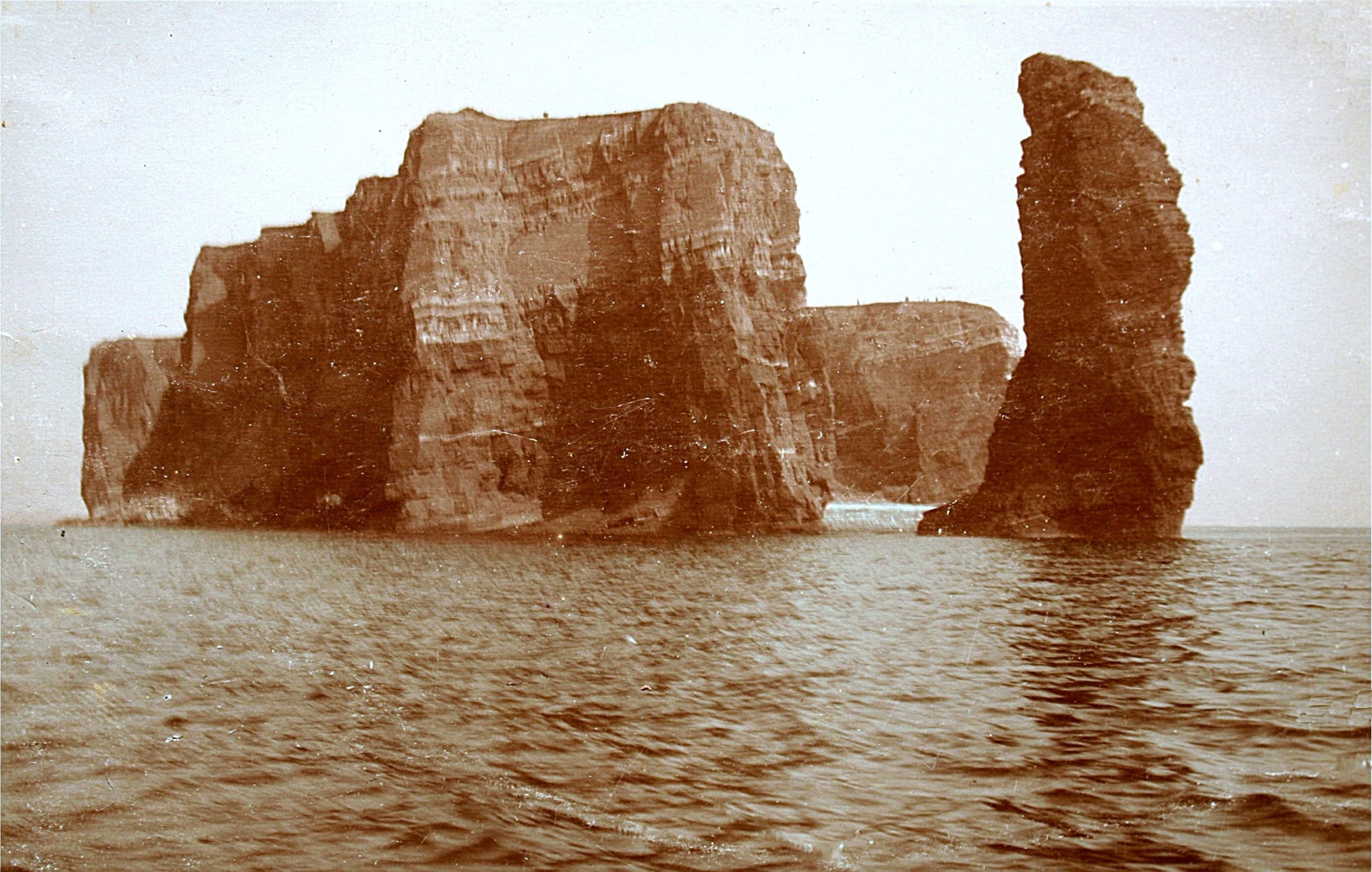
Once recovered from his hay fever, Heisenberg returned to work, but this time he decided to completely change his approach and temporarily abandoned the Bohr narrative (the attempt to describe those supposed particles). Following the same path that had allowed Einstein to develop his theory of relativity, he decided to shed the burden of that classical representation that Bohr had reintroduced with his planetary image. He chose to discard the assumption of electrons with trajectories, only taking into account what was actually observed, and sought a formalism that expressed those results consistently. The physicists already had a wealth of data collected from spectroscopic experiments. Those data were lists of intensities, and Heisenberg organized them into rows and began inventing the mathematical rules that would allow him to perform calculations to predict their evolution. In Helgoland, Heisenberg advanced more and more quickly, and one night he experienced a moment of enlightenment:
My work increasingly focused on the question of the validity of the energy principle, and one night I got so far that I could determine each of the terms in the energy table, or, as we say today, in the energy matrix (…). When I saw that the first terms really confirmed the energy principle, I fell into a kind of excitement that made me commit errors in all the subsequent calculations. It was three in the morning when the definitive result of the calculation was complete before my eyes. The validity of the energy principle had been demonstrated in all terms, and since this result had presented itself—without any force—there could be no doubt about the absence of mathematical contradictions or about the complete unity of the quantum mechanics hinted at here. At first, I was profoundly shaken. I had the premonition that through the surface of atomic phenomena, I was looking towards an underlying depth of fascinating inner beauty, and I almost lost my senses thinking that I now had to pursue this multitude of mathematical structures that nature had opened before me. I was so impressed that I could not sleep. Therefore, with the first light of dawn, I left the house and headed to the southern tip of the plateau, where a tower-shaped rock that jutted into the sea had awakened in me the desire to climb it. I managed to scale the tower without much difficulty and sat at its summit waiting for the sunrise.
Heisenberg had discovered the underlying order of the intensities measured in the laboratory. In doing so, he had unwittingly rediscovered a branch of mathematics that physicists, accustomed to differential equations, mostly ignored: matrix algebra. This also allows us to say: the mathematical formalism of quantum mechanics is not particularly complicated; it is CBC algebra.
However, despite everything, matrix mechanics was not received with much enthusiasm by the scientific community. Beyond the fact that physicists of the time, used to working with differential equations, were not keen on the idea of having to learn an unfamiliar mathematics, the main problem was different: what were those matrices talking about? How could reality be represented with those tables of intensive values? How could one make sense of the existence of atoms? As Sin Itiro Tomonaga points out:
If the location of an electron and other particles became such an abstract aggregate, or matrix, how could we explain in this theory the trajectory of a particle commonly observed in a Wilson chamber? And it was Lorentz who asked: Can you imagine me as nothing more than a matrix? It's hard to believe that all of this is real.
It was difficult to reconcile Heisenberg's solution with the worldview held by physicists, to link his matrices with the atomic image. Moreover, what meaning could be assigned to the intensities? Let's clarify that by intensities we mean a form of non-binary quantification. That is, not based on 0 and 1, but in terms of all the values that lie between 0 and 1 (including 0 and 1). Heisenberg, as we mentioned, had decided to abandon the search for electronic trajectories, had set aside the atomic vision, and this had finally allowed him to find the mathematical formulation of the theory. But it was a formulation centered on intensities, and this is not something that can be easily redirected to the atomic image. Because a particle is a list of properties. And a particle either has those properties or it doesn't; it has a binary representation. But what does it mean for a property to be worth 0.33? What is 33% of a property? What does it mean for the particle to actually be in a state quantified intensively at 33%? (In the next article, we will delve deeper into this point and the difficulties it brings).
The mathematical problem had largely been solved, but what remained was fundamentally a conceptual problem. And although it may not be commonly heard, physics is also a science of concepts. This is something that much of contemporary physics would do well to remember: a physical theory is not (and never was) just mathematics and a series of experiments. The mathematical formalism alone cannot represent the world; it does not allow us to think about reality; the results it provides are quantitative. Only concepts can represent, allowing us to establish a qualitative relationship with reality, to conceive the theory in terms of a vision of experience and the world, to articulate what it is about. Just think of classical physics, with the worldview it constructs using concepts like particle, electromagnetic wave, field, gravity, etc.
A physical theory is not (and never was) just mathematics and a series of experiments. (...) Only concepts can represent, allowing us to establish a qualitative relationship with reality, to conceive the theory in terms of a vision of experience and the world, to articulate what it is about.
In the same vein, without concepts, experiences cannot be imagined, the famous “thought experiments” that are in fact at the very origin of classical physics. This is something that Einstein reminds us of (and insists upon), for whom the creation of conceptual hypotheses is the central part of a physicist's work, and without it, there can be no development of new theories. Furthermore, without concepts, there is not even an understanding of experimental observations; we do not know what we are observing. As Heisenberg learned from Einstein: “only the theory decides what has been observed.” Or, to quote Heisenberg himself:
The history of physics is not just a sequence of experimental discoveries and observations, followed by their mathematical description; it is also a history of concepts. For the understanding of phenomena, the first condition is the introduction of appropriate concepts. Only with the help of correct concepts can we know what has been observed.
Perhaps an example will help: in a laboratory, let's say, a “click” occurs in a detector, or a “spot” appears on a photographic plate. It is commonly said that this is a particle, that we have observed the effect of a particle colliding with the screen containing the detector, or with the plate. But it is evident that we do not actually observe a particle directly, and we first need to have the concept of a particle to make sense of what was observed.
Let’s return to Heisenberg: his theory was incomplete; it lacked the concepts that would allow it to represent, at least, some aspect of reality, and thus enable an understanding of what was being observed in the laboratory. And, if we think about it this way, two options then presented themselves: either new concepts were developed in accordance with this new mathematical formalism, concepts that would therefore inevitably be different from the previous ones, or some way was found to ally these strange results with the classical representation that had been maintained, with more or less difficulty. Thus, two paths opened up, which represented the fundamental dispute in the 20th century (and into the 21st), not only regarding science but also concerning the possibility of understanding (or not) reality.
But enough problems for one note: discreteness, quantum jumps, and intensities of who knows what. Let's leave it here, until the next installment.
Las notas de 421 no tienen paywall
Y a cada colaborador se le paga por su trabajo. Las dos cosas dependen de los suscriptores.