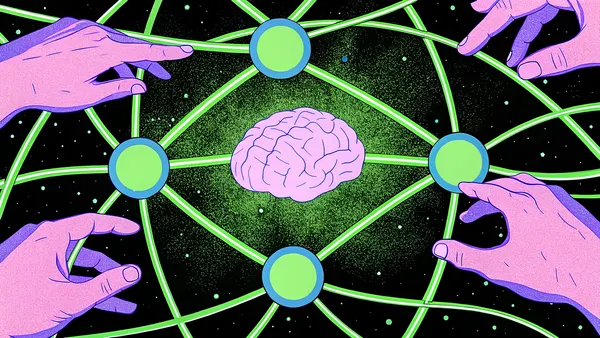
Who Controls the Las Toninas Submarine Cables and Your Internet Access
Did you think the internet was in the cloud? It’s at the bottom of the ocean. Find out how the 2008 crisis allowed Google and Meta to take control of the Las Toninas undersea fiber-optic cables, dominating the flow of data and establishing themselves in the regional geopolitical landscape.
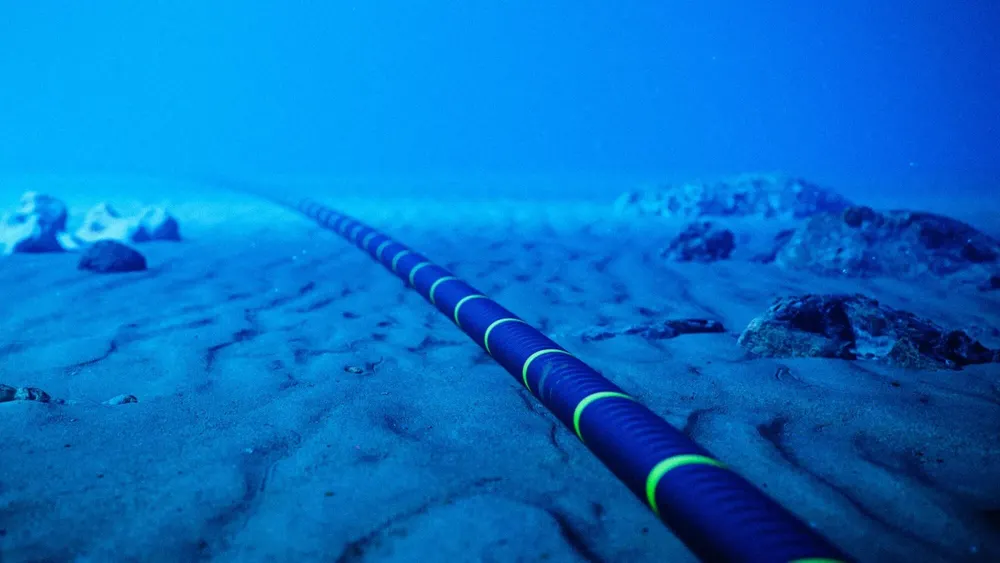
Las Toninas is the main access point for fiber optic cables in Argentina, which enable connection to the Internet. The submarine cables are crucial for communications, financial flows, and access to data stored digitally in the cloud. They are part of the infrastructure that drives the world, the mycelium through which all the questions and answers of our time circulate.
Argentina is connected by a total of seven submarine cables. The first four are: Unisur, laid by Antel Uruguay and Telxius in 1995; the South American Crossing (SAC) from Cirion Technologies and Sparkle in 2000; the South America–1 (Sam–1) from 2001, also by Telxius; and the Bicentenario cable from Antel Uruguay and Telecom Argentina in 2011. In 2018, the Tannat cable was also manufactured by Antel Uruguay and a new player: Google. In 2021, the Malbec cable was deployed by V.tal and Meta. In 2025, the Firmina cable, made exclusively by Google, arrived.
The submarine cables are crucial for communications, financial flows, and access to data stored digitally in the cloud. They are part of the infrastructure that drives the world.
So, stating that “Google and Meta control the submarine cables of Las Toninas (and also your data)” isn’t necessarily clickbait. But to delve deeper into that, we first need to develop the concepts of convergence and concentration, to then understand how the real estate collapse of Lehman Brothers in the United States was a necessary cause of the current scenario.
Convergence refers to the integration of two or more things. In its technological sense, it alludes to the articulation within the same architecture or network of systems originally designed as autonomous, which then function efficiently, whether as digital technology (apps, platforms, software) or as devices themselves (smartphones, computers). Not to mention, Google, as an app and as a fiber optic submarine cable, is a phenomenon of convergence. Guillermo Mastrini points out that, in the face of convergence, contemporary states have few tools to regulate Big Tech corporations whose capital far exceeds the GDP of most countries.
 Juan von Zeschau
Concentration, in turn, is linked to the adaptive quality of capital in complex market conditions, as was the case during the 2008 crisis. Concentration allows companies to gain comparative advantages over others, as they can control strategic links in the value chain (aka submarine cables), monopolize extraordinary revenues, and influence the relative prices of the market. This has consequences: according to Martin Becerra, the concentration of ownership over, for example, media and communication devices undermines the diversity of viewpoints and sources.
Convergence and concentration feed into each other: those who integrate the most systems concentrate profits. And vice versa.
Subprime mortgage crisis
Men and women in suits are leaving a building with cardboard boxes full of personal belongings. It's 2008, Lehman Brothers is bankrupt, and the subprime mortgage crisis has erupted. At that moment, the response from the U.S. government is for the Federal Reserve to step in and rescue the banks with a sum of around $700 billion. Private debt turns into public debt, and governments increase their fiscal deficit in order to contain the private collapse.
To cope with the assumed debt, later on, governments increase the money supply to "ease" the recession. This is compounded by the rise in corporate savings and the expansion of tax havens. The result: a lot of liquidity, a lot of cash available to be invested. Investors then seek out riskier assets to put their capital into. Those high-risk investments mean pouring money into tech startups, the so-called Unicorns, many of the companies now known as Big Tech. A classic example is Facebook, now the supercompany Meta, which encompasses Facebook, Instagram, WhatsApp, Messenger, and Threads, and which has, among many other economic and political capabilities, the ability to lay fiber optic cables at will.
In other words, during the 2008 crisis, an immense capital was injected into the Internet, turning it into the new bastion of capitalism. The development of algorithms, data extraction and data commercialization, advertising, cookies, and sales exploded. But for the big tech companies, it wasn't enough just to commercialize our time in their paradise of bits, brainrot, and constant drug. Now they also care about the hardware: controlling how those bits travel, at what speed, and where they go.
For the big tech companies, it wasn't enough just to commercialize our time in their paradise of bits, brainrot, and constant drug. Now they also care about the hardware: controlling how those bits travel, at what speed, and where they go.
Nick Srnicek, in his book Platform Capitalism, argues that with the oil crisis of 1973, the neoliberal crisis of the nineties, and the 2008 crisis, a prolonged decline in manufacturing profitability occurred, leading capitalism to turn to data to maintain its vitality. The Tech companies, inflated by capital, increased their concentration, convergence, and hardware, not only to boost their profits but also to become the protagonists of the global political scene. And, just like the telegraph cables of the 19th century, controlling the flow of information through submarine cables is a strategic tool.
Flavia Costa introduces the concept of technocene. Her proposal involves setting aside the supposed “dematerialization” of digital technologies and asking ourselves about the materiality, in this case, linked to submarine cables. It means stopping talking about the Internet as a "cloud" or "network," as something intangible.
An average internet user
You, an everyday internet user, are unlikely to grasp how data travels "materially."
The journey of digital information occurs along what are known as hardware highways, through the TCP/IP protocol suite. The most commonly used is the IP protocol. In this protocol, every device connected to the Internet, whether it’s a computer or a wifi router, is assigned a unique series of numbers known as an IP Address. The IP is assigned to a house or a mobile number: it is unique and exclusive. It acts as a shipping address through which all information reaches its destination.
To make it clearer, let’s follow this example: we enter a domain name, for instance, https://www.421.news/es/. The browser sends a request to the Domain Name System (DNS) server to obtain the corresponding IP address. After getting the numbers of the IP address, the browser forwards the request to the Data Center of the server. In other words, this text I’m searching for on the 421 website travels from a Data Center (for example, Google) to me.
We need to set aside the supposed "dematerialization" of digital technologies and ask ourselves about the materiality, in this case, linked to submarine cables. This means stopping to think of the internet as a "cloud" or "network," as something intangible.
Once the server receives the request to access a particular website, it initiates the flow of the data packet. This data is transmitted in digital format, through fiber optic cables, in the form of light pulses. These light pulses sometimes travel thousands of kilometers through submarine cables.
However, the Internet has a structure that is considered robust because the hardware highway can vary. This means that submarine cables are just one type of transmission medium. There are guided (wired) and unguided (wireless) media, meaning that data traffic can arrive via electromagnetic waves, satellites, wifi, 5G, ethernet cables, and, in some cases, submarine cables. In fact, you can trace the path taken by the data packet, to a certain extent, with Traceroute. In most cases, for information to travel through submarine cables, the search must involve two different continents, which justifies the journey across the ocean floor.
Materiality in Argentina
In February 2025, Grupo Clarín, which controls Telecom Argentina, acquired almost 100% of Telefónica Móviles Argentina, which operated under Movistar and Tuenti, for $1.245 billion. Welcome back, Héctor Magnetto. However, the operation is still under government scrutiny because it raises concerns about the "monopolistic position" that would arise from concentrating almost 70% of the services. The "new Telecom" and Claro (from Grupo Telmex) hold the remaining percentage. Let’s remember that Telecom had already bought Cablevisión and developed the Personal brand, which includes Flow and Fibertel. In summary, it’s Personal+Movistar on one side, and Claro on the other.
This would slightly change the map described in previous paragraphs, but for now, the government of Javier Milei has notably yet to approve the purchase.
 Javier Pallero
Beyond local issues, the reality is that contemporary states are losing their territorial powers to Big Tech companies that surpass them in capital and influence. It’s the infinity of the Internet versus the limits of a country. The fact that these companies are taking ownership of submarine cables gives them significant political influence over certain countries. This is how we should interpret the tweets from Elon Musk celebrating Milei's presidency, or Peter Thiel's recent visit.
Las notas de 421 no tienen paywall
Y a cada colaborador se le paga por su trabajo. Las dos cosas dependen de los suscriptores.