Writing in the Age of AI: Composing Instead of Typing
Does AI destroy authorship or transform it? The author doesn't vanish with technology: they act as the conductor of an orchestra, responsible for the work.

What is an author? No absolute answer is satisfying, partly because the concept of authorship has changed across history and cultures, and partly because what we mean by author varies depending on the art and/or medium in question. Every movie has directors and screenwriters, who may or may not be the same person, but there's also such a thing as "auteur cinema." In TV series, the figure of the showrunner has long carried a lot of weight, but if we ask who the author of the Game of Thrones series is, it would be hard to decide whether it's George R. R. Martin, author of the novels it was based on, the showrunners David Benioff and D. B. Weiss, or the writers or directors of each episode. Similar problems come up with video games, where there are also some "auteur" titles (Monkey Island and Ron Gilbert's other graphic adventures), but in most cases we have no idea, or don't even know how to apply the category.
But in the world of texts, you might say, the question is relatively easy. We assume, in principle, that authorship arises from the sum of the material work of writing and the intellectual work of composing the text. That's undoubtedly true in most cases. When a student, a friend or a colleague tells us "I wrote this" and shows it to us, we start from the assumption that they came up with it and typed it (or wrote it by hand). But you don't have to try very hard to find a whole lot of gray areas. Ancient philosophers and orators often dictated their texts to a slave who transcribed them. It's fair to assume that in many cases that transcription involved some editing, however superficial, of what the master was dictating. The tradition of dictation as a form of writing, of course, never went away. Slaves were replaced by secretaries, or by spouses, like María Kodama, who took Borges's dictation in the last part of his life. How many of those scribes played significant roles in a text's authorship? How many times did Aristotle tell his slave, "okay, I'm heading out for a drink with Plato, you take it from there with that thing I always say about virtue as habit"?
But even granting that this possibility is very real and documented in some cases, we still mostly attribute authorship to the author who puts their name behind the words they thought up. Dictating, while not the same as writing, is still a bodily task involving the invisible but real materiality of sound waves. As for writing technologies, there are interesting studies on the effects of the shift from, say, the goose quill to the metal nib, or to the typewriter, or to the word processor. But no change has been as drastic as the one we're living through now with generative artificial intelligence, the first technology that seems to be altering the very concept of writing in all its dimensions.
Agency and authorship
At this point in the game, defining "generative artificial intelligence" or "large language model" (LLM) seems pretty unnecessary, but there's one common confusion worth unpacking. Defining the models running behind the user-friendly interface of ChatGPT, Claude or Gemini as mere next-word predictors, "stochastic parrots," is an oversimplification that distorts the reality of the matter. It's like saying all your PC does is process ones and zeros really fast. In a sense, albeit a fairly inaccurate one, it's true.
No change has been as drastic as the one we're living through now with generative artificial intelligence, the first technology that seems to be altering the very concept of writing in all its dimensions.
But that doesn't come anywhere close to describing what a computer actually does. Unless we're running small local models on our own PC, the generative AIs we use online every day, even the free versions, employ a huge variety of subsystems and tools that let them search the internet, connect to other apps, "reason" (though not, of course, the way human beings do) about what they write in order to evaluate it, read files in different formats, remember previous interactions, and so on. And if we're running the model from a desktop application like Claude Code, Google Antigravity or OpenAI's Codex, the possibilities cover pretty much anything you can do with a PC. They are, as people have been saying for a while now, "agents," although the definition of agent in this context isn't immediately obvious.
Agent comes from the Latin verb agere, "to do," from which "action" also derives, and "author" comes from auctor, which is also related to auctoritas (the authority of whoever originates something and can answer for it), even if today the connection between the two words isn't as obvious as it was in other eras. Writing a text, then, is doing it, that is, carrying it out, but also acquiring an authority over it, in the most literal and least metaphorical sense possible: being able to say "I stand behind this." Being the agent of a text (producing it, executing it, giving it material or verbal form) isn't the same as being its author in this second sense: someone who can be held accountable for what that text claims, promises or implies. Dictated, delegated or assisted writing has always put these two dimensions in tension, but no technology had ever split them apart as clearly as generative AI.
We can now, very easily, delegate the entire writing process, both the material part and the ideational one, to a technology, and get a text that comfortably meets the minimum conditions of human textuality, and in most cases a lot more than that. It's not a stretch to say that, even with their well-known flaws, they write much better than the vast majority of human beings. And you no longer need to prompt with much rigor or detail. Sure, they have annoying tics: they overuse adversative constructions (it's not this, it's that), certain devices like em dashes and colons, and they generally lean toward a kind of redundancy that quickly gets tedious. But these are flaws you can easily find in human beings with little interest or training in writing, which is a hard art to master even if you're not trying to be Flaubert or Virgil.
If we're part of that minority that does have a specific interest in writing, we can still choose not to use artificial intelligence (or at least not for that) and seek the distinction of the human and handcrafted in a textual ecosystem advancing unstoppably toward automation. After all, there are still craft fairs and furniture built by hand by carpenters, despite the industrialization of virtually every good we use day to day. But we can also, as many of us are doing, opt for paths and strategies that involve capitalizing on some of this technology's potential without abandoning the idea that we are responsible for what we write. What we'll propose in the rest of this article is a model for thinking about and carrying out writing with AI without losing sight of the fact that authorship (in the strong sense, that of auctoritas) remains entirely human, regardless of how much of the word-by-word writing of the text has been delegated.
The author as composer
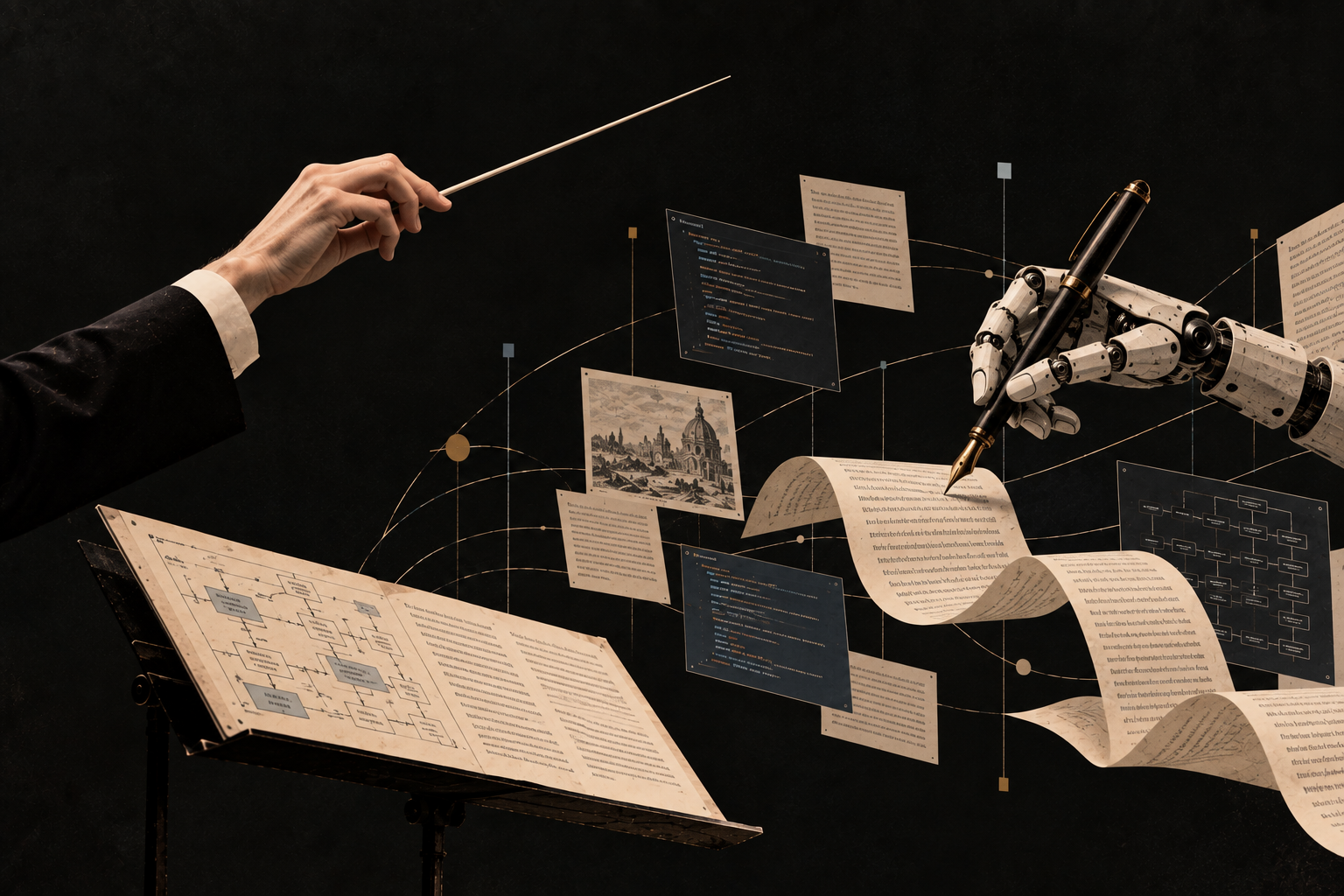
Let's go back to the beginning of the article. Even before generative AI burst onto the scene, the definition of authorship varied by medium. To think about the dynamics of human-machine co-authorship in AI-mediated writing, we propose the following analogy: the author as composer, a composer who, as has often happened and still does, not only writes the score but also conducts the orchestra.
Working with AI in any field means, to a large extent, taking on the role of coordinator. In the case of writing, this means we'll no longer handle the manual performance of each instrument, the same way a conductor doesn't play every flute, violin or cymbal (though they do need to know how each one works and sounds). In very concrete terms, it means we won't write (or dictate) word by word, just as the composer/conductor doesn't produce every sound. Their job is to write a score that assigns roles, defines entrances and anticipates effects, trusting that each player knows how to do their part without needing to be told how to play note by note. Working with an LLM has, in the sense we're proposing here, that same logic: we ask for rewordings, generate variants, delegate expansions or compressions, and decide what survives the final cut, but the AI works as an extraordinarily skilled instrumentalist. It can competently perform a local task (tightening a paragraph's cohesion, varying the vocabulary, spelling out an inference we only hinted at) but it doesn't have, and can't have, a communicative purpose of its own beyond that specific task. The overall intentionality of the text, and what we called authority in the first section, remain entirely human. And from this division of labor follows something that tends to get overlooked in the more alarmist debates: authorial responsibility isn't diluted by delegation, it's intensified. If the instrumentalist hits a wrong note (a hallucinated quote, a made-up fact, an argument that sounds better than it is), that failure isn't just the instrument's but the conductor's. Being composer/conductor isn't doing less. It's answering for more, even for what you didn't type.
And from this division of labor follows something that tends to get overlooked in the more alarmist debates: authorial responsibility isn't diluted by delegation, it's intensified.
But this division of tasks presupposes that whoever's conducting knows what they're talking about. Only someone with command of and training in the subject can direct the AI well, knowing what's trivial, what's rehashing a cliché, and which detail is actually decisive. Not just anyone can step up in front of the orchestra and start conducting. On the contrary, it takes more judgment and more knowledge to know what to ask of the instrumentalist and when to be suspicious of what it plays.
Starting points: macrostructure, relevance, materials and style
The linguist Teun van Dijk proposed the concept of "macrostructure" to explain that texts (written or spoken) can be synthesized through a set of rules (the "macrorules") in such a way that, however long or complex they may be, they can always be summed up in a handful of propositions that condense the essentials. You could say that writing as a composer means, first and foremost, starting by defining the macrostructure of the text we want to produce.
But a clear idea, for human communication (and every text is communicative on some level), is never merely an idea. It's always an idea in a context, something worth saying to one or many people in a specific situation. This brings us to a different concept: the text's relevance. Intuitively, we can say a text is relevant insofar as it says something that stands out, that becomes important in a given context.
So the two basic components we need before starting the process of textual composition are: a more or less finished outline of the central ideas of what I want to write (the text's macrostructure, whose organization will vary depending on whether I'm writing an expository, argumentative, narrative text, etc.) and a definition of what I consider relevant about that text in a situation that may be more concrete or more general, but that we can never leave out of the planning.
To move on to the level of actually interacting with the AI, we'll need two more elements. First, there are the materials I want the model to have at hand for the writing. This opens up a world of possibilities with no universal advice, since it also depends heavily on the kind of text I want to write. If I'm drafting an academic paper on an ultra-specific topic, I'll need to upload fairly detailed information (other academic papers on that topic, for example), but if I'm writing about something better known (that is, a topic the language model can reasonably be assumed to have received enough information about during training), this may be unnecessary. But I can also upload texts whose style I want to use as a reference. As with everything, there's a lot of trial and error. Many of us thought that if we fed ChatGPT or Claude as much information as possible we'd make it much smarter, when the opposite often happens: models strain to squeeze something out of everything we give them, even when it isn't relevant to the situation at hand.
So, for now we have the macrostructure, a hypothesis about the relevance of what I'm going to produce, and materials. Last item: style. Here the variations depending on the field the text is meant for are endless, ranging from a total erasure of personal style in pursuit of expository clarity (which itself admits countless variations depending on who it's supposed to be clear to: a newbie, an expert, someone in between?) to the search for a voice of one's own, recognizable and handcrafted. In cases like the latter, there's no way we can delegate the writing of any part of the text. We'd be like a conductor who insists on playing the solo instrument at the concert.
Write and iterate
How does all this translate into prompts? There's no recipe: prompt engineering is old news. You could paste this article in, say you want to reproduce this method, and ask the model to ask you the relevant questions, for example. Or you could put together a structured template prompt with these four components and fill them in each time. Something like this:
# PROMPT FOR STARTING WRITING PROJECTS
## MACROSTRUCTURE
(fill in with the central ideas of the text)
## RELEVANCE IN CONTEXT
(fill in with the relevance hypothesis tailored to the context we're working in, detailing the most important elements of that context and the relevance the text takes on for each of them)
## MATERIALS
(upload files and, if necessary, explain what they are and how to use them)
## STYLE
(fill in with the general aspects and the specific points of the register to adopt)
But what really matters in this new phase of human writing isn't these minutiae, which could be solved in many different ways. The important thing is finding the author's place in this environment. And for that we need to conceive of planning our writing in such a way that we can remain responsible for what we write even when the process of writing "word by word" has been delegated. In practice, that means a significant shift in how much time we assign to each task. Obviously, planning has always been a key part of writing, as everything from ancient treatises on rhetoric to last year's handbooks will tell you. But the ability to delegate that we now have lets us think about this on a different scale.
Let's take an example from academia, though it applies to other fields too. A common piece of advice given to people who are stuck on writing their thesis is: that's it, just start writing however it comes out, forget about reading more texts or thinking up more connections. Just write; otherwise you won't make it and you'll never get started. Now we can imagine that, if a grad student has to turn in their thesis in a year, they can plan in detail right up to the second-to-last day, and on the final day give the model a series of detailed, chapter-by-chapter instructions. The writing would get done in a matter of hours.
Of course, this isn't quite accurate, because it leaves out the editing and revision time that has to be factored in. It would be like a composer who writes a piece down to the last detail of each note's intensity in the subtlest pizzicato of the last violin, but doesn't rehearse until opening night. Textual composition is an extremely iterative process at all four of the levels we mentioned. That revision will remain our responsibility and the ultimate source of our auctoritas.
The risks of conducting without ever having played an instrument
The fact that AI can do almost anything with words doesn't mean it can do anything with ideas. There's a useful distinction to be made here. Since they're trained to predict the most probable outcome, LLMs are extraordinary at formulating ideas that reinforce stable patterns. In other words, they're very good at operating within what Steven Thurlow calls convergent thinking. On the other hand, LLMs become structurally weak when it comes to venturing into divergent thinking: when it's time to formulate a completely new hypothesis, bend an argument toward unexplored places or redefine a problem, the models' consistency and reliability evaporate. That's why we can't delegate to them the original hypothesis, the argumentative twist, the moment when our text aims to surprise, whether with a metaphor, an idea or a change of rhythm.
We can't delegate to them the original hypothesis, the argumentative twist, the moment when our text aims to surprise, whether with a metaphor, an idea or a change of rhythm.
Today, models are a grand expression of writing's lowest common denominator, of the expected and the "correct" (when they're not hallucinating). That means they offer something to measure ourselves against. We can ask them to write the passage we have in mind and read what they came up with. Whatever strikes us as flat, generic or foreign tells us, by contrast, where what we want to say actually lies. This doesn't change the division of roles. Your own voice is still human work, but now it has a point of comparison that wasn't as readily at hand before.
It's also worth keeping in mind what we're composing with. The most widely used generative AI apps today are controlled by foreign megacorporations (OpenAI, Google, Anthropic) with their own commercial and geopolitical agendas. Using them to write, even with the most careful orchestral direction, means taking part on some level in the opaque mechanisms through which those companies improve their models, turn a profit and build influence. It's not a reason to abandon assisted writing, but it is one more reason not to delegate without judgment or without awareness of who's on the other side of the model.
Finally, there's an uncomfortable question looking ahead, more pedagogical than technical. How does this model coexist with the training of future composers? What happens when someone can skip straight past the slow, painstaking work of writing word by word? The risk isn't a nostalgic one. If an entire generation is trained directly in delegation, what judgment of their own will the writers of the future use to evaluate what the AI hands back to them? Conducting an orchestra without ever having played an instrument is a civilizational risk for which we still have no solid answers.
Las notas de 421 no tienen paywall
Y a cada colaborador se le paga por su trabajo. Las dos cosas dependen de los suscriptores.